
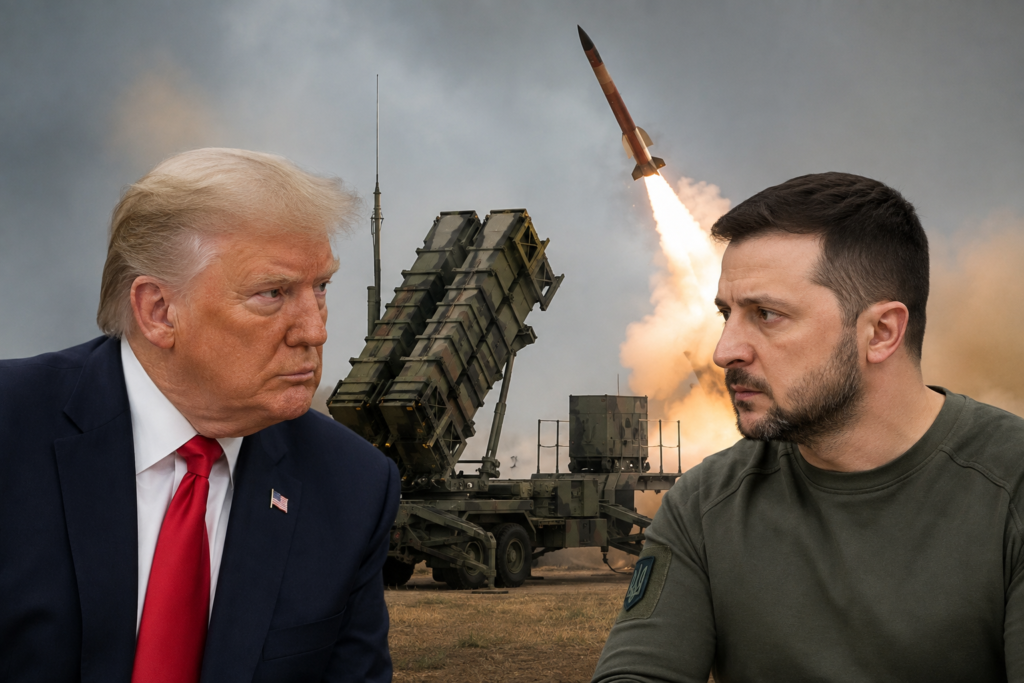
Image Credits: Trump says the US has not approved Patriot missile production in Ukraine. AI-generated illustration created by Open Chronicle using ChatGPT (OpenAI). July 2026. This image is illustrative and does not depict a real-world scene.
By Open Chronicle News Desk with Agencies
U.S. President Donald Trump said on Friday that the United States has not agreed to allow Ukraine to manufacture Patriot missile interceptors, contradicting comments made by Ukrainian President Volodymyr Zelensky after their recent meeting at the White House.
Speaking to reporters, Trump stressed that Washington had not authorised domestic production of the advanced air defence missiles in Ukraine.
“We have to be very careful about letting somebody build them,” Trump said, adding that no agreement had been reached.
The remarks came just days after Zelensky suggested that the two leaders had discussed and agreed in principle to licensing the production of Patriot missile systems in Ukraine.
Different interpretations after White House talks
Trump and Zelensky met for more than an hour earlier this week as Ukraine sought additional military support amid an intensifying Russian missile campaign and stalled U.S.-led diplomatic efforts to secure a ceasefire.
Following the meeting, Zelensky said the United States had agreed to license Patriot missile production for Ukraine.
Trump, however, offered a more cautious assessment, saying only that “many things were discussed” and describing the meeting as having gone “very well.”
His latest comments make clear that no formal approval has been granted for local production of the Patriot system.
Ukraine seeks stronger air defences
Kyiv has repeatedly argued that expanding its domestic defence industry is essential as Russia continues to increase long-range missile strikes against Ukrainian cities.
Ukraine’s ambassador to Washington, Olha Stefanishyna, said discussions with the Pentagon remain focused on obtaining a licence to manufacture Patriot PAC-3 missile interceptors.
She acknowledged that establishing production could take anywhere between one and five years, making it an unlikely solution for Ukraine’s immediate defence needs.
Stefanishyna also revealed that Ukraine is discussing alternative arrangements that would allow it to purchase Patriot missiles over the long term while potentially exchanging positions in the production queue with other international buyers.
Defence industry cooperation continues
Despite the uncertainty surrounding missile production, cooperation between Ukraine and major U.S. defence manufacturers continues to expand.
According to Stefanishyna, representatives from Raytheon, which produces the Patriot air defence system, have already visited Ukraine.
She also said Lockheed Martin, the manufacturer of the PAC-3 interceptor missiles, is preparing to send a team of specialists to the country to explore future cooperation.
The discussions reflect Ukraine’s broader effort to strengthen its domestic defence industry while reducing dependence on overseas deliveries.
Ballistic missile threat growing
Stefanishyna warned that Russia’s growing use of ballistic missiles presents one of Ukraine’s greatest military challenges.
“The devastating effect of every overnight attack right now is unbelievable,” she said, noting that recent Russian assaults had involved 30 to 40 ballistic missiles in a single night.
While Ukrainian air defences have become increasingly effective against drones supplied by Iran and produced by Russia, Kyiv continues to rely heavily on Patriot systems to intercept high-speed ballistic missiles.
She argued that Russia is rapidly expanding production of such weapons under President Vladimir Putin, increasing pressure on Ukraine’s already stretched air defence network.
Civilian toll rising
The renewed debate over Patriot missiles comes as the humanitarian impact of the war continues to worsen.
According to the United Nations, last month was the deadliest for Ukrainian civilians since April 2022, reflecting the increasing intensity of Russian long-range missile and drone attacks.
Ukraine hopes renewed diplomatic efforts could eventually produce a ceasefire before winter, but officials insist additional air defence systems and interceptor missiles remain an urgent priority to protect civilian populations and critical infrastructure.
Trump’s comments suggest that while discussions on future defence cooperation continue, Washington has not yet committed to allowing Ukraine to manufacture one of the United States’ most advanced missile defence systems.