
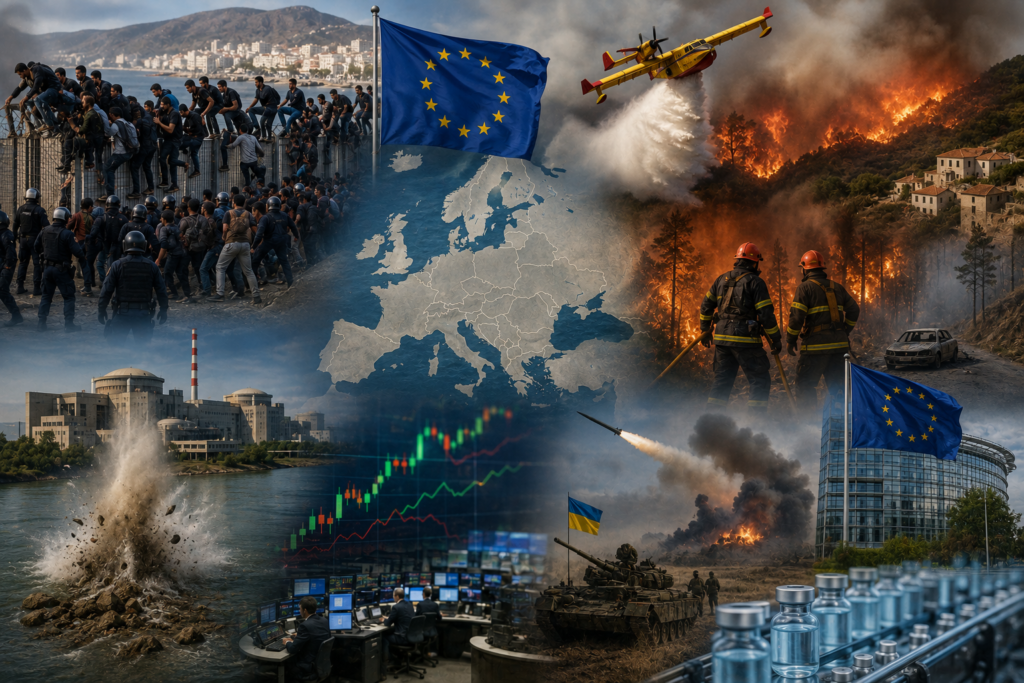
Image Credits: Europe News Brief: Top Stories Shaping the Continent, August 3, 2026. AI-generated illustration created by Open Chronicle using ChatGPT (OpenAI). August 2026. This image is illustrative and does not depict a real-world scene.
By Open Chronicle with agencies
Europe is facing a series of interconnected challenges as migration pressures, extreme weather, geopolitical tensions and market uncertainty dominate the continent’s headlines. From the humanitarian crisis in Ceuta to devastating wildfires across southern Europe, governments are balancing emergency responses with broader political and economic concerns.
Europe divided over Ceuta migration crisis
The migration emergency in Spain’s North African enclave of Ceuta remains the continent’s most pressing political issue after tens of thousands of migrants attempted to enter the territory in recent days.
European Union governments remain divided over how to respond to the crisis. Italy has temporarily strengthened border controls with Spain, while EU ministers are preparing emergency discussions focused on migration policy, external border security and cooperation with North African partners.
The crisis has reignited debate over the bloc’s asylum system and burden-sharing among member states.
Heatwave fuels wildfires and energy concerns
An intense heatwave continues to grip southern Europe, driving major wildfires and placing additional strain on energy infrastructure.
Greece remains one of the hardest-hit countries, where hundreds of firefighters continue battling blazes threatening communities west of Athens. The emergency intensified after two firefighting helicopters collided during operations, killing two crew members.
Elsewhere, Romania has taken the unusual step of blasting rocks in the Danube River to improve water flow needed to cool the Cernavodă nuclear power plant, while Hungary and Serbia are facing growing concerns over energy supplies as river levels continue to fall.
European markets rise on hopes of Middle East diplomacy
European stock markets opened higher after U.S. President Donald Trump announced that planned military action against Iran would be postponed to allow diplomatic negotiations to continue.
Lower oil prices supported gains in travel, automotive and industrial sectors, although investors remain cautious as Tehran continues to deny that any agreement has been reached with Washington.
Market analysts said sentiment remains highly sensitive to developments in the Middle East.
Greece continues large-scale firefighting operations
Emergency crews remain deployed across Greece as wildfires continue to spread under strong winds, prolonged drought and extreme temperatures.
Authorities have warned that weather conditions could further complicate containment efforts in the coming days, with several communities remaining under evacuation orders.
France, Spain and Italy remain on wildfire alert
France continues to battle significant wildfires, while Spain faces the dual challenge of managing active fires and responding to the ongoing migration emergency in Ceuta.
Italy has also raised its preparedness level as forecasts indicate the heatwave will continue to move across southern Europe, increasing the risk of new fires.
Ukraine conflict remains central to European security
The war in Ukraine continues to dominate Europe’s security agenda despite competition from other major news events.
Recent Russian missile attacks and Ukrainian drone strikes deep inside Russian territory have highlighted the conflict’s continued intensity, while European governments maintain military, financial and political support for Kyiv.
AstraZeneca speculation unsettles investors
European financial markets have also been influenced by reports suggesting pharmaceutical giant AstraZeneca could be exploring a possible merger with Bristol Myers Squibb.
Although no agreement has been announced, the speculation weighed on AstraZeneca’s share price and became one of the day’s most closely watched business stories across Europe.
As Europe confronts simultaneous humanitarian, environmental, security and economic challenges, governments across the continent continue coordinating responses to crises that increasingly extend beyond national borders.