
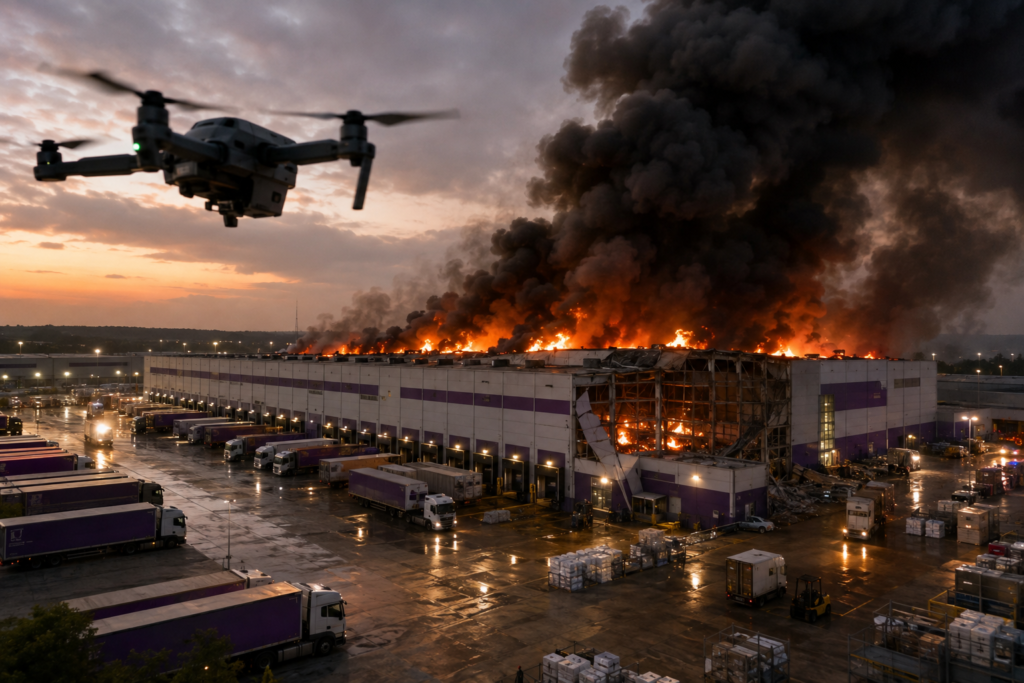
Image Credits: Ukraine targets Wildberries as Kyiv seeks to disrupt Russia’s wartime logistics network. AI-generated illustration created by Open Chronicle using ChatGPT (OpenAI). August 2026. This image is illustrative and does not depict a real-world scene.
By Open Chronicle with agencies
Ukraine has intensified its drone campaign against Wildberries, Russia’s largest e-commerce company, striking another of the retailer’s logistics facilities as Kyiv argues the company’s infrastructure is playing an increasingly important role in supporting Moscow’s war effort.
The latest attack targeted a Wildberries warehouse in Russia’s Vladimir region, marking the third strike against the company’s logistics network in just two weeks. Images shared on social media showed thick black smoke rising from the facility after the attack, while witnesses reported drones flying over the area shortly beforehand.
Wildberries confirmed that a fire broke out at the warehouse following the strike. The company initially reported no casualties, but Vladimir region Governor Alexander Avdeyev later said two people had been injured.
Why is Ukraine targeting Wildberries?
Since mid July, Ukraine has launched dozens of attacks against Wildberries logistics centres across Russia, claiming the company’s distribution network is being used to transport military-related equipment.
President Volodymyr Zelenskyy has stated that warehouses targeted by Ukrainian drones are involved in supplying Russian forces with drone components, navigation systems and other equipment supporting military operations.
Wildberries’ online marketplace offers a wide range of products, including drone components, tactical equipment and body armour. Ukrainian officials argue that these logistics facilities have become part of Russia’s broader wartime supply chain.
A giant of Russia’s economy
Founded in 2004, Wildberries has grown into Russia’s largest online retailer, frequently compared to Amazon because of its dominant position in the country’s e-commerce market.
The company reports annual turnover of between €70 billion and €75 billion, representing more than two percent of Russia’s gross domestic product according to various estimates.
Wildberries directly employs around 50,000 people, while its wider logistics network supports well over 100,000 workers during peak periods.
Its economic importance has made the company a strategic target as Ukraine increasingly seeks to strike infrastructure that supports Russia’s military capabilities beyond traditional defence industries.
Sanctions and political pressure
Wildberries and its founder, Tatiana Kim, Russia’s richest woman, have already been targeted by international sanctions linked to Moscow’s full-scale invasion of Ukraine.
When imposing sanctions in 2022, Poland described Wildberries as one of Russia’s largest taxpayers, highlighting the company’s contribution to the Russian economy.
More recently, the European Union sanctioned the company’s banking division, citing its financial contribution to Russia’s state budget.
Kim stated last week that Wildberries is not legally required to compensate customers or sellers for losses resulting from Ukrainian attacks, although the company is widely expected to seek government support.
Moscow considers financial assistance
The repeated attacks have placed growing pressure on thousands of businesses that depend on Wildberries to sell their products across Russia.
According to Russian media reports, the government is exploring financial support measures for the company and merchants using its platform.
State-controlled lender VTB Bank is reportedly expected to play a central role in any rescue package, which could include subsidised loans, tax relief or other financial assistance.
Many sellers have complained on social media that they have suffered significant financial losses with little support from the company, warning that thousands of small businesses could face bankruptcy without meaningful government intervention.
The attacks reflect Ukraine’s evolving strategy of targeting infrastructure it believes contributes to Russia’s wartime economy, expanding the battlefield beyond military bases to include major logistics networks that Kyiv says help sustain Moscow’s military operations.