
By Open Chronicle with agencies
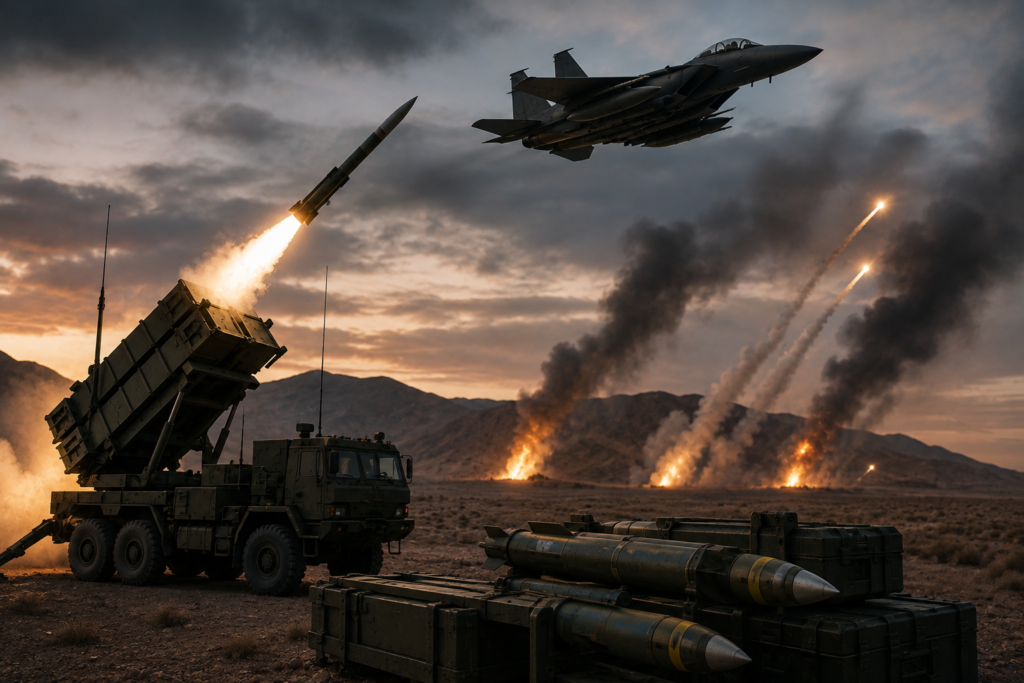
A prolonged military campaign against Iran has significantly reduced the U.S. Army’s stockpile of long-range precision missiles, raising questions about America’s ability to sustain extended high-intensity operations while maintaining readiness for other potential global conflicts.
According to a Reuters report citing officials familiar with the matter, the United States has expended the vast majority of its inventory of Army Tactical Missile Systems (ATACMS) and Precision Strike Missiles (PrSM) during the five-month conflict, highlighting the enormous logistical demands of modern warfare.
Long-range weapons consumed at an unprecedented rate
ATACMS and the newer Precision Strike Missile are among the U.S. Army’s most valuable long-range conventional strike weapons.
Designed to destroy high-value targets from hundreds of kilometres away with exceptional accuracy, the missiles allow commanders to engage enemy infrastructure while reducing the need to expose aircraft and pilots to heavily defended airspace.
Officials quoted in the report said that “virtually all” of the Army’s available land-based precision missiles have been used during operations against Iranian targets.
The PrSM, which is gradually replacing the older ATACMS, remains in relatively limited production because it is still being introduced into operational service.
Strategic consequences
The reduction in missile inventories has significant implications for U.S. military planning.
Without large stocks of stand-off precision weapons, future military operations could require greater reliance on crewed aircraft conducting bombing missions against heavily defended targets, increasing operational risks.
Military planners also face the challenge of maintaining sufficient inventories to deter other potential adversaries, particularly Russia and China, while continuing operations in the Middle East.
The issue has reportedly become the subject of discussions within the Trump administration as officials assess how long military operations against Iran could continue without affecting readiness elsewhere.
Pentagon stresses confidence
The White House has sought to reassure allies and the public that U.S. military capabilities remain unmatched.
President Donald Trump said American defence manufacturers are producing more munitions than ever before while expanding production facilities to replenish inventories.
Pentagon spokesperson Sean Parnell also emphasised that the U.S. military retains the capabilities required to conduct operations whenever and wherever directed by the President.
Officials insist that replenishment efforts are already underway, with additional production contracts supporting both current and future missile requirements.
Production struggles to match demand
Despite record levels of defence manufacturing, analysts caution that rebuilding inventories of advanced precision weapons takes considerable time.
Each missile costs well over US$1 million, while manufacturing involves highly specialised components, advanced electronics and complex supply chains that cannot be expanded overnight.
Although production of artillery ammunition and several missile systems has increased substantially in recent years, defence experts warn that prolonged high-intensity conflicts consume munitions faster than they can currently be replaced.
To address future requirements, the U.S. Army has already placed large procurement orders for additional Precision Strike Missiles scheduled for delivery beginning in 2027.
Missile defence stockpiles also under pressure
Concerns extend beyond offensive weapons.
Recent assessments by the Center for Strategic and International Studies (CSIS) estimate that approximately 65 percent of Patriot interceptor missiles and at least 38 percent of THAAD interceptor missiles available at the start of the conflict have been expended.
These systems play a critical role in protecting military bases, strategic infrastructure and allied territory against ballistic and cruise missile attacks.
At the same time, the U.S. Navy has reportedly used nearly half of its global inventory of Tomahawk cruise missiles, weapons widely employed to strike heavily defended targets without risking pilots.
Rebuilding for future conflicts
The growing demand for precision-guided weapons is driving a broader expansion of the American defence industrial base.
Major defence contractor Raytheon, part of RTX, has reached a tentative multi-year agreement with the Pentagon to significantly increase Tomahawk missile production while expanding output of several other advanced munitions.
The effort reflects a wider recognition that future conflicts involving major powers are likely to require substantially larger stockpiles than previously anticipated.
Lessons from modern warfare
The reported reduction in U.S. missile inventories illustrates one of the central lessons emerging from recent conflicts.
Modern warfare increasingly depends on precision-guided weapons capable of striking targets at long range while minimising risks to personnel. However, these systems are expensive, technologically complex and difficult to replace quickly once consumed.
For military planners, the challenge is no longer simply developing advanced weapons but ensuring the industrial capacity exists to sustain prolonged operations against well-equipped adversaries.
The experience of the Iran campaign is likely to influence U.S. procurement policy, defence spending and weapons production for years to come as Washington seeks to balance ongoing military commitments with long-term strategic readiness.
The Grand Strategy Institute
Continue Exploring Strategic Analysis
Return to The Grand Strategy Institute for strategic assessments, long-form analysis and research examining geopolitics, military affairs, international security, emerging technologies and the changing international order.
← Back to The Grand Strategy Institute