
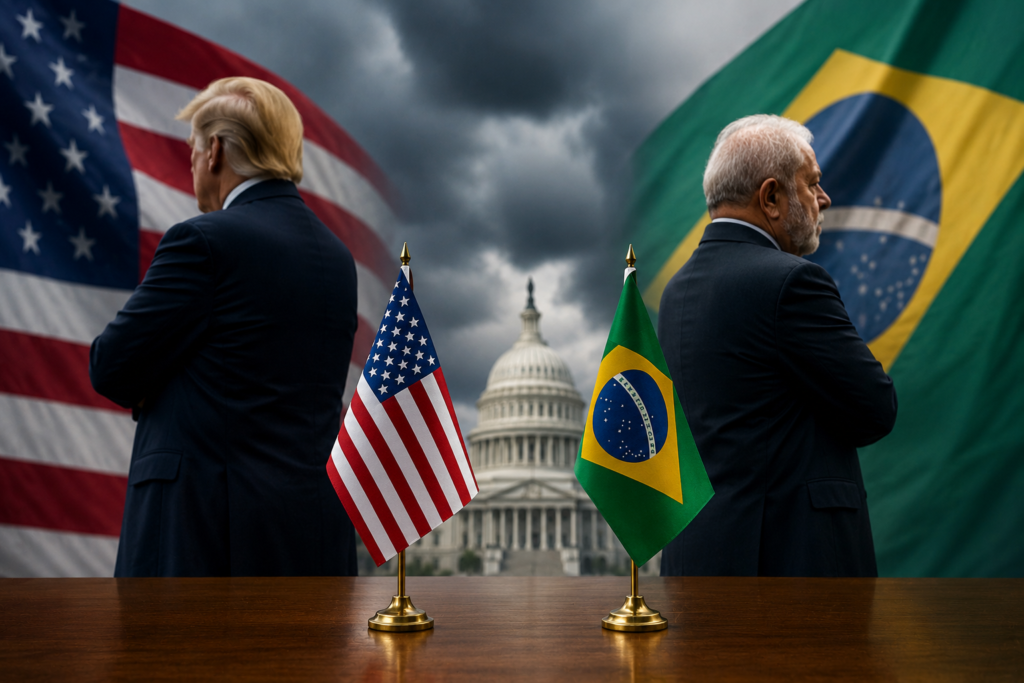
Image Credits: U.S. Revokes Brazilian Ambassador’s Visa as Diplomatic Dispute Escalates. AI-generated illustration created by Open Chronicle using ChatGPT (OpenAI). August 2026. This image is illustrative and does not depict a real-world scene.
By Open Chronicle with agencies
Relations between the United States and Brazil have entered one of their most serious diplomatic disputes in recent years after Washington revoked the visa of Brazil’s ambassador to the United States and warned that further measures could follow if the current impasse is not resolved.
The move comes amid an escalating disagreement over diplomatic appointments, with the administration of President Donald Trump accusing Brazil of deliberately delaying formal approval of its nominee for U.S. ambassador to Brasília.
The dispute threatens to deepen political tensions between the two countries while adding uncertainty to trade relations and regional diplomacy.
Ambassador’s visa revoked
The U.S. State Department confirmed that it had revoked the visa of Maria Luiza Ribeiro Viotti, Brazil’s ambassador in Washington, in what officials described as a reciprocal diplomatic measure.
According to a senior State Department official, the decision was taken after Brazil declined to complete the formal approval process for President Trump’s nominee to serve as the next U.S. ambassador to Brazil.
The United States also denied visas to two additional Brazilian diplomatic officials as part of the broader response.
Officials stressed that the measure does not amount to expulsion from the United States but represents a temporary suspension of diplomatic privileges.
“The visa can be restored once the diplomatic balance is re-established,” a State Department official said, describing the decision as reversible if both governments reach an agreement.
Diplomatic protocol at the centre of the dispute
At the heart of the disagreement is Brazil’s delay in granting agrément, the formal diplomatic approval required before a foreign ambassador can officially take up their post.
President Trump nominated Daniel Perez, a Florida congressman and close ally of Secretary of State Marco Rubio, as the next U.S. ambassador to Brazil on 1 June.
In normal diplomatic practice, the receiving state grants agrément before an ambassador assumes office. While governments retain the sovereign right to accept or reject nominees, such approvals are generally considered routine between friendly nations.
Washington argues that Brazil’s prolonged delay represents an unusual departure from established diplomatic practice.
Relations between Washington and Brasília deteriorate
The latest development reflects broader tensions that have emerged between the Trump administration and the government of Brazilian President Luiz Inácio Lula da Silva.
Although the two countries remain important economic and strategic partners, differences over foreign policy, trade and political priorities have increasingly strained bilateral relations.
The diplomatic dispute now risks spilling into other areas of cooperation, including commercial ties and regional security initiatives.
Analysts also note that worsening relations with Washington could become a significant political issue ahead of Brazil’s presidential elections scheduled for October.
Possible further measures
According to U.S. officials familiar with the discussions, Washington had previously warned that it would consider retaliatory measures if Brazil continued withholding formal approval of the ambassadorial nomination.
The visa revocation appears to represent the first concrete step in that strategy.
While no additional sanctions have yet been announced, officials indicated that further diplomatic or administrative measures remain under consideration should the deadlock continue.
Brazil yet to respond
At the time of publication, the Brazilian government had not issued an official response to Washington’s latest action.
Whether the dispute remains confined to diplomatic protocol or expands into broader political and economic disagreements will likely depend on negotiations between the two governments in the coming days.
For now, the visa dispute marks an unusually public deterioration in relations between two of the Western Hemisphere’s largest democracies, highlighting how diplomatic procedures can quickly become flashpoints in wider geopolitical disagreements.