
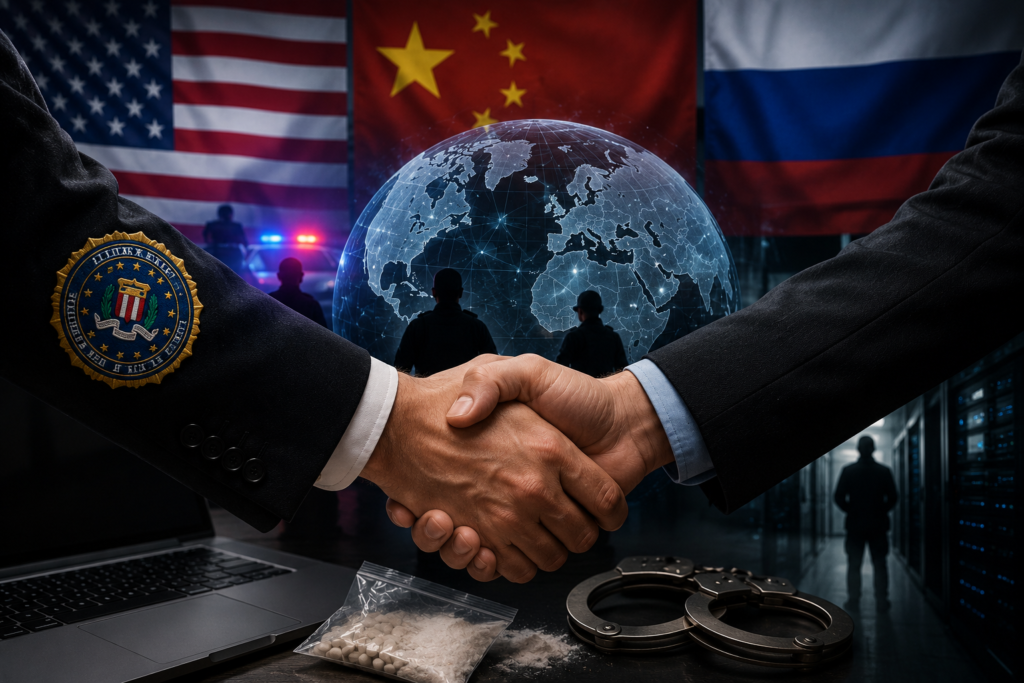
Image Credits: FBI Expands Law Enforcement Cooperation with China and Russia in Unprecedented Strategic Shift. AI-generated illustration created by Open Chronicle using ChatGPT (OpenAI). August 2026. This image is illustrative and does not depict a real-world scene.
By Open Chronicle with agencies
The U.S. Federal Bureau of Investigation has established an unprecedented level of operational cooperation with law enforcement agencies in China and Russia, marking a significant departure from decades of policy that largely treated both countries as intelligence adversaries rather than investigative partners.
Under FBI Director Kash Patel, the bureau has developed targeted partnerships focused on combating transnational crimes, including fentanyl trafficking, cyber fraud, online child exploitation and human trafficking. The initiative represents one of the most significant changes in U.S. international law enforcement cooperation in recent years and has sparked debate within the American national security community.
A new approach to international crime
According to Reuters, the FBI’s new partnerships involve carefully defined areas of cooperation rather than broader intelligence sharing.
Officials say the arrangements include personnel exchanges, joint investigations and coordinated operations against criminal organisations operating across national borders. Chinese law enforcement officers have visited FBI facilities in the United States, while FBI personnel have travelled to China to work alongside local investigators on specific cases. Similar cooperation with Russia is also being developed, with a visit by Director Patel reportedly under consideration later this year.
Patel described the initiative as cooperation with “non-traditional partners,” arguing that transnational criminal networks increasingly operate across geopolitical boundaries and require selective international collaboration despite broader political rivalries.
Joint operations produce tangible results
Supporters of the initiative point to several successful operations carried out through the new partnerships.
One example cited by officials is Operation Sand Dollar, a multinational investigation involving U.S., Chinese and Dubai authorities that resulted in hundreds of arrests and the rescue of trafficked workers. Other cooperative efforts have focused on disrupting international cyber fraud networks, dismantling child exploitation rings and targeting suppliers involved in the illicit fentanyl trade.
The Trump administration has also placed particular emphasis on reducing the flow of fentanyl precursor chemicals, an issue that has remained a central concern in U.S. relations with China for several years. Earlier this year, FBI Director Patel met China’s Minister of Public Security, Wang Xiaohong, with both sides agreeing to deepen practical cooperation against transnational crime.
Balancing cooperation and competition
Despite the expanding law enforcement ties, Washington continues to regard both China and Russia as strategic competitors.
Officials insist the partnerships are narrowly limited to specific criminal investigations and do not alter broader U.S. counterintelligence priorities or its security relationships with long-standing allies such as the Five Eyes intelligence partnership.
Patel has repeatedly stated that robust vetting procedures and counterintelligence safeguards remain in place to prevent the exposure of sensitive investigative methods or classified information.
Concerns inside the security community
The initiative has nevertheless generated concern among current and former national security officials.
Critics argue that working more closely with the law enforcement agencies of authoritarian governments could expose U.S. investigative techniques or create opportunities for intelligence collection by foreign security services.
Some former FBI officials have questioned whether the benefits of operational cooperation outweigh the long-term security risks associated with engaging agencies that have historically been the focus of American counterintelligence investigations.
Others, however, acknowledge that criminal threats such as fentanyl trafficking, cybercrime and child exploitation increasingly require international cooperation regardless of geopolitical tensions.
A broader shift in strategy
The expanded partnerships reflect a broader evolution in how law enforcement agencies address transnational crime.
While strategic rivalry between the United States, China and Russia continues across military, economic and technological domains, officials argue that limited cooperation on shared criminal threats can serve mutual interests without diminishing wider geopolitical competition.
Patel has suggested that the model could eventually be adapted for cooperation with additional countries where common security interests outweigh political differences.
Whether this approach becomes a lasting feature of U.S. law enforcement policy or remains a temporary initiative will likely depend on its long-term effectiveness, the evolution of broader diplomatic relations and the confidence of American policymakers that operational cooperation can be maintained without compromising national security.