
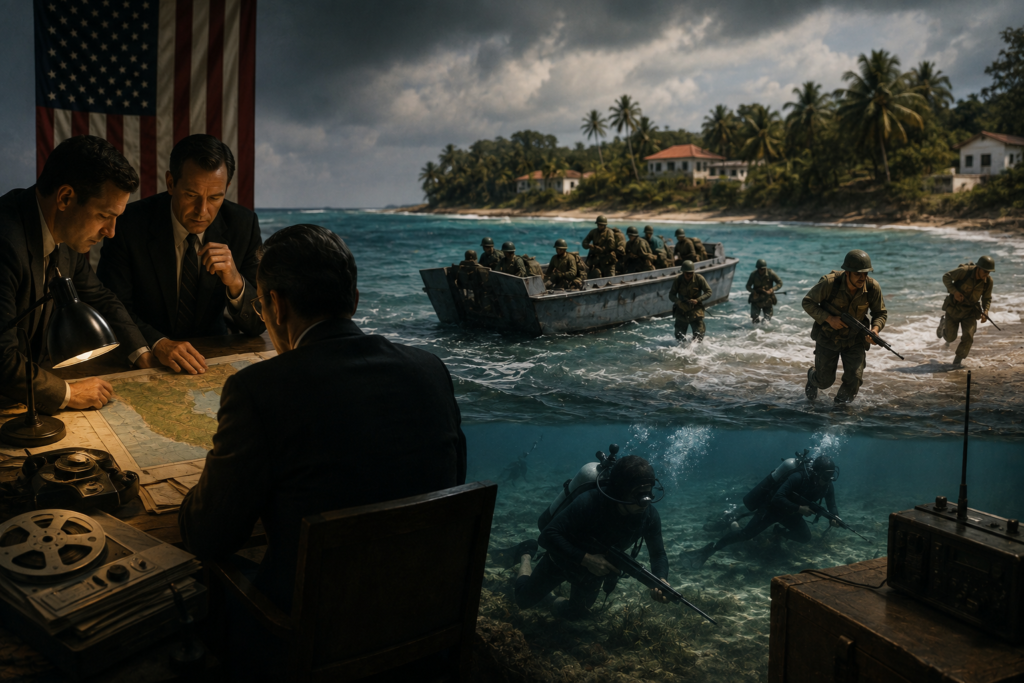
Image Credits: Inside the CIA Task Force That Took America’s Secret War Against Castro to Cuba. AI-generated illustration created by Open Chronicle using ChatGPT (OpenAI). August 2026. This image is illustrative and does not depict a real-world scene.
By Open Chronicle with agencies
Long before the confrontation between the United States and Cuba became one of the defining struggles of the Cold War, Washington was already building a secret apparatus intended to weaken, destabilise and ultimately replace Fidel Castro’s revolutionary government.
The story of the CIA task force created for operations against Cuba reveals how quickly the island became a central target of American covert action after Castro came to power in 1959.
What began with political warfare, intelligence collection and support for Cuban opponents of the new government developed into a much larger clandestine campaign involving propaganda, sabotage, paramilitary training and plans to infiltrate armed forces onto the island.
Declassified documents provide an unusually detailed view of that evolution. They show senior American officials wrestling with a fundamental question that would shape decades of U.S. foreign policy: could Washington remove a hostile government without openly going to war?
The answer would lead directly toward the Bay of Pigs invasion and one of the CIA’s most consequential failures.
Cuba becomes a priority for American intelligence
Castro’s victory over the government of Fulgencio Batista in January 1959 radically changed the political landscape of the Caribbean.
Relations between Havana and Washington deteriorated as Castro’s government nationalised property, strengthened relations with the Soviet bloc and increasingly presented the Cuban Revolution as an alternative political model for Latin America.
For the United States, Cuba was not a distant Cold War battlefield.
The island sits approximately 145 kilometres from Florida at its closest point.
Its political alignment therefore carried strategic significance far beyond its physical size.
As Washington became increasingly convinced that Castro was moving Cuba into the Soviet camp, intelligence officials began examining methods of undermining his government.
The CIA establishes a special task force
A crucial moment came on 9 March 1960, when CIA officials held the first meeting of what was known as the Branch 4 Task Force.
Declassified minutes identify the meeting as part of the planning process that eventually developed into the Bay of Pigs operation.
The task force represented an important escalation.
Rather than simply monitoring developments in Cuba, the CIA was beginning to construct an organised covert programme aimed directly at the Castro government.
The agency considered political, psychological and paramilitary measures.
The objective was ambitious: create sufficient internal and external pressure to make Castro’s government vulnerable to replacement.
The problem of Castro, Raúl and Che Guevara
The documents also demonstrate how early CIA planners recognised the difficulty of removing the Cuban leadership.
During the March 1960 meeting, J.C. King, chief of the CIA’s Western Hemisphere Division, warned that eliminating Fidel Castro alone would not necessarily bring down the government.
Castro was surrounded by other revolutionary leaders capable of maintaining the system, particularly his brother Raúl Castro and Ernesto “Che” Guevara.
King argued that unless the three could somehow be removed together, overthrowing the government was likely to become a prolonged struggle requiring force.
The observation exposed a central weakness in early American thinking about Cuba.
The revolution could not easily be reduced to one individual.
Washington was confronting a political structure with military organisations, revolutionary institutions and a leadership network that had already survived years of guerrilla warfare.
Eisenhower approves a covert programme
The planning accelerated during the spring of 1960.
A CIA document dated 16 May 1960, titled A Program of Covert Action Against the Castro Regime, outlined a coordinated campaign.
President Dwight D. Eisenhower authorised the programme the following day.
The strategy contained several components.
The CIA sought to encourage the creation of a unified Cuban political opposition capable of presenting itself as a credible alternative government.
It also wanted to develop powerful propaganda capabilities, build intelligence networks and create a paramilitary force composed largely of Cuban exiles.
The crucial political requirement was plausible deniability.
Washington wanted the replacement of Castro while avoiding an obvious appearance of direct U.S. intervention.
Propaganda becomes a weapon
Political warfare formed an important part of the operation.
Radio broadcasting offered the CIA a method of reaching Cubans without openly deploying American forces.
The strategy envisioned broadcasts encouraging resistance to Castro while presenting opposition groups as genuinely Cuban rather than instruments of Washington.
Propaganda was intended to work alongside clandestine political organisation.
If resistance could be encouraged inside Cuba while an organised opposition developed abroad, planners hoped the regime could eventually face simultaneous political and military pressure.
This model would become familiar throughout the Cold War.
Intelligence services increasingly treated information, political organisation, economic pressure and paramilitary activity as interconnected instruments.
Building a Cuban exile force
The most dangerous component was paramilitary.
Cuban exiles opposed to Castro were recruited and trained for operations against the island.
CIA plans eventually developed into a substantial force that became known as Brigade 2506.
Training took place outside Cuba, including facilities in Guatemala.
American military assessments examined whether the Cuban volunteer force possessed sufficient combat capability to carry out its planned mission.
Declassified U.S. records show that evaluators examined its air component, ground forces and logistics.
The conclusions contained an ominous warning.
If the invading force lost the element of surprise, conditions could develop beyond its military capability, potentially resulting in the destruction of part or all of the force.
That warning would prove remarkably prescient.
Plans for infiltration and guerrilla warfare
The covert programme was broader than a conventional amphibious landing.
CIA planners considered infiltrating smaller groups into Cuba before the main operation.
One proposal involved inserting a provisional political leadership alongside a Cuban volunteer infantry company.
Other trained personnel could operate as guerrillas and support the larger effort.
The broader concept relied on the assumption that an externally supported force could stimulate resistance already present within Cuban society.
That assumption became one of the operation’s critical vulnerabilities.
Creating an opposition army outside a country was one thing.
Generating a sustainable rebellion inside a state increasingly controlled by revolutionary security institutions was something very different.
From covert operation to invasion
As the programme expanded, so did its cost and complexity.
The original May 1960 covert plan carried a proposed budget of approximately $4.4 million.
By the time the invasion occurred, the cost had risen to approximately $45 million, according to documents highlighted by the National Security Archive.
The scale of the operation had fundamentally changed.
What began as a covert political and psychological programme was evolving into a paramilitary attempt to create conditions for regime change.
By early 1961, John F. Kennedy had replaced Eisenhower in the White House.
The new president inherited the operation.
He also inherited its assumptions, its trained exile force and the political dilemma surrounding direct American involvement.
The Bay of Pigs
On 17 April 1961, Brigade 2506 landed at the Bay of Pigs on Cuba’s southern coast.
The operation quickly unravelled.
Castro’s forces responded effectively, while the exile force failed to generate the internal uprising on which the broader political strategy depended.
Kennedy was unwilling to transform the covert operation into an overt American invasion.
Without sufficient support and unable to establish a sustainable position, the exile force was defeated within days.
More than a thousand members of Brigade 2506 were captured.
The operation intended to weaken Castro instead strengthened him politically.
A devastating intelligence failure
The consequences for the CIA were profound.
The Bay of Pigs exposed problems involving intelligence analysis, operational planning, political assumptions and communication between the agency, military officials and the White House.
Kennedy subsequently examined significant changes to the American intelligence system.
Documents published by the National Security Archive show that the president even asked adviser Arthur Schlesinger Jr. to examine British intelligence arrangements while considering possible CIA reorganisation.
The disaster also damaged American credibility.
For Castro, the failed invasion provided powerful evidence that Washington intended to destroy his government.
For the Soviet Union, Cuba became an increasingly important strategic partner in the Western Hemisphere.
The secret war did not end
The failure at the Bay of Pigs did not end American covert operations against Cuba.
Instead, the clandestine campaign entered another phase.
The Kennedy administration subsequently authorised Operation Mongoose, an extensive covert programme intended to destabilise the Castro government through intelligence operations, propaganda, sabotage and other forms of pressure.
The CIA created Task Force W to coordinate significant parts of the campaign.
Cuba consequently became one of the most intensively targeted countries in the history of American covert action.
The confrontation would soon intersect with an even more dangerous development.
From covert action to nuclear confrontation
In 1962, the Soviet Union secretly began deploying nuclear missiles to Cuba.
American reconnaissance discovered the installations, triggering the Cuban Missile Crisis.
For thirteen days in October, Washington and Moscow approached the possibility of nuclear war.
The crisis cannot be understood entirely separately from the covert struggle that preceded it.
Castro had survived the Bay of Pigs and continued facing American efforts to undermine his government.
From Havana’s perspective, another invasion remained a genuine possibility.
For Moscow, strengthening Cuba provided both an opportunity to protect an ally and a means of altering the strategic nuclear balance.
A clandestine confrontation had evolved into a superpower crisis.
What the CIA task force reveals
The history of the Cuba task force provides a revealing example of how intelligence operations can expand far beyond their original conception.
The March 1960 meetings were not yet the Bay of Pigs invasion.
They represented the beginning of a process.
Political pressure led to covert organisation. Covert organisation produced paramilitary planning. Paramilitary planning created an exile army. That army eventually became the instrument of an attempted regime change operation.
At every stage, policymakers faced the same fundamental tension.
They wanted decisive political results while limiting visible American responsibility.
The Bay of Pigs demonstrated how difficult that balance could be.
The enduring legacy
More than six decades later, the episode remains one of the most important case studies in intelligence history.
It demonstrates the appeal of covert action to governments confronting adversaries they do not want to fight openly.
It also illustrates its limitations.
Intelligence agencies can recruit operatives, finance opposition groups, conduct propaganda campaigns and organise paramilitary forces.
What they cannot easily manufacture is political legitimacy or a popular uprising where the necessary conditions do not exist.
The CIA task force established in 1960 was created to solve what Washington regarded as the growing strategic problem of Fidel Castro’s Cuba.
Instead, the programme contributed to an operation that strengthened Castro, embarrassed the United States and helped deepen the Cold War confrontation in the Caribbean.
The lesson was costly.
Yet Cuba would remain a battlefield of espionage, sabotage, political warfare and intelligence competition for decades to come.
References
Militarnyi, USA: CIA Task Force Operations Against Cuba.
National Security Archive, Cuba: The Bay of Pigs Invasion 65 Years Later, published 16 April 2026.
Central Intelligence Agency, minutes of the first Branch 4 Task Force meeting, 9 March 1960.
Central Intelligence Agency, A Program of Covert Action Against the Castro Regime, 16 May 1960.
Foreign Relations of the United States, 1961–1963, Volume X, Cuba, documents concerning evaluation and planning of the CIA paramilitary task force.