
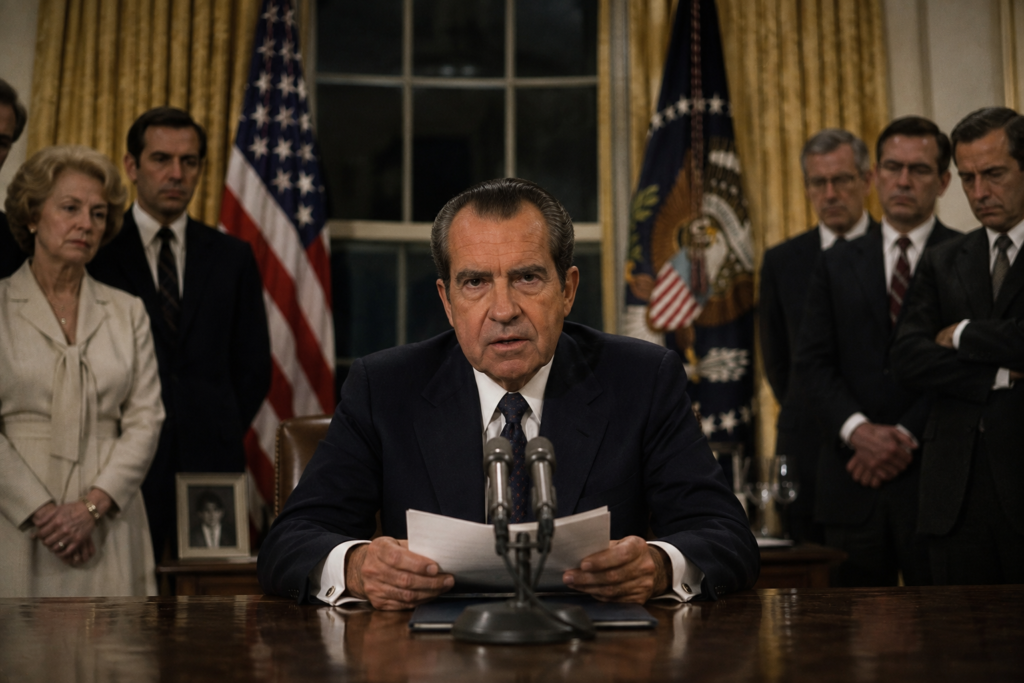
Image Credits: Today in History, August 8: 1974 Richard Nixon Announces His Resignation as the Watergate Scandal Engulfs His Presidency. AI-generated illustration created by Open Chronicle using ChatGPT (OpenAI). August 2026. This image is illustrative and does not depict a real-world scene.
By Open Chronicle
8 August 1974
On 8 August 1974, President Richard Nixon addressed the American people from the Oval Office and announced that he would resign from the presidency of the United States. His decision came as the Watergate scandal destroyed his political authority and made impeachment and removal from office increasingly likely.
Nixon’s resignation, which became effective the following day, made him the first and, to date, only president of the United States to resign from office. The crisis became one of the defining political scandals in American history and profoundly affected public confidence in government.
The Watergate Break-In
The scandal began during the early hours of 17 June 1972, when five men were arrested after breaking into the headquarters of the Democratic National Committee at the Watergate office complex in Washington, D.C.
The burglars had attempted to install surveillance equipment and obtain information that could potentially benefit Nixon’s reelection campaign.
Initially, the incident appeared to be an isolated political burglary. Investigations soon revealed connections between the burglars and individuals associated with the Committee for the Re-Election of the President, commonly known as CRP or CREEP.
Nixon was campaigning for a second term at the time. Despite the developing investigation, he defeated Democratic candidate George McGovern by a landslide in the November 1972 presidential election.
The scandal, however, did not disappear.
The Investigation Expands
Journalists, congressional investigators and federal prosecutors gradually uncovered evidence of a broader campaign of political espionage, sabotage and attempts to obstruct the investigation.
Reporters Bob Woodward and Carl Bernstein of The Washington Post played an important role in investigating connections between the burglary and Nixon’s reelection organisation.
Meanwhile, criminal investigations and congressional hearings exposed increasingly serious allegations concerning members of the administration.
Several senior officials resigned or were dismissed, including White House Chief of Staff H. R. Haldeman, domestic affairs adviser John Ehrlichman and Attorney General Richard Kleindienst.
White House Counsel John Dean became a crucial witness. During televised Senate hearings in 1973, he testified about efforts within the administration to conceal the circumstances surrounding Watergate.
Millions of Americans watched the hearings.
The White House Tapes
One of the most important developments came when investigators learned that Nixon had installed a recording system in the White House that automatically recorded many presidential conversations.
The tapes potentially contained direct evidence concerning what Nixon knew about Watergate and the subsequent cover-up.
Special prosecutor Archibald Cox sought access to the recordings, but Nixon refused to surrender them.
The confrontation culminated on 20 October 1973 in what became known as the Saturday Night Massacre.
Nixon ordered Attorney General Elliot Richardson to dismiss Cox. Richardson refused and resigned. Deputy Attorney General William Ruckelshaus also refused and left office. Solicitor General Robert Bork ultimately carried out the president’s order.
The episode produced an enormous political backlash and intensified calls for Nixon’s impeachment.
Nixon v. United States
The dispute over the recordings eventually reached the United States Supreme Court.
Nixon argued that presidential executive privilege allowed him to withhold the tapes. On 24 July 1974, however, the Supreme Court unanimously ruled in United States v. Nixon that the president had to provide the requested recordings.
The decision represented a major constitutional affirmation that presidential authority was subject to the rule of law.
When additional tapes were released, Nixon’s political position deteriorated rapidly.
Particularly damaging was a recording from 23 June 1972, only six days after the Watergate break-in. The conversation demonstrated that Nixon had participated in discussions about using the Central Intelligence Agency to interfere with the FBI investigation.
The recording became known as the “smoking gun” tape.
Several Republican politicians who had previously supported the president concluded that impeachment and conviction were now almost inevitable.
Impeachment Becomes Likely
The House Judiciary Committee had already approved three articles of impeachment against Nixon.
They accused the president of obstruction of justice, abuse of presidential power and contempt of Congress.
Nixon’s support in Congress collapsed following the release of the smoking gun tape.
Senior Republican congressional leaders visited the White House and informed the president that he could no longer expect sufficient support to survive an impeachment trial in the Senate.
Nixon therefore faced a historic choice between almost certain removal from office and resignation.
He chose resignation.
The Oval Office Address
At 9:00 p.m. Eastern Time on 8 August 1974, Nixon appeared on national television from the Oval Office.
He acknowledged that he no longer possessed sufficient political support in Congress to continue effectively as president.
Nixon did not provide a full admission of wrongdoing. Instead, he argued that continuing the struggle over Watergate would consume the attention of the presidency at a time when the United States faced serious challenges at home and abroad.
He announced that his resignation would take effect at noon the following day.
The speech marked an extraordinary moment in American political history.
Never before had a United States president voluntarily surrendered the office.
Nixon Leaves the White House
On the morning of 9 August 1974, Nixon delivered an emotional farewell address to members of his administration and staff.
He then left the White House with his wife, Pat Nixon, boarding the presidential helicopter for the journey to Andrews Air Force Base and eventually California.
At noon, Vice President Gerald Ford took the oath of office as the 38th president of the United States.
Speaking shortly afterwards, Ford attempted to reassure a country exhausted by years of political crisis.
The constitutional transfer of power occurred peacefully and without interruption.
The Nixon Pardon
One month later, on 8 September 1974, President Ford granted Nixon a full and unconditional pardon for any federal crimes he might have committed while president.
Ford argued that a prolonged prosecution of the former president would prevent the country from recovering from Watergate.
The decision was extremely controversial.
Critics believed Nixon should have faced criminal proceedings, while supporters of the pardon argued that ending the controversy allowed the country to move forward.
Several senior Nixon administration officials were eventually convicted of crimes connected with the Watergate scandal.
The Legacy of Watergate
Watergate fundamentally changed American politics.
The scandal produced greater scrutiny of presidential authority, campaign financing and government secrecy. Congress introduced reforms designed to strengthen oversight and limit abuses of executive power.
It also transformed political journalism. Investigative reporting became increasingly important, while the work of journalists examining government misconduct gained new prominence.
Perhaps the deepest consequence was the damage to public trust.
Watergate reinforced widespread suspicion toward political institutions and demonstrated that even the president could be investigated and held accountable under the law.
The suffix “gate” subsequently became an international shorthand for political scandals of many different kinds.
Richard Nixon remained a controversial figure until he died in 1994. His presidency included significant achievements in foreign affairs, including opening diplomatic relations with the People’s Republic of China, pursuing détente with the Soviet Union and negotiating major arms-control agreements.
Yet Watergate permanently shaped his historical reputation.
Nixon’s announcement on 8 August 1974 represented the dramatic conclusion of a constitutional crisis that had consumed the United States for more than two years. His resignation demonstrated both the potential for presidential abuse of power and the ability of democratic institutions, courts, Congress, journalism and the constitutional process to challenge that power.
More than half a century later, Watergate remains one of the most important case studies in presidential accountability and the rule of law in a democratic society.