
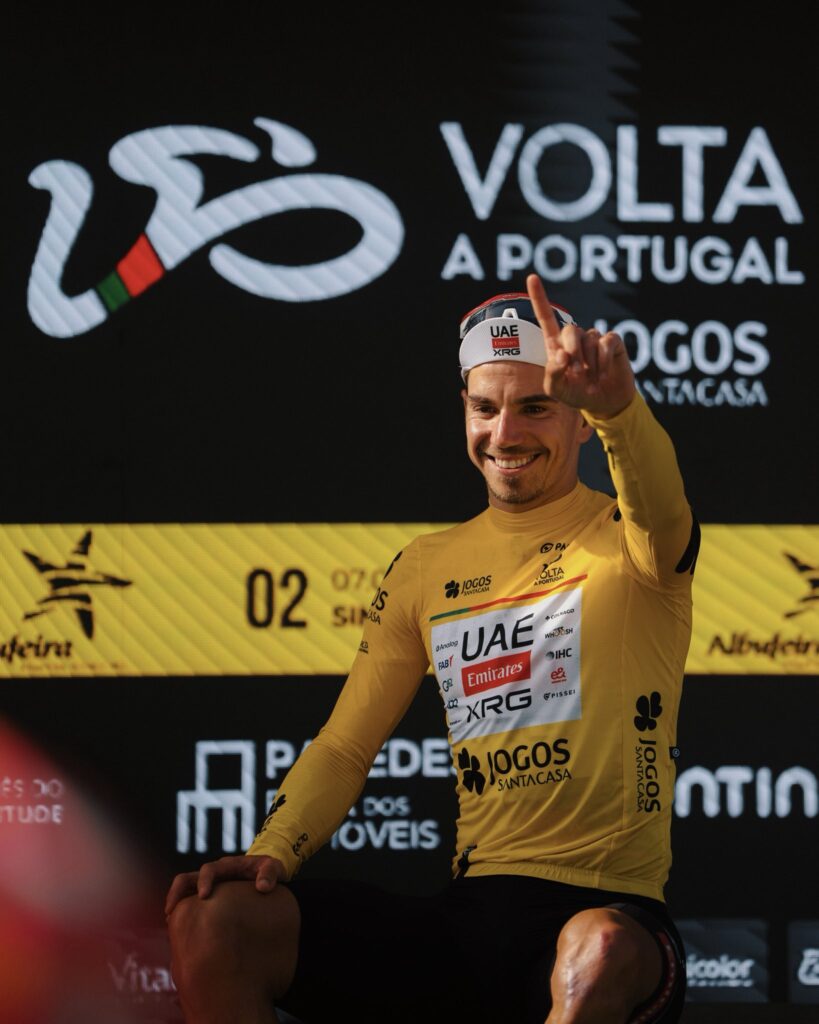
Image: from @UAE-TeamEmirates X @TeamEmiratesUAE
By Open Chronicle Cycling
Three road stages into the 2026 Volta a Portugal, UAE Team Emirates XRG controls the Yellow Jersey, but it does not yet control the race.
That distinction is becoming increasingly important.
Rui Oliveira has successfully carried yellow through three very different road stages. Behind him, however, Anicolor Campicarn has quietly constructed perhaps the most threatening tactical position in the peloton.
Rafael Reis sits only three seconds from the race lead. Artem Nych, the two-time defending champion, is only ten seconds behind.
UAE has the jersey.
Anicolor has two riders capable of putting it under pressure.
And after stages dominated by positioning, breakaways, sprint tactics and small time differences, the Volta is approaching the terrain where those tactical possibilities will finally collide.
The road to the mountains could transform the race.
UAE Has Controlled the Race Without Dominating It
UAE Team Emirates XRG could hardly have asked for a stronger beginning to its first Volta a Portugal.
Julius Johansen won the opening time trial in Lisbon.
Rui Oliveira finished second.
Luca Giaimi also placed among the strongest riders against the clock.
The immediate impression was one of overwhelming collective strength.
But Stage 1 demonstrated that controlling a Volta is considerably more complicated than controlling a 6.5 kilometre time trial.
The roads around Sintra fragmented the peloton.
Johansen could not remain with the strongest group.
Oliveira could.
UAE reacted correctly.
Instead of committing resources to defending a leader who was losing contact, the team’s strategic centre shifted toward Oliveira.
That flexibility preserved yellow.
It was the first important tactical decision of UAE’s Volta.
Rui Oliveira Has Become the Perfect Short-Term Leader
Oliveira’s leadership has subsequently worked extremely well for UAE.
He has been consistently positioned near the front without requiring the team to construct every stage around a victory attempt.
In Albufeira, he finished sixth.
In Elvas, he finished fifth after trying to anticipate the sprint.
Most importantly, he has avoided losing time.
That has allowed UAE to defend the Yellow Jersey economically.
But Oliveira’s position also presents an interesting strategic question.
How much should UAE invest in defending his leadership once the race reaches the major climbs?
Until now, the answer has been simple.
Protect yellow.
In the mountains, the calculation becomes more complicated.
The team must decide whether Oliveira remains its strongest General Classification option or whether another rider should receive greater tactical freedom.
That decision does not necessarily have to be made before the climbing begins.
The road can make it for them.
Anicolor Has Built the Most Dangerous Position
If UAE has the jersey, Anicolor Campicarn arguably has the tactical initiative.
Rafael Reis is second overall at three seconds.
Artem Nych is fourth at ten seconds.
That creates a classic stage racing problem for the leader’s team.
Which rider does UAE follow?
Reis represents the immediate threat to yellow.
Nych represents the greater historical threat to the final General Classification.
The Russian has won the previous two editions of the Volta and understands better than almost anyone in the race how to manage the decisive Portuguese climbs.
Anicolor therefore does not necessarily need to attack with Nych first.
It can use Reis.
If Reis accelerates, UAE must react because three seconds are enough to change the Yellow Jersey.
If UAE spends resources controlling Reis, opportunities could subsequently appear for Nych.
This is the tactical advantage of having multiple riders near the top of a General Classification.
One rider creates the threat.
The other exploits the response.
Santiago Mesa Gives Anicolor Another Weapon
Anicolor’s victory in Albufeira added another dimension to the team’s strategy.
Santiago Mesa demonstrated that Anicolor does not need to sacrifice every stage opportunity in pursuit of the General Classification.
The Colombian won the sprint by only 0.16 seconds over Daniel Cavia.
That result matters tactically.
Teams built exclusively around a GC leader frequently have to choose between controlling stages and preserving domestiques.
Anicolor possesses enough variety to pursue victories while keeping Reis and Nych protected.
Mesa can contest faster finishes.
Reis can threaten through small gaps and bonus seconds.
Nych can wait for the mountains.
That is an unusually broad set of options.
The Breakaways Have Revealed Who Is Willing to Work
The opening stages have also provided clues about the responsibilities inside the peloton.
Stage 2 produced a breakaway that included Óscar Rota and Adam Lewis and survived until six kilometres from Albufeira.
Stage 3 went even further.
Ronan O’Connor, José Miguel Moreira, Gonçalo Rodrigues and Joshua Lebo forced the peloton into a long pursuit between Beja and Elvas.
The escape survived until almost the final kilometre.
In both cases, UAE had an obvious reason to contribute to the chase.
It owned yellow.
But UAE was not alone.
Sprint teams progressively became involved as the probability of a bunch finish increased.
This created an advantageous situation for the race leader’s team.
Every kilometre controlled by Burgos Burpellet BH, Tavfer Ovos Matinados Mortágua, NSN Development Team or another stage hunting squad is a kilometre UAE does not have to control alone.
That dynamic has helped Oliveira.
The mountains will remove much of that assistance.
Why Elvas Was Important
Stage 3 produced no major GC gaps.
Tactically, however, it revealed several things.
First, Oliveira remains confident enough to race aggressively.
His acceleration before the final sprint was not the behaviour of a rider simply trying to hide inside the peloton and protect yellow.
He saw an opportunity and attempted to exploit it.
Second, Tavfer demonstrated considerable strength in a fast finish.
Leangel Linarez and João Matias finishing first and second was more than an excellent result.
It showed that Tavfer can organise the final kilometres effectively and possesses multiple fast riders.
Third, the peloton came dangerously close to allowing the breakaway to survive.
The catch occurred only in the final kilometre.
That tells future breakaways something important.
The peloton is not invulnerable.
The Seconds Have Created a Tactical Trap
The General Classification remains extraordinarily compressed.
Rui Oliveira leads.
Rafael Reis is at three seconds.
Miguel Salgueiro is at nine.
Artem Nych is at ten.
Axel van der Tuuk and Txomin Juaristi are at 11.
Tiago Antunes is at 13.
Emanuel Duarte and Adrià Pericas are at 17.
Fábio Costa is at 21.
The top ten therefore fits inside only 21 seconds.
Until now, that has encouraged conservative racing among the main contenders.
Nobody needs to launch a desperate long-range attack when the race remains separated by seconds, and the decisive climbs are still ahead.
But the same compression creates instability.
One acceleration can change several positions.
One mechanical problem can destroy a General Classification campaign.
One badly positioned rider can lose the Yellow Jersey.
And one successful mountain attack can transform seconds into minutes.
Tiago Antunes Remains a Wild Card
Tiago Antunes deserves particular attention as the race approaches the mountains.
The Efapel leader was affected by the Stage 2 crash but remains only 13 seconds from yellow.
That is significant.
Antunes does not need to recover a major deficit before beginning to race aggressively.
He is already there.
Unlike some riders around him in the standings, his climbing ability means the transition toward harder terrain should theoretically increase rather than reduce his tactical relevance.
Efapel therefore enters the next phase with a straightforward opportunity.
It does not control the race.
It does not need to.
It can wait for UAE and Anicolor to begin watching each other and search for the moment when that rivalry creates space.
Pericas Gives UAE a Second Card
The presence of Adrià Pericas only 17 seconds behind Oliveira may become increasingly important.
The young Spaniard leads the youth classification, but viewing him exclusively through the White Jersey understates his tactical value.
If Pericas demonstrates stronger climbing legs than Oliveira, UAE immediately gains an alternative.
That can also work defensively.
Anicolor cannot assume that distancing Oliveira automatically means defeating UAE.
If another UAE rider remains with the strongest climbers, the team can transfer its GC ambitions without abandoning the race.
The same principle that helped UAE move from Johansen to Oliveira after Stage 1 could apply again.
That flexibility is perhaps UAE’s greatest strategic advantage.
Nych Has Had No Reason to Show Himself
Perhaps the most interesting rider in the race is also one of the least visible.
Artem Nych has not needed to do anything yet.
That should concern his rivals rather than reassure them.
The defending champion is only ten seconds behind.
He has not had to chase bonus seconds.
He has not needed to attack on unsuitable terrain.
He has not been forced into a long pursuit.
His objective during the opening phase has simply been to remain close.
Mission accomplished.
The fundamental question of this Volta is not whether Nych can sprint with Oliveira or contest an intermediate bonus with Reis.
It is whether anyone can distance him when the road becomes truly difficult.
The next phase begins answering that question.
The Mountains Change the Rules
Everything that has defined the race so far becomes less important once the major climbing begins.
Sprint trains matter less.
Bonus seconds become secondary.
Positioning remains important, but raw climbing ability becomes decisive.
The large teams can no longer rely on sprint squads to help control breakaways.
Domestiques disappear one by one.
Eventually, tactical complexity gives way to something much simpler.
Who can follow?
That is where the balance between UAE and Anicolor could change.
Oliveira has earned the right to defend yellow.
Reis has earned the right to attack it.
Nych has earned, through two consecutive Volta victories, the right to be considered one of the principal references when the road rises.
Antunes has an opportunity.
Pericas has an opportunity.
And several riders currently separated by seconds will discover that the classification can change far more quickly than it did during the opening stages.
Tactical Board After Stage 3
| Team | Position | Tactical Situation |
|---|---|---|
| UAE Team Emirates XRG | Rui Oliveira in yellow | Must defend the race lead while evaluating its strongest climbing option |
| Anicolor Campicarn | Reis +0:03, Nych +0:10 | Best two-rider tactical position among the GC teams |
| Team Tavira Crédito Agrícola | Miguel Salgueiro +0:09 | Close enough to exploit attacks between the principal favourites |
| Euskaltel Euskadi | Van der Tuuk and Juaristi +0:11 | Two riders inside striking distance provide tactical flexibility |
| Efapel Cycling | Tiago Antunes +0:13 | Can attack rather than assume responsibility for controlling the race |
| Feira dos Sofás Boavista | Fábio Costa +0:21 | Still close enough to influence the GC while Óscar Rota targets the mountains competition |
| Tavfer Ovos Matinados Mortágua | Stage hunting | Linarez and Matias have demonstrated major strength in fast finishes |
Who Has the Tactical Advantage?
At this moment, there are two different answers.
UAE has the positional advantage.
It owns yellow and therefore begins every stage with the race under its control.
Anicolor has the attacking advantage.
It has two serious GC cards positioned close enough that UAE cannot comfortably ignore either of them.
That distinction should define the next phase of the Volta.
UAE must respond.
Anicolor can choose when to ask the question.
The danger for Anicolor is becoming too clever.
If Reis and Nych spend too much time trying to create tactical dilemmas rather than following the strongest riders, another contender could exploit the hesitation.
Antunes, Salgueiro, Juaristi, Van der Tuuk and Pericas are all close enough to matter.
The Volta is not yet a two-team race.
Race Analysis Verdict
After Stage 3, UAE Team Emirates XRG leads the Volta, but Anicolor Campicarn may hold the strongest tactical hand.
Rui Oliveira has been one of the most consistent riders of the opening days and deserves his Yellow Jersey.
But three seconds over Rafael Reis and ten over Artem Nych provide no meaningful security before the major climbs.
UAE’s greatest strength is depth and flexibility.
Anicolor’s greatest strength is the presence of two different GC threats.
Efapel and Euskaltel can afford to wait.
Tavira has already demonstrated that it can exploit hesitation.
And the aggressive breakaways of the opening stages have shown that controlling this Volta requires constant attention.
Until now, the race has been decided in seconds.
The mountains are where the real hierarchy should emerge.
And for the first time in the 2026 Volta a Portugal, defending yellow may soon become more difficult than taking it.