
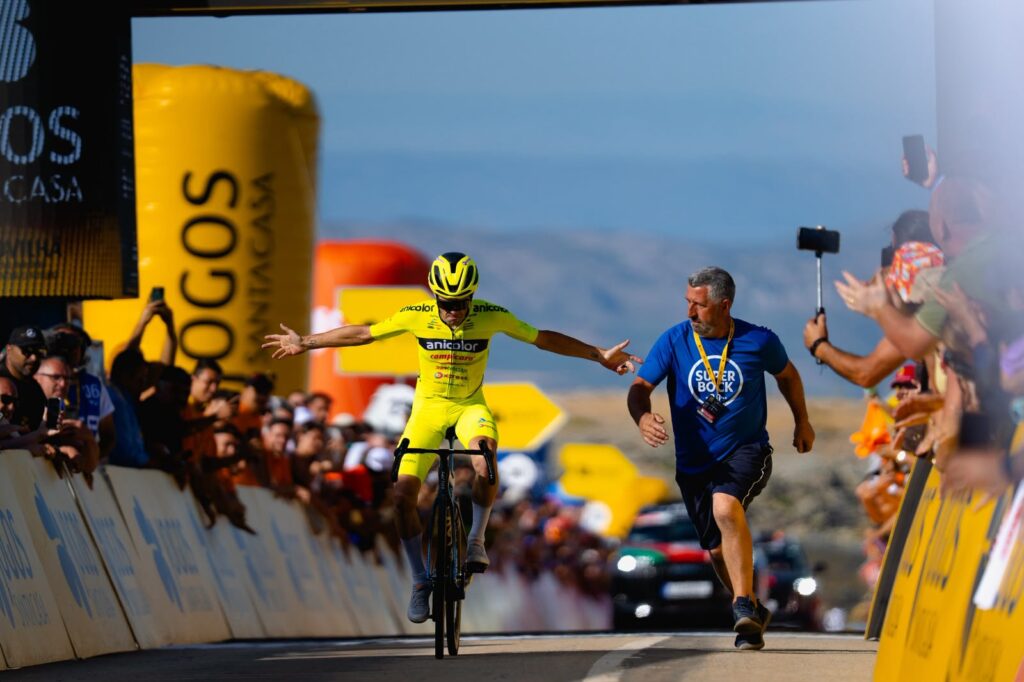
Image: from falso plano X @falsoplanoblog
By Open Chronicle Cycling
The 2026 Volta a Portugal entered Serra da Estrela with a General Classification separated by seconds.
It left Torre with one team controlling the race.
Anicolor Campicarn has Alexis Guérin in the Yellow Jersey and two time defending champion Artem Nych in second place.
Guérin leads Nych by 1 minute and 26 seconds. José Neves, the closest rider outside Anicolor, is already 1:58 behind. Pedro Silva follows at 2:01.
Those gaps represent far more than a reshuffling of the standings.
They fundamentally change the tactical structure of the 87th Volta a Portugal.
Until Torre, the responsibility belonged largely to UAE Team Emirates XRG and Rui Oliveira. They had the jersey, while Anicolor and the other General Classification teams could wait for the mountains.
Now the roles have reversed.
Anicolor has yellow.
Anicolor has the defending champion immediately behind.
And everyone else must find a way to break a formation that suddenly possesses almost every tactical advantage available in a stage race.
But there is one important complication.
The next stage is an individual time trial.
There will be no teammates to protect Guérin.
No tactical bluff.
No waiting for Nych.
For 17.4 kilometres between Anadia and Águeda, every contender will be alone against the clock.
Torre Changed More Than the Yellow Jersey
Before Stage 4, the General Classification remained extraordinarily compressed.
Rui Oliveira led.
Rafael Reis was only three seconds behind.
Miguel Salgueiro was at nine seconds.
Nych was at ten.
Axel van der Tuuk and Txomin Juaristi were at 11.
Tiago Antunes was at 13.
Only 21 seconds separated the top ten.
That situation produced tactical caution.
There was little reason for the principal favourites to take major risks on terrain that was unlikely to decide the race.
Torre removed that logic.
The first serious mountain finish created exactly the separation the opening stages had failed to produce.
Guérin now leads Nych by 1:26.
Neves is at 1:58.
Silva is at 2:01.
The race has moved from a contest for seconds to a contest for minutes.
That changes how every major team must approach the remaining stages.
Guérin’s Attack Was a Tactical Masterstroke
The defining move came with just under 15 kilometres remaining on the final climb.
Guérin attacked.
The crucial element was not simply that he escaped.
It was that the situation behind allowed him to continue.
Before the stage, Guérin was not the obvious rider around whom every rival was constructing its strategy.
Nych was.
As the winner of the previous two editions, Nych naturally commanded attention from every serious General Classification contender.
That gave Anicolor an opportunity.
A move from Nych would immediately demand a response.
A move from another Anicolor rider required a more complicated calculation.
How much energy should a rival spend chasing Guérin while Nych remained behind?
The answer came too slowly.
Guérin turned tactical freedom into physical separation.
By the time the implications became obvious, the road had already changed the Volta.
The Nych Factor Made the Attack More Dangerous
This is where Anicolor’s strength becomes particularly important.
Guérin was never attacking in isolation.
Nych was behind him.
That meant rival riders could not simply commit everything to the pursuit without considering what the defending champion might do next.
If a contender accelerated aggressively to close Guérin, Nych could follow.
If nobody chased, Guérin gained time.
It is one of the classic tactical dilemmas in stage racing.
Two strong riders from the same team can force opponents to make decisions for them.
Torre demonstrated exactly how powerful that can be.
Guérin eventually won.
Nych finished second.
The team achieved the ideal outcome.
Anicolor Now Has Two Ways to Win
The situation after Torre is even more difficult for Anicolor’s rivals than the situation during the climb.
Guérin has yellow.
Nych is second.
That gives the team two fundamentally different ways to defend the race.
The first is conventional.
Protect Guérin.
Control dangerous breakaways.
Keep the Frenchman close to his principal rivals.
Use Nych and the rest of the team to neutralise attacks.
The second possibility is considerably more aggressive.
Allow Nych tactical freedom.
If another team attacks Guérin and Nych can follow, Anicolor does not necessarily need to chase immediately.
Nych himself is a potential race winner.
That means opponents cannot simply isolate the Yellow Jersey and assume the job is finished.
They must distance both Anicolor leaders.
That is much harder.
Nych May Be More Dangerous in Second Than He Was Before Torre
There is a paradox at the centre of the new General Classification.
Nych lost time to a teammate.
Yet his tactical position may have improved.
Before Torre, everyone expected Nych to attack eventually.
He was the defending champion.
He was Anicolor’s obvious reference.
Every acceleration from him would attract immediate attention.
Now he sits 1:26 behind his own teammate.
He no longer has to carry the responsibility of being Anicolor’s only route to victory.
That can make him more dangerous.
If Guérin remains strong, Nych becomes an extraordinary defensive weapon.
If Guérin shows weakness, Nych becomes the alternative leader.
If rivals hesitate between the two, Anicolor benefits again.
The defending champion has effectively gained tactical freedom without losing his status as one of the principal favourites.
The Pressure Has Shifted to José Neves
José Neves is now the closest rider outside Anicolor.
At 1:58, his situation is completely different from the one facing riders before Torre.
He can no longer simply follow.
At some point, he must recover time.
But Neves also cannot afford to attack recklessly.
Pedro Silva is only three seconds behind him.
The battle for third place is therefore almost as tight as the battle for yellow is now stretched.
That creates another tactical problem.
Neves must look forward at Guérin and Nych while simultaneously protecting his position from Silva and the riders behind.
The time trial could help clarify that situation.
A strong ride in Águeda could reduce the deficit to Anicolor while creating greater separation behind.
A poor performance could do the opposite.
Pedro Silva Has Nothing to Lose
Pedro Silva occupies one of the most interesting positions in the race.
Fourth overall at 2:01, he is only three seconds from the podium.
Unlike Anicolor, his team does not control the race.
Unlike Neves, he does not currently occupy a podium position that must be defended.
That can eventually give him tactical freedom.
If Silva attacks during a future mountain stage, the first responsibility to react belongs to Anicolor.
Neves must then decide whether protecting third place justifies contributing to the pursuit.
Those are exactly the situations an aggressive rider can exploit.
The Torre result therefore did not close the podium battle.
It made it more interesting.
UAE Must Rewrite Its Race
The biggest strategic loser of Stage 4 was UAE Team Emirates XRG.
That does not mean the team’s Volta has failed.
It means its objectives have changed.
UAE controlled the opening phase of the race.
Julius Johansen won the Lisbon Prologue and wore the first Yellow Jersey.
Rui Oliveira then took over the leadership and successfully defended yellow through three road stages.
That strategy worked.
But Torre exposed the limitation of building the race around Oliveira once the terrain became substantially harder.
The team now has to adapt.
Adrià Pericas becomes increasingly important.
The young rider retained the White Jersey and sits ninth overall at 2:19.
That gap is significant but not terminal.
Pericas is still close enough to pursue a strong General Classification while defending the youth competition.
For UAE, the strategic priority should no longer be recreating the race it had before Torre.
That race is gone.
The priority is identifying what Pericas can achieve from the new situation.
Pericas Could Become an Attacking Asset
There is another reason Pericas matters.
He does not have the Yellow Jersey to defend.
That sounds obvious, but tactically it changes everything.
UAE spent several days carrying responsibility for the race because Oliveira was the leader.
Now Anicolor carries that burden.
Pericas can potentially race more aggressively.
If he enters a dangerous move, Anicolor must decide whether to chase.
If he attacks on a climb, Guérin and Nych must respond according to the threat he represents.
UAE has moved from defence to offence.
Used correctly, that could actually make the team more unpredictable.
Anicolor Must Avoid Defending Too Early
Having first and second overall is an extraordinary advantage.
It can also create a psychological trap.
Teams in this position sometimes become overly defensive.
Every breakaway suddenly looks dangerous.
Every acceleration demands a response.
Domestiques are spent controlling stages that did not genuinely threaten the leader.
Anicolor should resist that temptation.
Guérin has nearly two minutes over the closest rider outside his own team.
That means the team can afford to calculate.
Not every breakaway matters.
Not every attack needs an immediate chase.
The objective should be to preserve resources for the riders who genuinely threaten the General Classification.
The strongest use of a dominant position is not controlling everything.
It is forcing everyone else to take responsibility for changing it.
The Team Classification Reveals Anicolor’s Depth
The collective standings reinforce the same conclusion.
Anicolor leads the team classification with 48:55:04.
Efapel Cycling is 4:37 behind.
GI Group Holding Simoldes UDO trails by 4:50.
Those gaps matter because they demonstrate that Anicolor’s performance on Torre was not dependent on one isolated rider.
The team has depth.
That depth will become increasingly important as the Volta accumulates fatigue.
Protecting two riders at the top of the General Classification requires more resources than protecting one.
At the moment, Anicolor appears to have them.
The Mountains Competition Creates Another Interesting Dynamic
Óscar Rota still leads the Blue Jersey competition with 28 points.
But Guérin is now only two points behind.
Nych has 20.
That creates an unusual overlap between the General Classification and the mountains competition.
Rota accumulated his advantage through aggressive breakaways.
Guérin and Nych can collect mountain points simply by contesting decisive summit finishes.
This means Rota may have to become even more aggressive if he wants to retain blue.
Waiting for the GC riders to reach the final climbs is unlikely to be enough.
He may need to target early mountain points through breakaways.
That could influence the tactical shape of future mountain stages.
Stage 5 Removes the Tactical Safety Net
The most fascinating element of the post-Torre situation is what happens immediately next.
There is no transitional sprint stage.
No quiet day for Anicolor to reorganise.
The Volta goes directly into a 17.4 kilometre individual time trial from Anadia to Águeda.
For the General Classification riders, that changes the rules again.
Guérin cannot use Nych.
Nych cannot use Guérin.
Neves cannot follow wheels.
Silva cannot wait for somebody else to chase.
Pericas cannot rely on UAE’s collective strength.
Each rider must produce his own performance.
That makes Stage 5 an unusually important test of the hierarchy established at Torre.
The Time Trial Could Strengthen Anicolor
The ideal scenario for Anicolor is obvious.
Guérin produces a strong time trial and preserves most of his advantage.
Nych also performs well and remains second.
If that happens, the team enters the rest day with its dominant position confirmed in two completely different disciplines.
That would send an important message to the rest of the peloton.
Torre would no longer look like an isolated mountain performance.
It would look like the beginning of a sustainable bid for overall victory.
Or It Could Reopen the Race
The opposite scenario is equally important.
If Guérin struggles against the clock, the 1:26 advantage over Nych and 1:58 over Neves could shrink quickly.
That would reopen tactical possibilities.
Nych could move closer to his teammate.
Neves could return to within realistic attacking distance.
Silva could strengthen his podium challenge.
Pericas could recover valuable time.
The key number is therefore not necessarily whether Guérin keeps yellow.
It is how much of his advantage remains after Águeda.
A Yellow Jersey with nearly two minutes over the opposition can dictate the race.
A Yellow Jersey with 30 or 40 seconds must react to it.
Tactical Board After Torre
| Team | Current Position | Tactical Priority |
|---|---|---|
| Anicolor Campicarn | Guérin 1st, Nych 2nd | Protect two GC options without wasting resources |
| GI Group Holding Simoldes UDO | Neves 3rd at +1:58 | Use the time trial to reduce the deficit and consolidate the podium |
| Feira dos Sofás Boavista | Silva 4th at +2:01 | Stay close to Neves while preserving attacking freedom |
| UAE Team Emirates XRG | Pericas 9th at +2:19, White Jersey | Shift from defending yellow to attacking the GC and protecting youth |
| Efapel Cycling | Strong team classification position | Use collective depth to create opportunities rather than control |
| Burgos Burpellet BH | Cavia leads points | Protect the Orange Jersey and target faster stages |
Who Has the Tactical Advantage?
There is no longer much ambiguity.
Anicolor Campicarn has the strongest hand in the race.
Before Torre, UAE had the positional advantage because it owned yellow, while Anicolor possessed attacking options through Nych and others.
That balance has disappeared.
Anicolor now owns the Yellow Jersey.
It has the defending champion in second.
It leads the team classification.
And its closest external rival is almost two minutes behind.
That is control.
But it is not victory.
There are still too many kilometres remaining, too many climbs, too many tactical possibilities and, immediately, a time trial capable of changing the gaps again.
Race Analysis Verdict
Torre did not decide the 2026 Volta a Portugal.
It established who everyone else now has to beat.
Anicolor Campicarn emerged from Serra da Estrela with the perfect stage racing position: Alexis Guérin in yellow and Artem Nych immediately behind him.
Guérin’s attack worked because he had the legs to make it work, but also because Anicolor’s tactical depth made the response extraordinarily difficult.
That same depth now becomes the team’s greatest weapon.
José Neves is the closest external challenger.
Pedro Silva is within touching distance of the podium.
Adrià Pericas gives UAE a new strategic direction.
And the teams that previously watched UAE control the race can now place responsibility firmly on Anicolor.
But before any of those tactical battles resume, the Volta presents a brutally simple examination.
One rider.
One bicycle.
One clock.
17.4 kilometres from Anadia to Águeda.
Torre revealed the strongest climbers.
Stage 5 will tell us whether the new hierarchy can survive when tactics disappear.