
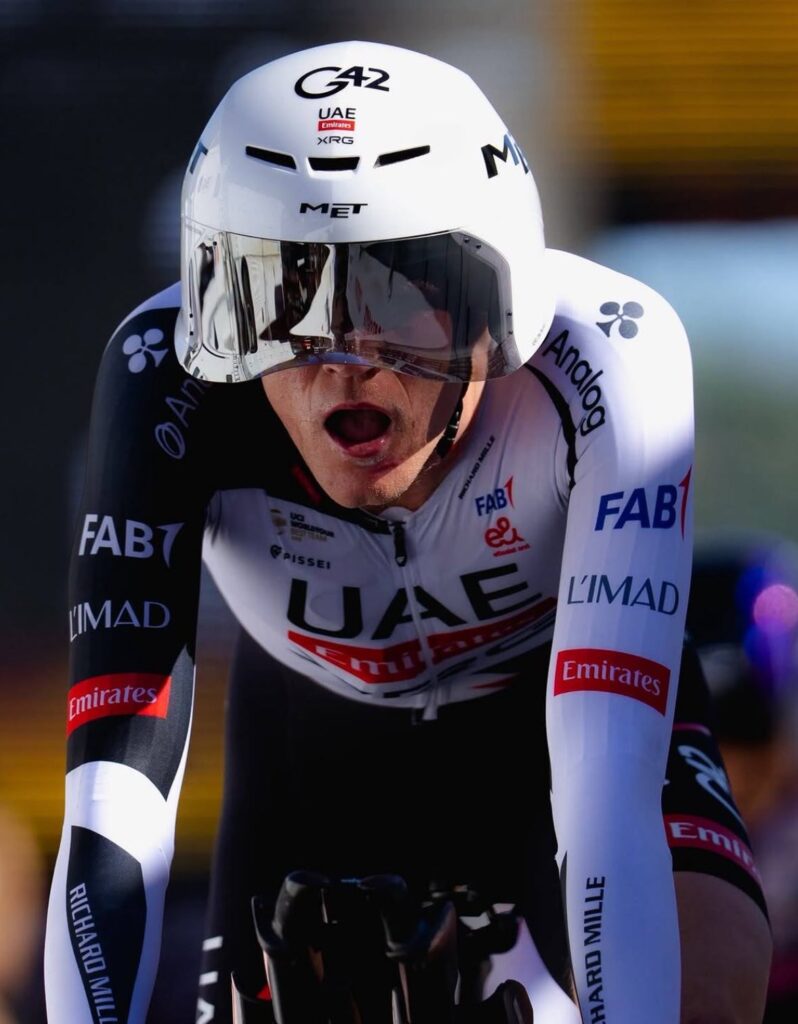
Image: from Portuguese Cycling Magazine X @PCMPTMag
By Open Chronicle Cycling
For a few minutes on the evening of 5 August, the streets of Lisbon belonged to Julius Johansen.
The Danish rider opened the 87th Volta a Portugal with a powerful performance against the clock, winning the 6.5 kilometre prologue and becoming the first rider to wear the Yellow Jersey in the 2026 edition.
It was a short effort, completed in only 7 minutes and 45 seconds, but its significance extended well beyond those opening kilometres.
Johansen had provided UAE Team Emirates XRG with the perfect start to the race.
He had also written his name into the long history of riders who have opened Portugal’s national tour as race leader.
A Fast Night in Lisbon
The 2026 Volta began not with the uncertainty of a mass start, but with one rider at a time racing through the Portuguese capital.
A 6.5 kilometre individual time trial meant there was nowhere to hide.
There were no teammates to control the race, no wheels to follow and no tactical calculations inside a peloton.
Only speed mattered.
Johansen produced more of it than anyone else.
His winning time of 7:45 represented an average speed of approximately 50.3 km/h, enough to put him four seconds ahead of teammate Rui Oliveira.
Rafael Reis of Anicolor Campicarn completed the opening podium at six seconds.
Behind them, Luca Giaimi gave UAE another rider near the top of the standings by finishing fourth at nine seconds.
The message from the opening evening was clear.
UAE had arrived at the Volta with considerable strength.
Johansen was the rider who converted that strength into the first victory.
That’s right, @VoltaPortugal – we’re here! 🤩🇵🇹
We can’t wait to make our race debut tomorrow, at the longest stage race outside of the Grand Tours. This should be a cracker 🔥
Our squad is as follows ⤵️
🇮🇹 @LucaGiaimi
🇩🇰 Julius Johansen
🇵🇹 @roliveira57
🇪🇸 @adriapericas… pic.twitter.com/8QCl7sHZyi— @UAE-TeamEmirates (@TeamEmiratesUAE) August 4, 2026
The First Yellow Jersey
Winning the opening stage of a stage race carries a reward that goes beyond the stage itself.
Johansen became the first Yellow Jersey of the 2026 Volta a Portugal.
For a race approaching its centenary, that places his name within a much larger story.
Since the first Volta was held in 1927, generations of riders have competed for the jersey that identifies the leader of Portugal’s greatest cycling race.
Johansen’s spell in yellow would ultimately be brief, but that does not diminish its place in the chronology of the race.
Every edition has a first leader.
In 2026, it was Julius Johansen.
A Rider Built for Power
Johansen’s victory in Lisbon suited the characteristics that have defined much of his career.
Born in Denmark in 1999, he emerged as a rider with considerable power and versatility, capable of performing both on the road and on the track.
His background helps explain why a short, high speed effort against the clock represented such an attractive opportunity.
Johansen was already an accomplished international cyclist long before arriving in Lisbon.
One of the defining achievements of his early career came at the 2017 UCI Road World Championships in Bergen, where he became junior road race world champion.
That victory immediately identified him as one of Denmark’s most promising young riders.
His development would subsequently extend well beyond road racing.
World Champion on the Track
Johansen became an important member of Denmark’s extraordinarily successful track endurance programme.
His track career brought him to the highest level of international competition, particularly in the team pursuit.
Denmark became one of the dominant nations in the discipline, combining exceptional aerodynamics, pacing and sustained power.
Johansen was part of that generation.
At the 2020 UCI Track Cycling World Championships in Berlin, Denmark won the team pursuit world title.
The Danish squad also pushed the discipline to extraordinary speeds, establishing world record performances during an era in which the country’s team pursuit programme became one of the benchmarks of international track cycling.
For Johansen, the experience reinforced qualities that translate naturally to short time trials.
Power.
Aerodynamic efficiency.
Pacing.
The ability to sustain enormous speed over a relatively short period.
All of those qualities were visible again on the opening evening of the Volta.
From Track Speed to Road Racing
Combining track and road competition has long been an important development path for riders with Johansen’s characteristics.
Track cycling develops explosive acceleration and sustained power, while road racing requires those qualities to be applied within a far more unpredictable tactical environment.
Johansen has spent his professional career learning to combine the two.
His profile is therefore different from that of a pure climber such as the riders who later emerged at the front when the 2026 Volta reached Torre.
He is not expected to build his entire race around long mountain ascents.
Instead, his value comes from versatility.
Short time trials, powerful finishes, breakaways, positioning and team work can all provide opportunities.
Lisbon was perhaps the clearest possible demonstration of that skill set.
UAE Team Emirates XRG Arrives in Portugal
Johansen’s presence in the 2026 Volta also reflected the significance of UAE Team Emirates XRG’s participation.
A UCI WorldTeam entering Portugal’s national tour inevitably changes the competitive landscape.
UAE arrived with riders capable of influencing several classifications and several different types of stages.
Johansen immediately delivered the opening victory.
Rui Oliveira finished second.
Luca Giaimi was fourth.
Three UAE riders therefore occupied three of the first four positions after the prologue.
It was one of the strongest collective starts any team could have produced.
Johansen stood at the centre of it wearing yellow.
The Oliveira Threat Was Already There
There was, however, an interesting detail in the opening classification.
Only four seconds separated Johansen from Rui Oliveira.
The Portuguese rider was competing on home roads and had produced a performance that immediately placed him within striking distance of the race lead.
That gap shaped the next stage.
Johansen had yellow, but UAE also possessed another rider capable of taking it.
The situation gave the team tactical flexibility.
Rather than depending entirely on one leader, UAE controlled the first two positions and could respond to different race scenarios.
Twenty four hours later, the Yellow Jersey would remain within the team.
But it would change shoulders.
Yellow Passes From Johansen to Oliveira
Stage 1 took the peloton from Lourinhã to Queluz through the Sintra area.
Francisco Campos won the stage.
The more important development for the General Classification came behind the stage victory.
Rui Oliveira gained enough time to move ahead of Johansen and become the new race leader.
Johansen’s spell in yellow was over.
UAE’s control of the jersey was not.
It represented a smooth transition between teammates and demonstrated why the team’s opening performance in Lisbon had been so valuable.
The four second separation created during the prologue had placed Oliveira close enough to exploit the first opportunity presented by the road.
Johansen had opened the Volta for UAE.
Oliveira continued the team’s leadership.
More Than a Yellow Jersey
A rider’s contribution to a stage race cannot always be measured by the number of days spent leading it.
Johansen’s opening performance established the conditions for everything that followed during UAE’s first phase of the Volta.
His victory gave the team immediate authority.
It placed several teammates high in the classification.
It forced rival teams to consider UAE from the opening kilometres.
And it gave the squad control of yellow before the race had even reached its first road stage.
When Oliveira subsequently became leader, the colour of the jersey remained unchanged even though the rider wearing it had changed.
For UAE, that continuity mattered.
A Different Race in the Mountains
As the Volta moved south through Albufeira and Elvas and then toward Serra da Estrela, the nature of the competition gradually changed.
The opening phase had rewarded speed, positioning and tactical control.
Torre rewarded climbing.
Alexis Guérin’s attack on Stage 4 transformed the General Classification, while Artem Nych completed an Anicolor Campicarn one two.
The race that Johansen had led in Lisbon had entered a completely different phase.
That contrast is one of the defining characteristics of a stage race.
The rider best suited to the opening kilometres does not necessarily resemble the rider best suited to the decisive mountains.
Johansen’s moment belonged to Lisbon.
Guérin’s belonged to Torre.
Both became chapters of the same race.
Why Johansen Matters to the 2026 Volta
When the 87th Volta a Portugal is eventually remembered, the decisive mountain stages and final battle for overall victory will naturally dominate much of the story.
But every edition begins somewhere.
The 2026 race began with a Danish rider travelling through Lisbon at more than 50 kilometres per hour.
Johansen gave the Volta its first benchmark.
7 minutes and 45 seconds.
Everyone else had to beat it.
Nobody did.
That made him the first stage winner.
The first General Classification leader.
And the first Yellow Jersey of the 2026 Volta a Portugal.
Whatever happened afterwards, those distinctions cannot change.
Rider Profile
Name: Julius Johansen
Nationality: Denmark
Born: 1999
Team at the 2026 Volta: UAE Team Emirates XRG
Rider type: Powerful all rounder, time trial and track specialist
2026 Volta highlight: Winner of the Lisbon Prologue
Prologue time: 7:45
Average speed: Approximately 50.3 km/h
First Yellow Jersey: 5 August 2026
Major career highlight: Junior Road World Champion, 2017
Track highlight: World Champion with Denmark in the team pursuit
The First Chapter
There will be more celebrated climbs.
There will be larger time gaps.
There will be attacks that determine who ultimately wins the 2026 Volta a Portugal.
But there can only be one first winner.
Under the Lisbon evening sky, that rider was Julius Johansen.
His 7 minute and 45 second ride provided the opening chapter of the 87th Volta.
And when the first Yellow Jersey of the race was presented, it belonged to him.