
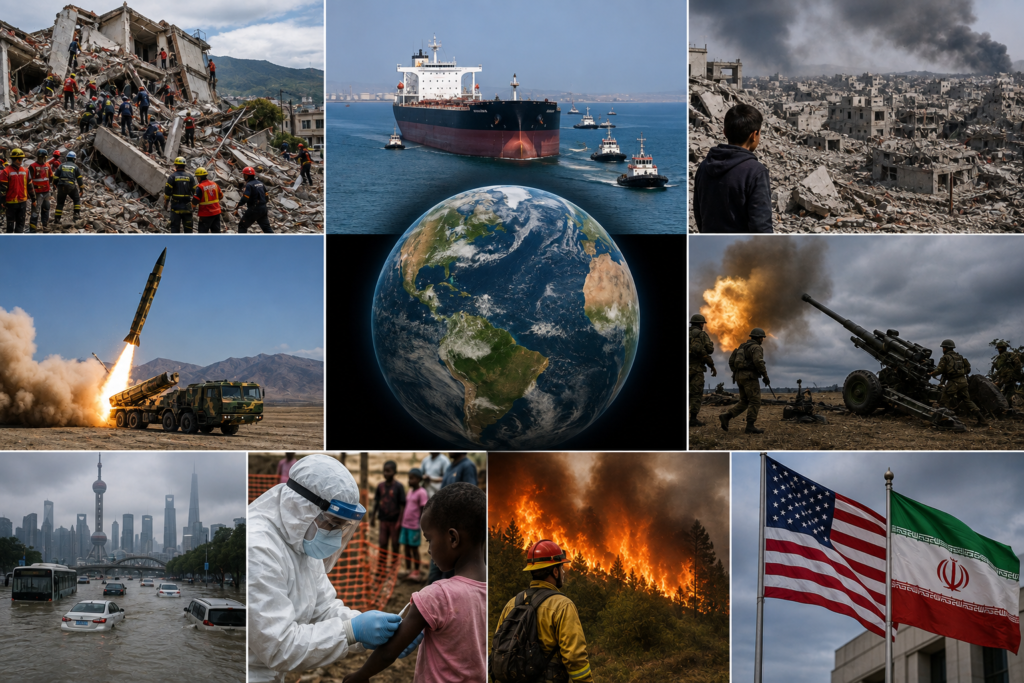
Image Credits: World News Brief: The Top Global Stories Shaping August 11, 2026. AI-generated illustration created by Open Chronicle using ChatGPT (OpenAI). August 2026. This image is illustrative and does not depict a real-world scene.
By Open Chronicle with agencies
The international agenda on Tuesday, August 11, is being shaped by a combination of geopolitical confrontation, war, humanitarian emergencies and growing strategic competition.
The confrontation between the United States and Iran remains at the centre of global attention as uncertainty surrounds efforts to restore normal shipping through the Strait of Hormuz. In Colombia, rescue operations continue after a devastating earthquake killed dozens of people, while diplomacy surrounding Gaza faces difficult questions over Israeli withdrawal and the future of Hamas.
At the same time, China’s latest missile test is drawing attention to the accelerating military competition in the Pacific. Russia’s war against Ukraine continues to expand beyond the conventional battlefield, European governments are strengthening critical infrastructure against hybrid threats, and the Democratic Republic of Congo is confronting a worsening Ebola emergency.
These are the major international stories shaping August 11, 2026.
U.S. and Iran remain locked in confrontation over the Strait of Hormuz
The struggle over the Strait of Hormuz remains one of the most consequential geopolitical developments in the world.
Shipping through the strategically vital waterway has fallen dramatically during the conflict, disrupting one of the principal arteries of the global energy system.
According to Reuters reporting, traffic through the strait fell to only a handful of vessels on Monday, compared with roughly 130 to 140 vessels per day before the war.
That extraordinary decline illustrates the scale of the disruption.
The Strait of Hormuz connects the Persian Gulf with the Arabian Sea and provides a route for a substantial share of global oil and liquefied natural gas exports.
Any prolonged disruption therefore has consequences far beyond Iran and the Gulf.
Oil prices, shipping costs, maritime insurance, inflation and supply chains can all be affected.
Diplomatic efforts involving Iran, Oman and the United States have raised hopes that shipping arrangements could eventually be restored, but optimism surrounding an agreement has weakened.
Iran has linked reopening the waterway to concessions from Washington, while President Donald Trump has intensified pressure on Tehran and demanded compensation for people killed or wounded during the conflict.
The competing demands demonstrate that the dispute over Hormuz is inseparable from the wider confrontation between Iran and the United States.
For the global economy, the question is increasingly urgent: how long can one of the world’s most important maritime routes remain severely disrupted?
Colombia searches for survivors after devastating earthquake
Colombia continues to confront the consequences of the powerful earthquake that struck the western part of the country on Monday.
At least 77 people were reported killed as buildings collapsed across several communities and rescue teams began searching damaged structures.
The earthquake was felt across a wide area, including in Bogotá.
Emergency operations continued into Tuesday as authorities attempted to reach people trapped beneath rubble and establish the full extent of the destruction.
The immediate priorities remain rescue, medical assistance, temporary accommodation and assessment of damaged infrastructure.
The disaster has become one of the most serious humanitarian stories in the Americas.
Colombia lies within a highly active seismic region where several tectonic plates interact, making earthquakes a persistent national risk.
The final human and economic cost of Monday’s disaster may take considerably longer to establish.
Gaza diplomacy confronts its most difficult questions
Diplomatic efforts surrounding Gaza have entered another sensitive phase.
A framework promoted by the Trump administration depends on resolving two exceptionally difficult issues: the future disarmament of Hamas and the withdrawal of Israeli forces.
Both questions go to the centre of the conflict.
Israel considers preventing Hamas from rebuilding its military capabilities a fundamental security requirement.
Palestinians and international mediators, meanwhile, continue to focus on the future of Israeli military deployments and the political administration of Gaza.
Disagreement over these questions could determine whether current diplomatic efforts produce a durable settlement or another temporary arrangement.
The challenge is no longer simply negotiating a pause in fighting.
Any lasting agreement would have to establish a security framework, determine the future governance of Gaza, address humanitarian reconstruction and provide mechanisms capable of preventing another cycle of conflict.
That makes the current negotiations one of the most important diplomatic tests in the Middle East.
China’s missile test intensifies Pacific security debate
China’s military modernisation returned to international attention after a missile test generated renewed concern across the Pacific.
The test involved a missile capable of carrying a nuclear warhead and has intensified debate among Pacific countries over China’s growing military power and the wider militarisation of the region.
The development comes amid a much larger transformation of Indo-Pacific security.
China is expanding its naval, missile, nuclear and space capabilities while the United States strengthens military cooperation with allies and partners across the region.
Japan and Australia are increasing defence investment. The Philippines has expanded security cooperation with Washington, while smaller Pacific states increasingly find themselves navigating competition between major powers.
Missile technology is particularly important because long-range systems can reshape military calculations across enormous geographical areas.
China’s expanding arsenal therefore affects not only its nuclear deterrent but also the strategic calculations of Washington and governments throughout the Pacific.
The latest test is another indication that the Indo-Pacific is becoming one of the defining military theatres of the twenty-first century.
Ukraine war reaches deeper into Russia
The geographical boundaries of the Russia-Ukraine war continue to expand.
Ukraine has increasingly demonstrated an ability to strike targets deep inside Russian territory using long-range drones and other systems.
The attacks are designed in part to disrupt Russia’s military industrial capacity, logistics, energy infrastructure and ability to sustain operations at the front.
Recent strikes inside Russia have also caused civilian casualties, illustrating the increasing human consequences of a conflict extending far beyond the traditional battlefield.
At the same time, Russia continues extensive missile and drone attacks against Ukrainian cities and infrastructure.
The result is a war increasingly defined by strategic depth.
Airfields, refineries, factories, communications networks and logistical centres hundreds or even thousands of kilometres from the front can now influence military operations.
The distinction between the battlefield and the rear is becoming progressively weaker.
Ukrainian prisoners describe alleged abuse in Russian detention
Another dimension of the war is receiving renewed international attention following testimony from former Ukrainian prisoners.
A Reuters investigation published Tuesday gathered accounts from Ukrainians who described torture and sexual abuse while held in Russian detention.
The allegations add to extensive international concern surrounding the treatment of prisoners during the conflict.
Documenting such abuses is particularly important because accountability for wartime conduct could remain a major legal and political issue long after active fighting eventually ends.
International organisations, governments and investigators have spent years collecting evidence of alleged violations committed during the war.
The testimonies demonstrate that the conflict is being fought not only on the battlefield but also through questions of detention, human rights and international humanitarian law.
Poland and Baltic states prepare for hybrid threats
Europe’s confrontation with Russia increasingly extends into a less visible domain.
Poland and the Baltic states are strengthening security around critical infrastructure amid fears of sabotage, covert operations and potential Russian false flag activity.
Energy installations, communications systems, transportation networks and other strategically important facilities are receiving greater protection.
The measures demonstrate how dramatically European security thinking has changed.
A modern confrontation does not necessarily begin with tanks crossing a border.
Cyberattacks, sabotage, interference with communications, attacks against infrastructure and covert influence operations can create disruption while making attribution difficult.
For countries along NATO’s eastern frontier, preparing for these scenarios has become part of national defence.
Poland, Lithuania, Latvia and Estonia occupy particularly sensitive geographical positions close to Russia and Belarus.
Protecting civilian infrastructure has consequently become inseparable from military deterrence.
Sweden says it disrupted a Russian intelligence operation
Sweden has also placed renewed attention on Russian intelligence activity.
The Swedish security service said it had disrupted an operation linked to Russia that allegedly sought to influence decision-making and damage Sweden’s reputation as well as that of its European Union and NATO partners.
The case illustrates the growing importance of intelligence competition across Europe.
Since Russia invaded Ukraine, European governments have expelled suspected intelligence officers, investigated espionage networks and increased surveillance of activities connected to Moscow.
Sweden’s membership of NATO has further increased its strategic importance.
The Nordic region now forms an increasingly integrated part of the alliance’s northern security architecture, including the Baltic Sea.
Espionage, political influence and information operations are therefore likely to remain central components of the confrontation between Russia and Western governments.
Europe targets Russia’s sanctions networks
Economic warfare is another major part of that confrontation.
Austria recently announced that authorities had dismantled an alleged sanctions evasion network involving a Vienna based company.
The company was accused of supplying equipment that could be used in the manufacture of engines for Russian missiles and fighter aircraft.
The case highlights one of the central difficulties surrounding Western sanctions.
Restricting exports directly to Russia is relatively straightforward compared with preventing technology from reaching Russian industry through intermediaries, shell companies or third countries.
Advanced manufacturing equipment can have both civilian and military applications, making enforcement particularly complicated.
Western governments are therefore increasingly focusing not only on introducing sanctions but also on preventing their circumvention.
Russia accelerates its own satellite internet network
The technological dimension of the Russia-Ukraine conflict is also expanding into space.
According to Ukrainian intelligence, Russia is developing a satellite communications network comparable in concept to low Earth orbit systems such as Starlink more rapidly than Kyiv previously anticipated.
Russia reportedly intends to have nearly 300 satellites in orbit by 2027.
If successful, such a network could provide Moscow with more resilient communications capabilities for both civilian and military purposes.
The Ukraine war has demonstrated how important satellite connectivity has become to modern warfare.
Units require reliable communications for command, reconnaissance, targeting, drone operations and logistics.
Traditional ground-based communications can be destroyed or electronically disrupted.
Large satellite constellations are considerably more difficult to neutralise.
Russia’s programme therefore represents more than another telecommunications project.
It forms part of the growing military competition in space.
Ebola deaths pass 2,000 in the Democratic Republic of Congo
A major health emergency is unfolding in the Democratic Republic of Congo.
Authorities said the confirmed death toll from the Ebola outbreak has surpassed 2,000, reaching 2,011.
The scale of the outbreak makes it one of the most serious humanitarian developments currently facing Africa.
Ebola is particularly dangerous because severe cases can progress rapidly and outbreaks require intensive public health responses involving isolation, contact tracing, treatment and community surveillance.
Containing transmission can become considerably more difficult in regions affected by displacement, weak healthcare infrastructure or insecurity.
The crisis demonstrates that global security is not defined exclusively by wars and geopolitical confrontation.
Major infectious disease outbreaks can destabilise communities, overwhelm health systems and create economic and humanitarian consequences extending across borders.
Extreme weather continues to pressure several continents
Climate-related emergencies remain part of the global picture.
Southern Spain continues to confront wildfire conditions complicated by strong winds, while Canada has recorded a fatality connected to the rapidly moving Bald Range wildfire in British Columbia.
China has faced another form of disruption.
Storm Dolphin brought severe weather to eastern China, affecting Shanghai and causing major aviation disruption.
The events are geographically separate, but collectively they demonstrate the increasing strain that extreme weather places on infrastructure and emergency services.
Wildfires threaten homes, electricity systems and agriculture.
Flooding can paralyse transportation networks.
Extreme heat increases pressure on healthcare and electricity generation.
Climate resilience is consequently becoming a question not simply of environmental policy but of national infrastructure and economic security.
Oil spill off Oman adds another threat to a strategic maritime region
Oman is dealing with a significant environmental emergency after an oil spill from a grounded tanker spread across approximately 400 square kilometres.
Authorities are attempting to contain the pollution and assess the potential impact on marine ecosystems.
The incident carries additional significance because of its location.
Oman sits beside some of the most strategically important shipping routes in the world and close to the Strait of Hormuz.
The Gulf and surrounding waters are already under extraordinary pressure from military confrontation and disrupted shipping.
A major tanker accident therefore adds an environmental challenge to an already complicated maritime security situation.
Markets remain vulnerable to geopolitical shocks
Global financial markets continue to display relative resilience despite the accumulation of international crises.
But that stability remains fragile.
Energy prices are particularly sensitive to developments involving Iran and the Strait of Hormuz.
Brent crude traded around the high $80 range on Tuesday as investors attempted to assess the probability of a diplomatic agreement and the prospects for restored shipping.
Markets are also watching U.S. inflation and the implications for future Federal Reserve policy.
The combination creates an unusual environment.
Investors must simultaneously assess monetary policy, war, shipping disruption and energy supply.
A breakthrough over Hormuz could reduce pressure on oil prices.
A renewed escalation could produce the opposite effect extremely quickly.
The wider picture
The international agenda of August 11 demonstrates how closely interconnected modern crises have become.
A maritime confrontation in the Middle East can influence inflation in Europe and Asia.
A satellite programme developed in Russia can alter battlefield communications in Ukraine.
A missile test in China can affect defence planning thousands of kilometres across the Pacific.
Sabotage threats can transform civilian energy infrastructure into national security assets.
Meanwhile, earthquakes, wildfires, storms and disease outbreaks continue regardless of geopolitical competition.
The result is an international system facing several forms of instability simultaneously.
Traditional military power remains crucial.
But so do energy routes, satellites, intelligence networks, public health systems, technological supply chains and climate resilience.
That combination is increasingly defining global security in 2026.
Open Chronicle Global Watch
Several developments deserve particularly close attention over the coming days.
United States and Iran: Whether negotiations can restore substantial shipping through the Strait of Hormuz remains the most important immediate geopolitical question.
Colombia: Search and rescue operations could reveal a higher human cost from the earthquake.
Gaza: Negotiations over Israeli withdrawal, Hamas disarmament and future governance will determine whether the current diplomatic initiative can advance.
China: The strategic consequences of Beijing’s expanding missile capabilities will continue to influence Pacific defence planning.
Russia and Ukraine: Long-range strikes and hybrid operations are increasingly widening the geographical and technological dimensions of the conflict.
Europe: Intelligence operations, sabotage concerns and sanctions enforcement are becoming central components of European security.
Democratic Republic of Congo: The Ebola outbreak requires urgent attention as the confirmed death toll passes another grim threshold.
Global economy: Hormuz, oil prices and U.S. inflation remain capable of rapidly changing the financial outlook.
The defining story of August 11 is therefore not a single crisis.
It is the simultaneous pressure of war, strategic rivalry, natural disasters, public health emergencies and economic uncertainty on an increasingly interconnected world.