
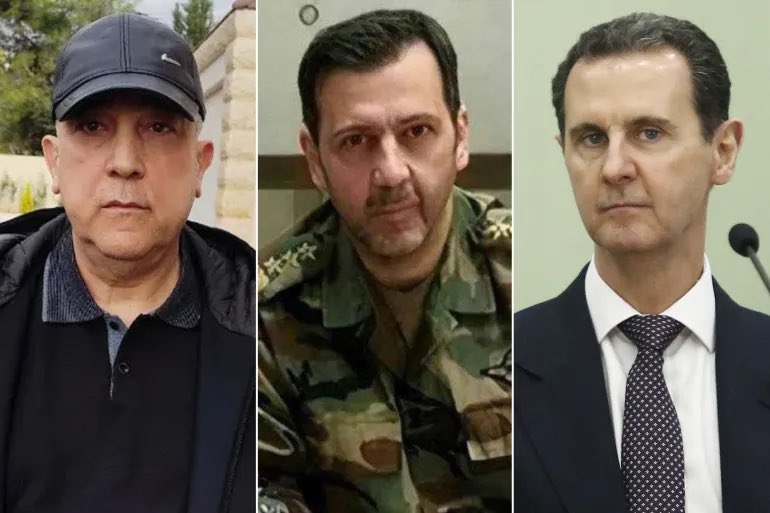
Image: from Fared Al Mahlool | فريد المحلول X @FARED_ALHOR
By Open Chronicle with agencies
A Syrian court has sentenced former President Bashar al Assad, his younger brother Maher al Assad and their cousin Atef Najib to death after convicting them over crimes committed during Syria’s long civil war, marking an extraordinary moment in the country’s attempt to confront the legacy of the former regime.
The Fourth Criminal Court in Damascus delivered the verdicts on Tuesday, August 11, sentencing Bashar and Maher al-Assad in absentia.
Najib, a former senior security official whose actions in the southern province of Daraa became closely associated with the beginning of the 2011 uprising, was present in court when the sentence was announced.
The verdicts represent the first sentences against Assad and members of his immediate circle since the collapse of the family’s decades-long rule.
Syria’s ex-president Bashar al-Assad, his brother Maher al-Assad and cousin Atef Najib have been sentenced to death after a court in Damascus convicted them of crimes against humanity during the country’s nearly 14-year civil war.
Al Jazeera’s @Mohammadfff_ has the latest. pic.twitter.com/ke5ljgmCc4
— Al Jazeera English (@AJEnglish) August 11, 2026
Assad convicted over war crimes and crimes against humanity
The court found Bashar al Assad responsible for using Syrian state institutions to commit war crimes and crimes against humanity during the conflict.
Judge Fakhareddine al Aryan announced the ruling during proceedings broadcast on Syrian state television.
The judgment represents a historic reversal for a man who ruled Syria for more than two decades and whose government survived years of rebellion before ultimately losing power.
Assad succeeded his father, Hafez al Assad, as president in 2000.
The family’s political dominance of Syria stretched across more than five decades before the former government collapsed in December 2024.
Bashar al Assad subsequently fled Syria and has remained outside the country, making the sentence largely symbolic unless he is eventually returned to Syrian jurisdiction.
Maher al Assad also sentenced
The court also imposed a death sentence on Maher al Assad, Bashar’s younger brother and one of the most powerful military figures associated with the former government.
Maher played a prominent role in Syria’s security establishment and commanded the elite Fourth Armoured Division.
The unit became one of the regime’s most important military formations during the civil war and was repeatedly associated with operations against opposition-controlled areas.
Like Bashar, Maher was not present for the proceedings and was convicted in absentia.
The prosecution of the brothers therefore represents more than a judgment against individual officials. It is also an attempt by Syria’s new authorities to establish legal responsibility at the highest levels of the former political and military system.
Atef Najib and the origins of the Syrian uprising
The conviction of Atef Najib carries particular historical significance.
Najib, a cousin of Bashar al-Assad, served as a senior security official in Daraa when anti-government protests began there in 2011.
Daraa is widely regarded as the birthplace of the Syrian uprising.
The detention and alleged torture of teenagers accused of writing anti-government graffiti helped trigger demonstrations in the city.
Security forces responded with a violent crackdown.
Rather than suppressing the unrest, the response helped spread protests across Syria.
What began as demonstrations demanding political change gradually developed into an armed uprising and eventually a devastating civil war involving the Syrian government, opposition organisations, jihadist movements, Kurdish forces and numerous foreign powers.
Najib was convicted over his role in the crackdown that helped ignite that wider confrontation.
Unlike the Assad brothers, he appeared physically before the court.
He stood inside a courtroom cage wearing a prison uniform as the judge announced the sentence.
The court said Najib has the right to appeal.
A conflict that transformed Syria
The Syrian conflict became one of the most destructive wars of the twenty-first century.
Around half a million people are estimated to have been killed during approximately 14 years of conflict, while millions more were displaced inside Syria or became refugees abroad.
Entire cities and communities were devastated.
The war also became an international confrontation.
Russia and Iran intervened in support of Assad’s government, while the United States, Turkey, Gulf states and other countries became involved to varying degrees in the conflict and its numerous factions.
The rise of Islamic State transformed Syria and neighbouring Iraq into the centre of an international campaign against the extremist organisation.
Russia’s military intervention beginning in 2015 became particularly important to Assad’s survival, providing air power and military assistance that helped government forces recover significant territory.
For years, Assad appeared to have survived the uprising.
That assumption ultimately proved wrong.
The fall of the Assad government
The collapse of Assad’s government in December 2024 fundamentally changed Syria’s political landscape.
The fall of Damascus ended more than five decades of Assad family rule and opened an uncertain transition for a country deeply fractured by war.
It also created the possibility of prosecuting former government officials inside Syria.
Since the collapse of the former regime, Syrian authorities have arrested several people suspected of involvement in serious abuses committed during the conflict.
The trials of Bashar and Maher al-Assad began in April 2026 in their absence, while Najib was already in custody.
The August verdict therefore represents the most politically significant prosecution yet undertaken against the former leadership.
Justice after decades of repression
Outside the courthouse in Damascus, Syrians gathered to hear the verdict.
For families of people killed, detained or displaced during the conflict, the proceedings carried enormous symbolic significance.
Adnan al Masalmeh, an attorney representing families of Najib’s victims, described the verdict as a moment of justice for Syrians who had suffered under the former regime.
The emotional response reflects the scale of unresolved trauma created by the conflict.
Thousands of families continue seeking information about relatives who disappeared into Syria’s detention system.
Mass graves, former prisons and government archives have become central to attempts to understand the scale of abuses committed during the war.
Accountability is therefore likely to remain one of the defining questions of Syria’s post-Assad era.
Questions over the death penalty and due process
The verdicts nevertheless raise difficult legal questions.
International human rights organisations have welcomed efforts to investigate and prosecute serious crimes committed during the Syrian conflict, but they have also stressed that proceedings must meet international standards of fairness.
The use of the death penalty is particularly controversial.
Syria continues to retain capital punishment.
Human rights organisations generally oppose the death penalty even for individuals convicted of exceptionally serious crimes.
Trials conducted in absentia also create additional questions concerning due process and the ability of defendants to participate in their defence.
The challenge for Syria’s transitional justice system will therefore be to demonstrate that accountability for crimes committed by the former regime is based on credible judicial procedures rather than political retaliation.
Syria’s wider accountability challenge
The Assad verdict also highlights a much larger problem.
Crimes during the Syrian conflict were committed by numerous actors.
Government forces and intelligence services have faced extensive allegations involving torture, enforced disappearance, indiscriminate attacks and other serious violations.
But opposition armed groups, jihadist organisations and other forces have also been accused of abuses.
If Syria’s new authorities want to establish a durable system of transitional justice, accountability may eventually have to extend beyond officials connected with the former government.
That will be politically difficult.
Yet the legitimacy of the new judicial system could depend partly on whether it demonstrates that serious crimes are investigated regardless of the identity or affiliation of the perpetrators.
Assad remains beyond Syria’s reach
The immediate practical consequence of Bashar al-Assad’s sentence remains limited because the former president is outside Syrian custody.
A death sentence issued in Damascus cannot be implemented unless Assad is returned to the country.
His continued presence abroad therefore transforms the verdict into both a judicial decision and an international political question.
Whether he will ever stand physically before a Syrian court remains uncertain.
For the moment, the significance of the judgment lies elsewhere.
For decades, Bashar al-Assad occupied the highest position in a state whose security institutions appeared virtually untouchable.
Now a Syrian court has formally convicted the former president of crimes committed through that system.
A landmark moment for post-Assad Syria
The August 11 verdict will almost certainly become one of the defining events of Syria’s political transition.
For supporters of the proceedings, it represents long-awaited accountability for a government accused of widespread atrocities during one of the modern Middle East’s most devastating conflicts.
For Syria’s new authorities, however, the judgment also creates a test.
Punishing former leaders is only one element of transitional justice.
The country must also establish credible courts, investigate disappearances, identify victims, examine mass graves, preserve evidence and determine responsibility for crimes committed by different sides during years of warfare.
Rebuilding trust in institutions may prove as difficult as rebuilding Syria’s destroyed infrastructure.
The sentencing of Bashar al-Assad, Maher al-Assad and Atef Najib therefore closes one chapter while opening another.
The Assad family’s rule is over.
The struggle to establish how Syria remembers, investigates and judges the crimes of its war has only begun.