
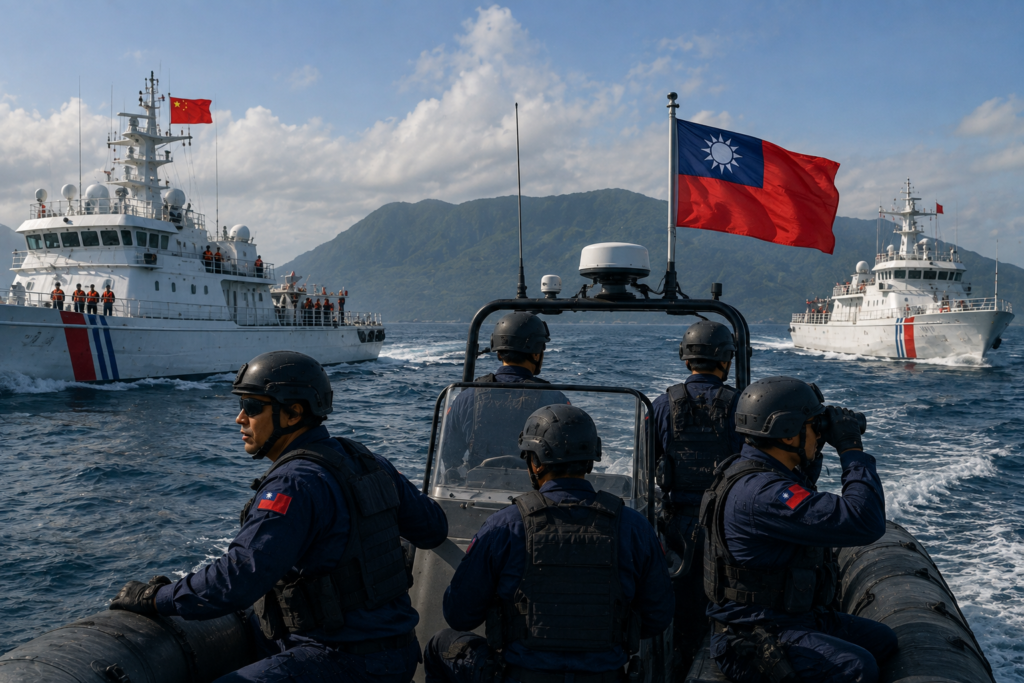
Image Credits: US Trains Taiwan Coast Guard as China Expands Maritime Patrols Around the Island. AI-generated illustration created by Open Chronicle using ChatGPT (OpenAI). August 2026. This image is illustrative and does not depict a real-world scene.
By Open Chronicle Defence with agencies
The United States is training Taiwan’s coast guard in maritime patrol and law enforcement operations as Chinese coast guard and military activity around the island continues to expand, adding another layer to the increasingly complex security competition across the Taiwan Strait and western Pacific.
Taiwan confirmed that the latest training programme runs from August 10 to August 21 and focuses on small craft operations, coordination between teams and maritime patrol techniques.
The programme comes as Beijing increases the presence of coast guard ships, naval vessels and military aircraft around Taiwan, including activity in waters east of the island that Taipei has described as provocative.
Although cooperation between the American and Taiwanese coast guards is not new, the latest training is notable because such activities have traditionally received relatively little publicity.
Training for increasingly complex waters
Taiwan’s Coast Guard Administration said the programme is intended to strengthen its maritime law enforcement capabilities when operating in complex environments.
The training includes small craft operations, team coordination and maritime patrols.
Taiwanese authorities did not provide extensive operational details, reflecting the political sensitivity surrounding security cooperation between Taipei and Washington.
But the broader purpose is clear.
Taiwan increasingly faces maritime pressure that exists somewhere between traditional civilian law enforcement and conventional military operations.
China’s coast guard plays a central role in that strategy.
Unlike a conventional naval deployment, coast guard operations can allow Beijing to assert jurisdiction and maintain pressure without necessarily crossing immediately into overt military confrontation.
That makes Taiwan’s own coast guard strategically important.
US and Taiwan cooperation dates to 2021
Washington and Taipei signed a memorandum of understanding in 2021 intended to strengthen cooperation between their respective coast guards.
The arrangement created a framework for greater collaboration on maritime issues, although joint activities have generally attracted less attention than American military support for Taiwan.
That may now be changing.
The American Institute in Taiwan, which functions as Washington’s de facto embassy in the absence of formal diplomatic relations, published an undated photograph in July showing a U.S. Coast Guard vessel sailing alongside a Taiwanese coast guard ship.
The image provided a rare public indication of cooperation at sea.
The latest training programme makes that relationship more visible.
China’s coast guard presence is expanding
The development comes against a rapidly changing maritime environment around Taiwan.
China regards Taiwan as part of its territory and claims jurisdiction over surrounding waters, a position rejected by Taipei.
Beijing has significantly increased military and coast guard activity near the island in recent years.
Chinese fighter aircraft, warships and other vessels now operate around Taiwan with remarkable frequency.
Taiwan’s defence authorities have consequently been forced to monitor almost continuous activity around the island.
The coast guard dimension adds another challenge.
Chinese coast guard vessels can conduct patrols and law enforcement-style operations while reinforcing Beijing’s territorial claims without deploying naval combatants for every mission.
Chinese patrols move east of Taiwan
One recent development has caused particular concern in Taipei.
Chinese ships began patrolling an area of the western Pacific near Taiwan’s east coast in June, according to the report.
Taiwan described the move as provocative and characterised it as “expansionism in disguise.”
The geography matters.
Most discussion of a potential Taiwan conflict naturally concentrates on the Taiwan Strait, separating the island from mainland China.
Taiwan’s eastern coastline faces the Pacific.
Those waters could become strategically important during a crisis because they provide access toward Japan, the Philippines and the wider Pacific.
They could also become important routes for external support reaching Taiwan.
A sustained Chinese maritime presence east of the island therefore carries implications beyond ordinary coast guard patrols.
The coast guard could play a major role in a Taiwan crisis
The growing focus on coast guards reflects the unusual nature of the confrontation surrounding Taiwan.
Not every scenario begins with missiles or an amphibious invasion.
Security analysts have long examined the possibility of Beijing applying escalating pressure through maritime inspections, exclusion zones, quarantine measures or blockade like operations.
China’s coast guard could become particularly important in such scenarios.
Beijing might portray certain operations as domestic law enforcement rather than military action because it considers Taiwan Chinese territory.
That could create difficult decisions for Taiwan and its international partners.
Responding with military force to coast guard vessels could escalate a confrontation.
Failing to respond could allow Beijing to gradually establish new operational realities around the island.
The grey zone challenge
This is commonly described as grey zone competition.
The concept refers to coercive activities designed to achieve strategic objectives while remaining below the threshold of conventional war.
Coast guard patrols are particularly useful for such operations because the vessels involved are government assets but are not necessarily naval warships.
China has employed similar methods in other contested maritime areas.
Persistent patrols can gradually establish presence, challenge rival claims, and force another country to devote resources to monitoring and responding.
For Taiwan, that creates a problem of endurance.
Every Chinese patrol may require Taiwanese vessels, personnel and surveillance resources to monitor it.
Over time, the cumulative pressure becomes strategically significant.
Why small craft training matters
Against that background, seemingly routine training in small boat operations assumes greater importance.
Taiwan cannot respond to every maritime incident with a major coast guard cutter or naval vessel.
Smaller craft provide flexibility for patrol, interception, inspection and coastal security missions.
Training crews to coordinate effectively becomes especially important when multiple incidents occur simultaneously.
A crisis could involve civilian ships, fishing vessels, coast guard cutters, military aircraft and naval vessels operating in the same area.
Determining what is happening and responding proportionately could become extremely difficult.
The ability to coordinate teams quickly may therefore matter as much as the capabilities of individual vessels.
Maritime law enforcement is becoming part of deterrence
The distinction between law enforcement and national defence is increasingly blurred around Taiwan.
A coast guard’s traditional responsibilities include policing territorial waters, combating smuggling, conducting search and rescue missions and enforcing maritime regulations.
Those missions remain important.
But Taiwan’s coast guard also operates directly alongside one of the world’s largest and most powerful maritime security organisations.
China’s coast guard has grown into an enormous force equipped with some exceptionally large vessels.
Taiwan consequently needs its coast guard to perform both ordinary law enforcement duties and a wider national security role.
American training can contribute to that transformation without necessarily turning the organisation into another navy.
Washington walks a careful diplomatic line
The United States does not maintain formal diplomatic relations with Taiwan.
Washington nevertheless maintains extensive unofficial ties with Taipei and provides defensive arms under the framework established by American law.
Successive U.S. administrations have also emphasised the importance of peace and stability across the Taiwan Strait.
Coast guard cooperation provides another instrument within that relationship.
It is significant precisely because it occupies a space below conventional military cooperation.
Training focused on maritime law enforcement can improve Taiwan’s ability to resist coercive activity while avoiding the appearance of creating a formal military alliance.
That distinction is unlikely to satisfy Beijing.
China has consistently opposed official and military contacts between Washington and Taipei.
Taiwan faces pressure from air and sea
The coast guard training cannot be separated from China’s wider military activity.
Chinese aircraft and warships operate around Taiwan on an almost daily basis, according to the report.
These operations serve several purposes.
They allow Chinese forces to train in the environment surrounding Taiwan.
They test Taiwanese surveillance and response procedures.
They provide Beijing with information about Taiwan’s reactions.
They also create political and psychological pressure.
Repeated operations can gradually normalise a Chinese military presence close to the island.
That creates another strategic problem for Taipei: distinguishing routine pressure from preparations for something more serious.
The east coast could become strategically decisive
Chinese operations east of Taiwan deserve particular attention for another reason.
Taiwan’s eastern side has traditionally been considered less exposed than its western coastline.
The island’s mountainous geography also provides a degree of protection for infrastructure and military facilities in the east.
But expanding Chinese naval and coast guard activity into the western Pacific complicates that assumption.
During a major crisis, Chinese forces operating east of Taiwan could potentially help isolate the island from outside assistance.
They could also complicate operations by American and allied forces approaching from the Pacific.
Routine coast guard patrols should not automatically be interpreted as preparation for such a scenario.
But they can help China develop operational familiarity with waters that would become strategically important during a conflict.
Coast guards are becoming strategic forces
The Taiwan situation reflects a broader transformation in maritime security.
Coast guards were once viewed primarily as policing organisations.
Increasingly, they are becoming instruments of national strategy.
They enforce territorial claims.
They maintain presence in disputed waters.
They escort fishing fleets.
They monitor foreign vessels.
And they can operate in confrontations where deploying a navy might be considered excessively escalatory.
That makes coast guard capability an increasingly important component of deterrence in the Indo Pacific.
For Taiwan, strengthening that capability provides another layer between ordinary civilian maritime activity and military escalation.
A competition fought below the threshold of war
The latest U.S. training programme is relatively modest compared with fighter aircraft sales, missile systems or major military exercises.
Its strategic importance lies elsewhere.
The most frequent confrontation around Taiwan is not currently an open war.
It is a persistent contest involving ships, aircraft, patrol routes, jurisdiction, surveillance and presence.
China is attempting to demonstrate that it can operate around Taiwan whenever it chooses.
Taiwan is attempting to show that it can monitor and resist that pressure.
Washington is helping Taipei develop the capabilities required to do so.
The August training programme is therefore another indication that preparations surrounding Taiwan increasingly extend beyond the conventional battlefield.
If the struggle over the island continues to unfold through grey zone pressure, maritime patrols and competing claims of jurisdiction, coast guards could become some of the most important forces involved.