
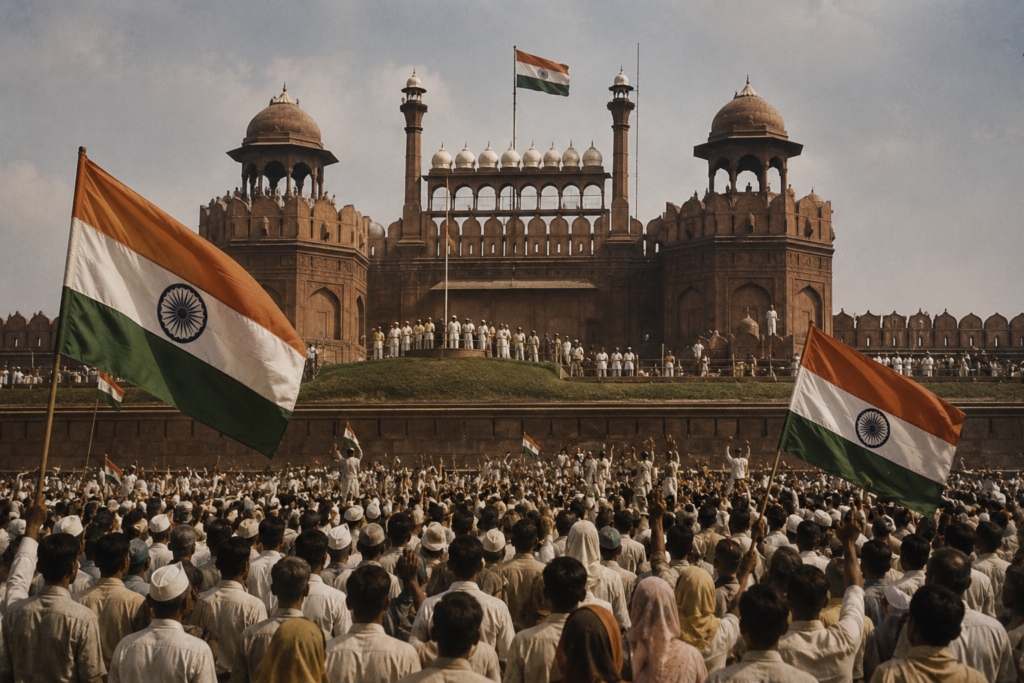
Image Credits: Today in History, August 15, 1947: India Gains Independence and the British Raj Comes to an End. AI-generated illustration created by Open Chronicle using ChatGPT (OpenAI). August 2026. This image is illustrative and does not depict a real-world scene.
By Open Chronicle History Desk
At midnight on August 15, 1947, one of the most consequential political transformations of the twentieth century became reality. After generations of colonial rule and decades of organised resistance, India became an independent nation.
In New Delhi, Jawaharlal Nehru addressed the Constituent Assembly with a speech that would become inseparable from the moment of independence. Across the country, celebrations marked the end of British rule and the beginning of a new political era.
Yet independence arrived amid profound upheaval.
The British Indian Empire had been divided into two independent dominions, India and Pakistan. The partition triggered one of the largest migrations in modern history, accompanied by communal violence that killed hundreds of thousands and displaced millions.
August 15 therefore occupies a complex place in history. It represents liberation from colonial rule and the emergence of the world’s largest democracy, but it also belongs to the traumatic history of partition.
The British Empire in India
British involvement in the Indian subcontinent had begun centuries before independence.
The English East India Company gradually transformed itself from a commercial enterprise into a territorial power during the eighteenth century. Following victories such as the Battle of Plassey in 1757, the company expanded its political and military influence across large parts of India.
By the nineteenth century, extensive territories were either directly controlled by the company or governed by Indian rulers operating within a system dominated by British power.
The Indian Rebellion of 1857 fundamentally changed that arrangement.
Beginning among soldiers of the East India Company’s army and spreading across parts of northern and central India, the rebellion became the greatest challenge yet to British authority on the subcontinent.
After suppressing it, Britain abolished company rule.
In 1858, India came directly under the British Crown.
The era of the British Raj had begun.
The Rise of Indian Nationalism
During the following decades, political movements demanding greater Indian participation in government developed steadily.
The Indian National Congress was founded in 1885. Initially, many of its leaders sought constitutional reform rather than complete independence.
Over time, however, demands became more ambitious.
The experience of the First World War accelerated political change. More than a million Indian soldiers and labourers served overseas in support of the British war effort, while political leaders expected meaningful reforms in return.
Instead, tensions increased.
The Rowlatt Acts of 1919 allowed colonial authorities to detain suspected political activists without trial and generated widespread opposition.
Then came one of the defining episodes in the history of British India.
The Amritsar Massacre
On April 13, 1919, thousands of people gathered at Jallianwala Bagh in Amritsar.
British troops commanded by Brigadier General Reginald Dyer entered the area and opened fire on the crowd.
Hundreds were killed.
The massacre shocked India and severely damaged the legitimacy of British rule.
For many Indians who had previously believed political reform could be achieved gradually within the imperial system, Amritsar represented a turning point.
The independence movement entered a new phase.
Gandhi and Mass Resistance
No individual became more closely associated with India’s independence struggle than Mohandas Karamchand Gandhi.
After developing his philosophy of nonviolent resistance while living in South Africa, Gandhi returned to India in 1915.
He increasingly transformed Indian nationalism into a mass political movement.
Gandhi promoted satyagraha, resistance based on nonviolence and civil disobedience.
His campaigns mobilised millions of ordinary Indians.
One of the most famous campaigns came in 1930.
British colonial law maintained a monopoly over the production and sale of salt. Gandhi chose the seemingly simple commodity as the focus of a national campaign against colonial authority.
He walked hundreds of kilometres from his ashram to the coastal village of Dandi.
Thousands joined him along the route.
When Gandhi reached the coast and symbolically produced salt in defiance of British law, the Salt March became an international symbol of resistance.
The independence struggle had demonstrated that British authority could be challenged not only through political institutions, but through organised mass participation.
Nehru and the Vision of Independent India
Alongside Gandhi emerged a generation of political leaders who would shape the future Indian state.
Among the most important was Jawaharlal Nehru.
Educated in Britain and deeply influenced by nationalism, socialism and internationalism, Nehru became a leading figure within the Indian National Congress.
He advocated complete independence and imagined India as a modern, secular and democratic state.
Gandhi and Nehru did not always agree on India’s political or economic future, but together they became central figures in the movement against British rule.
Another political force was also becoming increasingly important.
The All India Muslim League, led by Muhammad Ali Jinnah, increasingly argued that Muslims required political safeguards that could not necessarily be guaranteed within a Hindu majority independent India.
That dispute would ultimately shape the circumstances in which independence arrived.
The Second World War Changes Everything
The Second World War placed enormous pressure on the British Empire.
In 1939, Britain declared India to be at war with Germany without consulting elected Indian political leaders.
The decision intensified nationalist opposition.
At the same time, Japan’s rapid expansion across Southeast Asia brought the war directly toward India’s borders.
In 1942, the Indian National Congress launched the Quit India Movement, demanding an end to British rule.
Gandhi, Nehru, and other senior Congress leaders were arrested.
Although Britain maintained control during the war, the political environment had changed fundamentally.
Britain emerged victorious in 1945, but economically exhausted.
Maintaining the empire was becoming increasingly difficult.
The question was no longer simply whether India would become independent.
The question was how independence would happen.
The Problem of Partition
Relations between the Indian National Congress and the Muslim League became increasingly difficult during the final years of British rule.
Jinnah argued that Muslims constituted a distinct political nation and supported the creation of Pakistan.
Congress leaders generally preferred a united India, although negotiations over constitutional arrangements repeatedly failed.
Communal tensions intensified.
In August 1946, violence in Calcutta killed thousands of people. Further clashes spread to other regions.
British Prime Minister Clement Attlee’s government concluded that power should be transferred rapidly.
Lord Louis Mountbatten arrived in India in March 1947 as the final Viceroy.
The timetable accelerated dramatically.
Rather than attempting to maintain a single political state, British India would be partitioned.
Two new dominions would emerge.
India and Pakistan.
Drawing a Border
The responsibility for determining the boundary between the new states was given to British lawyer Cyril Radcliffe.
He had never previously visited India.
Radcliffe was given only weeks to determine the borders dividing Punjab in the northwest and Bengal in the east.
The task was extraordinarily complex.
Districts contained mixed populations of Hindus, Muslims and Sikhs. Economic networks, railway lines, irrigation systems and communities crossed the boundaries that political leaders were attempting to create.
The resulting boundary became known as the Radcliffe Line.
Pakistan celebrated independence on August 14, 1947.
India followed on August 15.
But the final boundary decisions were not officially published until after independence.
Millions of people suddenly found themselves on what they regarded as the wrong side of an international frontier.
A Tryst with Destiny
As midnight approached on August 14, India’s Constituent Assembly gathered in New Delhi.
Jawaharlal Nehru addressed the chamber.
His speech, remembered as Tryst with Destiny, became one of the defining political addresses of the twentieth century.
Nehru spoke of a moment when India would move from the old world into the new and when a nation long suppressed would find its voice.
At midnight, British rule ended.
India became independent.
Nehru became the country’s first Prime Minister.
The following day brought ceremonies, crowds and celebrations across New Delhi and throughout the new nation.
The Indian national flag was raised.
After nearly two centuries of expanding British domination, the Raj was over.
Independence and Partition
For millions, however, independence was accompanied not by celebration but by fear.
Partition triggered a vast movement of populations.
Muslims travelled toward Pakistan.
Hindus and Sikhs moved toward India.
Entire communities were uprooted.
Trains carried refugees across the new borders. Some arrived, filled with people fleeing violence. Others became targets of massacres.
Punjab experienced particularly intense bloodshed.
Communal violence spread through towns and villages as political uncertainty, fear, and revenge overwhelmed local communities.
Estimates vary, but roughly 14 million people may have crossed the new borders during the upheaval.
Hundreds of thousands were killed, with some estimates considerably higher.
Women were subjected to widespread abduction and sexual violence.
Families disappeared.
Communities that had existed alongside one another for generations were permanently transformed.
Partition became one of the largest and most traumatic forced migrations of the twentieth century.
Gandhi Away from the Celebrations
One of the most striking aspects of independence was Gandhi’s absence from the official celebrations in New Delhi.
While political leaders marked the creation of the new state, Gandhi was in Calcutta attempting to stop communal violence.
For the man whose campaigns had done so much to mobilise the independence movement, the division of India represented a profound disappointment.
He had hoped that Hindus and Muslims could live together within an independent country.
Instead, independence arrived through partition.
Less than six months later, on January 30, 1948, Gandhi was assassinated in New Delhi by Nathuram Godse, a Hindu nationalist who opposed Gandhi’s approach toward Muslims and Pakistan.
The killing shocked the new nation.
Building the Republic
Independence was only the beginning of India’s political transformation.
The country inherited enormous challenges.
Hundreds of princely states had to be integrated into the new political system.
Millions of refugees required assistance.
Religious tensions remained dangerous.
Poverty was widespread.
India also needed to create political institutions capable of governing an extraordinarily large and diverse population.
Under Nehru and other leaders, the country adopted a parliamentary democratic system.
A Constituent Assembly prepared a new constitution.
On January 26, 1950, the Constitution of India came into effect.
The Dominion of India became the Republic of India.
Universal adult suffrage provided voting rights across a society marked by enormous differences of language, religion, caste, wealth and education.
The scale of the democratic experiment was unprecedented.
The End of an Empire
Indian independence also had consequences far beyond South Asia.
Britain’s withdrawal demonstrated that European colonial empires were no longer politically secure.
Across Asia and Africa, nationalist movements were demanding sovereignty.
Within decades, much of the European colonial system would disappear.
India, once described as the most important possession of the British Empire, became one of the leading voices of the postcolonial world.
Under Nehru, it played a major role in the emergence of the Non Aligned Movement and sought to maintain independence from both the Western and Soviet blocs during the Cold War.
The global balance of power was changing.
The Legacy of August 15
August 15 is celebrated every year in India as Independence Day.
The Prime Minister traditionally addresses the nation from the Red Fort in Delhi, and the Indian flag is raised in ceremonies across the country.
Yet the history of 1947 cannot be understood through independence alone.
The creation of India and Pakistan produced two intertwined legacies.
One was liberation from colonial rule.
The other was partition.
The political consequences remain visible today, particularly in the long and difficult relationship between India and Pakistan and in disputes rooted in the territorial settlement of 1947.
For Britain, Indian independence represented a decisive stage in the dismantling of its empire.
For the wider world, it became one of the defining moments of twentieth century decolonisation.
For India, it represented the recovery of political sovereignty after generations of foreign rule and the beginning of an ambitious experiment in democratic government.
At midnight on August 15, 1947, an empire receded and a new nation entered history.
The celebrations were immense.
So were the human costs.
Together, independence and partition transformed South Asia and helped reshape the modern world.