
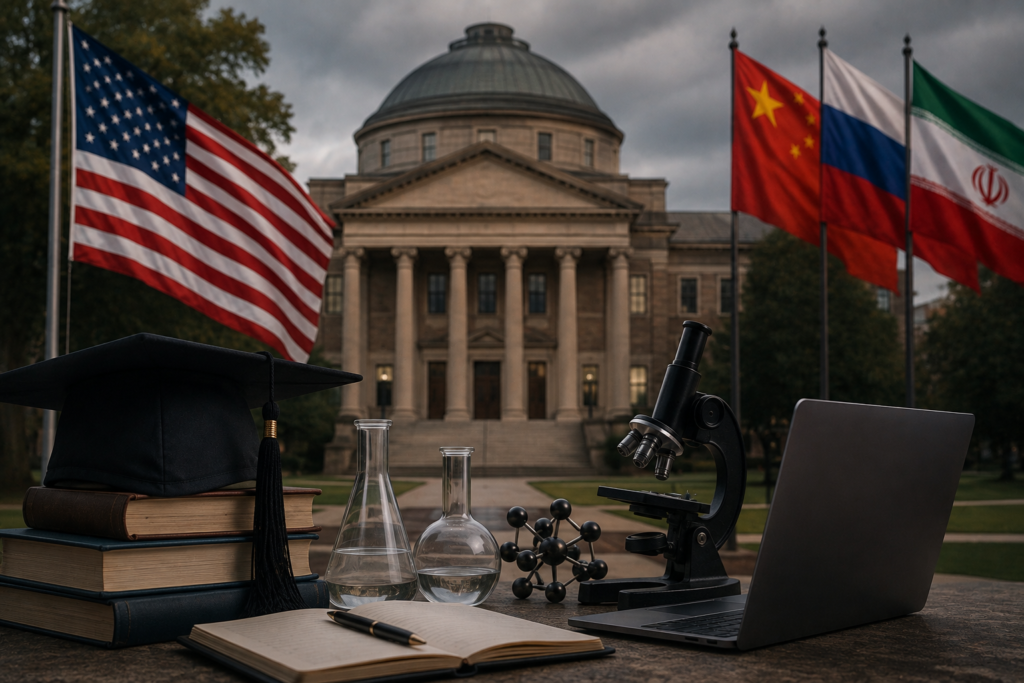
Image Credits: Pentagon Orders 30 US Universities to Audit Research Ties With China, Russia and Iran. AI-generated illustration created by Open Chronicle using ChatGPT (OpenAI). August 2026. This image is illustrative and does not depict a real-world scene.
By Open Chronicle with agencies
The Pentagon has ordered 30 American universities to conduct immediate reviews of their academic and research relationships with institutions in China, Russia and Iran, escalating Washington’s campaign to prevent sensitive US technology and taxpayer-funded research from reaching strategic competitors.
The US Department of Defense said the universities must examine academic, financial and research collaborations involving foreign entities considered potential national security concerns. The review covers connections with a list of approximately 130 research institutions in China, Russia and Iran, including civilian universities.
The institutions have been instructed to identify potential exposure of sensitive or export-controlled research and establish mitigation measures. Where partnerships are considered problematic, universities could be required to terminate them.
The findings must be submitted to the Pentagon by August 31.
Thirty universities face scrutiny
The Defense Department did not publicly identify the universities receiving the notices.
However, a US official provided a list to Fox News that includes some of America’s most prestigious research institutions.
Among those reportedly under review are Harvard University, the Massachusetts Institute of Technology, Cornell University, Duke University, Johns Hopkins University, Georgetown University and New York University.
Major public research institutions are also included, among them the University of California campuses at Berkeley, Los Angeles and San Diego, the University of Texas at Austin, Penn State University, the University of North Carolina at Chapel Hill and the University of Illinois Urbana-Champaign.
The scale of the review demonstrates how concerns over foreign access to American research are moving beyond individual investigations and becoming part of a broader national security strategy.
Pentagon focuses on 130 foreign institutions
At the centre of the initiative is a list established under Section 1286 of the Fiscal Year 2019 National Defense Authorization Act.
The Pentagon describes the organisations covered by the review as foreign entities of concern. Institutions associated with rebranded Confucius Institutes are also included.
According to the department, approximately 130 research organisations based in China, Russia and Iran fall within the scope of the review.
Importantly, the list is not limited to military laboratories.
Civilian universities and research organisations can also become relevant when they maintain connections with defence establishments, conduct dual use research or participate in technological programmes that could ultimately contribute to military capabilities.
This is one of the central difficulties surrounding modern research security. Technologies developed for civilian purposes can frequently have military applications.
Artificial intelligence, advanced materials, aerospace engineering, quantum technologies, robotics and semiconductor research are obvious examples.
Universities ordered to conduct comprehensive audits
The Pentagon wants institutions to go beyond simply identifying existing partnerships.
Universities have been instructed to conduct what the department describes as comprehensive audits of their foreign collaborations.
Those reviews are expected to assess whether sensitive research, intellectual property or technologies subject to export controls could have been exposed through international partnerships.
Institutions must then develop mitigation plans.
In some cases, that could mean strengthening oversight or restricting access to particular projects. In others, the Pentagon says problematic partnerships should be terminated.
The policy therefore places significant responsibility on universities themselves to understand not only who their researchers collaborate with, but also the institutional relationships surrounding their foreign partners.
Washington fears technology transfer
The Pentagon says the initiative is intended to protect American taxpayer-funded research from unauthorised technology transfer, intellectual property theft and exploitation by foreign adversaries.
That concern has become increasingly important as technological competition between the United States and China intensifies.
American universities occupy a central position in global scientific research.
Their laboratories frequently work at the frontier of artificial intelligence, biotechnology, computing, aerospace engineering and other strategically important fields.
International collaboration has historically been one of the strengths of that system.
Researchers move between universities, publish findings internationally and participate in projects involving institutions across several countries.
But the same openness that accelerates scientific development can create vulnerabilities when research has potential military applications.
China is at the centre of Washington’s concerns
Although the Pentagon initiative includes Russia and Iran, China occupies a particularly important position in America’s research security debate.
Washington increasingly views technological competition with Beijing as one of the defining elements of the long-term strategic rivalry between the two powers.
The Pentagon has been examining whether research originating in the United States could ultimately strengthen Chinese military capabilities.
The Jerusalem Post noted previous reporting concerning Chinese military researchers allegedly using outputs from American artificial intelligence models to help train domestic systems.
Such concerns illustrate how difficult technological controls have become.
Traditional military exports can be relatively easy to identify. A fighter aircraft, missile or radar system is clearly a defence product.
Artificial intelligence research is fundamentally different.
Algorithms, datasets, software tools and scientific papers can have applications across civilian and military sectors simultaneously.
Harvard again comes under scrutiny
Harvard University is among the institutions reportedly receiving Pentagon attention.
The university has already faced investigations concerning research partnerships with Chinese institutions.
According to allegations cited in the report, Harvard-affiliated researchers collaborated on academic work with researchers connected to institutions including China’s National University of Defense Technology, Beihang University and Nanjing University of Science and Technology.
Those institutions have attracted American scrutiny because of their connections with China’s defence and military research ecosystem.
Harvard has also faced questions regarding foreign funding.
The report cites allegations that the university received more than $600 million from China under the federal foreign gift disclosure system.
The existence of foreign funding does not by itself demonstrate improper activity. The central question for investigators is whether universities possess sufficient systems to identify potentially sensitive partnerships and prevent restricted research from being transferred improperly.
Research security becomes part of national defence
The Pentagon’s approach reflects a broader transformation in how the United States defines national security.
Military power increasingly depends on technologies that originate partly outside traditional defence companies.
Commercial companies lead important developments in artificial intelligence.
Universities conduct fundamental research in quantum computing and advanced materials.
Private laboratories develop biotechnology.
Civilian satellite companies provide capabilities with enormous military relevance.
The boundary between civilian technological innovation and military capability has consequently become increasingly blurred.
Protecting research ecosystems has therefore become part of defence policy.
Universities remain crucial Pentagon partners
The Defense Department is not attempting to separate itself from academia.
Quite the opposite.
American universities conduct substantial amounts of Pentagon-supported research and remain important contributors to US technological superiority.
Assistant Secretary for Science and Technology Joseph Jewell emphasised that universities are critical partners in a wide range of defence research programmes. Because of that importance, he argued, research investments must be protected against foreign exploitation.
That creates a delicate policy challenge.
Washington wants universities to maintain the openness and international collaboration that make American research institutions successful.
At the same time, it wants to prevent strategic competitors from exploiting those networks.
Too little oversight could create security vulnerabilities.
Too much restriction could damage the international research environment that has historically helped make American universities globally competitive.
Congress is involved in the effort
The Pentagon says it is coordinating the initiative with several congressional bodies.
These include the House and Senate Armed Services Committees, the House and Senate Appropriations Committees and the House Select Committee on the Chinese Communist Party.
That congressional involvement suggests the issue extends beyond a single departmental review.
Research security has increasingly attracted bipartisan attention in Washington, particularly concerning China.
Lawmakers have examined university funding, scientific partnerships, technology transfers and foreign recruitment programmes as part of the broader competition with Beijing.
The involvement of appropriations committees is particularly significant because federal funding provides Washington with considerable leverage over university research practices.
Pentagon funding restrictions are already in effect
Since the beginning of fiscal year 2026, the Pentagon has been prohibited from providing funding for fundamental research involving organisations included on the foreign entities of concern list.
The latest university audits appear designed partly to ensure that those restrictions are being implemented throughout complicated international research networks.
A Pentagon-funded American laboratory, for example, might collaborate with another domestic university that maintains a partnership with an overseas institution.
Determining whether sensitive information could move through such networks requires considerably more scrutiny than simply checking the nationality of individual researchers.
That is why institutional relationships have become increasingly important.
Russia and Iran broaden the security challenge
China may dominate America’s long-term technological competition, but including Russia and Iran demonstrates that Washington sees research security as a broader problem.
Russia possesses extensive expertise in aerospace engineering, nuclear science, missile technology and military research.
Iran has developed increasingly sophisticated missile, drone and defence industries despite decades of international sanctions.
Both countries have incentives to obtain foreign technologies and technical knowledge that could support domestic military programmes.
The Pentagon is therefore examining research relationships through the wider lens of strategic competition rather than focusing exclusively on China.
Academic openness confronts strategic rivalry
The controversy ultimately reflects a fundamental tension facing universities throughout the Western world.
Science develops through collaboration.
National security depends partly on controlling strategically valuable knowledge.
For decades, American universities benefited enormously from international researchers and partnerships. Many of the world’s leading scientists studied or worked in the United States, contributing directly to American innovation.
That system remains one of America’s greatest technological advantages.
But growing geopolitical rivalry means governments increasingly want to know where research travels after it leaves the laboratory.
The challenge is determining where legitimate scientific collaboration ends, and unacceptable security exposure begins.
Universities face an August 31 deadline
The immediate task for the 30 institutions is now clear.
They must examine their foreign academic, financial, and research relationships, identify potentially sensitive exposure, and report their findings to the Defense Department by August 31.
The consequences of those reviews could extend beyond the universities currently involved.
If the Pentagon identifies weaknesses in how institutions monitor foreign partnerships, similar requirements could eventually spread across the wider American research system.
The initiative therefore represents another step in the transformation of universities into an increasingly important front in geopolitical competition.
The contest between the United States and its strategic rivals is no longer confined to military bases, intelligence agencies or defence factories.
It increasingly reaches laboratories, research programmes and university campuses.
For Washington, protecting technological superiority now means understanding not only what America invents, but also who has access to the knowledge behind those inventions.