
By Open Chronicle History Desk
On August 22, 1485, two armies confronted each other in the countryside of Leicestershire in a battle that would change the course of English history.
On one side stood Richard III, King of England, the last monarch of the House of York and the last English king to die in battle.
On the other was Henry Tudor, Earl of Richmond, an exile with a distant and contested claim to the throne who had returned to England determined to seize the crown.
Their confrontation at the Battle of Bosworth Field was the culmination of decades of dynastic conflict traditionally known as the Wars of the Roses.
Richard entered the battle as king.
By the end of the day, he was dead.
Henry Tudor emerged victorious and became Henry VII, founding a dynasty that would rule England for more than a century and produce some of the most famous monarchs in British history.
Bosworth did not completely end the Wars of the Roses. Further rebellions and another major battle would follow.
But August 22, 1485, marked one of the great turning points of English history.
The Plantagenet era was effectively ending.
The age of the Tudors was beginning.
England and the Wars of the Roses
The struggle that brought Richard III and Henry Tudor to Bosworth had roots stretching back generations.
England’s political system had been destabilised by the reign of Henry VI, whose periods of mental incapacity and weak government intensified rivalries among the kingdom’s most powerful aristocratic families.
Two branches of the Plantagenet dynasty emerged at the centre of the conflict.
The House of Lancaster was associated with the red rose.
The House of York became associated with the white rose.
The familiar term “Wars of the Roses” was popularised much later, but it came to describe a series of dynastic conflicts, rebellions and political reversals that dominated English politics during much of the second half of the fifteenth century.
The struggle was not a continuous war between two perfectly organised parties.
Loyalties shifted.
Families changed sides.
Personal rivalries mixed with constitutional disputes and competing claims to the crown.
Kings were made, deposed, restored and killed.
England’s monarchy became dangerously dependent upon military victory.
The Rise of the House of York
Richard, Duke of York, emerged as the principal rival to Henry VI.
Although Richard himself was killed at the Battle of Wakefield in 1460, his sons continued the struggle.
His eldest surviving son became Edward IV.
Edward was a formidable military commander.
After defeating Lancastrian forces at the Battle of Towton in 1461, he established himself as King of England.
Even his reign was interrupted.
In 1470, the powerful Richard Neville, Earl of Warwick, known as the “Kingmaker”, helped restore Henry VI temporarily to the throne.
Edward returned from exile the following year.
He defeated Warwick at Barnet and the Lancastrians at Tewkesbury.
Henry VI subsequently died in the Tower of London.
Edward IV’s position appeared secure.
For more than a decade, England experienced relative political stability.
Then Edward died unexpectedly in April 1483.
He was only forty years old.
His death reopened the struggle for power.
Richard, Duke of Gloucester
Edward IV’s eldest son, Edward V, was only twelve.
Richard, Duke of Gloucester, younger brother of the dead king, was named Lord Protector.
Richard had been one of Edward IV’s most important supporters.
He possessed substantial lands and influence in northern England and had demonstrated military ability during campaigns against Scotland.
Initially, his role appeared to be that of protector for the young king.
Events moved rapidly.
Edward V was brought to London and lodged in the Tower of London, which at the time was both a royal residence and fortress.
His younger brother, Richard, Duke of York, eventually joined him.
Then the legitimacy of Edward IV’s children was challenged.
It was claimed that Edward IV had previously contracted a marriage agreement that rendered his later marriage to Elizabeth Woodville invalid.
Parliament subsequently accepted the argument through the document known as Titulus Regius.
Edward IV’s children were declared illegitimate.
Richard became king.
He was crowned Richard III on July 6, 1483.
The Princes in the Tower
The disappearance of Edward V and his younger brother became one of the most enduring mysteries in English history.
The boys were seen with decreasing frequency inside the Tower during the summer of 1483.
Eventually they disappeared from public view.
Their fate remains uncertain.
They became known to history as the Princes in the Tower.
Richard III has traditionally been accused of ordering their deaths because their existence represented a threat to his throne.
That accusation became central to his later reputation.
Yet no surviving evidence conclusively establishes exactly what happened, when the princes died or who was responsible.
Other individuals have been proposed as possible perpetrators.
The mystery remains unresolved.
Politically, however, the disappearance was disastrous.
Suspicion surrounding Richard’s accession helped alienate sections of the English nobility.
Opposition began to gather around another potential claimant.
His name was Henry Tudor.
Who Was Henry Tudor?
Henry Tudor’s claim to the English throne was complicated.
His mother, Margaret Beaufort, descended from John of Gaunt, Duke of Lancaster and son of Edward III.
The Beaufort family originated from John of Gaunt’s children with Katherine Swynford.
Although the children were later legitimised, their line had historically been excluded from succession to the crown.
Henry’s claim through his mother was therefore distant and politically vulnerable.
His father, Edmund Tudor, provided another important dynastic connection.
The Tudor family was Welsh.
Edmund was the son of Owen Tudor and Catherine of Valois, widow of Henry V.
Henry Tudor therefore possessed connections to the Lancastrian royal tradition, but he was hardly the obvious heir to the throne.
The destruction of other Lancastrian claimants during the Wars of the Roses changed his position.
By the 1480s, he had become one of the most important surviving figures around whom opposition to Yorkist rule could organise.
Years in Exile
Henry spent much of his youth outside England.
After the Yorkist victory at Tewkesbury in 1471, he fled with his uncle Jasper Tudor to Brittany.
For more than a decade he lived in political exile.
His survival became increasingly important.
Edward IV attempted to secure his return, while Henry’s supporters worked to preserve him as a potential Lancastrian claimant.
Richard III’s accession transformed the political situation.
Opponents of the new king began looking toward Henry.
The failed rebellion of the Duke of Buckingham in 1483 demonstrated the existence of serious opposition to Richard.
Henry attempted to participate but was unable to land successfully in England.
The rebellion collapsed.
Buckingham was captured and executed.
Henry survived.
From exile, he made a politically brilliant promise.
Elizabeth of York
Henry pledged that if he became king, he would marry Elizabeth of York, eldest daughter of Edward IV.
The marriage would unite the competing dynastic traditions of Lancaster and York.
It also dramatically strengthened Henry’s political appeal.
Yorkists hostile to Richard III could now support Henry without necessarily abandoning their own dynastic interests.
The proposed marriage created the possibility of reconciliation after decades of conflict.
But Henry first had to win a crown.
And the crown would have to be won in England.
Henry Lands in Wales
In August 1485, Henry sailed from France with a relatively small force consisting of English exiles and foreign troops.
He landed at Mill Bay near Dale in Pembrokeshire, Wales, on August 7.
His Welsh ancestry was politically useful.
Henry presented himself partly through the traditions of his Tudor family and attracted supporters as he advanced through Wales.
He moved eastward toward England.
His army grew as additional supporters joined.
Richard III responded quickly.
The king assembled his forces and prepared to confront the invasion.
The decisive battle would take place in the Midlands.
The Stanley Problem
One of the greatest uncertainties facing both men involved the powerful Stanley family.
Thomas Stanley, Lord Stanley, and his brother Sir William Stanley commanded substantial forces.
Their loyalties were uncertain.
Thomas Stanley was married to Margaret Beaufort.
He was therefore Henry Tudor’s stepfather.
Yet he had served Richard III and held important positions under the king.
Richard understood the danger.
Lord Stanley’s son, George Stanley, Lord Strange, was held as security for his father’s loyalty.
According to later accounts, Richard threatened Strange’s life if Stanley betrayed him.
Still, the Stanley forces remained separate as the two main armies approached one another.
Both Richard and Henry knew that their intervention could determine the outcome.
Bosworth Field
The battle took place on August 22, 1485, near Market Bosworth in Leicestershire.
Modern archaeological investigation has refined understanding of the battlefield’s location, placing much of the fighting around the area of Fenn Lane, rather than precisely where older traditions had sometimes located it.
Richard’s army was larger than Henry’s.
The king also possessed artillery.
His forces were organised into divisions traditionally described as battles.
John Howard, Duke of Norfolk, commanded the vanguard.
Henry Percy, Earl of Northumberland, commanded another substantial force.
Richard controlled the royal reserve.
Henry’s army was smaller and included experienced soldiers who had served on the continent.
Because Henry himself had limited battlefield command experience, much of the tactical leadership was entrusted to John de Vere, Earl of Oxford.
The Stanleys remained apart.
The battle began.
Oxford’s Advance
Oxford’s troops advanced against Norfolk’s forces.
Fighting became intense.
Rather than allowing his army to become dispersed, Oxford reportedly ordered his men to remain closely grouped.
The discipline of Henry’s forces helped prevent Richard’s larger army from overwhelming them.
Norfolk was killed.
Richard’s position began to deteriorate.
Northumberland’s troops did not intervene decisively.
Why remains debated.
Terrain may have limited movement.
Political hesitation may also have played a role.
Whatever the reason, part of Richard’s numerical advantage was not being translated into battlefield power.
The king now faced a dangerous situation.
Then he saw an opportunity.
Richard’s Final Charge
Henry Tudor was positioned away from the main fighting and was moving toward the Stanleys.
Richard recognised that killing Henry could end the battle immediately.
Medieval warfare frequently turned on the fate of individual leaders.
If Henry died, his invasion might collapse regardless of what was happening elsewhere on the battlefield.
Richard made a bold decision.
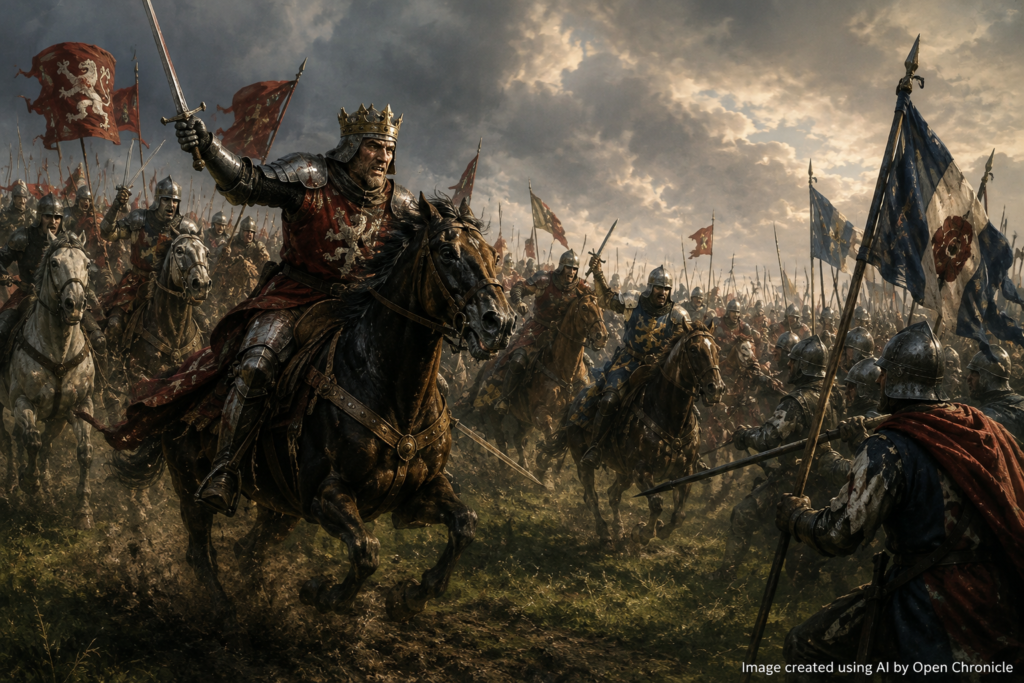
He led a mounted charge directly toward Henry.
It became the most famous moment of the Battle of Bosworth.
Richard and his household knights crashed through Henry’s defenders.
The king reportedly killed Henry’s standard bearer, Sir William Brandon.
He came dangerously close to Henry himself.
For a moment, Richard III may have been only a short distance from killing the man who would become Henry VII.
Then the Stanleys intervened.
The Stanleys Choose Henry
Sir William Stanley’s forces entered the battle on Henry’s side.
Richard’s attack became surrounded.
The king’s horse was apparently lost or became trapped in difficult ground.
Richard continued fighting on foot.
Later Tudor accounts emphasised his courage in these final moments.
Even hostile chroniclers did not portray him simply fleeing the battlefield.
Richard fought until he was killed.
Tradition later attributed to him the declaration:
“Treason! Treason! Treason!”
Whether he actually spoke those words is uncertain.
What is certain is that England’s king died fighting among his enemies.
Richard III was thirty two years old.
He became the last English monarch to die in battle.
“A Horse! A Horse!”
Richard’s final battle became immortalised through literature.
More than a century later, William Shakespeare transformed Bosworth into one of the most famous scenes in English drama.
His Richard cries:
“A horse! A horse! My kingdom for a horse!”
There is no historical evidence that Richard actually said this.
Shakespeare’s Richard III was written during the Tudor era and drew heavily upon traditions hostile to the defeated king.
The play helped create the popular image of Richard as a physically deformed, ruthless usurper willing to murder his relatives for power.
That image became extraordinarily influential.
The historical Richard III is more complicated.
His reputation remains one of the most contested of any English monarch.
The Crown in the Field
According to tradition, Richard’s crown was found after the battle and presented to Henry Tudor.
Later accounts claimed it was discovered beneath a hawthorn bush.
Lord Stanley supposedly placed it upon Henry’s head.
Whether the details are literal or symbolic, the political meaning was unmistakable.
Henry had won.
He was proclaimed king as Henry VII.
Importantly, Henry dated the beginning of his reign to August 21, the day before Bosworth.
This allowed those who had fought against him at Bosworth technically to be treated as having committed treason against their lawful king.
It was a clever use of royal authority after a victory that had, in reality, been achieved through conquest.
Henry Tudor now had to transform battlefield victory into a durable dynasty.
The Fate of Richard’s Body
Richard’s body was stripped and taken to Leicester.
It was publicly displayed to demonstrate that the king was dead.
He was then buried at the church of the Greyfriars.
During the English Reformation, the friary disappeared.
Over the centuries, the precise location of Richard’s grave was lost.
His remains became the subject of legends.
For more than five hundred years, nobody knew with certainty where the last Plantagenet king lay.
Then came one of the most remarkable archaeological discoveries in modern British history.
Richard III Is Found
In 2012, archaeologists excavated a car park in Leicester while searching for the remains of the Greyfriars church.
A skeleton was discovered.
It displayed severe battle injuries and a curved spine caused by scoliosis.
Historical, archaeological and genetic evidence was assembled.
DNA analysis involving descendants of Richard’s family provided further support.
In 2013, researchers announced that the remains were those of Richard III.
The discovery generated worldwide interest.
The injuries revealed the violence of his final moments.
Several wounds were identified on the skull, including devastating injuries likely inflicted during or immediately after the battle.
In March 2015, Richard III was reinterred at Leicester Cathedral.
More than five centuries after Bosworth, the defeated king received a new burial.
Henry VII Consolidates Power
Winning Bosworth did not automatically make Henry secure.
His dynastic claim remained weak.
Other Yorkist claimants survived.
Henry therefore moved carefully.
He was crowned on October 30, 1485.
In January 1486, he married Elizabeth of York, fulfilling the promise made before his invasion.
The marriage united the Houses of Lancaster and York symbolically.
The Tudor rose, combining red and white, became one of the great symbols of the new dynasty.
Henry and Elizabeth’s children connected the competing royal lines.
But rebellion continued.
Bosworth Was Not the Last Battle
It is tempting to describe Bosworth as the battle that ended the Wars of the Roses.
The reality is more complicated.
Two years later, Henry VII faced a major Yorkist rebellion centred around the pretender Lambert Simnel.
The confrontation culminated in the Battle of Stoke Field on June 16, 1487.
Henry’s forces won.
Stoke is often regarded as the final major battle of the Wars of the Roses.
Other threats continued.
Perkin Warbeck later claimed to be Richard, Duke of York, one of the missing Princes in the Tower.
Henry’s government survived these challenges.
Gradually, Tudor rule became secure.
Bosworth had created the dynasty.
The following years ensured its survival.
The Tudor Dynasty
Few people standing on the battlefield in 1485 could have known how important the Tudor name would become.
Henry VII ruled until 1509.
His son became Henry VIII, one of the most famous monarchs in European history.
Under Henry VIII, England broke with papal authority and experienced the beginning of the English Reformation.
Henry VII’s grandchildren included Edward VI, Mary I and Elizabeth I.
During Elizabeth’s reign, England confronted the Spanish Armada, expanded maritime activity and experienced an extraordinary flowering of literature and theatre.
The Tudor period became one of the most recognisable eras of English history.
All of it traced its dynastic origins to Henry’s victory at Bosworth.
The End of the Plantagenets
Richard III’s death also carried enormous symbolic significance.
The Plantagenet dynasty had ruled England, through its various branches, since the accession of Henry II in 1154.
Its kings had fought in the Crusades.
They had signed Magna Carta.
They had conquered and lost territories in France.
They had fought the Hundred Years’ War.
They had confronted baronial rebellions and constitutional crises.
For more than three centuries, Plantagenet monarchs had shaped medieval England.
Richard III was its final king.
His death at Bosworth therefore represented much more than the defeat of one ruler.
It became a convenient historical boundary between political worlds.
Was Bosworth the End of the Middle Ages?
Older historical narratives sometimes presented Bosworth as the symbolic end of medieval England and the beginning of the early modern period.
Modern historians tend to treat such divisions more cautiously.
Societies do not transform overnight because one king dies in battle.
Many medieval institutions continued under the Tudors.
The aristocracy remained powerful.
England’s economy, society and government evolved gradually.
Yet Bosworth undeniably represented a major dynastic and political rupture.
A king whose authority rested on Yorkist and Plantagenet legitimacy was killed.
A challenger with a distant hereditary claim seized power through military victory.
The dynasty Henry created would subsequently strengthen royal government and reshape England’s relationship with Europe and Christianity.
Bosworth therefore remains a legitimate turning point, even if history itself did not change eras in a single afternoon.
Richard III and Historical Memory
Few English kings have experienced such dramatic changes in reputation.
Tudor writers had strong reasons to portray Richard negatively.
If Richard was an illegitimate tyrant, Henry Tudor’s overthrow of him appeared more easily justified.
Thomas More’s influential account presented Richard as physically and morally corrupted.
Shakespeare later transformed that tradition into unforgettable drama.
But modern historians have reassessed many aspects of Richard’s reign.
Supporters point to his administrative reforms, interest in justice and popularity in parts of northern England.
The Richard III Society has played a major role in challenging the traditional image of the king.
Others argue that revisionism can go too far.
Richard did seize the throne from his nephew.
The Princes in the Tower disappeared during his reign.
Political opponents were executed.
The historical debate continues because the surviving evidence does not answer every question.
Bosworth therefore remains not only a battlefield but part of an enduring argument about memory, legitimacy and the writing of history.
Why August 22 Matters
The Battle of Bosworth Field was relatively small compared with many of Europe’s great medieval battles.
Yet its political consequences were enormous.
Richard III entered the field as King of England.
Henry Tudor entered as a claimant whose chances of establishing a dynasty were uncertain.
Hours later, Richard was dead and Henry possessed the crown.
The victory did not immediately end dynastic conflict.
It did not instantly create modern England.
But it redirected the monarchy.
The Plantagenet age was ending.
The Tudor age had begun.
Through Henry VII came Henry VIII, the English Reformation, Edward VI, Mary I and Elizabeth I.
The consequences of Tudor government would eventually affect religion, monarchy, Parliament, England’s relationship with Europe and the country’s emergence as an increasingly important maritime power.
And at the centre of that transformation stands the violent afternoon of August 22, 1485.
Richard III saw Henry Tudor across the battlefield and made one final attempt to decide England’s future personally.
He charged.
He came close.
Then the Stanleys intervened.
The king fell.
Henry survived.
And on a battlefield in Leicestershire, the crown of England passed from one dynasty to another.