
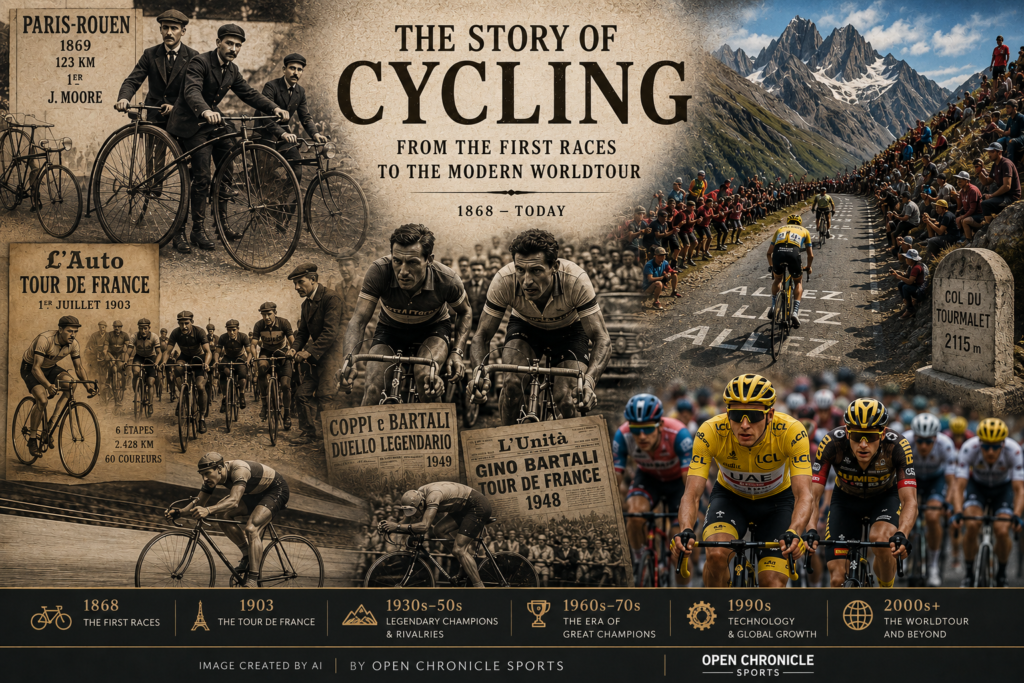
By Open Chronicle Sports
The history of competitive cycling began before the creation of the great races that would later define the sport.
Its origins lie in the rapid development of the bicycle during the nineteenth century, when inventors across Europe experimented with different forms of human powered two wheeled transport. The transformation of these early machines into a practical bicycle created something new. For the first time, relatively ordinary people could travel significant distances under their own power at speeds previously difficult to achieve without an animal or mechanical engine.
Competition followed almost immediately.
By the second half of the nineteenth century, bicycle races were being organised in parks, on roads and on purpose built tracks. What began as a technological novelty soon became a recognised sporting activity.
Over the following century and a half, cycling would develop into one of the most complex and geographically distinctive sports in the world.
The Bicycle Before the Sport
The earliest ancestor of the modern bicycle is commonly associated with Karl Drais, who demonstrated his two wheeled Laufmaschine in 1817.
The machine had no pedals. Riders propelled themselves by pushing against the ground with their feet.
Further developments followed during the nineteenth century. Pedal driven velocipedes appeared in the 1860s, followed by high wheel bicycles whose enormous front wheels allowed greater speed but created considerable safety problems.
The decisive transformation came during the 1880s with the development of the so called safety bicycle.
Its two wheels were of similar size, power was transmitted to the rear wheel through a chain, and the geometry increasingly resembled that of the modern bicycle.
The introduction of practical pneumatic tyres further improved comfort, control and speed.
By the end of the nineteenth century, the bicycle had become a genuine means of transport and an important commercial product.
It had also become a racing machine.
The First Organised Races
One of the earliest documented bicycle competitions took place at the Parc de Saint Cloud near Paris on 31 May 1868.
The race was short by later standards, but historically important because it demonstrated the emergence of organised bicycle competition.
The winner was James Moore, an Englishman living in France.
The following year, Moore won the much more ambitious Paris Rouen road race.
Held in 1869, Paris Rouen covered approximately 123 kilometres and represented an important development in the history of cycling.
The road itself had become the arena.
This would become one of cycling’s defining characteristics.
Unlike many sports, cycling did not require a stadium. Public roads, hills, towns and eventually entire regions could become part of the competition.
The Rise of Track Cycling
Road racing was only one branch of the developing sport.
Track cycling became extremely popular during the late nineteenth century.
Velodromes were built in major cities, and spectators paid to watch riders compete in sprint races, endurance events and long distance contests.
The controlled environment of the track allowed organisers to stage regular competitions and made cycling an attractive spectator sport.
Track racing also contributed to the early professionalisation of cycling.
Successful riders could earn appearance fees and prize money, while manufacturers recognised that racing success could promote bicycles and components.
The relationship between competition and the bicycle industry was established very early.
It remains central to professional cycling today.
Cycling and the First Modern Olympic Games
Cycling was included in the programme of the first modern Olympic Games, held in Athens in 1896.
The Olympic cycling programme included road and track competition.
Its inclusion demonstrated how quickly the bicycle had moved from technological invention to internationally recognised sport.
The Olympic Games would later become one of the major institutions shaping cycling history, particularly in track cycling and, much later, mountain bike and BMX.
The Birth of the Great One Day Races
During the final years of the nineteenth century and the opening decades of the twentieth, a number of races appeared that still exist today.
Liège Bastogne Liège traces its origins to 1892.
Paris Roubaix was first held in 1896.
Il Lombardia began in 1905.
Milano Sanremo followed in 1907.
The Tour of Flanders was first organised in 1913.
These events developed into some of the most prestigious races in professional cycling.
Over time, the five races became known collectively as the Monuments.
Their importance derives partly from longevity.
Generations of riders have raced on many of the same roads.
Victories are therefore not isolated sporting results. They become part of a historical sequence stretching across decades.
The Creation of the UCI
As cycling expanded internationally, national organisations increasingly required a common governing structure.
The Union Cycliste Internationale was founded in Paris on 14 April 1900.
The founding members represented cycling organisations from Belgium, France, Italy, Switzerland and the United States.
The creation of the UCI provided an international institutional framework for the sport.
It would eventually oversee World Championships, international regulations, rankings and the modern structure of professional cycling.
Newspapers and the Creation of Stage Racing
One of the most unusual characteristics of cycling history is the role played by newspapers.
Several of the greatest races were created partly as promotional instruments.
Newspapers recognised that long distance bicycle races could generate stories day after day.
The race promoted the newspaper.
The newspaper promoted the race.
This relationship was fundamental to the emergence of the Grand Tours.
The Tour de France
The most important example was the Tour de France.
The race emerged from competition within the French sporting press.
The newspaper L’Auto, led by Henri Desgrange, sought a dramatic event capable of increasing circulation.
Journalist Géo Lefèvre proposed an enormous race around France.
The first Tour de France began on 1 July 1903.
Sixty riders started.
The race consisted of six enormous stages covering approximately 2,400 kilometres.
Maurice Garin became the first winner.
Early editions were extraordinarily demanding.
Stages frequently extended for hundreds of kilometres.
Riders competed through the night.
Road surfaces were poor.
Mechanical problems were common.
Outside assistance was heavily restricted.
The Tour was designed as a test of endurance as much as speed.
Its success transformed professional cycling.
The Mountains Enter the Tour
The early Tour quickly became more ambitious.
The Pyrenees were introduced in 1910.
The Alps followed in 1911.
The decision permanently changed stage racing.
High mountain roads created a form of competition unlike anything else in sport.
Riders could remain together for hundreds of kilometres before a climb exposed differences in endurance and strength.
Mountain passes became historical landmarks.
The Tourmalet, Galibier and later Alpe d’Huez and Mont Ventoux became inseparable from the cultural identity of the Tour.
The landscape itself had become part of cycling history.
The Giro d’Italia
Italy soon created its own major national stage race.
The Giro d’Italia was first held in 1909.
Like the Tour, it emerged from newspaper competition.
La Gazzetta dello Sport organised the race, and Luigi Ganna became the first overall winner.
The Giro developed a distinctive relationship with Italian geography.
The Alps and Dolomites became central to the race.
Over time, climbs such as the Stelvio, Gavia, Mortirolo and Zoncolan became legendary.
The race leader’s pink jersey, the maglia rosa, was introduced in 1931.
Its colour reflected the pink paper traditionally used by La Gazzetta dello Sport.
The jersey demonstrated again how closely journalism and professional cycling had developed together.
The Vuelta a España
Spain joined the Grand Tour tradition with the first Vuelta a España in 1935.
Gustaaf Deloor of Belgium won the inaugural edition and repeated his victory in 1936.
The race’s early development was interrupted by the Spanish Civil War and the Second World War.
Despite these difficulties, the Vuelta eventually became firmly established alongside the Tour and Giro.
The three races became cycling’s Grand Tours.
Each required approximately three weeks of competition.
Each developed a distinct geography and cultural identity.
Each became capable of defining an entire career.
Cycling and the First World War
The First World War interrupted the growth of European cycling.
Many races were suspended.
Professional riders entered military service.
Some were killed.
Roads that had hosted races became military routes.
After the war, cycling resumed.
The restoration of competitions helped create a sense of continuity between pre war and post war sporting life.
The races themselves became institutions capable of surviving political catastrophe.
This pattern would be repeated after the Second World War.
The Interwar Period
The years between the two world wars saw increasing professionalisation.
Teams became more organised.
Manufacturers became more involved.
Race tactics developed.
Riders increasingly specialised.
The Grand Tours expanded.
National sporting heroes emerged.
In Italy, Alfredo Binda became one of the dominant riders of the era.
He won the Giro d’Italia five times and became road world champion three times.
His dominance was so considerable that organisers famously paid him not to ride the 1930 Giro because they feared another victory would reduce public interest.
The episode illustrates how powerful individual riders could become within cycling culture.
The Second World War
The Second World War again disrupted professional racing.
The Tour de France was not held between 1940 and 1946.
Many other competitions were interrupted.
Professional careers were suspended.
Some riders became soldiers.
Others became involved in resistance movements or civilian survival.
When racing returned after the war, the great events acquired additional symbolic importance.
Cycling represented continuity.
The roads were open again.
The races returned.
Bartali and Coppi
Post war Italian cycling was dominated culturally by the rivalry between Gino Bartali and Fausto Coppi.
Bartali had already won the Tour de France in 1938.
He returned ten years later to win again in 1948.
Coppi represented a younger generation.
Their rivalry was athletic, cultural and political in the broadest sense.
Italian society projected different identities onto the two riders.
Bartali was associated with tradition and religious conservatism.
Coppi appeared modern and unconventional.
Both were exceptional competitors.
Coppi became the first rider to win the Giro d’Italia and Tour de France in the same year, achieving the double in 1949 and again in 1952.
Their rivalry helped turn cycling into one of the defining spectacles of post war Italy.
The Development of World Championship Racing
The UCI Road World Championships became another major pillar of international cycling.
Unlike professional trade team racing, the World Championships were contested by national selections.
This created a different tactical environment.
Winning the road World Championship awarded the rainbow jersey.
The rainbow bands became one of the most prestigious visual symbols in cycling.
A world champion could wear the jersey for the following season in races corresponding to the title won.
Former world champions could continue displaying rainbow bands on their sleeves.
The result was a rare connection between history and contemporary competition.
A rider’s past remained visible on the jersey.
Jacques Anquetil and the Modern Stage Racer
During the late 1950s and 1960s, Jacques Anquetil helped redefine Grand Tour strategy.
Anquetil was exceptionally strong against the clock.
He used time trials to build advantages and then controlled races with calculation and discipline.
He became the first rider to win the Tour de France five times.
His victories demonstrated that professional cycling was becoming increasingly systematic.
Preparation, pacing and race management were becoming more sophisticated.
The rider was no longer simply an endurance adventurer.
The modern professional athlete was emerging.
Eddy Merckx and Total Cycling
If Anquetil represented control, Eddy Merckx represented conquest.
Merckx became the dominant figure of professional cycling during the late 1960s and 1970s.
His range was extraordinary.
He won Grand Tours.
Monuments.
World Championships.
Time trials.
Mountain stages.
One day races.
Stage races.
Merckx won five Tours de France, five Giros d’Italia and one Vuelta a España.
He won all five Monuments during his career.
His aggressive racing style earned him the nickname The Cannibal.
Merckx became the standard against which later generations of all round champions would be measured.
His career also marked one of the final great periods before increasingly intense specialisation separated Grand Tour riders, sprinters and Classics specialists.
Professional Teams Become More Important
Cycling teams had existed from the early professional era, but their organisation became increasingly sophisticated during the twentieth century.
Teams were generally financed through commercial sponsorship.
This distinguished cycling from many club based sports.
A team could change name when its sponsor changed.
A historic sporting structure could therefore appear under several commercial identities across its existence.
Sponsors came from bicycle manufacturers, food companies, banks, industrial firms, telecommunications companies and many other sectors.
The system provided essential financing.
It also created instability.
Teams could disappear if sponsorship ended.
Professional cycling consequently developed a culture in which riders, races and jerseys often possessed greater continuity than team names.
The Era of Hinault
Bernard Hinault became the dominant Grand Tour rider of the late 1970s and early 1980s.
He won the Tour de France five times.
He also won the Giro d’Italia three times and the Vuelta a España twice.
Hinault combined Grand Tour ability with success in major Classics and the World Championship.
His career reflected an era in which the strongest stage racers could still pursue a broad racing programme.
The increasing specialisation of later decades would make such careers more difficult to reproduce.
Cycling Expands Beyond Western Europe
For much of its early history, elite cycling remained concentrated in western Europe.
Belgium, France, Italy, Spain, the Netherlands and Switzerland formed its traditional core.
During the second half of the twentieth century, the sport became more international.
Colombian climbers became important figures in European stage racing.
Australia developed a significant professional and Olympic programme.
The United States became increasingly involved.
Eastern European riders entered the professional peloton after political changes opened new pathways.
Britain later developed one of the world’s strongest cycling systems.
The geographic identity of professional cycling began to change.
Greg LeMond and Internationalisation
Greg LeMond became an important symbol of this expansion.
In 1986, he became the first American to win the Tour de France.
His rivalry with teammate Bernard Hinault became one of the great stories of the decade.
LeMond later won the Tour again in 1989 in one of the closest finishes in race history.
He began the final time trial 50 seconds behind Laurent Fignon.
By the finish in Paris, LeMond had won the Tour by eight seconds.
The result demonstrated both the drama of stage racing and the growing importance of aerodynamics and time trial technology.
LeMond won a third Tour in 1990.
His career helped accelerate cycling’s international visibility.
Miguel Indurain and the Age of Controlled Dominance
During the 1990s, Miguel Indurain established a new model of Grand Tour dominance.
The Spanish rider combined exceptional time trial ability with controlled mountain performance.
He won the Tour de France five consecutive times between 1991 and 1995.
He also won the Giro d’Italia in 1992 and 1993.
Indurain’s era reflected increasing professional sophistication.
Teams controlled races more effectively.
Training methods improved.
Equipment became increasingly specialised.
Grand Tour strategy became more structured.
The sport was entering a period in which scientific preparation would become central.
The Development of Women’s Competitive Cycling
Women’s cycling has existed throughout much of cycling history, although institutional opportunities were often far more limited than those available to men.
The bicycle itself had important social significance for women during the nineteenth century because it increased independent mobility.
Competitive opportunities nevertheless developed unevenly.
The Women’s Road World Championship was introduced in 1958.
Beryl Burton became one of the major figures of twentieth century cycling, dominating domestic and international competition.
Jeannie Longo later built an extraordinary career across several decades.
The Olympic women’s road race was introduced in 1984.
Women’s professional racing continued growing, though often with limited media coverage and financial support.
During the twenty first century, structural development accelerated.
The UCI Women’s WorldTour was introduced in 2016.
The creation of the Tour de France Femmes avec Zwift in 2022 represented another major milestone.
Women’s cycling increasingly became integrated into the central international narrative of the sport.
Mountain Biking Changes the Definition of Cycling
Cycling experienced another major transformation during the late twentieth century with the emergence of mountain biking.
The discipline developed strongly in the United States during the 1970s.
Riders modified bicycles for descending and riding on rough terrain.
Specialised frames, tyres and eventually suspension systems emerged.
Mountain biking became internationally organised during the 1980s and 1990s.
The UCI Mountain Bike World Championships began in 1990.
Cross Country mountain biking entered the Olympic Games in 1996.
Downhill, Cross Country, Short Track and Enduro later developed their own specialised cultures.
Cycling was no longer defined exclusively by roads and velodromes.
BMX and New Cycling Cultures
BMX originated in the United States during the late 1960s and early 1970s.
Young riders imitated motocross on bicycles.
The discipline developed its own racing tracks, bicycle technology and youth culture.
BMX Racing entered the Olympic programme in 2008.
BMX Freestyle followed in 2021 at the Tokyo Games.
The inclusion of these disciplines demonstrated the extraordinary adaptability of cycling.
The same basic machine could support endurance racing, sprint racing, mountain competition and acrobatic performance.
The Rise of Sports Science
Modern professional cycling increasingly became a scientific enterprise.
Training was once largely based on experience, accumulated mileage and intuition.
Power meters fundamentally changed that relationship.
Coaches could measure output precisely.
Physiological testing became increasingly sophisticated.
Altitude training became systematic.
Nutrition changed dramatically.
Recovery became measurable.
Aerodynamics became a specialised field.
Team staff expanded to include coaches, nutritionists, doctors, engineers, data analysts and performance scientists.
The rider remained the engine.
But the organisation surrounding that rider became more complex than ever before.
Carbon Fibre and the Modern Racing Bicycle
Bicycle technology changed significantly during the twentieth and early twenty first centuries.
Steel frames dominated for generations.
Aluminium and titanium later became important.
Carbon fibre ultimately became the primary material for elite professional racing bicycles.
Electronic shifting became widespread.
Disc brakes became standard.
Aerodynamic integration transformed frame design.
Tubeless tyre systems increased in importance.
Time trial bicycles became highly specialised machines.
Modern racing equipment represents a constant compromise between weight, stiffness, comfort, aerodynamics and regulation.
Yet the basic architecture remains recognisable.
Two wheels.
A frame.
A chain driven drivetrain.
Handlebars.
Pedals.
The machine evolved.
The principle survived.
Doping and the Crisis of Credibility
The history of professional cycling also includes repeated problems with doping.
Performance enhancing substances were used in different forms throughout much of the sport’s history.
The introduction of EPO and sophisticated blood manipulation during the late twentieth century created a particularly serious crisis.
The 1998 Festina affair exposed organised doping practices during the Tour de France.
Further scandals followed.
The case of Lance Armstrong became the most internationally famous.
Armstrong had been credited with seven consecutive Tour de France victories between 1999 and 2005.
Following investigations into systematic doping, those results were stripped.
The episode caused severe damage to the credibility of professional cycling.
Anti doping systems subsequently became increasingly sophisticated.
The biological passport, improved testing and greater institutional scrutiny became central to modern regulation.
The subject remains essential to any serious historical account of the sport.
The ProTour and the Search for a Global Structure
Professional cycling had always possessed a complicated calendar.
Some races were organised independently.
Teams had different priorities.
National traditions remained powerful.
The UCI attempted repeatedly to create a more coherent elite competition structure.
The UCI ProTour was introduced in 2005.
Disputes between the UCI, race organisers and professional teams followed.
Further reforms eventually produced the modern UCI WorldTour.
The WorldTour became the top tier of men’s professional road cycling.
It linked leading teams and major international races within a season long structure.
The Women’s WorldTour later created a parallel elite framework for women’s road cycling.
What the WorldTour Changed
The WorldTour did not replace cycling’s traditional races.
Instead, it provided a modern structure around them.
The Tour de France remained the Tour de France.
Paris Roubaix remained Paris Roubaix.
The Giro retained its identity.
The Monuments remained historical institutions in their own right.
The WorldTour organised the elite calendar but did not erase the local traditions that had created cycling.
This distinction explains much about the sport.
Professional cycling is simultaneously modern and historical.
It operates through global rankings, international teams, data systems and sophisticated commercial structures.
Yet its greatest prestige still comes from roads first raced more than a century ago.
The Modern Multidisciplinary Champion
Contemporary cycling has also seen the return of riders capable of succeeding across different forms of racing.
Mathieu van der Poel combined cyclocross dominance with major road victories and mountain bike competition.
Wout van Aert competed successfully in cyclocross, Classics, sprints, time trials and Grand Tour stages.
Tom Pidcock achieved elite success across road, cyclocross and mountain bike.
Tadej Pogačar combined Grand Tour dominance with Monument victories and World Championship success.
These riders challenged the assumption that extreme specialisation had permanently separated cycling disciplines and race types.
In some ways, the modern peloton began to resemble older eras, when the strongest champions attempted to win almost everywhere.
The Globalisation of the Peloton
The professional peloton today is far more international than the sport of the early twentieth century.
Slovenia has produced Grand Tour champions.
Eritrea has produced major stage and Classics winners.
Colombia remains an important source of elite climbers.
Australia has become a central cycling nation.
Asian and Middle Eastern races occupy significant places in the international calendar.
African cycling is gaining increasing institutional importance.
The 2025 UCI Road World Championships in Kigali, Rwanda, became the first Road World Championships held in Africa.
The event symbolised a broader transformation.
Cycling’s historical heart remains European.
Its future is increasingly global.
The Persistence of the Old Roads
Despite all these changes, professional cycling remains deeply connected to its origins.
Paris Roubaix still crosses cobbled farm roads.
The Tour of Flanders still races over Flemish bergs.
The Tour de France still climbs the Alps and Pyrenees.
The Giro still returns to the Dolomites.
The Vuelta still searches for steep Spanish mountains.
Old races survive because geography cannot be modernised in the same way as equipment.
A carbon bicycle may be radically different from the machine ridden in 1910.
The Tourmalet remains the Tourmalet.
This gives cycling an unusual historical continuity.
Modern riders do not merely compete in races created by earlier generations.
They often travel over the same physical landscapes.
The Spectator and the Road
Cycling also developed a unique spectator culture.
Most major road races are not contained inside ticketed stadiums.
Spectators stand directly beside the road.
They gather on mountain passes.
They camp beside cobbled sectors.
They decorate villages.
They paint riders’ names onto the asphalt.
A race can pass through a community for only a few minutes, but preparation may last for days.
The public becomes part of the landscape.
This is one reason cycling developed such strong regional identities.
Flanders does not simply host cycling.
Parts of Flanders culturally live through it.
The Tour does not merely pass across France.
It repeatedly creates a moving portrait of the country.
Rivalries and Historical Memory
Cycling history is structured not only by races and victories but by rivalries.
Coppi and Bartali.
Anquetil and Poulidor.
Hinault and LeMond.
LeMond and Fignon.
Contador and Schleck.
Pogačar and Vingegaard.
These rivalries matter because individual achievement becomes clearer when confronted by resistance.
Champions require opponents.
The historical significance of a victory depends partly on who had to be defeated.
Cycling is therefore best understood not as a sequence of isolated winners but as a network of generations competing against one another.
The Importance of the Domestique
Professional road cycling also developed a distinctive team culture based on sacrifice.
A domestique may spend an entire race working for another rider.
He or she may control breakaways, shelter a leader from the wind, retrieve bottles, set mountain tempo or sacrifice a bicycle after a mechanical problem.
The rider who wins receives the public recognition.
But the race may have been made possible by several teammates whose names never appear near the top of the classification.
This structure distinguishes cycling from many individual sports.
The winner is an individual.
The victory is often collective.
Cycling as Historical Landscape
Few sports preserve geography as thoroughly as cycling.
A climb becomes associated with past champions.
A cobbled sector acquires decades of memory.
A finish line becomes historically significant because previous races ended there.
The physical landscape stores sporting history.
This is why places such as the Tourmalet, Mont Ventoux, Alpe d’Huez, Stelvio, Roubaix and Oude Kwaremont carry meaning far beyond their geography.
The road becomes an archive.
From the First Race to the WorldTour
Competitive cycling has travelled an extraordinary distance since the races of the 1860s.
It moved from experimental bicycles to carbon fibre machines.
From local competitions to global broadcasting.
From newspaper promotion to international media networks.
From simple trade teams to organisations employing specialists in physiology, aerodynamics, nutrition and data science.
From European roads to a genuinely international peloton.
But the central structure remains remarkably familiar.
A start.
A route.
A bicycle.
An opponent.
A finish.
The technological environment has changed almost beyond recognition.
The sporting idea has not.
A Living History
Cycling history is not complete.
The great races continue.
New champions appear.
Old records fall.
Women’s cycling continues expanding.
New countries enter the international elite.
Disciplines continue evolving.
The WorldTour itself will change.
Future bicycles will become faster and more sophisticated.
Training will become more precise.
But every modern cyclist still enters a sport shaped by riders who came before.
When the peloton enters the Roubaix cobbles, it enters a history beginning in the nineteenth century.
When the Tour climbs the Tourmalet, contemporary riders follow a route first transformed into sporting mythology in 1910.
When a world champion wears rainbow bands, the rider participates in a tradition passed down through generations.
Cycling does not merely remember its history.
It repeatedly rides through it.
And that is perhaps the clearest reason the sport remains so distinctive.
Its past is not hidden inside museums.
It is still outside.
On the roads.
On the climbs.
On the tracks.
Waiting for the next race.