
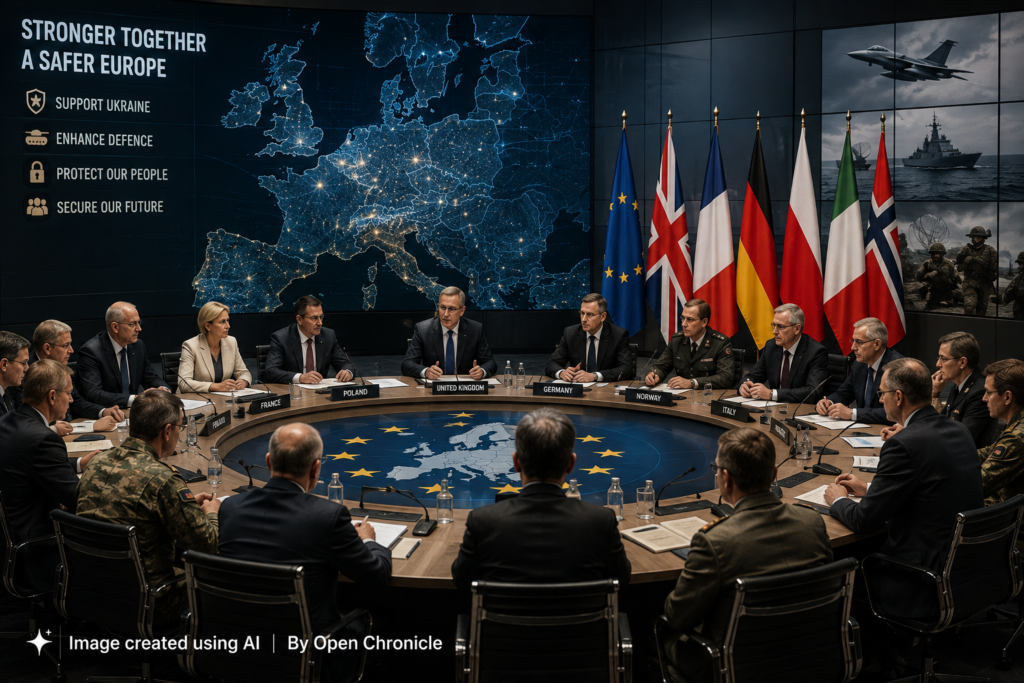
By Open Chronicle Defence
Europe’s security architecture is changing.
For decades, European defence was largely organised around permanent institutions, above all NATO and the European Union, supported by bilateral alliances and national armed forces. Those structures remain fundamental, but the increasingly complex security environment surrounding Europe is encouraging another model of cooperation: the ad hoc coalition.
These coalitions bring together groups of states willing and able to cooperate on a particular military or security objective without requiring every member of a larger organisation to participate.
They can emerge rapidly, concentrate resources around a clearly defined mission and dissolve or evolve once that mission changes.
As Europe confronts the war in Ukraine, Russian military pressure, instability around its southern neighbourhood, maritime security challenges, cyber threats and uncertainty about the long-term distribution of responsibilities between Europe and the United States, such flexible arrangements are becoming increasingly important.
They do not necessarily replace NATO or the EU.
Instead, they may increasingly operate alongside them.
What is an ad hoc coalition?
An ad hoc coalition is essentially a temporary or purpose-built grouping of countries formed to address a specific strategic problem.
Unlike a permanent alliance, it does not necessarily require an extensive institutional structure, common treaty obligations or unanimous participation from a large membership.
A small number of governments can identify a shared objective and begin coordinating resources.
The mission might involve military assistance to another country, maritime protection, air defence, training, deterrence, intelligence sharing, procurement or preparations for a possible multinational deployment.
Membership can also reflect capability.
One coalition might bring together countries possessing advanced air defence systems. Another could focus on naval forces. A third could coordinate artillery ammunition or long range weapons.
This creates a model built around the question of who can contribute what, rather than requiring every European government to participate in every initiative.
Ukraine accelerated the trend
Russia’s full scale invasion of Ukraine transformed European defence cooperation.
European governments suddenly had to make decisions involving weapons deliveries, ammunition production, training, intelligence, logistics and long term military support on a scale not experienced for decades.
Existing institutions played essential roles.
NATO coordinated the broader deterrence and defence of Allied territory, while the European Union developed financial, industrial and military assistance mechanisms.
But governments also discovered that smaller groups could sometimes move faster.
Countries possessing particular weapons systems could coordinate training and deliveries.
States with similar strategic priorities could develop joint initiatives without waiting for agreement among every European government.
The result has been an increasingly complex network of overlapping coalitions.
The coalition of the willing concept
One of the most visible expressions of this approach is the idea of a European-led coalition of the willing supporting Ukraine.
The concept reflects a fundamental reality of European security.
Not every country has identical political constraints, military capabilities, or perceptions of risk.
Some governments may be prepared to provide advanced weapons but unwilling to deploy personnel.
Others may support training missions.
Some could contribute aircraft or naval forces.
A smaller group might eventually be willing to participate in security arrangements connected to a ceasefire or postwar settlement.
An ad hoc coalition allows those differences to coexist.
Participation does not have to be identical for the coalition to function.
Speed is the principal advantage
Large multinational institutions derive legitimacy and strength from broad participation, but broad participation can complicate decision-making.
Thirty or more governments rarely possess identical interests.
Negotiations take time.
Political objections can delay action.
Ad hoc coalitions reduce this problem by beginning with countries that already agree on the objective.
Instead of asking whether every European state is prepared to participate, governments can ask which countries are prepared to act immediately.
That distinction can be crucial during a crisis.
Military operations frequently develop faster than diplomatic institutions.
Air defence systems may be required within weeks.
A maritime route may require protection immediately.
A partner country might urgently need ammunition.
Smaller coalitions can potentially translate political agreement into operational activity more rapidly.
Geography increasingly shapes cooperation
European security concerns are not distributed evenly.
Countries bordering Russia naturally perceive certain threats differently from states geographically removed from Russia’s western frontier.
Baltic and Nordic countries have strong interests in northern European security.
Poland and other Central and Eastern European states focus heavily on NATO’s eastern flank.
Mediterranean countries simultaneously confront instability in North Africa, migration pressures and maritime security challenges.
Britain and France possess capabilities for expeditionary military operations that many smaller European states do not.
Ad hoc cooperation allows geography to shape military organisation.
Countries confronting similar regional challenges can combine forces without requiring the entire continent to reorganise around every individual problem.
Capability coalitions offer another model
Coalitions can also be organised around military capability rather than geography.
Modern armed forces are extraordinarily complex.
No European country other than the largest military powers can realistically maintain every capability at substantial scale.
Countries therefore increasingly specialise and cooperate.
A coalition might concentrate on:
Air and missile defence, integrating radar networks, interceptors and command systems.
Long-range strike, coordinating missiles, targeting capabilities and industrial production.
Armoured warfare, sharing logistics, maintenance and training for common vehicle families.
Maritime security, protecting shipping routes and critical infrastructure.
Drone warfare, developing unmanned systems and counter-drone capabilities.
Cyber defence, sharing intelligence concerning attacks and vulnerabilities.
Military mobility, ensuring forces can move rapidly across European territory.
Such cooperation can transform several limited national capabilities into a more credible multinational force.
Britain remains central despite Brexit
The emergence of flexible coalitions is particularly relevant to the United Kingdom.
Britain left the European Union but remains one of Europe’s most capable military powers and a leading member of NATO.
Traditional EU-centred defence cooperation therefore cannot fully represent Europe’s available military power.
Ad hoc coalitions provide a mechanism through which Britain can work closely with France, Germany, Poland, Nordic countries and other European partners without requiring institutional reintegration with the EU.
This is especially important in areas such as nuclear deterrence, intelligence, expeditionary operations, air power and maritime warfare.
European defence increasingly requires structures capable of including both EU and non-EU countries.
Flexible coalitions provide exactly that possibility.
France has long favoured European strategic initiative
France has historically advocated greater European capacity to act independently when necessary.
Ad hoc coalitions fit comfortably within that strategic tradition.
France possesses nuclear weapons, advanced combat aircraft, naval forces, intelligence capabilities and experience conducting overseas military operations.
Paris can therefore function as a framework nation around which smaller contributors organise.
Combined with British capabilities, France also provides Europe with one of its few military forces capable of supporting substantial operations beyond national territory.
A closer British-French security relationship could consequently become one of the foundations upon which future European coalitions are constructed.
Poland and the eastern flank are gaining influence
The geographical centre of gravity of European defence has also moved eastward.
Poland has undertaken major military modernisation while becoming an increasingly important logistical and strategic hub for NATO’s support to Ukraine.
The Baltic states, Finland and other countries close to Russia have similarly increased their influence over European security discussions.
Their experience and threat perception give them particular importance in coalitions focused on territorial defence, artillery, air defence, military mobility and reinforcement of NATO’s eastern flank.
Future European security structures may therefore become less concentrated around traditional Western European capitals.
Different countries could lead different missions.
The Nordic region demonstrates the potential
Northern Europe offers an especially strong environment for flexible defence cooperation.
Denmark, Finland, Iceland, Norway and Sweden possess overlapping strategic interests across the Baltic, Arctic and North Atlantic regions.
Finland and Sweden’s membership of NATO has further transformed the military geography of northern Europe.
National forces can increasingly be viewed as components of a wider regional defence network.
Aircraft can operate across borders.
Naval forces can coordinate surveillance.
Air defence information can be shared.
Military infrastructure can support Allied reinforcement.
The region illustrates how neighbouring states can develop a level of practical integration that complements the larger NATO framework.
Maritime coalitions could become increasingly important
Europe depends heavily on the sea.
Energy supplies, commercial trade, communications cables and military reinforcement routes cross waters surrounding the continent.
The sabotage or disruption of underwater infrastructure has increased concern about the vulnerability of submarine cables, pipelines and offshore installations.
Protecting such infrastructure requires persistent surveillance across enormous maritime areas.
No single European navy can monitor everything.
Multinational maritime coalitions could combine warships, patrol aircraft, submarines, drones, satellites and intelligence networks to maintain a more comprehensive picture.
The Baltic Sea, North Sea, Mediterranean and North Atlantic could each require different combinations of participating states.
Defence industry cooperation may follow the same model
The coalition approach is not limited to military operations.
Europe’s fragmented defence industry remains one of the continent’s longstanding strategic weaknesses.
Countries operate numerous types of tanks, artillery systems, aircraft and missiles, complicating procurement and logistics.
Groups of states purchasing the same equipment can generate economies of scale.
Joint orders can give manufacturers the confidence to expand production.
Shared maintenance infrastructure can reduce costs.
Common ammunition standards can simplify wartime logistics.
Smaller procurement coalitions may sometimes prove easier to establish than continent wide programmes involving numerous governments with competing industrial interests.
But fragmentation carries risks
The flexibility of ad hoc coalitions is also their weakness.
Too many overlapping initiatives could make European defence more complicated rather than more coherent.
One country might participate in several groups operating under different political arrangements.
Command responsibilities could become unclear.
Procurement programmes could duplicate one another.
Different coalitions might compete for the same limited military resources.
Political leadership could also become contested.
A system designed to overcome institutional bureaucracy could eventually create a new form of organisational fragmentation.
Coordination therefore remains essential.
NATO remains the foundation
The rise of ad hoc coalitions does not mean NATO has become irrelevant.
For most European countries, NATO remains the central framework for collective territorial defence.
Its integrated command structure, defence planning system, multinational exercises and Article 5 guarantee provide capabilities that temporary coalitions cannot easily reproduce.
The United States also contributes strategic capabilities that Europe still struggles to provide independently at comparable scale.
These include intelligence, surveillance, aerial refuelling, strategic transport, missile defence and other high end capabilities.
Ad hoc coalitions therefore work best when they reinforce the Alliance rather than create competing command structures.
The EU has a different but complementary role
The European Union possesses tools NATO does not.
It can regulate industry, finance defence programmes, coordinate economic policy and mobilise the enormous industrial potential of the European single market.
This gives the EU an increasingly important role in defence production.
Missiles, ammunition, drones and armoured vehicles cannot be generated simply through military planning.
Factories need contracts.
Supply chains require investment.
Workers must be trained.
Raw materials must be secured.
Production capacity needs financing.
Ad hoc coalitions can identify urgent military requirements while EU mechanisms help create the industrial capacity required to satisfy them.
The two approaches can therefore complement each other.
The American question
Behind much of the current European defence debate lies a larger strategic question: how much responsibility will the United States carry for European security in the future?
For decades, American military power formed the indispensable foundation of NATO.
That relationship remains enormously important.
But European governments increasingly recognise that they must be capable of assuming greater responsibility for their own defence regardless of changes in Washington.
This does not necessarily mean creating a European alternative to NATO.
It means developing enough military capability that Europe can act when American resources are unavailable, concentrated elsewhere or politically constrained.
Ad hoc coalitions could become one mechanism for achieving that objective.
From alliances to networks
European security may therefore be moving toward a more networked architecture.
NATO remains the central military alliance.
The European Union provides political, financial and industrial instruments.
Regional organisations connect neighbouring states.
Bilateral treaties deepen particularly important relationships.
Ad hoc coalitions then emerge around individual missions or capabilities.
The result is not a single European army.
It is something more flexible.
A country might participate in a Baltic maritime coalition, an air defence initiative, a Ukrainian training mission and a multinational procurement programme simultaneously.
Another country might contribute to only two of those structures.
Military cooperation becomes modular.
The real test will come during a crisis
Coalitions look effective when governments broadly agree.
Their durability becomes harder to predict when casualties occur, financial costs rise or political leadership changes.
Temporary arrangements may lack the legal and institutional resilience of formal alliances.
Parliaments can withdraw support.
Governments can change.
Strategic priorities can diverge.
Military forces promised to one coalition may suddenly be required elsewhere.
For ad hoc cooperation to become strategically credible, participating governments must therefore demonstrate that flexibility does not mean unreliability.
A new layer of European defence
Europe is unlikely to replace its existing security institutions with ad hoc coalitions.
Nor would doing so necessarily be desirable.
NATO provides collective defence.
The European Union provides economic and industrial scale.
National governments retain sovereignty over their armed forces.
What ad hoc coalitions add is another layer: the ability for smaller groups of capable and politically aligned countries to act rapidly when universal agreement is unnecessary or impossible.
That model fits an increasingly unpredictable security environment.
Different threats require different capabilities.
Different regions face different pressures.
Different governments possess different levels of political willingness.
European defence consequently may not evolve toward one perfectly unified structure.
Instead, it may become a network of overlapping institutions and coalitions capable of assembling the right combination of countries for the problem at hand.
In that sense, the future of European defence may depend not simply on building larger institutions, but on learning how to connect smaller ones.
The strategic challenge will be ensuring that flexibility produces greater military power rather than greater fragmentation.
If Europe succeeds, ad hoc coalitions could become one of the defining features of the continent’s emerging security architecture.
The Grand Strategy Institute
Continue Exploring Strategic Analysis
Return to The Grand Strategy Institute for strategic assessments, long-form analysis and research examining geopolitics, military affairs, international security, emerging technologies and the changing international order.
← Back to The Grand Strategy Institute