
By Open Chronicle Defence
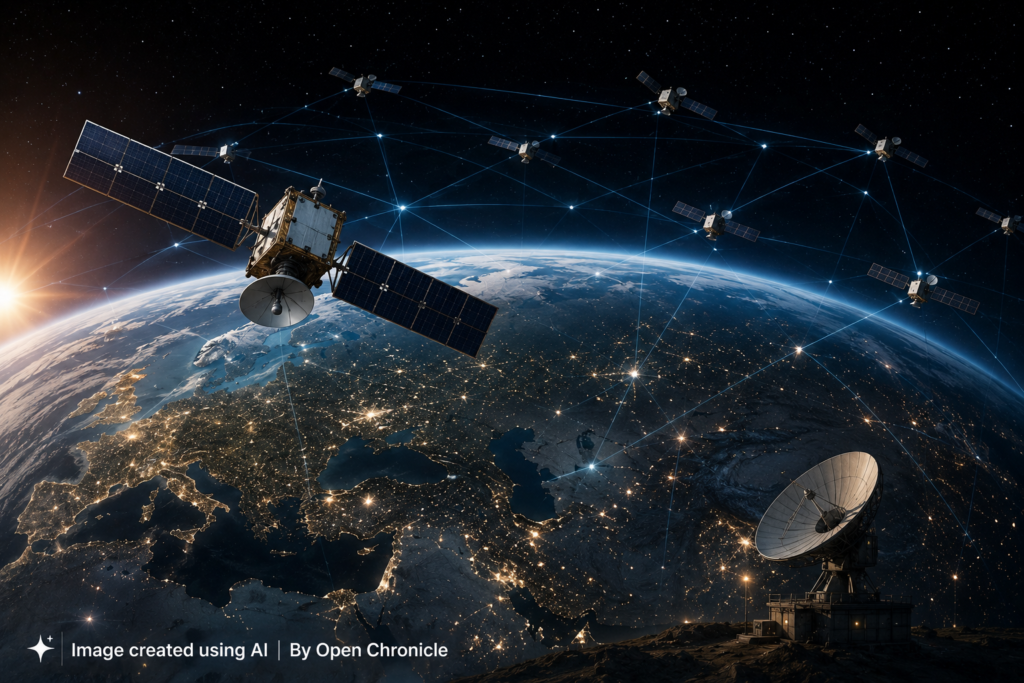
Russia is moving ahead with plans to develop its own low Earth orbit satellite internet constellation, an ambitious project intended to provide high speed connectivity across Russian territory and eventually offer an alternative to SpaceX’s Starlink system.
Known as Rassvet, meaning “Dawn” in Russian, the network is expected to consist of hundreds of satellites operating in low Earth orbit. The system is planned to begin commercial operations in 2027, potentially giving Moscow an independent satellite communications infrastructure at a time when space based connectivity has become increasingly important to both civilian economies and modern warfare.
The project reflects a broader technological shift. Satellite internet is no longer simply about providing broadband to remote communities. Networks of hundreds or thousands of interconnected satellites are becoming strategically important communications systems capable of supporting governments, businesses, emergency services and military forces.
Russia now wants a constellation of its own.
Building a Russian low Earth orbit constellation
Traditional communications satellites generally operate in geostationary orbit, approximately 36,000 kilometres above Earth.
Rassvet is being developed around a very different architecture.
By placing large numbers of smaller satellites in low Earth orbit, a constellation can provide lower latency communications because signals travel considerably shorter distances between users and spacecraft.
Individual satellites move rapidly across the sky, meaning continuous service requires many spacecraft working together as a coordinated network.
As one satellite disappears beyond the horizon, another takes over the connection.
This architecture is fundamentally similar to the concept that has made SpaceX Starlink one of the world’s most important commercial satellite communications systems.
Russia’s challenge will be developing that architecture at sufficient scale.
Hundreds of satellites will be required
A global or near global low Earth orbit communications system cannot depend on a handful of spacecraft.
Coverage improves as the constellation grows.
Hundreds of satellites allow the network to provide more persistent service across large geographic areas, while larger constellations can increase capacity and resilience.
Russia’s enormous territory makes satellite communications particularly attractive.
Many regions of Siberia, the Arctic and the Russian Far East contain widely dispersed communities where constructing extensive terrestrial fibre or mobile infrastructure can be economically difficult.
Satellite broadband can bypass much of that physical challenge.
A terminal with a clear view of the sky can potentially connect directly to the orbital network without requiring conventional telecommunications infrastructure nearby.
2027 is the critical target
Rassvet is planned to enter service in 2027.
That timetable makes the next phase of the programme particularly important.
Building satellites is only part of the challenge. Russia will need launch capacity, ground stations, user terminals, network management systems and sufficient production capability to replenish the constellation.
Low Earth orbit satellites do not remain operational indefinitely.
Atmospheric drag gradually reduces their altitude, while radiation, hardware failures and technological obsolescence create additional replacement requirements.
A successful constellation therefore requires continuous manufacturing and launch operations rather than a single deployment campaign.
In effect, Rassvet must become an industrial ecosystem.
Starlink changed expectations for satellite communications
Russia’s programme cannot be separated from the extraordinary expansion of Starlink.
SpaceX has demonstrated that large constellations of relatively small satellites can provide broadband connectivity to users far beyond conventional terrestrial infrastructure.
Starlink terminals have been deployed on homes, businesses, ships and aircraft, while the system has also demonstrated considerable value during disasters and military conflicts.
The war in Ukraine transformed perceptions of the technology.
Satellite internet became an important component of battlefield communications, allowing Ukrainian forces and government institutions to maintain connectivity even when terrestrial infrastructure was damaged or destroyed.
That experience demonstrated that commercial satellite constellations could possess enormous strategic value.
Ukraine demonstrated the military importance of resilient connectivity
Modern military forces depend heavily on information.
Units need communications with headquarters.
Drone operators require data connections.
Intelligence must move rapidly between sensors and commanders.
Artillery units need targeting information.
Logistics networks require coordination.
If those communications depend entirely on terrestrial infrastructure, destroying towers, fibre connections and command centres can severely disrupt military operations.
Distributed satellite constellations complicate that problem.
Destroying one ground station or communications tower does not eliminate the entire network.
Hundreds or thousands of satellites continue passing overhead.
Portable terminals can move with military units.
That resilience has made low Earth orbit communications an increasingly important component of modern warfare.
Russia has every reason to want comparable sovereign capability.
Strategic autonomy is central to the project
Dependence on foreign communications infrastructure creates vulnerabilities.
A foreign company ultimately controls access to the network.
Services can potentially be restricted.
Terminals can be geofenced.
Software can be modified.
Governments can impose export controls or sanctions.
During a geopolitical crisis, those dependencies become strategically significant.
A Russian owned constellation would give Moscow substantially greater control over access, coverage and network policy.
The government could determine where service operates and which users receive priority.
Military and government traffic could potentially receive dedicated capabilities.
Sensitive communications would no longer need to depend on infrastructure controlled by an American company.
For Moscow, that sovereignty may be as important as the commercial potential of Rassvet.
The Arctic could become one of Rassvet’s most important markets
Russia’s geography gives the constellation another strategic purpose.
The Arctic is becoming increasingly important economically and militarily as melting sea ice changes navigation patterns and governments invest in northern infrastructure.
Russia possesses an enormous Arctic coastline.
Military installations, energy projects, shipping routes and remote settlements all require reliable communications.
Traditional geostationary satellite systems can face limitations at very high latitudes because satellites appear low on the horizon.
Low Earth orbit constellations using appropriate orbital configurations can provide stronger coverage across northern regions.
Rassvet could therefore become an important component of Russia’s Arctic communications architecture.
Satellite internet also supports remote industry
The commercial applications extend far beyond households.
Russia’s natural resources are frequently located in remote areas.
Oil and gas installations, mines, pipelines, railways and maritime operations can all benefit from reliable broadband communications.
Industrial equipment increasingly depends on continuous data transmission.
Sensors monitor infrastructure.
Remote teams supervise machinery.
Automated systems transmit maintenance information.
Workers require communications with central operations.
Satellite broadband can connect these installations without requiring extensive terrestrial networks.
Rassvet could therefore support both national communications resilience and Russia’s resource economy.
Competing with Starlink will be difficult
Building a functioning constellation is one challenge.
Competing with Starlink is another.
SpaceX possesses a major structural advantage because it controls both satellite manufacturing and launch infrastructure.
Its Falcon 9 rockets routinely deploy batches of Starlink spacecraft, allowing the company to expand and replenish its constellation at considerable scale.
Russia possesses extensive experience in space launch technology, but creating a commercially competitive satellite network requires more than rockets.
Satellite manufacturing must achieve high production rates.
User terminals must be affordable.
Launch costs must remain manageable.
Software must coordinate an enormous moving network.
Ground infrastructure must process huge quantities of data.
Service must remain reliable enough to attract customers.
The competition is therefore industrial as much as technological.
Mass production represents a major test
Traditional satellites can take years to design and manufacture.
Mega constellations require a different philosophy.
Satellites must increasingly be produced almost like industrial products.
Standardised designs, automated manufacturing and rapid testing become essential.
If hundreds of spacecraft are required initially and replacements must subsequently be launched every year, traditional bespoke satellite production becomes economically unsustainable.
Rassvet’s success will consequently depend heavily on whether Russia can establish a sufficiently efficient production pipeline.
That may prove one of the most important measures of the programme’s viability.
Sanctions create additional complications
Russia’s technology sector has faced extensive Western sanctions and export restrictions since the invasion of Ukraine.
Advanced electronics are particularly important to satellite systems.
Processors, communications equipment, sensors, radiation resistant components and specialised manufacturing tools can all become potential bottlenecks.
Russia has developed mechanisms for obtaining some foreign technology through alternative supply chains while expanding domestic production in strategic sectors.
Nevertheless, a constellation involving hundreds of sophisticated spacecraft places considerable demands on the electronics industry.
Rassvet will therefore also test Russia’s ability to sustain a major high technology programme under long term restrictions.
China could become an important factor
Russia is not the only country seeking alternatives to American satellite constellations.
China is developing its own large low Earth orbit communications networks as part of an increasingly competitive global space environment.
That creates potential areas of cooperation but also competition.
Moscow and Beijing have deepened strategic relations in recent years, particularly as Russia’s access to Western technology and financial markets has declined.
Satellite communications could eventually become another area where technological ecosystems divide along geopolitical lines.
American and allied systems may dominate one group of markets.
Chinese networks could serve another.
Russia may seek to establish Rassvet as an independent third option or integrate elements of its communications architecture with friendly states.
The military potential cannot be ignored
Rassvet is presented as a communications network, but almost any resilient satellite broadband constellation has potential military applications.
The same infrastructure connecting a remote village can connect a deployed military unit.
The same network supporting an industrial facility can transmit intelligence.
Satellite communications can link drones, ships, aircraft and ground forces across enormous distances.
They can support command networks operating beyond the reach of conventional radio systems.
A sovereign Russian constellation could therefore strengthen the resilience of military communications during a conflict.
This does not mean every Rassvet satellite would become a dedicated military spacecraft.
It means the communications infrastructure itself could become strategically useful.
Networks are becoming more important than individual satellites
The development represents a broader transformation in space power.
Traditional military space programmes often concentrated on small numbers of extremely sophisticated satellites.
Modern constellations distribute capability across many spacecraft.
That creates resilience.
Losing one satellite may have relatively little impact because others can compensate.
Additional satellites can be launched as replacements.
Software can redistribute traffic across the constellation.
The network becomes more important than any individual spacecraft.
This principle mirrors developments occurring elsewhere in modern warfare, where distributed systems are increasingly replacing dependence on a few extremely valuable platforms.
Space is becoming part of critical national infrastructure
As societies become more dependent on satellite communications, the distinction between space infrastructure and terrestrial infrastructure continues to disappear.
Banks depend on connectivity.
Energy networks require data.
Aircraft and ships need communications.
Military forces rely on digital networks.
Emergency services require resilient connections during disasters.
A country capable of maintaining communications even after terrestrial networks are disrupted possesses an important strategic advantage.
Russia’s pursuit of Rassvet should therefore be understood within a larger effort to strengthen technological sovereignty.
The world may be heading toward competing satellite internets
The long term implications extend beyond Russia.
The early internet developed around a broadly interconnected global architecture.
Satellite broadband may evolve differently.
National security concerns increasingly influence telecommunications policy.
Governments want control over sensitive data.
Military forces want guaranteed access.
Countries fear dependence on foreign technology companies.
Sanctions and geopolitical competition reinforce those pressures.
The result could be multiple overlapping satellite networks aligned with different governments and technological ecosystems.
Starlink may remain dominant in many countries.
China will develop alternatives.
Europe is investing in sovereign satellite communications.
Russia is now attempting to establish Rassvet.
The sky above Earth could consequently become populated not by one universal satellite internet but by competing constellations reflecting the geopolitical divisions below.
Russia’s race to 2027
Rassvet remains an ambitious undertaking.
Deploying hundreds of satellites, creating affordable terminals, maintaining launch capacity and building a reliable communications network represent formidable engineering and industrial challenges.
But Russia’s motivation is clear.
The war in Ukraine has demonstrated that resilient satellite communications are no longer merely a commercial convenience.
They are strategic infrastructure.
A country unable to control its own space based communications network risks dependence on companies and governments whose interests may eventually diverge from its own.
Russia wants to reduce that vulnerability.
If Rassvet enters service as planned in 2027 and subsequently expands into a large operational constellation, Moscow will have taken an important step toward creating an independent communications architecture in orbit.
The competition surrounding satellite internet is therefore becoming about much more than broadband.
It is becoming a contest over who controls the networks through which the increasingly digital world communicates.
The Grand Strategy Institute
Continue Exploring Strategic Analysis
Return to The Grand Strategy Institute for strategic assessments, long-form analysis and research examining geopolitics, military affairs, international security, emerging technologies and the changing international order.
← Back to The Grand Strategy Institute