
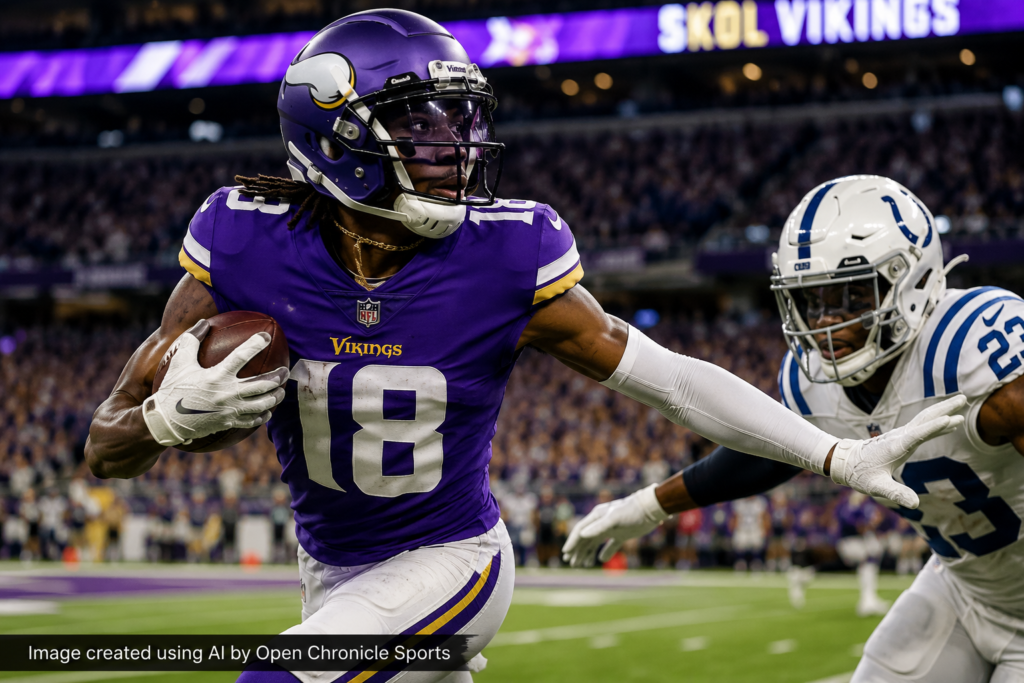
By Open Chronicle Sports
Players to Watch | Minnesota Vikings | Wide Receiver
A great wide receiver can catch the football.
An elite wide receiver can change where an entire defense is allowed to stand.
Justin Jefferson belongs to the second category.
Since entering the NFL with the Minnesota Vikings, Jefferson has become one of the defining receivers of his generation, combining exceptional route running, body control, acceleration, spatial awareness and an instinctive understanding of how to create separation from defenders.
The spectacular catches attract the highlights.
But Jefferson’s greatness often begins several seconds earlier.
It begins with a step.
A hesitation.
A change of direction.
A defender leaning slightly toward the wrong side.
By the time the football arrives, the decisive part of the play may already have happened.
That is why Jefferson provides an ideal introduction to one of the most sophisticated positions in modern football.
Wide receiver is not simply about catching.
It is about creating space where none appeared to exist.
The Art of Getting Open
Every passing play contains a battle between receiver and defender.
The receiver knows where he intends to go.
The defender does not.
That should provide the receiver with an advantage.
NFL defensive backs, however, are extraordinary athletes. They study tendencies, understand route combinations and possess enough speed to recover from small mistakes.
The receiver therefore needs more than speed.
He needs deception.
Jefferson excels at it.
A slight movement of the shoulders can suggest an outside route.
A change in stride length can convince a cornerback that a break is coming.
A sudden acceleration can force the defender to open his hips.
Once the defender commits, Jefferson attacks the space created by that decision.
This is route running at its highest level.
The objective is not merely to run from one point to another.
The objective is to manipulate the defender responsible for preventing you from getting there.
Separation
One of the most important concepts when evaluating wide receivers is separation.
A quarterback needs a window in which to deliver the football.
The larger that window becomes, the easier the throw.
Receivers create those windows through speed, route technique, positioning and timing.
Jefferson can create separation in multiple ways.
He can accelerate beyond a defender.
He can use precise footwork to change direction.
He can vary the tempo of a route, slowing slightly before exploding into another movement.
And he understands how defensive backs react to his own reputation.
A cornerback who fears Jefferson’s deep speed may provide additional space underneath.
A defender expecting an inside break can become vulnerable outside.
Every successful route influences the next one.
That is why elite receiver play resembles a long conversation between receiver and defensive back.
Jefferson is constantly giving the defender information.
Not all of it is true.
More Than Speed
The fastest player does not automatically become the best receiver.
NFL football is filled with exceptional athletes.
What separates the elite is how athleticism is combined with technique.
Jefferson entered the league in 2020 as the 22nd overall selection in the NFL Draft and immediately demonstrated that his college production at LSU could translate to professional football.
His rookie season produced 1,400 receiving yards.
Then came 1,616 yards in 2021.
In 2022, Jefferson exploded for 1,809 receiving yards and 128 receptions, performances that helped earn him the Associated Press NFL Offensive Player of the Year award.
Within three seasons, he had already established himself among the league’s most dangerous offensive players.
The production was extraordinary.
The consistency behind it was even more important.
Defenses knew Minnesota wanted to find Jefferson.
They constructed game plans specifically to limit him.
He continued getting open.
When Everybody Knows Where the Ball Is Going
There is a significant difference between producing when a defense is surprised by you and producing when the defense is designed to stop you.
Elite receivers eventually encounter the second problem.
Safeties begin leaning toward their side of the field.
Cornerbacks receive help.
Defenses use bracket coverage, placing one defender underneath and another over the top.
The objective is simple.
Remove the star receiver from the game.
But every additional defender committed to Jefferson creates a consequence elsewhere.
If two defenders are occupied by one receiver, another Minnesota player may face a more favourable matchup.
If a safety moves toward Jefferson before the snap, the structure of the defense has already changed.
This is one of the most important ways a superstar receiver influences football without touching the ball.
Attention is itself an offensive weapon.
The Catch Radius
Getting open is only part of receiving.
Sometimes the defender remains close.
Sometimes pressure forces the quarterback to release the football early.
Sometimes the throw is imperfect.
Elite receivers must still provide solutions.
Jefferson possesses exceptional body control around the catch point.
He can adjust to passes behind him, extend outside his frame and maintain awareness of the sideline while competing with defenders.
Few plays illustrated this better than his extraordinary fourth down reception against Buffalo in November 2022.
With Minnesota facing fourth and 18 late in the game, Jefferson reached backward with one hand while Bills defender Cam Lewis simultaneously attempted to intercept the pass.
Jefferson somehow secured the football.
It became one of the defining catches of his career and one of the most memorable receptions of the modern NFL.
But its significance goes beyond spectacle.
It demonstrates something fundamental about elite receivers.
They expand the quarterback’s margin for error.
A throw does not always need to be perfect when the receiver can make the impossible catch possible.
The Quarterback and Receiver Relationship
Passing football requires coordination between two players who may be separated by more than 30 yards when the ball arrives.
The quarterback must anticipate.
The receiver must arrive.
Timing connects them.
Many NFL throws are released before the receiver has completed his route. The quarterback is not throwing to where the receiver currently stands.
He is throwing to where the receiver is supposed to be.
That requires trust.
Jefferson’s career has also demonstrated why elite receivers must adapt to different quarterbacks.
The football may arrive with different velocity.
Timing may change.
Ball placement may change.
A quarterback may prefer certain routes or respond differently when pressure arrives.
The receiver must learn those tendencies.
In 2026, this dimension becomes particularly interesting for Minnesota.
Jefferson enters another season as the central reference point of the Vikings passing game, but the offensive environment around him continues to evolve.
For a receiver already established among the NFL elite, adaptation becomes part of leadership.
The Modern WR1
NFL teams frequently use the term WR1.
It means more than simply being the receiver with the most catches.
A true number one receiver shapes the offense.
He can line up outside.
He can move into the slot.
He can attack deep.
He can operate underneath.
He can defeat man coverage.
He can recognise zones.
Most importantly, he forces defenses to prepare specifically for him.
Jefferson represents that modern WR1.
Minnesota can move him across formations to prevent defenses from easily predicting where he will attack.
Motion can reveal whether the defense is playing man or zone coverage.
Alignment can create favourable matchups.
Stacked receivers can make it harder for defensive backs to establish contact immediately after the snap.
The receiver therefore becomes part of the tactical structure of the offense before he even begins running.
Jefferson is not simply placed on one side of the field and asked to beat the cornerback.
He is a movable problem.
The Mental Battle
Receiver versus cornerback is one of football’s most fascinating individual contests.
It is physical.
But it is also psychological.
A receiver may run several similar routes early in a game specifically to establish expectations.
Later, the opening movements look identical.
The defender recognises what he believes is coming.
Then the route changes.
That is where preparation becomes deception.
Jefferson’s route running is particularly effective because his movements can appear similar until the moment they are not.
Defenders cannot simply react to where he is.
They must anticipate where he intends to go.
Against an elite route runner, anticipation becomes dangerous.
Guess correctly and the defender may make a play.
Guess incorrectly and Jefferson can be several yards away before the mistake can be repaired.
What to Watch
When watching Justin Jefferson, try not to follow the football immediately after the snap.
Find number 18.
Watch his first five steps.
Notice whether he accelerates immediately or changes tempo.
Watch the defender’s hips.
If the cornerback turns too early, Jefferson may attack the opposite direction.
Look at the safety.
Is he moving toward Jefferson’s side of the field?
If he is, Minnesota may already have created an advantage somewhere else.
Watch where Jefferson lines up.
Outside receiver?
Slot?
Motion before the snap?
Those alignments can reveal what Minnesota is attempting to accomplish.
Then watch the moment immediately before the catch.
Jefferson’s ability to position his body between the defender and the football is often as important as the catch itself.
The highlight is the reception.
The craft is everything that happened before it.
The Challenge of Being the Standard
Once a player becomes one of the best at his position, the challenge changes.
He is no longer surprising opponents.
He is the player opponents prepare to stop.
Every defensive coordinator has studied Jefferson.
Every cornerback understands his reputation.
Every secondary knows Minnesota wants to involve him.
That knowledge has not removed his influence.
This is one of the clearest distinctions between temporary success and sustained excellence.
Great players do not dominate because opponents do not understand what they are doing.
They dominate even after opponents understand.
Jefferson has reached that stage of his career.
Why Justin Jefferson Represents the NFL
Patrick Mahomes demonstrates creativity.
Josh Allen demonstrates power.
Lamar Jackson demonstrates possibility through movement.
Justin Jefferson demonstrates precision.
His football is built around inches and fractions of seconds.
One step determines leverage.
One hesitation changes a defender’s balance.
One perfectly timed break creates the throwing window.
One extraordinary adjustment turns an incomplete pass into a catch.
This is another essential part of understanding the NFL.
Football can appear chaotic from a distance.
Twenty two players move simultaneously. Collisions happen everywhere. Quarterbacks have seconds to make decisions.
But beneath that apparent chaos is extraordinary precision.
Routes are measured.
Timing is rehearsed.
Footwork matters.
Spacing matters.
Jefferson embodies that precision.
His greatest plays may end with spectacular catches, celebrations and roaring crowds.
But the real work often happened before anyone watching the football noticed him.
A defender moved half a step too far.
Jefferson saw it.
And the play was already his.
That is the art of the modern wide receiver.
And few players perform it better than Justin Jefferson.