
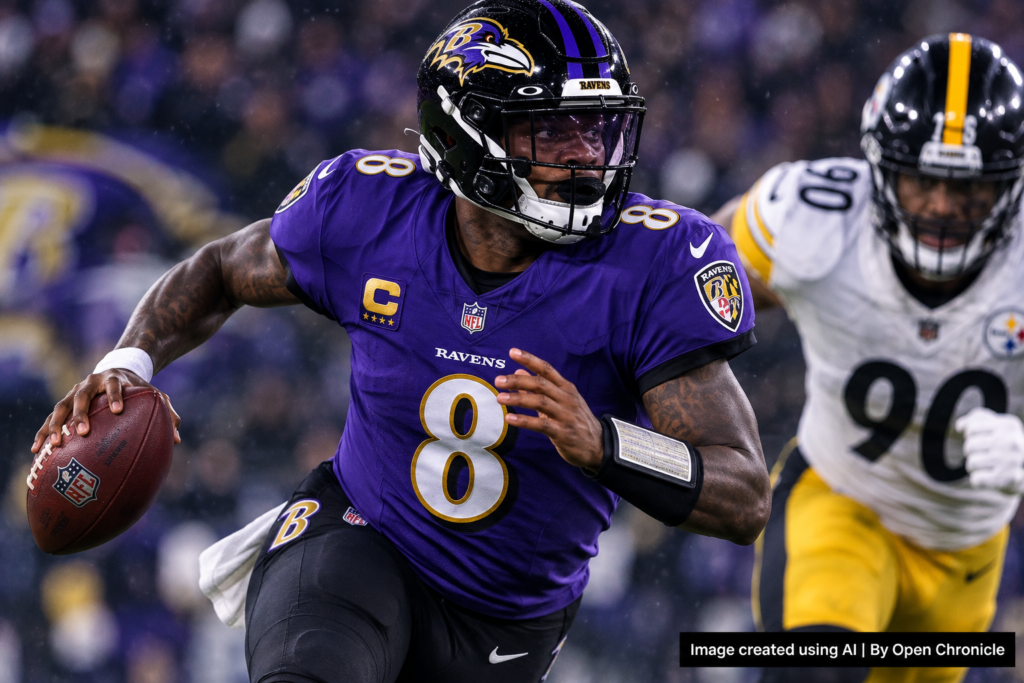
By Open Chronicle Sports
Players to Watch | Baltimore Ravens | Quarterback
There are quarterbacks who move well.
There are quarterbacks who can escape pressure.
And then there is Lamar Jackson.
Since arriving in Baltimore, Jackson has challenged one of the oldest assumptions in professional football: that a quarterback’s greatest influence must come almost exclusively from his arm.
Jackson can beat a defense by throwing from the pocket. He can extend a passing play until coverage collapses. He can escape pressure and turn a broken play into a first down.
But he can also do something even more disruptive.
He can force an entire defense to change its geometry simply because he might run.
That possibility has helped make Jackson one of the defining players of the modern NFL and one of the clearest examples of how the quarterback position continues to evolve.
A Different Kind of Quarterback
NFL defenses depend on assignments.
A defensive lineman attacks a particular gap. A linebacker watches a particular area. A defensive back follows a receiver or protects a zone.
Every player has a responsibility.
Lamar Jackson complicates those responsibilities.
Against a conventional quarterback, a defender may pursue the running back while assuming the quarterback will remain behind the line of scrimmage.
Against Jackson, that assumption can be fatal.
If the defender follows the running back, Jackson may keep the football.
If the defender remains focused on Jackson, space may open for the running back.
If another defender moves forward to help, Jackson may throw into the area that defender has just abandoned.
One decision creates another.
That is why Jackson’s influence cannot be measured simply by counting his rushing yards.
The threat of the run can be almost as important as the run itself.
The Mathematics of Eleven Against Eleven
Football is partly a game of numbers.
When a traditional quarterback hands the football to a running back, the quarterback usually stops being an immediate rushing threat. The defense can therefore commit its resources elsewhere.
A quarterback such as Jackson changes that calculation.
Baltimore can construct plays in which the defense must respect every potential ball carrier, including the quarterback.
Suddenly, the offense is playing something much closer to true eleven against eleven football.
One defender may be forced to account specifically for Jackson.
That player cannot fully commit to Derrick Henry.
Another defender may hesitate because Jackson could keep the ball around the edge.
That hesitation may create the lane Baltimore needs.
This is one reason the Ravens’ rushing attack can be so difficult to defend.
Jackson does not need to carry the football to influence where defenders move.
His presence is already part of the play.
More Than a Runner
Reducing Lamar Jackson to his running ability has always misunderstood the player.
His career numbers demonstrate that.
Through the end of the 2025 regular season, Jackson had thrown for 22,608 yards and 187 touchdowns while maintaining a career passer rating of 102.2. He had also accumulated 6,522 rushing yards and 35 rushing touchdowns.
Those figures describe something far more sophisticated than a running quarterback.
They describe a quarterback capable of attacking a defense in fundamentally different ways.
His 2024 season demonstrated the passing side particularly clearly.
Jackson threw for a career high 4,172 yards and 41 touchdowns against only four interceptions, producing a 119.6 passer rating. He simultaneously rushed for another 915 yards.
That combination is the problem.
Defenses cannot simply decide to stop Lamar Jackson the runner.
They must stop Lamar Jackson the quarterback at the same time.
The Open Field
Few moments in football reveal Jackson’s uniqueness better than when he reaches open space.
Defenders normally possess an advantage when pursuing quarterbacks.
They are often faster, more explosive and accustomed to tackling players who are trying primarily to protect themselves.
Jackson reverses that relationship.
His acceleration can erase pursuit angles.
His ability to change direction forces defenders to slow down.
His balance allows him to make cuts without surrendering momentum.
And because defenders know how dangerous he can be, they sometimes begin adjusting before Jackson has actually decided where he is going.
That is when the geometry changes.
A safety moves inward.
A linebacker hesitates.
A defensive end becomes concerned with containment rather than penetration.
Space appears somewhere else.
Jackson has influenced the defense without even touching that space himself.
Two MVP Seasons
Jackson’s impact quickly became impossible to dismiss.
His breakthrough 2019 season produced 3,127 passing yards, 36 passing touchdowns and 1,206 rushing yards. He was named NFL Most Valuable Player.
Four seasons later, he won the award again.
The second MVP was important because it demonstrated that Jackson was not simply the product of one extraordinary season or an offensive novelty defenses would eventually solve.
He had become one of the league’s enduring elite quarterbacks.
The evolution continued in 2024, when his passing production reached another level.
The trajectory matters.
Jackson entered the league as one of football’s most extraordinary athletes.
He developed into one of football’s most complete offensive problems.
Baltimore Built Around Lamar
The best NFL organizations do not force exceptional players into predetermined systems.
They identify what makes those players exceptional and construct systems capable of exploiting it.
Baltimore has repeatedly attempted to do that with Jackson.
The Ravens’ offense has incorporated quarterback runs, option concepts, play action, shotgun formations and formations designed to create uncertainty before the snap.
The arrival of Derrick Henry added another extraordinary dimension.
A defense confronting Baltimore could find itself worrying simultaneously about one of the most physically imposing running backs in football and one of the most dangerous running quarterbacks the league has ever seen.
Behind those threats remain the passing options.
Zay Flowers recorded 1,211 receiving yards in 2025, while Baltimore continued to deploy tight ends and receivers around Jackson’s ability to extend plays.
Every additional weapon increases the number of questions a defense must answer.
Jackson is the player asking those questions.
The Difficult 2025 Season
Great careers are not composed exclusively of upward movement.
Jackson’s 2025 season provided a reminder.
He appeared in 13 games, completing 63.6 percent of his passes for 2,549 yards, 21 touchdowns and seven interceptions. He added 349 rushing yards and two rushing touchdowns.
Those numbers would represent a productive season for many quarterbacks.
For Jackson, they represented a decline from the extraordinary standard established in 2024.
Injuries were an important part of the story.
Jackson missed four games and was not consistently at full strength during the season. Baltimore consequently enters 2026 hoping that a healthy Jackson can return to the level that made him an MVP candidate almost by default.
That context makes this season particularly interesting.
Jackson is not trying to prove that his style can succeed in the NFL.
He has already answered that question.
He is trying to demonstrate how high that style can climb again.
A New Offense for 2026
There is another reason to watch Jackson closely this season.
Baltimore has changed its offensive system.
New offensive coordinator Declan Doyle has introduced concepts that will ask Jackson to operate more frequently from under center, something that represents a noticeable adjustment from previous seasons.
More than 80 percent of Jackson’s dropback passes came from pistol or shotgun looks last season. During 2026 training camp, however, Baltimore has deliberately expanded his work from under center.
That may appear to be a technical detail.
It is potentially much more important.
Under center formations can alter the appearance of the running game, strengthen certain forms of play action and force defenses to process different information before and immediately after the snap.
For Jackson, it could add another layer of uncertainty.
A quarterback already famous for making defenses defend more possibilities may now be operating from an offense designed to create even more of them.
Jackson has responded positively to the new system and said during training camp that he believes his best football can still be ahead of him.
Ready for Week 1
Baltimore has treated Jackson carefully during the preseason.
He did not play in the Ravens’ opening preseason games, with the organization prioritizing preparation and health rather than unnecessary exhibition snaps.
The meaningful work has taken place in training camp and joint practices.
By August 26, Jackson said he felt fully ready for the regular season and comfortable with Doyle’s offense after months spent learning the system and developing chemistry with his teammates.
Baltimore opens its regular season against Indianapolis on September 13.
For Jackson, that game begins his ninth NFL season.
At 29, the Ravens believe their quarterback remains firmly in his prime.
The Championship Question
There is nevertheless one subject that follows every elite quarterback eventually.
January.
And February.
Individual excellence changes expectations.
Once a quarterback has won MVP awards, produced historic seasons and repeatedly carried his team into contention, regular season brilliance is no longer enough to define the conversation.
Championships enter it.
That is where Jackson’s story remains unfinished.
Baltimore has consistently been capable of competing with the NFL’s strongest teams during his era, but the Super Bowl appearance has remained elusive.
This should not erase what Jackson has accomplished.
It changes what comes next.
The question is no longer whether Lamar Jackson can become one of the great quarterbacks of his generation.
He already has.
The question is whether his extraordinary career will eventually include the championship moment that permanently changes how it is remembered.
What to Watch
When watching Lamar Jackson, resist the temptation to follow only the football.
Watch the defenders.
Before the snap, identify the defensive end closest to Jackson.
After the snap, see whether that defender attacks the running back or remains outside to contain the quarterback.
Watch the linebackers.
Do they move toward Jackson when he begins to scramble?
If they do, look at the space opening behind them.
Watch Jackson’s eyes when he leaves the pocket.
He may appear to be running, but he frequently remains a passer until the final possible moment.
Then watch his acceleration.
There are moments when a defensive pursuit angle looks correct until Jackson changes speed.
Suddenly it is not.
In 2026, there is something else to observe.
Watch where he takes the snap.
Baltimore’s increased use of under center formations could become one of the most interesting tactical developments of the Ravens’ new offense.
Why Lamar Jackson Represents the NFL
Patrick Mahomes demonstrates creativity.
Josh Allen demonstrates power.
Lamar Jackson demonstrates possibility.
He represents what happens when an extraordinary athlete enters a position governed by decades of convention and refuses to remain inside its traditional boundaries.
Defenses adapted.
Baltimore adapted.
The league adapted.
And Jackson adapted again.
That cycle is one of the fundamental characteristics of the NFL.
Innovation creates an advantage.
Opponents search for an answer.
The advantage evolves.
Football moves forward.
Lamar Jackson has been part of that process since the moment he became Baltimore’s starting quarterback.
He did not invent quarterback mobility.
He did something more important.
He demonstrated how completely mobility could become integrated into elite NFL quarterback play without sacrificing the ability to dominate through the air.
The result is a player who changes more than individual plays.
He changes where defenders stand.
He changes what they are responsible for.
He changes what they believe might happen next.
In football, controlling those possibilities is power.
Few players have ever possessed more of it than Lamar Jackson.