
By Open Chronicle
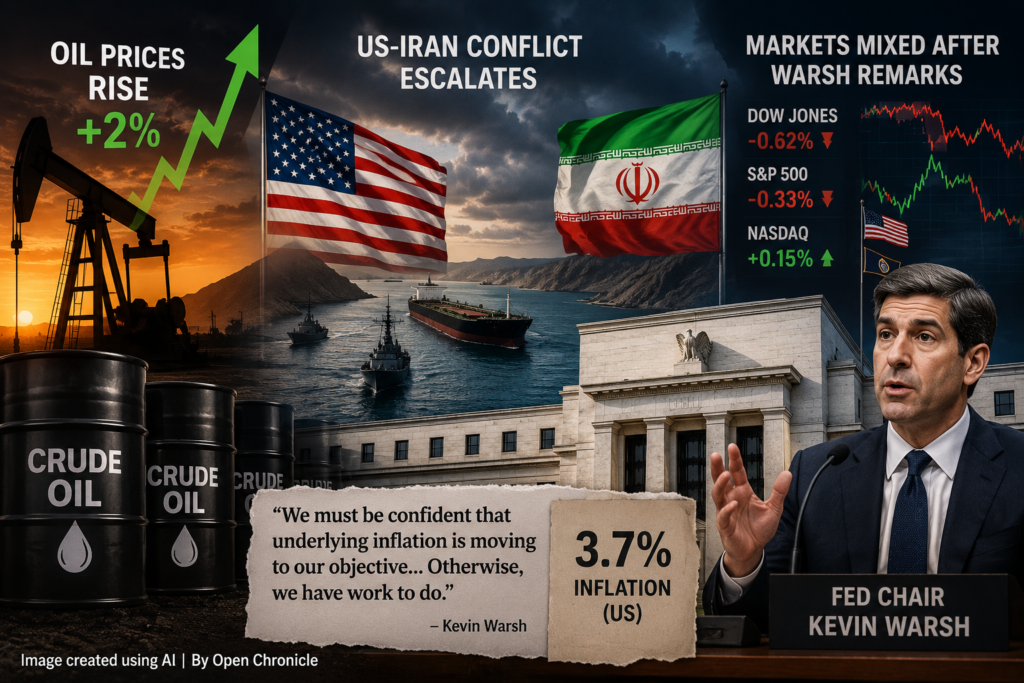
Oil prices rose sharply on Monday as renewed fighting between the United States and Iran revived concerns over energy supplies through the Strait of Hormuz, while global equity markets delivered a mixed performance following hawkish comments from Federal Reserve Chair Kevin Warsh.
Both major crude benchmarks gained more than 2 percent after Washington said it had struck Iranian rocket launchers on Larak Island in the Strait of Hormuz. The operation, the first reported US strike on Iranian territory in about a month, prompted retaliation from Tehran and renewed fears that a period of reduced hostilities could be ending.
The escalation comes just after the US-Iran conflict passed the six-month mark and places the Strait of Hormuz back at the centre of global market concerns. The waterway normally handles roughly one fifth of global oil consumption and remains crucial to international energy supplies.
Hormuz Risk Returns to Oil Markets
Crude prices had declined through much of the previous week as traders reduced some of the geopolitical premium built into energy markets during earlier phases of the conflict.
Monday’s developments abruptly changed that calculation.
The US attack and Iran’s subsequent retaliation highlighted the continuing vulnerability of shipping through Hormuz, where traffic has already been severely disrupted by the conflict.
Washington has been seeking to restore commercial navigation through the waterway while increasing economic pressure on Tehran. US officials have described their wider strategy as one aimed at intensifying economic pressure on Iran.
For energy markets, however, the immediate concern remains whether renewed military exchanges could further restrict shipping or damage regional energy infrastructure.
Stephen Innes of SPI Asset Management said the latest developments demonstrated how quickly geopolitical risk could return to crude markets after signs that physical flows through Hormuz were improving.
Warsh Puts Markets on Alert for Higher Rates
Energy prices were only one source of uncertainty for investors.
Markets were also digesting comments from Federal Reserve Chair Kevin Warsh at the Jackson Hole symposium in Wyoming, where he delivered a strong warning about persistent US inflation.
Inflation is currently running at around 3.7 percent, well above the Federal Reserve’s 2 percent target.
Warsh said policymakers needed to be confident that underlying inflation was returning towards the target at an adequate pace.
“We must be confident that underlying inflation is moving to our objective, clearly and at sufficient speed,” he said. “Otherwise, we have work to do.”
He described the latest inflation readings as concerning and questioned whether current financial conditions could genuinely be considered restrictive.
Those remarks were interpreted by investors as opening the possibility of another increase in US interest rates.
Warsh nevertheless avoided explicitly committing himself to a rate increase, saying he remained committed to a policy discipline rather than a specific decision.
Treasury Yields and Dollar Rise
The reaction was particularly visible in US financial markets.
All three major Wall Street indexes finished lower on Friday, while short-term Treasury yields increased as investors adjusted expectations for monetary policy.
The US dollar also strengthened against several major currencies.
Gold moved lower. The precious metal typically benefits from expectations of falling interest rates because it does not provide investors with an interest payment.
The combination of rising oil prices and potentially tighter monetary policy presents an uncomfortable scenario for financial markets.
Higher energy prices can contribute directly to inflation while also increasing transportation, manufacturing and household costs. Persistent inflation could then make it more difficult for the Federal Reserve to reduce borrowing costs.
Asian and European Markets Mixed
Asian markets initially struggled before recovering unevenly during Monday’s trading.
Tokyo, Hong Kong, Sydney, Taipei, Jakarta and Mumbai finished lower, while Seoul, Shanghai, Singapore, Bangkok and Wellington advanced.
European trading was similarly mixed. Paris moved higher while Frankfurt declined. London markets were closed for a holiday.
Investors are now attempting to determine whether Warsh’s comments represent preparation for an imminent tightening of monetary policy or simply an effort to maintain flexibility while the Federal Reserve waits for more economic data.
September Rate Increase Remains Uncertain
Despite the more hawkish tone from Jackson Hole, some analysts remain sceptical that the Federal Reserve will raise rates at its next meeting.
David Chao of Invesco said Warsh had increased the perceived probability of another rate increase but had deliberately avoided signalling a September move.
That puts considerable importance on the economic figures scheduled for release over the next two weeks.
The US employment report will provide another indication of the strength of the labour market, followed by fresh consumer price data.
Chris Weston of Pepperstone said an employment report broadly matching expectations could make the subsequent core inflation figures particularly important in determining market expectations for Federal Reserve policy.
That could produce significant volatility across bonds, currencies and equities.
Energy and Monetary Policy Become Increasingly Connected
The Iran conflict has complicated the Federal Reserve’s efforts to bring inflation under control.
Energy prices have remained elevated because of uncertainty surrounding Middle Eastern supplies, and another sustained increase in crude prices could feed through into transport costs and consumer prices.
This creates a difficult policy environment.
Higher interest rates could help contain inflation but would also increase borrowing costs for households and businesses. Keeping rates unchanged for too long, meanwhile, could allow inflationary pressures generated partly by energy prices to become more persistent.
The interaction between Hormuz and Federal Reserve policy is therefore becoming increasingly important for markets.
As Innes observed, renewed tension in the strait could effectively place a floor beneath oil prices just as Warsh’s inflation concerns reduce expectations that the Federal Reserve will tolerate prolonged price pressures.
Markets Face Two Major Sources of Uncertainty
Investors now confront two closely connected risks.
The first is geopolitical. Any further escalation involving Iran, the United States or neighbouring states could disrupt energy infrastructure and commercial shipping around the Gulf.
The second is monetary. If higher energy costs prevent inflation from falling towards the Federal Reserve’s target, US interest rates could remain elevated or potentially rise further.
Much will depend on whether the latest military exchange remains contained and whether shipping conditions through the Strait of Hormuz continue to improve.
For now, Monday’s surge in crude prices shows that markets remain extremely sensitive to developments in the Gulf.
After several days in which some of the conflict premium had begun disappearing from oil prices, the latest US-Iran exchange has provided another reminder that the Strait of Hormuz remains one of the most important geopolitical risks facing the global economy.