
By Open Chronicle with agencies
The US Treasury’s decision to expand purchases of longer dated government debt has renewed debate over whether investors are becoming more reluctant to hold American bonds for extended periods, and what that could mean for the cost and stability of financing the federal government.
The Treasury recently announced plans to double its buybacks of longer term debt following a rise in US bond yields. Yields initially declined after the announcement, although the effect proved temporary.
At the heart of the issue is a shift in the maturity profile of US government borrowing. By retiring longer dated securities while relying more heavily on shorter term issuance, the Treasury can potentially reduce current interest costs and relieve pressure on longer term yields.
But that strategy comes with risks of its own.
How the buyback strategy works
A Treasury buyback involves purchasing outstanding government securities from the market. In the framework described in the supplied analysis, shorter term borrowing effectively finances the retirement of longer term debt.
The result is a reduction in the average maturity of government borrowing.
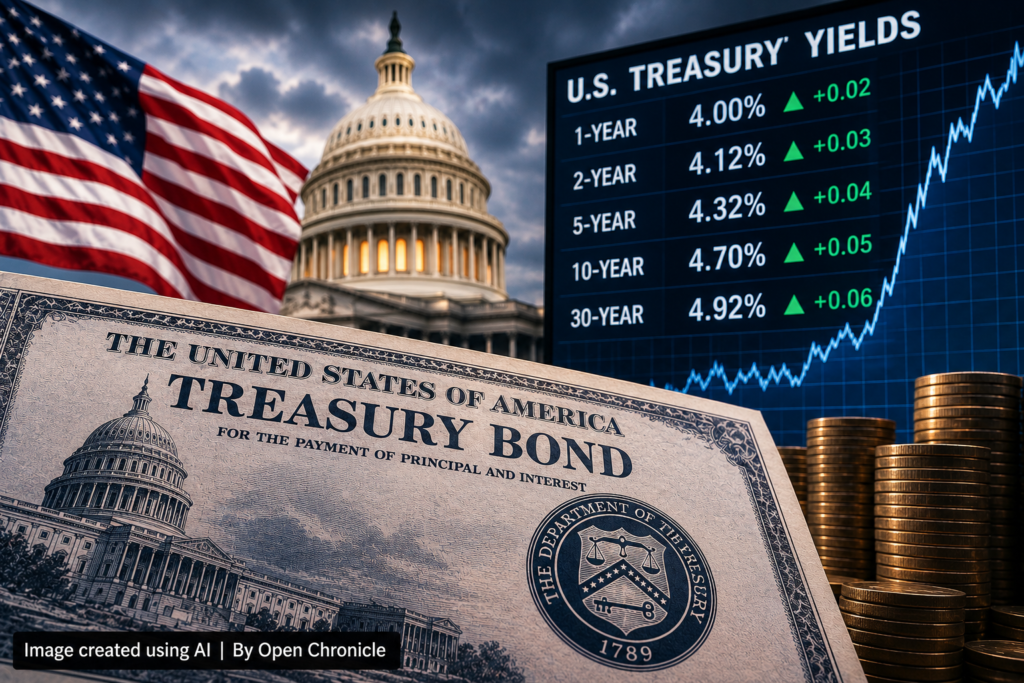
There are immediate financial advantages. According to the figures provided, the ten year Treasury yield stands at around 4.7%, compared with approximately 4% for one year debt.
Replacing some ten year borrowing with one year securities could therefore reduce the government’s immediate interest expense.
Lower longer term Treasury yields can also filter through the wider economy because government bonds serve as benchmarks for numerous forms of private borrowing.
Mortgage rates, corporate borrowing costs and other longer term credit products can consequently benefit when Treasury yields decline.
Lower costs today, greater refinancing risk tomorrow
The trade off is refinancing risk.
A government issuing ten year debt locks in its borrowing costs for a decade. With one year debt, it must return to the market much sooner.
If interest rates rise before that debt needs to be refinanced, today’s apparent savings can disappear rapidly.
This becomes particularly important when inflation remains uncertain. Federal Reserve Chair Kevin Warsh has indicated that rates could rise if inflation remains elevated, according to the supplied material.
Greater reliance on short term borrowing would therefore leave the Treasury more exposed to future changes in monetary policy and financial conditions.
Longer maturity borrowing is more expensive partly because investors normally demand compensation for committing their capital over longer periods. From the issuer’s perspective, however, that premium purchases something valuable: predictability.
What rising yields tell us
The more important question is why investors have demanded higher yields on longer term Treasury securities.
Bond prices and yields move in opposite directions. When demand for bonds weakens, prices generally fall and yields rise.
The recent increase in longer term yields can therefore be interpreted as evidence that investors require greater compensation to hold US government debt over extended periods.
That does not necessarily mean investors are losing confidence in the United States’ ability to repay its debts.
There are several possible explanations.
A strong economic outlook can push yields higher because investors find more attractive opportunities elsewhere and anticipate stronger growth. Alternatively, investors may demand higher returns because they are becoming more concerned about inflation, federal deficits or the trajectory of government debt.
Those explanations have very different implications for Washington.
Growth or fiscal anxiety?
Inflation expectations provide one way of distinguishing between them.
According to the supplied figures, the ten year breakeven inflation rate has increased by approximately 10 basis points since the beginning of the year. Over the same period, the actual ten year Treasury yield has risen by roughly 50 basis points.
If those figures accurately reflect market conditions, inflation expectations alone cannot explain most of the increase in Treasury yields.
That could indicate that stronger economic growth, changing investment opportunities and other market factors are playing significant roles.
However, breakeven inflation rates are imperfect measures, and fiscal concerns may still be contributing to the movement.
Investors are increasingly sensitive not simply to inflation but also to the volume of debt Washington must issue to finance persistent budget deficits.
Why the Treasury’s response matters
The Treasury’s decision to intervene through expanded buybacks itself provides another piece of the puzzle.
If rising yields were entirely the consequence of stronger economic growth, policymakers might have relatively little reason to suppress them. Higher yields generated by growing economic activity can be a normal feature of an expanding economy.
If officials believe yields are instead being pushed higher by deteriorating market liquidity, concerns about government finances or weakening demand for longer term securities, intervention becomes easier to understand.
The Treasury’s actions therefore raise questions about how policymakers themselves interpret recent bond market movements.
Critics may view the strategy as an attempt to influence longer term borrowing costs. Another interpretation is that the Treasury is adapting its financing operations to changing investor demand.
Are investors actually losing faith?
For now, describing the situation as a broad loss of faith in US government debt would go beyond the evidence presented.
Demand for shorter maturity Treasury securities remains comparatively stable, while rising longer term yields can result from several economic forces.
The more significant development may instead be a change in the type of risk investors are prepared to accept.
Investors can remain willing to lend to the US government while simultaneously becoming less enthusiastic about locking money into its debt for ten or thirty years without receiving substantially higher returns.
That distinction matters.
A preference for short term Treasury bills over longer maturity bonds does not necessarily represent a rejection of US government debt. It does, however, make financing the government more sensitive to changes in interest rates.
A potential feedback loop
The greatest longer term danger would emerge if the average maturity of US federal debt fell substantially.
Greater reliance on short term borrowing would require Washington to refinance a larger proportion of its debt more frequently. Rising interest rates could then translate into higher government borrowing costs much faster than under a longer maturity structure.
That could weaken the fiscal outlook, which in turn could make investors demand an even greater premium for holding longer term Treasury securities.
Such a cycle could reinforce the very movement toward short term borrowing that policymakers are currently using to reduce financing costs.
The current Treasury strategy therefore offers a clear trade off: lower borrowing costs and potentially reduced pressure on longer term yields today, in exchange for greater exposure to refinancing conditions and future interest rates.
Whether investors are genuinely losing faith in US Treasury bonds remains uncertain. What is clearer from the supplied data is that the market is demanding greater compensation for holding American government debt over longer periods, and Washington’s response could have important consequences for how the world’s largest sovereign debt market is financed in the years ahead.