
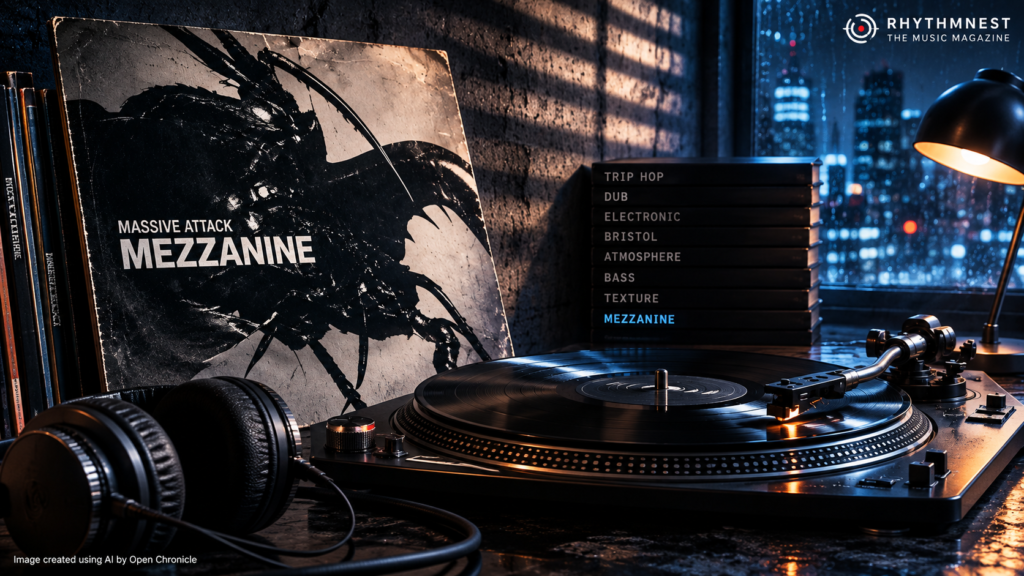
By RhythmNest
There are albums that belong to a particular decade, and there are albums that seem to exist outside time.
Mezzanine belongs to the second group.
Released by Massive Attack in 1998, the album arrived at a moment when electronic music was expanding rapidly beyond clubs and underground scenes. Sampling, hip hop production, dub, ambient music and increasingly sophisticated studio technology were beginning to reshape popular music. Yet Mezzanine did not sound like an attempt to capture that moment.
It sounded like something coming from somewhere else entirely.
Dark, physical, intimate and strangely futuristic, Mezzanine transformed the atmospheric foundations of trip hop into something heavier and more unsettling. Guitars appeared where listeners expected samples. Bass became almost architectural. Silence carried as much tension as percussion. Voices seemed to emerge from rooms barely illuminated.
More than a quarter of a century later, the remarkable thing is not simply that Mezzanine remains influential.
It is that it still sounds dangerous.
Bristol After Midnight
To understand Mezzanine, it helps to understand where Massive Attack came from.
The group’s roots lie in Bristol’s extraordinary musical culture of the 1980s, particularly the Wild Bunch sound system, where hip hop, reggae, dub, soul, funk and electronic music collided without much concern for conventional genre boundaries.
That philosophy became central to Massive Attack.
Their 1991 debut, Blue Lines, helped establish a new language for British electronic music. Slow breakbeats, sampling, dub influenced bass and soulful vocals created something that journalists would eventually call trip hop, although the musicians associated with the movement often resisted the term.
Protection followed in 1994, refining the formula with greater elegance and introspection.
But Mezzanine was different.
Instead of making another beautifully atmospheric record, Massive Attack moved toward confrontation.
The warmth began to disappear.
The lights went down.
And the music became heavier.
The Sound of Tension
The first thing that distinguishes Mezzanine is its extraordinary sense of tension.
Many electronic albums build excitement through tempo.
Mezzanine does almost the opposite.
Much of the record moves slowly, deliberately and sometimes ominously. The music rarely rushes because it does not need to.
The bass does much of the psychological work.
Low frequencies move beneath the songs like pressure building underground. Drums appear with enormous physical presence, while samples, guitars and electronic textures occupy carefully controlled spaces around them.
The production often feels minimal, but close listening reveals remarkable complexity.
Sounds appear briefly and disappear.
Reverberation creates imaginary spaces.
Distortion becomes texture.
Repetition creates anxiety rather than comfort.
There is always the sensation that something is approaching.
Angel
Few opening tracks establish an album’s identity as effectively as Angel.
The song begins almost cautiously.
A bass line emerges.
Then another layer.
Then another.
Gradually, the track becomes enormous.
Horace Andy’s distinctive voice floats above an arrangement that grows increasingly threatening, while guitars eventually transform the song into something approaching psychedelic rock.
Yet the transition never feels forced.
Electronic production, dub and rock become parts of the same language.
By the time Angel reaches its peak, Massive Attack have already explained what Mezzanine is going to be.
Not trip hop as background music.
Not electronic music designed simply for dancing.
Something much more physical.
Risingson
If Angel establishes the atmosphere, Risingson pulls the listener deeper inside it.
The rhythm feels almost narcotic.
Voices appear close to the listener, creating an uncomfortable intimacy. The track moves with the confidence of hip hop but without its conventional structure.
Nothing resolves completely.
That lack of resolution becomes one of the album’s defining characteristics.
Mezzanine rarely provides emotional release.
It prefers suspense.
Teardrop
And then comes Teardrop.
Perhaps the album’s most famous composition, it provides one of Mezzanine‘s rare moments of fragile beauty.
Elizabeth Fraser of Cocteau Twins delivers a vocal performance that seems almost detached from gravity. Her voice moves above a delicate rhythmic pattern while piano and electronic textures create an atmosphere simultaneously intimate and enormous.
The song demonstrates one of Massive Attack’s greatest strengths.
They understood that darkness becomes more powerful when contrasted with beauty.
Without Teardrop, Mezzanine might have become oppressively heavy.
Instead, the track opens a window.
Light enters briefly.
That makes the darkness surrounding it feel even deeper.
Inertia Creeps
If one song captures the physical character of Mezzanine, it may be Inertia Creeps.
Its rhythm feels mechanical, sensual and unsettling at the same time.
Rather than using percussion simply to establish tempo, Massive Attack turn rhythm into atmosphere.
The song seems to move through an enclosed space.
Bass, percussion and fragmented electronic sounds create a sense of movement without ever providing conventional momentum.
It is music that seems to breathe.
Slowly.
Heavily.
Uncomfortably.
Exchange
One of the album’s great strengths is its sequencing.
After periods of extraordinary density, Massive Attack understand when to remove elements.
Exchange functions almost like an empty room between more emotionally demanding pieces.
These quieter moments are essential.
They allow the listener’s ears to reset while preserving the album’s atmosphere.
That careful control of intensity is one reason Mezzanine works so effectively as a complete album rather than simply a collection of songs.
Dissolved Girl
Dissolved Girl pushes the record toward another kind of darkness.
Sara Jay’s vocal performance is surrounded by guitars, electronic textures and a restless rhythmic foundation.
The track captures something central to the album’s emotional vocabulary: intimacy that never feels entirely safe.
Throughout Mezzanine, closeness and danger repeatedly occupy the same space.
Love, desire, isolation and paranoia become difficult to separate.
Man Next Door
Massive Attack’s interpretation of Man Next Door, sung by Horace Andy, demonstrates how deeply reggae and dub remain embedded in the group’s musical DNA.
But this is not nostalgic reggae.
The song is reconstructed through the darker aesthetic of Mezzanine.
Bass becomes threatening.
Space becomes oppressive.
Repetition becomes psychological.
The result illustrates how Massive Attack could take existing musical traditions and completely alter their emotional temperature.
Black Milk
Black Milk returns to the album’s quieter side.
Elizabeth Fraser once again provides an ethereal counterweight to the record’s heavy production.
But even here, calm is deceptive.
The music contains an underlying unease.
Nothing on Mezzanine ever feels completely peaceful.
That is part of its brilliance.
Mezzanine
The title track feels almost like the album examining itself.
Slow rhythms, fragmented voices and carefully positioned electronic details create an atmosphere of surveillance and isolation.
By this point, the listener has become accustomed to the record’s language.
Bass means danger.
Silence means anticipation.
Repetition means instability.
Massive Attack have created their own sonic vocabulary.
Group Four
Then comes Group Four.
Beginning with restraint, the track gradually develops into one of the album’s most intense moments.
The arrangement expands until the controlled atmosphere that has dominated much of the record begins to fracture.
It feels like pressure finally escaping.
Yet even this release is temporary.
Mezzanine still has one final descent to make.
Exchange, Again
The closing reprise returns the listener to familiar material, but after everything that has happened, it feels different.
That circularity matters.
The album does not really conclude.
It fades back into its own atmosphere.
There is no triumphant ending.
No explanation.
Just the sensation that the world of Mezzanine continues somewhere after the speakers become silent.
Elizabeth Fraser and the Human Centre
One of the most important elements of Mezzanine is Elizabeth Fraser.
Her appearances provide an extraordinary emotional counterpoint to the album’s darker textures.
Fraser does not simply sing over Massive Attack’s production.
Her voice becomes another instrument within it.
Sometimes intimate.
Sometimes distant.
Sometimes almost impossible to decipher.
That ambiguity suits Mezzanine perfectly.
The album is rarely interested in explaining emotion directly.
It creates environments in which emotion can emerge.
Horace Andy and the Connection to Dub
Horace Andy provides another crucial element.
His unmistakable voice connects Mezzanine with the Jamaican musical traditions that had influenced Massive Attack from the beginning.
Dub is fundamental to understanding the album.
Not merely as a genre, but as a production philosophy.
Space matters.
Bass matters.
Echo matters.
What disappears from a recording can be just as important as what remains.
Massive Attack take those principles and transport them into an entirely different environment.
When Electronic Music Discovered the Guitar Again
One of Mezzanine‘s most significant departures from Massive Attack’s earlier work was its increased use of guitars.
But these guitars rarely behave like conventional rock guitars.
They become texture.
Noise.
Pressure.
Atmosphere.
This approach helped blur distinctions between electronic music and alternative rock at a time when those worlds were often treated as separate.
The influence would spread widely.
Electronic producers became increasingly comfortable incorporating rock instrumentation, while rock musicians became more willing to treat the studio itself as an instrument.
Production as Architecture
Listening to Mezzanine on good headphones reveals how carefully the album is constructed.
There is extraordinary depth in the mix.
Bass often occupies the physical centre.
Percussion establishes distance.
Vocals move between intimacy and abstraction.
Small electronic details appear at the edges.
Guitars sometimes arrive not as melodies but as walls.
This is production as architecture.
The listener does not simply hear the songs.
The listener enters them.
That spatial quality is one reason the album has aged so remarkably well.
Its production does not depend heavily on fashionable effects from the late 1990s.
Instead, it depends on fundamental principles of contrast, dynamics, texture and space.
Those principles do not become obsolete.
The Darkness Was Internal Too
The tension audible on Mezzanine was not entirely fictional.
Its creation came during a difficult period for Massive Attack, with creative disagreements over the musical direction of the group.
That context helps explain why the album feels so different from its predecessors.
This was not a comfortable refinement of an established formula.
It was a transformation.
Sometimes great records emerge from harmony.
Others emerge from friction.
Mezzanine sounds like friction converted into sound.
Beyond Trip Hop
Calling Mezzanine a trip hop album is useful.
It is also insufficient.
There is dub here.
Hip hop.
Electronic music.
Alternative rock.
Post punk darkness.
Ambient space.
Psychedelia.
Industrial textures.
Soul.
The remarkable achievement is that none of these influences feels separate.
Massive Attack absorb them into a single atmosphere.
That atmosphere became enormously influential.
You can hear echoes of Mezzanine across later electronic music, cinematic sound design, alternative rock, television scores and increasingly atmospheric forms of pop.
Its influence is sometimes obvious.
More often, it exists as a philosophy.
Slow down.
Remove unnecessary sound.
Let the bass speak.
Use silence.
Allow beauty and fear to occupy the same room.
Why Mezzanine Still Sounds Modern
Technology has transformed music production since 1998.
Software instruments can recreate enormous studios inside a laptop.
Thousands of effects are available instantly.
Entire arrangements can be constructed without touching a physical instrument.
Yet technology alone does not create atmosphere.
Mezzanine remains modern because its greatest innovations were conceptual rather than technological.
Massive Attack understood restraint.
They understood texture.
They understood tension.
Most importantly, they understood that listeners do not need every musical idea explained to them.
Mystery is part of the experience.
And mystery ages remarkably well.
RhythmNest Essential
Artist: Massive Attack
Album: Mezzanine
Released: 1998
Genre: Trip Hop, Electronic, Dub, Alternative
Essential Tracks: Angel, Teardrop, Inertia Creeps, Risingson, Group Four
Start Here
Teardrop
The most immediately accessible doorway into the album, and one of the finest demonstrations of its ability to combine vulnerability with electronic precision.
Listen For
The bass.
Not simply the notes being played, but the way low frequencies define the physical space of almost every composition.
Then listen again and concentrate on what happens around the bass.
The silences become just as important.
Best Moment
The gradual transformation of Angel from a restrained dub influenced opening into an enormous wall of sound.
It contains the entire philosophy of Mezzanine within a single track.
If You Only Hear One Track
Angel
Teardrop may be the better known song, but Angel reveals more completely what Massive Attack achieved with this album.
Where to Go Next
Massive Attack, Blue Lines
Return to the beginning and hear how radically the group evolved.
Portishead, Dummy
Another essential Bristol record, but built around a very different kind of darkness.
Tricky, Maxinquaye
A more fractured, intimate and unsettling branch of the same musical environment.
Massive Attack, Protection
The bridge between the warmth of Blue Lines and the darkness that would consume Mezzanine.
Final Thoughts
Some records invite you to sing along.
Some invite you to dance.
Mezzanine invites you inside.
Once there, it changes the dimensions of the room.
The bass becomes heavier. The shadows become longer. Small sounds suddenly matter. Silence becomes uncomfortable.
That is why the album remains extraordinary.
Massive Attack did not simply make a darker electronic record. They discovered how darkness itself could become part of musical composition.
Beauty exists throughout Mezzanine, but it is rarely comfortable beauty.
It is fragile, nocturnal and sometimes threatening.
Twenty eight years after its release, the album still feels like something discovered rather than something manufactured.
Put on headphones.
Turn off the lights.
Start with Angel.
And let the record build the room around you.
RhythmNest Rating: ★★★★★
RhythmNest Library: The Record Shelf