
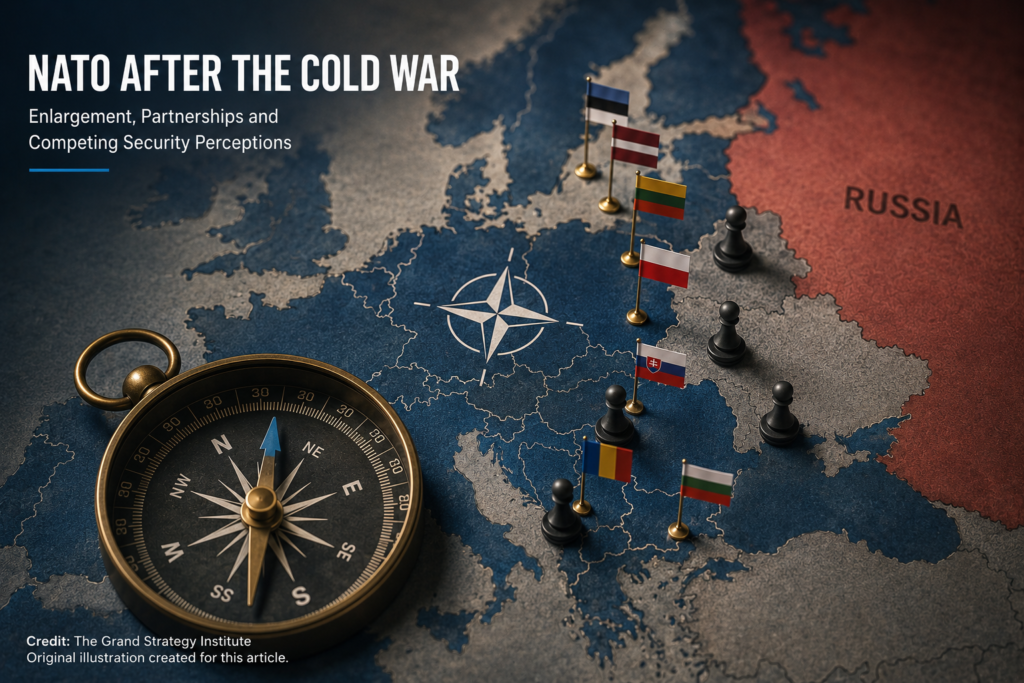
Chapter 4
NATO After the Cold War
Enlargement, Partnerships and Competing Security Perceptions
Part I — Foundations of the Conflict
Strategic Assessment SA-001 — The Russia–Ukraine War
The Grand Strategy Institute · Research Division
The end of the Cold War confronted NATO with a paradox.
The Alliance had achieved the strategic objective for which it had been created: the Soviet Union had collapsed, the Warsaw Pact had disappeared and the prospect of large scale conventional war between opposing military blocs in Europe had receded dramatically.
Yet NATO did not dissolve.
Instead, it transformed.
The Alliance reduced its dependence on the Cold War military posture, expanded dialogue with former adversaries, created new partnership structures, intervened in crises beyond its members’ territory, and eventually admitted many of the Central and Eastern European states that had previously belonged to the Soviet sphere.
This transformation became one of the most consequential developments in the post-Cold War European order.
To NATO members and many Central and Eastern European governments, enlargement represented the institutional extension of a Europe increasingly organised around sovereign choice, democratic reform and collective defence.
To Moscow, however, the same process increasingly came to represent the geographical expansion of a military alliance towards Russia’s borders and the erosion of strategic depth that Russian leaders had historically considered essential to national security.
These interpretations were not identical.
Nor were they mutually exclusive in every respect.
NATO genuinely attempted to develop cooperation with Russia while simultaneously enlarging.
Central and Eastern European states genuinely sought membership because of their own histories and security calculations.
Russian concerns about the military consequences of enlargement were also genuine.
The strategic problem was that the post-Cold War security architecture attempted to reconcile three principles that became increasingly difficult to satisfy simultaneously:
the sovereign right of states to choose their alliances;
NATO’s open door policy;
and
Russia’s demand for a security environment in which Western military structures would not continue moving closer to Russian territory.
Ukraine would eventually become the place where those principles collided most violently.
4.1 NATO’s Post-Cold War Identity Crisis
In 1989 and 1991, NATO faced a basic strategic question.
What was the purpose of an alliance whose principal adversary had disappeared?
During the Cold War, the answer had been relatively straightforward.
NATO existed to deter Soviet aggression and defend its members’ territory.
The disappearance of the Warsaw Pact and then the Soviet Union fundamentally altered that environment.
The Alliance’s 1991 Strategic Concept reflected this transformation. NATO described the new European environment as significantly improved and emphasised dialogue, cooperation and collective defence as mutually reinforcing components of security. The document explicitly sought broader partnership with former adversaries and described a Europe in which old divisions could be reduced through cooperation.
This represented a major conceptual departure.
NATO would remain a military alliance.
But it would increasingly become something more.
A political institution.
A framework for security cooperation.
A mechanism for defence reform.
A crisis management organisation.
And eventually, a pathway through which post communist states could anchor themselves within the Euro-Atlantic order.
This transformation was gradual rather than predetermined.
In the early 1990s, there was no universal consensus about how far NATO should expand or how its relationship with Russia should evolve.
The architecture emerged through successive decisions.
Those decisions would shape European security for the next three decades.
4.2 The Sovereignty Principle
One of the core ideas underlying NATO’s post-Cold War transformation was the principle that sovereign European states should be able to determine their own security relationships.
This principle carried enormous significance in Central and Eastern Europe.
For governments that had spent decades inside the Warsaw Pact or under Soviet political domination, independence was not simply the absence of occupation.
It meant the ability to make foreign and security policy decisions without external veto.
From this perspective, the right to seek NATO membership was inseparable from sovereignty itself.
Poland did not regard membership primarily as an act of hostility towards Russia.
Neither did Czechia, Hungary or later the Baltic states.
They saw membership as insurance against the possibility that history might reverse.
The memories shaping their decisions were different from those shaping Western European governments.
Poland remembered invasion and partition.
The Baltic states remembered Soviet annexation.
Czechoslovakia remembered 1968.
Hungary remembered 1956.
For these states, Russia was not an abstract security concern.
It was embedded in historical memory.
This helps explain why the demand for NATO membership came strongly from Central and Eastern Europe itself rather than simply being imposed outward by Washington.
The enlargement debate therefore cannot be understood accurately if the agency of those states is ignored.
4.3 Partnership Before Enlargement
Before large scale enlargement occurred, NATO attempted to construct an inclusive security architecture through partnership.
At the 1990 London Summit, Allied leaders offered a new cooperative relationship to former adversaries.
The North Atlantic Cooperation Council followed in 1991.
In 1994, NATO established the Partnership for Peace, or PfP, providing a framework for practical military and political cooperation with countries across Central and Eastern Europe and the former Soviet Union.
The programme was significant because it created several possible relationships between NATO and non-members.
A state could cooperate militarily with the Alliance without receiving Article 5 protection.
It could reform armed forces.
Participate in exercises.
Develop interoperability.
Contribute to peacekeeping operations.
And deepen political relationships without immediate accession.
Russia itself participated in partnership mechanisms.
So did Ukraine.
The early post-Cold War system was therefore not initially structured simply around NATO members versus Russia.
It contained multiple overlapping levels of cooperation.
This flexibility created optimism that a security order might emerge in which NATO could survive while Russia participated constructively in a wider European framework.
That possibility should not be underestimated.
For a time, it appeared plausible.
4.4 NATO Enlargement Becomes Policy
By the middle of the 1990s, enlargement moved from possibility to policy.
NATO’s 1995 Study on Enlargement argued that admitting new members could strengthen security and stability across the Euro-Atlantic area. According to NATO’s institutional account, the end of the Cold War provided an opportunity to extend stability to the new democracies of Central and Eastern Europe.
The strategic logic had several components.
Membership could reduce uncertainty in Central Europe.
It could encourage defence reform.
It could strengthen democratic civilian control over armed forces.
It could integrate militaries into common planning structures.
It could reduce incentives for competitive national rearmament.
And it could provide formal security guarantees that might prevent future regional instability.
This was the optimistic interpretation.
But enlargement also contained a harder geopolitical reality.
Article 5 protection would move eastward.
Military planning would eventually include territories once located within the Soviet strategic perimeter.
The political border of the Western security system would shift.
The enlargement process therefore simultaneously produced integration for some states and strategic contraction for Russia.
That tension was built into the architecture from the beginning.
4.5 The First Enlargement: 1999
In 1997, NATO invited Czechia, Hungary and Poland to begin accession negotiations.
They formally joined the Alliance on 12 March 1999.
This was the first post-Cold War enlargement.
Its political significance was enormous.
Former Warsaw Pact members were now protected by the same collective defence commitment that had once been designed to defend Western Europe from the Soviet alliance.
For the new members, this represented the end of geopolitical ambiguity.
They had joined the Western institutional system not merely economically or politically but militarily.
For NATO, enlargement represented the belief that the Alliance could expand without recreating Cold War confrontation.
For Russia, however, the strategic meaning was more difficult.
Moscow had lost its former military bloc.
It had withdrawn forces from much of Eastern Europe.
Yet the opposing alliance survived and expanded into territory from which Soviet forces had previously withdrawn.
Even during periods of cooperation, Russian officials repeatedly raised concerns about this asymmetry.
The seeds of future conflict were therefore present even during the apparent high point of post-Cold War integration.
4.6 NATO and Russia: Cooperation and Contradiction
The NATO-Russia relationship during the 1990s is often described too simply.
It was neither a straightforward partnership nor an inevitable confrontation.
It contained elements of both.
In 1997, NATO and Russia signed the Founding Act on Mutual Relations, Cooperation and Security.
The document declared that NATO and Russia did not consider one another adversaries and committed both sides to consultation, cooperation and the goal of an inclusive Euro Atlantic peace.
Russian troops also participated alongside NATO forces in peacekeeping operations in the Balkans.
This was historically significant.
Former adversaries were conducting military operations within overlapping structures.
The possibility of cooperative European security was therefore not imaginary.
But the Founding Act did not resolve the central question.
Russia wanted recognition of its security interests.
NATO insisted that sovereign states retained the right to choose their own alignments.
Those principles could coexist while enlargement remained limited.
They became harder to reconcile as NATO continued moving east.
4.7 Kosovo and the Collapse of Strategic Trust
The Kosovo intervention of 1999 became a major turning point.
NATO launched military operations against the Federal Republic of Yugoslavia without explicit authorisation from the United Nations Security Council.
Western governments justified the intervention principally through humanitarian concerns and the need to prevent further violence in Kosovo.
Russian leaders interpreted it very differently.
For Moscow, Kosovo appeared to demonstrate that NATO had transformed from a defensive alliance into an organisation willing to use force outside member territory without Russian consent and outside the traditional Security Council framework.
This mattered because Russia possessed a permanent seat and veto in the UN Security Council.
If NATO could conduct major military operations without that institution, one of Moscow’s principal mechanisms of influence over international security became less important.
The Kosovo war therefore contributed to a broader Russian conclusion.
NATO enlargement was not simply the expansion of a static defensive alliance.
The Alliance itself was changing.
That perception would influence later Russian assessments of Western military interventions.
4.8 The 1999 Strategic Concept
NATO’s own 1999 Strategic Concept reflected this transformation.
Collective defence remained central.
But the Alliance now explicitly incorporated crisis management and partnership into its fundamental security tasks.
The document also reaffirmed that NATO remained open to additional European members capable of fulfilling the requirements of membership.
This represented a more ambitious institution than the NATO of the early Cold War.
The Alliance was no longer concerned only with defending existing territory.
It increasingly sought to shape the wider European security environment.
That expansion of purpose was interpreted differently depending upon perspective.
From Brussels and Washington, it represented adaptation.
From many aspiring members, it represented opportunity.
From Moscow, it increasingly looked like institutional expansion.
4.9 The Membership Action Plan
At the 1999 Washington Summit, NATO created the Membership Action Plan, or MAP.
The purpose was to help aspiring members prepare politically, militarily and institutionally for possible accession.
MAP did not guarantee membership.
But it created a formal mechanism through which states could move closer to NATO standards.
The distinction between partnership and membership consequently became more structured.
States increasingly travelled along identifiable paths.
Partnership.
Reform.
Interoperability.
Membership preparation.
Accession.
This institutional progression was important because it made NATO enlargement less episodic.
It became a process.
That process increasingly shaped the strategic expectations of countries across Eastern Europe.
4.10 The Second Enlargement: 2004
The largest wave of NATO enlargement occurred in 2004.
Bulgaria.
Estonia.
Latvia.
Lithuania.
Romania.
Slovakia.
Slovenia.
All seven joined the Alliance on 29 March 2004.
This transformed the strategic geography of Europe much more dramatically than the 1999 enlargement.
The accession of Estonia, Latvia and Lithuania was particularly important.
These were not merely former Warsaw Pact members.
They had been republics of the Soviet Union itself.
NATO now directly bordered the Russian Federation along territory that had been part of the USSR little more than a decade earlier.
From the Baltic perspective, membership protected against precisely the historical danger they feared.
From the Russian perspective, the expansion reinforced the perception that the strategic settlement following Soviet withdrawal had evolved overwhelmingly in the West’s favour.
The same event therefore represented security for one side and insecurity for the other.
This is a classic example of the security dilemma.
4.11 The Security Dilemma
The security dilemma occurs when defensive measures undertaken by one state create insecurity in another.
The Baltic states sought NATO membership because they feared future Russian coercion.
Russia interpreted NATO membership of the Baltic states as evidence that Western military infrastructure was moving closer to Russian territory.
Russian military modernisation then increased Baltic fears.
Those fears strengthened support for NATO presence.
The cycle reinforces itself.
No side needs to begin with an intention to launch aggression for the dynamic to become destabilising.
Perception is sufficient.
This is one of the most important analytical concepts for understanding post-Cold War European security.
It explains how actors pursuing what they describe as defensive objectives can collectively produce a more confrontational environment.
4.12 Enlargement and the Russian Narrative of Encirclement
By the mid 2000s, NATO enlargement had become central to Russian political rhetoric.
The Russian argument increasingly emphasised several points.
The Cold War had ended.
The Warsaw Pact had dissolved.
Soviet forces had withdrawn.
Russia had accepted German reunification.
Yet NATO had not dissolved.
Instead, it expanded.
From the Russian perspective, this appeared to create an asymmetric post-Cold War settlement.
Western institutions grew.
Russian institutions contracted.
The geographical boundary of NATO moved east.
Moscow’s influence diminished.
This narrative became deeply embedded in Russian strategic culture.
It would later be used to support the argument that the post-Cold War settlement had been constructed at Russia’s expense.
The historical accuracy of every element of that narrative is less important than the fact that Russian policymakers increasingly believed it.
Strategic behaviour responds to perceived reality as well as objective capability.
4.13 The Question of Promises
One of the most contested historical debates concerns whether Western leaders promised the Soviet leadership that NATO would not expand eastward after German reunification.
This issue has acquired enormous political significance.
The documentary record demonstrates that discussions in 1990 included assurances and proposals concerning NATO military jurisdiction and the status of East Germany during reunification negotiations.
What remains contested is whether these conversations constituted a broader binding commitment preventing later NATO enlargement across Central and Eastern Europe.
No formal treaty established such a general prohibition.
Western governments therefore argue that no binding commitment preventing future enlargement existed.
Russian officials have repeatedly argued that the political understanding of the period was nevertheless violated.
The distinction matters.
International relations often operate not only through written treaties but through expectations.
A legal commitment and a political expectation are not the same thing.
But the collapse of expectations can still damage trust.
The dispute over what was or was not promised became part of a larger Russian narrative that the West had exploited Russian weakness during the 1990s.
4.14 Central European Agency
An exclusive focus on Western and Russian decisions can produce another analytical distortion.
It can turn Central and Eastern European states into passive objects.
They were not.
Poland actively sought NATO membership.
The Baltic states actively sought membership.
Romania and Bulgaria actively pursued integration.
These governments did not believe that Russia should possess a veto over their sovereign foreign policy.
This is fundamental.
A European security arrangement satisfying Russia by permanently excluding willing Central and Eastern European states from NATO would itself have imposed limits upon their sovereignty.
The problem therefore had no simple solution.
Respect Russian security concerns too extensively and the sovereignty of neighbouring states becomes constrained.
Ignore Russian security concerns entirely and strategic confrontation becomes more likely.
The post Cold War system never fully resolved this contradiction.
4.15 NATO Beyond Europe: Afghanistan
The terrorist attacks of 11 September 2001 produced another major transformation.
For the first time in its history, NATO invoked Article 5.
But the resulting military campaign was not conducted primarily in Europe.
It was conducted in Afghanistan.
NATO eventually led the International Security Assistance Force there for many years.
The Alliance was now operating far beyond the traditional territorial perimeter for which it had originally been designed.
Its threat assessment had changed.
Terrorism.
Weapons proliferation.
Failed states.
Cyber threats.
Missile proliferation.
These increasingly competed with conventional territorial defence for strategic attention.
NATO’s institutional history identifies this period as one in which the Alliance expanded partnerships and operational capabilities to address increasingly global challenges.
This created another paradox.
While NATO increasingly viewed itself as a global security management organisation, Russia continued to assess it partly through traditional military geography.
The two sides were increasingly interpreting the same institution through different strategic frameworks.
4.16 NATO and Ukraine After 1991
Ukraine occupied a unique position.
It was neither immediately seeking full integration into NATO nor willing to return entirely to Russian strategic control.
Instead, Kyiv developed a complex relationship with the Alliance.
Ukraine joined the Partnership for Peace.
It developed military cooperation with NATO.
Ukrainian forces contributed to international operations.
Interoperability increased.
Political dialogue deepened.
Yet domestic opinion on NATO membership remained divided for many years.
Ukrainian governments alternated between closer Western integration and policies designed to preserve strategic balance.
This ambiguity allowed Ukraine to cooperate with NATO without immediately forcing a final geopolitical choice.
For a time, that ambiguity was sustainable.
Over time, it became less so.
4.17 The Orange Revolution and Strategic Perception
The Orange Revolution of 2004 altered Russian perceptions of Ukraine’s political trajectory.
From the Ukrainian perspective, the crisis centred on contested elections, political mobilisation and demands for democratic accountability.
From Moscow’s perspective, it increasingly appeared as part of a broader pattern of Western supported political transformations across the post Soviet space.
This interpretation mattered because it connected NATO enlargement to domestic political change.
Russia increasingly viewed Western institutions not merely as military structures but as components of a wider geopolitical system capable of reducing Russian influence through political, economic and civil society mechanisms.
The distinction between security competition and regime competition therefore began to blur.
Ukraine became central to this interpretation.
4.18 The Bucharest Summit
The NATO Summit in Bucharest in April 2008 became one of the most consequential moments in the history of the Russia-Ukraine relationship.
Ukraine and Georgia sought closer movement towards NATO membership.
Allied governments were divided.
Some supported granting them a Membership Action Plan.
Others feared that doing so would unnecessarily provoke Russia and create security commitments the Alliance might not be prepared to enforce.
The compromise produced a historically ambiguous outcome.
NATO did not grant MAP.
But Allied leaders declared that Ukraine and Georgia would become members of NATO.
This decision created a strategic problem.
It offered a political promise without an immediate security guarantee.
Ukraine and Georgia were told that membership lay in their future.
But they remained outside Article 5 protection.
From Moscow’s perspective, the declaration suggested that NATO enlargement into two strategically important former Soviet republics remained an explicit objective.
From Kyiv and Tbilisi, it created expectations.
From a deterrence perspective, however, the states remained vulnerable.
This may have been one of the least stable possible outcomes.
4.19 The Strategic Ambiguity of Bucharest
Bucharest deserves particular analytical attention because it illustrates the difference between political signalling and military commitment.
A formal NATO member receives collective defence protection.
A non-member receives none.
Ukraine and Georgia occupied an intermediate position.
They were not neutral in the political sense because NATO had declared their future membership.
But they were not protected in the military sense because no accession had occurred.
The arrangement therefore generated political stakes without corresponding deterrence.
Russia could interpret future enlargement as a threat.
Yet the Alliance had no treaty obligation to defend either state while they remained outside NATO.
This strategic ambiguity would soon be tested.
4.20 Georgia 2008
Only months after Bucharest, war erupted between Russia and Georgia.
The conflict had complex immediate origins involving South Ossetia, Georgian military action and Russian intervention.
Its wider strategic significance was unmistakable.
A former Soviet republic seeking NATO membership had entered direct war with Russia.
Russian forces demonstrated that Moscow was prepared to use conventional military power in the post Soviet space.
The war changed assumptions across the region.
For states fearing Russia, it strengthened the argument that NATO membership was necessary.
For Moscow, the conflict demonstrated willingness to enforce red lines militarily.
For NATO, it raised an uncomfortable question.
How far could the open door policy extend when potential members were engaged in unresolved territorial conflicts with Russia?
The strategic contradiction intensified.
4.21 NATO’s 2010 Strategic Concept
At Lisbon in 2010, NATO adopted another Strategic Concept.
The Alliance identified three core tasks:
collective defence,
crisis management,
and cooperative security.
It reaffirmed the open door policy and emphasised partnerships as important instruments of international security.
The document reflected a period in which NATO still sought cooperation with Russia.
The focus remained heavily influenced by Afghanistan, terrorism, missile defence, proliferation and emerging threats.
Large scale conventional war in Europe was not treated as the central organising problem it had been during the Cold War.
That assumption would soon prove increasingly fragile.
4.22 The NATO Russia Reset
The early 2010s produced another attempt to improve relations.
Western governments pursued various forms of reset or pragmatic cooperation with Moscow.
Russia and NATO shared interests in areas such as counterterrorism, Afghanistan logistics and arms control.
Economic interdependence between Russia and Europe deepened.
Russian energy supplied European markets.
European capital and technology flowed into Russia.
From one perspective, this appeared to validate the assumption that economic integration would reduce geopolitical confrontation.
Yet underneath this cooperation, structural disagreements remained unresolved.
NATO enlargement.
Missile defence.
Kosovo.
Georgia.
Ukraine.
The political future of the post Soviet space.
The appearance of normalisation therefore concealed a persistent strategic dispute.
4.23 Ukraine’s Non-Bloc Policy
In 2010, under President Viktor Yanukovych, Ukraine formally adopted a non bloc position.
This appeared to reduce one of the most contentious questions in Russia-NATO relations.
Ukraine was not seeking immediate membership.
The policy reflected domestic divisions and Yanukovych’s preference for balancing relations between Russia and the West.
Yet neutrality or non-alignment is sustainable only if several conditions exist.
The state itself must support it.
Major external powers must accept it.
And credible security arrangements must protect it.
Ukraine possessed none of these conditions fully.
Its domestic politics remained contested.
Its economic orientation remained divided.
Russia and the European Union competed for influence.
The Budapest Memorandum did not provide an Article 5 style guarantee.
The non-bloc status therefore reduced immediate pressure without resolving Ukraine’s deeper strategic vulnerability.
4.24 The EU Dimension
NATO was not the only institution shaping Ukraine’s geopolitical trajectory.
The European Union became increasingly important.
For many Central and Eastern European states, EU and NATO integration had developed together.
The EU provided economic, legal and political integration.
NATO provided security.
Russia increasingly viewed these institutions as components of a broader Western geopolitical expansion, even though their functions were different.
This perception became particularly significant in Ukraine.
The crisis that began in 2013 was not initially triggered by NATO membership.
It began over an association agreement with the European Union.
Yet the confrontation quickly became connected to the wider question of Ukraine’s geopolitical orientation.
This illustrates how security competition had expanded beyond military alliances alone.
4.25 Crimea Changes NATO
Russia’s annexation of Crimea in 2014 fundamentally altered NATO’s strategic assumptions.
The post-Cold War belief that major territorial revision through military force had largely disappeared from Europe could no longer be maintained.
Russia had used military power to change an internationally recognised border.
Conflict had begun in the Donbas.
NATO consequently began returning attention towards territorial defence and deterrence.
The Alliance’s own institutional history identifies 2014 as the beginning of a major shift towards renewed strategic competition and strengthened eastern flank defence.
This was a profound reversal.
The NATO that had spent much of the previous decade focused on Afghanistan now had to reconsider Russia as a major military challenge.
The post-Cold War cycle was beginning to close.
4.26 The Eastern Flank
After 2014, NATO strengthened its military posture in Central and Eastern Europe.
Exercises increased.
Air policing expanded.
Readiness measures were strengthened.
Multinational forces were deployed to the eastern flank.
The strategic logic was deterrence.
The Alliance wanted to demonstrate that an attack upon eastern members would trigger a multinational response from the beginning of a conflict.
This was especially important for the Baltic states.
Their geography makes them difficult to reinforce quickly.
A visible NATO presence therefore served not merely operational purposes but political ones.
It demonstrated that defence of the eastern members was inseparable from defence of the Alliance as a whole.
Russia interpreted these deployments as further evidence of NATO military expansion.
The security dilemma deepened again.
4.27 Ukraine After 2014
The relationship between Ukraine and NATO changed dramatically after Crimea and the Donbas war.
Ukraine’s previous balancing strategy became politically far less viable.
Public opinion shifted.
Military cooperation with NATO expanded.
Western training increased.
Ukrainian armed forces began adapting more closely to NATO practices.
Defence reform accelerated.
Interoperability improved.
Ukraine remained outside NATO.
But the practical distance between Ukrainian and Western military institutions narrowed significantly.
From Kyiv’s perspective, this was a response to Russian military action.
From Moscow’s perspective, it confirmed the very Western strategic penetration Russia claimed to fear.
Again, cause and response became mutually reinforcing.
4.28 NATO’s Open Door and the Russian Veto Problem
The central political dispute increasingly became explicit.
Could Russia possess a veto over NATO membership decisions concerning neighbouring states?
NATO’s answer was no.
The Alliance’s open door principle held that European states meeting membership conditions could seek accession and that no third country possessed authority to prevent them from doing so.
Russia’s position was fundamentally different.
Moscow increasingly argued that the security choices of neighbouring states could not legitimately impose strategic insecurity upon Russia.
This was not merely a disagreement over Ukraine.
It was a disagreement over the nature of sovereignty.
NATO interpreted sovereignty as including alliance choice.
Russia increasingly interpreted security as requiring limits upon the alliance choices of strategically important neighbours.
Those two principles were increasingly incompatible.
4.29 The Problem of Indivisible Security
Russian diplomacy frequently invoked the concept of indivisible security.
The principle, articulated in various European security documents, holds broadly that the security of one state should not be strengthened at the expense of another.
Moscow argued that NATO enlargement violated this idea.
Western governments emphasised another principle contained in the European security order:
states possess the right to choose their own security arrangements.
Both claims referred to elements of the same post-Cold War diplomatic architecture.
The problem was that the principles could conflict.
If Ukraine joined NATO, Russia might claim its security had been diminished.
If Ukraine were permanently prevented from joining because Russia objected, Ukraine could claim its sovereignty had been diminished.
There was no neutral formula capable of satisfying both completely.
That contradiction eventually became one of the core disputes preceding the 2022 invasion.
4.30 NATO Was Not a Monolith
Another important analytical point is that NATO did not possess a single view of Russia or Ukraine.
The Alliance operates through consensus.
Its members had different histories and strategic priorities.
Poland and the Baltic states generally viewed Russia with significantly greater concern.
Germany and France often prioritised dialogue and economic relations more heavily.
The United States alternated between engagement and deterrence depending upon administration and strategic context.
Southern European states often focused more heavily upon instability in North Africa and the Mediterranean.
Turkey pursued its own complex relationship with Moscow.
This internal diversity matters because NATO policy frequently represented compromise rather than a unified geopolitical design.
The Bucharest Summit itself demonstrated these divisions.
Understanding NATO as a single actor with a perfectly coherent long term plan risks oversimplifying the history.
4.31 Was Enlargement a Strategic Error?
The question remains intensely debated.
Critics argue that NATO enlargement unnecessarily alienated Russia, weakened the possibility of an inclusive European security order and eventually contributed to the confrontation over Ukraine.
Supporters respond that enlargement stabilised Central and Eastern Europe, protected vulnerable democracies and reflected the sovereign choices of states with legitimate historical reasons to fear Russian dominance.
Both arguments contain important truths.
Enlargement produced genuine security benefits for new members.
It also produced genuine Russian strategic resentment.
The analytical challenge is distinguishing between consequence and responsibility.
A policy can contribute to another state’s threat perception without making that state’s later use of force inevitable or legitimate.
Likewise, the fact that Russia exploited enlargement rhetorically does not mean Russian concerns were entirely fabricated.
Strategic analysis requires holding both propositions simultaneously.
4.32 The Counterfactual Problem
Would Europe have been more stable without NATO enlargement?
There is no definitive answer.
One possibility is that Russia would have felt less threatened and cooperative security might have developed more successfully.
Another is that Central and Eastern Europe would have remained a geopolitical grey zone vulnerable to competitive influence, military pressure and nationalist rearmament.
The Baltic states might have faced far greater insecurity.
Poland might have pursued more independent military strategies.
Regional alliances might have emerged.
The absence of NATO enlargement would not necessarily have produced neutrality.
It might instead have produced strategic competition in a less institutionalised form.
This counterfactual matters because policy alternatives should be compared with realistic possibilities rather than idealised ones.
4.33 The Grey Zone Problem
Ukraine illustrates the danger of strategic grey zones particularly clearly.
States inside alliances possess defined protection.
States securely outside competing blocs may sometimes maintain stable neutrality.
States located between rival security systems can be far more vulnerable.
Ukraine spent much of the post-Cold War period in precisely this condition.
Too important to Russia to be treated as geopolitically irrelevant.
Too connected to Western institutions to remain entirely within Moscow’s sphere.
But outside the formal security guarantees of NATO.
The result was strategic ambiguity.
Ambiguity can provide flexibility.
It can also invite competition.
By the 2010s, Ukraine had become the principal grey zone of European security.
4.34 Deterrence Without Membership
After 2014, Western states faced a difficult policy problem.
They wanted to strengthen Ukraine.
But they did not want to extend Article 5.
This produced an intermediate strategy.
Training.
Weapons.
Intelligence cooperation.
Economic assistance.
Sanctions against Russia.
Political support.
But no formal collective defence guarantee.
The objective was to increase the cost of further Russian aggression without committing NATO to direct war.
This approach strengthened Ukrainian capability.
But it did not eliminate uncertainty regarding Western intervention.
That uncertainty would become central to Russian calculations before February 2022.
4.35 NATO and the 2021 Crisis
By 2021, the issue returned to the centre of European diplomacy.
Russia massed forces around Ukraine and demanded a fundamental renegotiation of the European security architecture.
Moscow’s proposals included legally binding guarantees that NATO would not expand further eastward, particularly to Ukraine, and restrictions on military deployments and activities near Russia.
For NATO, these demands crossed a fundamental political line.
Accepting them would effectively grant Moscow authority over the alliance choices of other sovereign states.
For Russia, refusing them demonstrated that Western governments were unwilling to address what Moscow described as fundamental security concerns.
The dispute therefore reached the point where diplomatic positions were almost structurally incompatible.
4.36 The Failure of Strategic Reassurance
Could NATO have reassured Russia while preserving the open door principle?
Various possibilities had existed over the years.
Arms control.
Transparency.
Limits on permanent deployments.
Missile agreements.
Military exercises notification.
Renewed conventional forces treaties.
Confidence building mechanisms.
A politically negotiated Ukrainian neutrality arrangement backed by credible guarantees might theoretically also have been possible under different circumstances.
But by late 2021, mutual trust had deteriorated drastically.
Russia doubted Western intentions.
Ukraine doubted Russian assurances.
Eastern NATO members doubted the value of constraints that might weaken deterrence.
Western governments doubted that Moscow’s demands were limited to defensive reassurance.
Diplomacy therefore operated within a profoundly degraded strategic environment.
4.37 The Enlargement Paradox
NATO enlargement produced one of the defining paradoxes of the European security order.
The Alliance expanded because Central and Eastern European states feared future Russian power.
Russia interpreted the expansion as evidence of Western strategic encroachment.
That perception contributed to Russian military modernisation and increasing coercion.
Those actions strengthened the fears that had motivated enlargement.
Additional states then sought NATO protection.
The cycle became self reinforcing.
The paradox is especially visible in the Nordic region.
Russia’s full scale invasion of Ukraine was justified partly through opposition to NATO enlargement.
Yet the invasion ultimately produced further enlargement, including Finland and Sweden.
A strategy intended to prevent NATO’s expansion therefore contributed directly to expanding the Alliance further.
This is a profound example of strategic action producing the opposite of its intended long term effect.
4.38 NATO as Alliance and Political Order
It is therefore insufficient to understand NATO purely as a military organisation.
For many members, NATO represents a political order.
Membership signals integration into a community of states organised around common institutions, military planning and political consultation.
This explains why enlargement possesses symbolic importance beyond military deployments.
To aspiring members, accession represents geopolitical belonging.
To Russia, that same movement represents the erosion of a strategic sphere in which Moscow historically exercised influence.
The competition is therefore partly territorial.
But it is also institutional.
Who defines the political organisation of Europe?
That question lies at the centre of the post-Cold War conflict.
4.39 Strategic Assessment
NATO’s post-Cold War transformation cannot be reduced to a single story of either Western expansion or democratic integration.
It was both an adaptation to a transformed security environment and a redistribution of geopolitical power.
The Alliance survived the disappearance of its principal adversary by changing its mission.
Partnership replaced rigid bloc confrontation.
Crisis management expanded.
Membership broadened.
Military interoperability increased.
The organisation became central to the political integration of Central and Eastern Europe.
These developments generated real stability for many states.
The security environment of Poland, Czechia, Hungary and the Baltic countries became considerably more predictable after membership.
But the same process contributed to a deteriorating relationship with Russia.
The central strategic failure was not necessarily enlargement itself.
It was the inability of the wider European order to construct a security architecture in which NATO enlargement, Russian security interests and the sovereignty of states between them could coexist sustainably.
No mechanism resolved the contradiction.
Partnership was insufficient.
The NATO-Russia Founding Act was insufficient.
The NATO-Russia Council was insufficient.
Economic integration was insufficient.
Arms control weakened.
Political trust collapsed.
And Ukraine remained outside NATO while moving progressively closer to Western institutions.
This created the worst combination of conditions.
It was strategically important to both sides.
It possessed no formal collective defence guarantee.
Its geopolitical orientation was contested.
Its security architecture remained unresolved.
By 2021, NATO had therefore become more than one issue in the Russia-Ukraine confrontation.
It had become the institutional symbol of the deeper dispute over who possessed the right to define Europe’s security order.
Chapter Conclusion
Enlargement, Sovereignty and the Security Dilemma
NATO survived the Cold War by transforming itself.
The 1991 Strategic Concept replaced confrontation with a strategy combining defence, dialogue and cooperation.
Partnership mechanisms connected former adversaries.
The Partnership for Peace expanded military cooperation.
The NATO-Russia Founding Act attempted to institutionalise a new relationship with Moscow.
But enlargement changed the strategic geography of Europe.
Czechia, Hungary and Poland joined in 1999.
Seven additional states joined in 2004.
The Baltic republics brought NATO directly to Russia’s borders.
Later enlargements extended the Alliance further.
For new members, accession represented sovereign choice and strategic protection.
For Moscow, it increasingly represented the erosion of strategic depth and the expansion of Western military institutions into the former Soviet security space.
The Bucharest Summit of 2008 intensified this contradiction by declaring that Ukraine and Georgia would eventually become NATO members without providing them immediate protection.
After Russia annexed Crimea in 2014, NATO returned increasingly to territorial defence.
Ukraine moved closer to the Alliance.
Russian perceptions hardened.
The security dilemma deepened.
By the eve of the 2022 invasion, the post-Cold War European order contained a fundamental contradiction it had never resolved:
Could NATO remain open to sovereign European states while simultaneously providing Russia with the strategic reassurance Moscow demanded?
No durable answer was found.
The consequences would be profound.
Key Findings
- NATO did not disappear after the Cold War because its members chose to transform the Alliance from a predominantly territorial defence organisation into a broader framework combining collective defence, partnership, crisis management and cooperative security.
- Partnership structures created after 1990, particularly the North Atlantic Cooperation Council and Partnership for Peace, initially reflected an attempt to build an inclusive security environment involving former adversaries.
- NATO enlargement was driven not only by Western strategic preferences but by strong demand from Central and Eastern European states seeking protection and institutional integration.
- Czechia, Hungary and Poland joined NATO in 1999, followed by Bulgaria, Estonia, Latvia, Lithuania, Romania, Slovakia and Slovenia in 2004.
- Enlargement provided substantial security benefits to new members while simultaneously contributing to Russian perceptions that the post Cold War strategic settlement was evolving disproportionately in the West’s favour.
- The 1997 NATO-Russia Founding Act demonstrates that enlargement and cooperation with Russia were pursued simultaneously rather than as mutually exclusive strategies.
- NATO’s Kosovo intervention in 1999 significantly damaged Russian trust by reinforcing Moscow’s perception that the Alliance had evolved beyond territorial defence into an organisation willing to use military force outside member territory.
- The 1999 Strategic Concept institutionalised a broader NATO role encompassing collective defence, crisis management, partnership and continued openness to enlargement.
- The accession of the Baltic states in 2004 transformed the strategic geography of the Alliance by extending NATO directly to territory bordering Russia.
- The interaction between Central European demand for security and Russian fears of encirclement created a classic security dilemma in which defensive measures taken by one side increased insecurity on the other.
- The debate over alleged Western promises not to enlarge NATO remains historically contested, but the larger strategic significance lies in the divergence between Russian political expectations and Western interpretations of the post-Cold War settlement.
- NATO’s operations in Afghanistan and wider crisis management activities demonstrated that the Alliance increasingly understood security globally, while Russia continued to assess NATO heavily through the traditional geography of military power.
- The 2008 Bucharest declaration created a particularly unstable form of strategic ambiguity by promising eventual NATO membership to Ukraine and Georgia without extending immediate Article 5 protection.
- The Russia-Georgia War later that year demonstrated Moscow’s willingness to employ conventional force in the former Soviet space and intensified the debate over NATO’s eastern enlargement.
- NATO’s 2010 Strategic Concept continued to emphasise collective defence, crisis management and cooperative security while maintaining the Alliance’s open door policy.
- Ukraine’s non-bloc policy temporarily reduced pressure around the membership question but did not resolve its underlying security vulnerability.
- Russia’s annexation of Crimea in 2014 transformed NATO’s threat assessment and accelerated the Alliance’s return towards territorial defence and eastern flank deterrence.
- After 2014, Ukraine’s practical military integration with NATO deepened substantially even though formal membership remained absent.
- The central dispute eventually became a conflict between two competing principles: NATO’s insistence that sovereign states possess the right to choose their alliances and Russia’s insistence that neighbouring states’ security choices could not legitimately diminish Russian security.
- The inability to reconcile these principles left Ukraine as the principal strategic grey zone in Europe and contributed to the deterioration of the security order preceding the full scale invasion.
Suggested Reading
Books
Mary Elise Sarotte, Not One Inch: America, Russia, and the Making of Post-Cold War Stalemate
M. E. Sarotte, 1989: The Struggle to Create Post-Cold War Europe
Ronald D. Asmus, Opening NATO’s Door
James M. Goldgeier, Not Whether But When: The U.S. Decision to Enlarge NATO
Angela Stent, Putin’s World
Michael E. O’Hanlon, Beyond NATO
Serhii Plokhy, The Russo-Ukrainian War
Paul D’Anieri, Ukraine and Russia: From Civilized Divorce to Uncivil War
Samuel Charap and Timothy Colton, Everyone Loses
Richard Sakwa, Frontline Ukraine
Academic and Policy Sources
NATO official Strategic Concepts, 1991, 1999, 2010 and 2022
NATO Study on Enlargement, 1995
NATO Russia Founding Act, 1997
NATO Washington Summit documentation, 1999
NATO Prague Summit documentation, 2002
NATO Bucharest Summit Declaration, 2008
NATO Lisbon Summit documentation, 2010
OSCE documents relating to European security and sovereign alignment
RAND Corporation studies on NATO enlargement and European deterrence
International Institute for Strategic Studies research on European security
Chatham House research on NATO-Russia relations
Carnegie Endowment research on post Soviet security
Center for Strategic and International Studies analysis of NATO strategy and enlargement
NATO Defence College publications on deterrence and Russia
References
This chapter draws upon official documents, institutional records and academic research including:
- The North Atlantic Treaty, 1949
- Charter of Paris for a New Europe, 1990
- NATO London Declaration, 1990
- NATO Strategic Concept, 1991
- North Atlantic Cooperation Council documentation
- Partnership for Peace Framework Document, 1994
- NATO Study on Enlargement, 1995
- NATO-Russia Founding Act on Mutual Relations, Cooperation and Security, 1997
- Madrid Summit Declaration, 1997
- Washington Summit Declaration, 1999
- NATO Strategic Concept, 1999
- Membership Action Plan documentation
- Prague Summit Declaration, 2002
- NATO enlargement documentation concerning the 1999 and 2004 accession rounds
- Bucharest Summit Declaration, 2008
- Strasbourg Kehl Summit documents, 2009
- NATO Strategic Concept, 2010
- NATO Russia Council documentation
- NATO Wales Summit Declaration, 2014
- NATO Warsaw Summit Communiqué, 2016
- NATO documentation concerning enhanced Forward Presence
- NATO Ukraine Commission documentation
- OSCE documents concerning European security principles
- Academic literature concerning NATO enlargement, Russian foreign policy, security dilemmas, alliance theory and post Cold War European security.
Continue the Strategic Assessment
Current Chapter
Chapter 4
NATO After the Cold War
Enlargement, Partnerships and Competing Security Perceptions
This chapter examined how NATO transformed after the disappearance of the Soviet Union, how enlargement reshaped the security geography of Europe and why the same process that provided security to Central and Eastern European states increasingly became interpreted in Moscow as a strategic threat.
Next Chapter
The Road to 2014
The Orange Revolution, Euromaidan, Crimea and the Beginning of the Donbas War
The next chapter moves from the institutional architecture of post-Cold War Europe to the sequence of political crises that transformed Ukraine into the centre of confrontation between Russia and the West.
It will examine the Orange Revolution, the struggle over Ukraine’s geopolitical orientation, the Yanukovych presidency, the European Union Association Agreement, Euromaidan, the collapse of the Ukrainian government in early 2014, Russia’s seizure and annexation of Crimea, the emergence of armed separatism in the Donbas, and the beginning of the conflict that would eventually lead to full scale war.
Read Chapter 5 → Coming Soon
The Grand Strategy Institute
Continue Exploring Strategic Analysis
Return to The Grand Strategy Institute for strategic assessments, long-form analysis and research examining geopolitics, military affairs, international security, emerging technologies and the changing international order.
← Back to The Grand Strategy Institute