
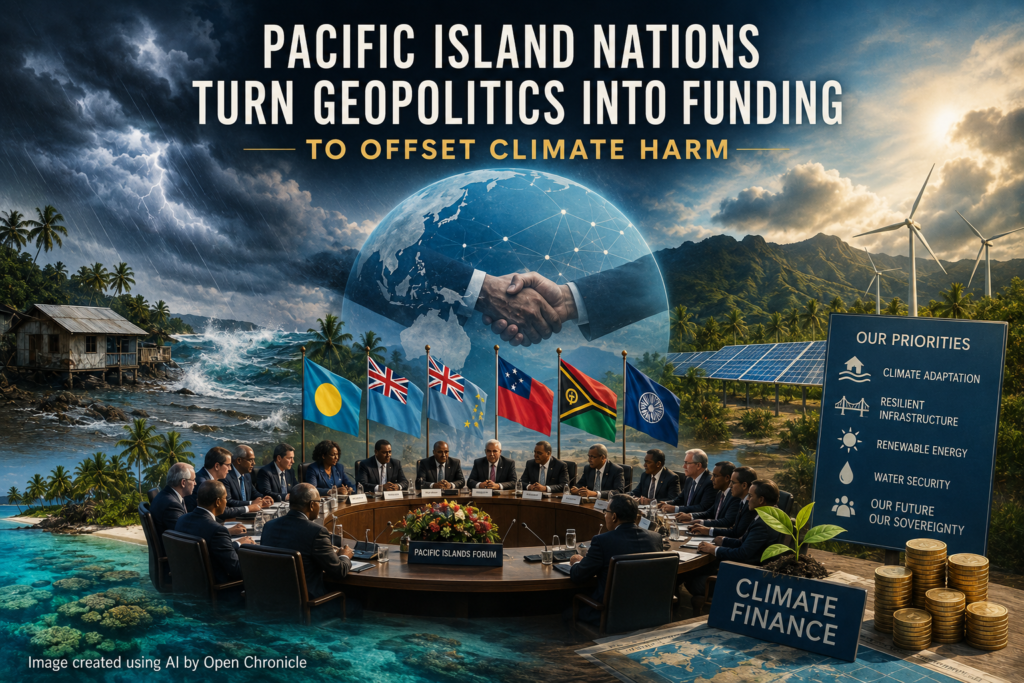
As climate vulnerability collides with competition among China, the United States, Australia and other powers, Pacific island states are seeking to convert their growing geopolitical importance into the finance required for national survival
The Grand Strategy Institute
Geopolitics, Climate Security and International Order
In the conventional vocabulary of international relations, power is usually measured through familiar indicators: military capability, population, economic output, industrial capacity, technological sophistication and control over strategic resources.
By almost all of these measures, the small island states of the Pacific appear structurally weak.
Many have tiny populations. Their domestic markets are small. Their military capabilities are limited or nonexistent. Their territories are separated by enormous distances, while their governments frequently lack the fiscal capacity required for large infrastructure programmes.
Yet this interpretation increasingly misses something fundamental.
The Pacific islands occupy one of the most strategically contested geographical spaces of the twenty first century.
As competition between China and the United States expands across the Indo Pacific, states that were once treated primarily as recipients of development assistance are acquiring a different kind of strategic value. Their diplomatic recognition, maritime territories, ports, airfields, voting power in international institutions and political alignment increasingly matter to larger powers.
Pacific governments understand this transformation.
Their emerging strategy is increasingly clear: if major powers regard the Pacific as strategically important, then geopolitical competition should generate tangible benefits for the societies whose territory gives the region that importance.
And the benefit Pacific leaders increasingly demand is climate finance.
At the 55th Pacific Islands Forum Leaders Meeting in Palau, that logic is becoming increasingly explicit. The summit is taking place as a new United Nations assessment warns that the world is moving towards an overshoot of the 1.5°C warming threshold. The UN stresses that every additional fraction of warming increases risks to livelihoods, ecosystems and vulnerable communities.
For Pacific island states, however, climate change is not principally an environmental issue.
It is becoming a question of territory, sovereignty, economic security, cultural survival and ultimately state continuity.
The strategic question facing Pacific leaders is therefore profound.
Can states possessing little conventional power transform their geographical importance into enough political leverage to finance their survival?
The answer could redefine what power means in the twenty first century.
Executive Assessment
The Pacific is experiencing the convergence of two transformations that are usually analysed separately.
The first is climate change.
Rising seas, warming oceans, increasingly damaging extreme weather and ecosystem degradation threaten infrastructure, fisheries, freshwater supplies and the habitability of vulnerable coastal communities. The United Nations notes that small islands are among the places facing a future increasingly shaped by sea level rise, while the World Meteorological Organization’s assessment of the South West Pacific describes hotter and more acidic seas alongside growing threats to coastal communities and low lying island nations.
The second transformation is geopolitical.
China’s expanding diplomatic, economic and security presence has increased the strategic attention given to the Pacific by Washington, Canberra, Wellington and other partners. Competition over diplomatic recognition between Beijing and Taipei adds another dimension. At the Palau summit itself, tensions between China and Taiwan have again demonstrated how larger geopolitical disputes can intrude into Pacific regional diplomacy.
Pacific leaders are increasingly attempting to connect these two realities.
Their argument is essentially transactional, although strategically sophisticated.
If external powers want influence, access, diplomatic support and regional legitimacy, they should help finance the existential security priorities identified by Pacific governments themselves.
This represents an attempt to convert geopolitical demand into climate capital.
The strategy could strengthen Pacific agency.
But it carries significant risks.
Great power competition may generate additional resources, yet it can also fragment regional institutions, create political dependencies and allow external security priorities to overshadow the very climate agenda Pacific governments are trying to advance.
The central strategic contest is therefore not simply China versus the United States.
It is whether Pacific island states can prevent themselves from becoming objects of great power competition and instead become strategic brokers capable of extracting resources from it.
1. The Pacific Paradox
The Pacific islands present one of the most striking geopolitical paradoxes in the international system.
Individually, many Pacific states are extraordinarily small.
Collectively, however, they occupy an immense strategic space.
The Pacific Ocean connects East Asia, Australia and the Americas. It contains major commercial routes, undersea communications infrastructure and maritime approaches relevant to military operations across the Indo Pacific.
Pacific island countries also possess vast exclusive economic zones relative to their land area.
This creates a distinction between territorial size and strategic space.
A country may possess only a few hundred square kilometres of land while exercising jurisdiction over a maritime area vastly larger.
From a traditional continental perspective, such a state appears small.
From a maritime geopolitical perspective, it can be extraordinarily consequential.
That difference increasingly matters as Indo-Pacific competition intensifies.
2. Climate Change as National Security
Pacific governments have repeatedly rejected the tendency of larger powers to treat climate change as merely one issue among many.
For the region, it is the organising security challenge.
Pacific Islands Forum leaders have formally described climate change as the single greatest threat to the livelihoods, security and wellbeing of Pacific peoples. They have also connected climate resilience directly to the long term vision of the Blue Pacific.
This language is strategically important.
When Washington, Beijing, Canberra or other capitals speak about Pacific security, they often think about naval competition, military access, strategic infrastructure and political influence.
Pacific governments frequently begin from somewhere else.
Sea level rise.
Freshwater.
Storm resilience.
Coastal infrastructure.
Food security.
Fisheries.
Climate mobility.
For them, a seawall may be as relevant to national security as a patrol vessel.
A resilient electricity grid may matter more to everyday sovereignty than a military exercise.
The disagreement is therefore partly about the definition of security itself.
Pacific states are attempting to force external powers to adopt their definition.
3. Melekeok and the Strategic Meaning of Adaptation
The situation described in Melekeok, Palau, captures the problem at human scale.
Storm driven seawater enters homes in vulnerable coastal areas. An inland subdivision intended to allow residents to relocate exists, but infrastructure necessary for wider resettlement has progressed slowly because funding arrives incrementally.
This illustrates a critical distinction between recognising climate vulnerability and financing adaptation.
The technical solution may already be known.
Move infrastructure.
Improve drainage.
Build resilient roads.
Provide water and sanitation.
Protect electricity networks.
Relocate vulnerable communities where necessary.
The strategic constraint is frequently money.
For small states with limited fiscal capacity, large adaptation projects can represent enormous proportions of national economic output.
Climate resilience therefore depends heavily upon external finance.
That dependence gives donors influence.
Pacific governments increasingly want to change the terms of that relationship.
4. From Aid Recipient to Strategic Partner
Traditional development assistance frequently follows a donor driven model.
A wealthy country provides funds.
It establishes conditions.
It determines eligibility.
It requires documentation.
It monitors implementation.
The recipient navigates the process.
Pacific leaders increasingly argue that this architecture is poorly suited to the urgency and scale of climate adaptation.
The problem is not necessarily the absence of global climate finance.
It is often accessibility.
Projects can require complicated applications, extensive institutional capacity and long approval periods.
For governments administering small populations across enormous maritime distances, bureaucratic complexity itself becomes a barrier.
This explains the political significance of the Pacific Resilience Facility.
5. The Pacific Resilience Facility
The Pacific Resilience Facility, or PRF, represents an attempt to change who controls adaptation finance.
Pacific Islands Forum leaders have described it as the first Pacific led, member owned and managed, people centred climate and disaster resilience financing facility. Previous Forum decisions called for partners to help capitalise it, with a target of US$500 million.
The institutional principle matters almost as much as the amount.
The PRF represents financial sovereignty.
Instead of Pacific communities adapting themselves to the administrative architecture of external financial institutions, the facility attempts to construct financing around Pacific priorities.
That challenges an established political economy of development assistance.
Donors accustomed to determining how their money is allocated may be less comfortable providing capital to a mechanism in which regional institutions exercise greater control.
From the Pacific perspective, however, that is precisely the point.
Climate resilience should not reproduce dependency.
It should strengthen agency.
6. Geopolitics Creates an Opportunity
This is where climate finance intersects with grand strategy.
Major powers increasingly want something from the Pacific.
China seeks diplomatic relationships, economic opportunities and regional influence.
The United States wants to reinforce its strategic position across the wider Indo-Pacific.
Australia and New Zealand seek to maintain deep regional partnerships and prevent strategic displacement.
Taiwan seeks to preserve diplomatic recognition among the remaining Pacific states that maintain relations with Taipei.
Japan, France, India, the European Union and others also possess varying interests.
Competition creates demand.
And demand creates leverage.
Palau’s President Surangel Whipps Jr. has effectively suggested that governments seeking greater involvement in the region can demonstrate their commitment by financing Pacific priorities, including climate and renewable energy projects. The current summit has simultaneously illustrated how quickly external rivalry, particularly between Beijing and Taipei, can dominate attention.
The underlying message is powerful:
Do not merely compete for the Pacific. Invest in the Pacific.
7. Climate Finance as Strategic Rent
International relations has long recognised the concept of strategic rent.
States occupying valuable geography can sometimes extract economic or security benefits from larger powers seeking access or alignment.
During the Cold War, strategic location could generate military assistance, economic aid or security guarantees.
The contemporary Pacific may be developing a twenty first century variation.
Instead of primarily exchanging strategic alignment for military assistance, island governments can attempt to exchange geopolitical access and diplomatic goodwill for climate resilience investment.
This does not require formal bargaining.
The leverage can remain implicit.
A government deciding whether to cooperate with one infrastructure partner or another possesses choices.
A state determining diplomatic recognition possesses choices.
A government negotiating port investment possesses choices.
A country voting in international organisations possesses choices.
The existence of alternatives increases negotiating power.
The challenge is using that power collectively rather than allowing external actors to negotiate separately with individual governments.
8. China Changes the Strategic Market
China’s increasing Pacific engagement transformed the strategic market even before any specific security arrangement was signed.
Beijing created an alternative.
That alone changed calculations in Washington and Canberra.
When states have only one major external partner, bargaining power is limited.
When multiple partners compete, bargaining power increases.
This does not mean Pacific governments necessarily prefer China.
Nor does it mean Chinese engagement carries no risks.
It means that strategic competition creates options.
Infrastructure, policing agreements, telecommunications, development finance and diplomatic relationships have consequently acquired geopolitical significance far beyond their immediate economic value.
For Pacific governments, the rational strategy is not necessarily choosing one camp.
It is maintaining enough strategic flexibility to preserve competition.
9. Taiwan and the Politics of Recognition
The China Taiwan competition provides perhaps the clearest example of how apparently small states can possess disproportionate diplomatic value.
Several Pacific countries have historically been among Taiwan’s limited number of formal diplomatic partners.
For Beijing, reducing Taiwan’s international recognition carries political importance.
For Taipei, retaining those relationships carries corresponding importance.
That makes diplomatic recognition valuable.
The tensions surrounding Chinese and Taiwanese representation at the Palau summit demonstrate that this contest remains capable of disrupting regional diplomacy.
Yet from a Pacific strategic perspective, the central question should not be Beijing versus Taipei.
It should be:
What does Pacific society gain from the competition?
That shift in perspective transforms diplomatic recognition from symbolic alignment into potential bargaining leverage.
10. The Australian Contradiction
Australia faces perhaps the most difficult strategic contradiction.
Canberra regards the Pacific as central to its security environment.
It seeks to remain a trusted partner.
It wants to limit the growth of Chinese strategic influence.
Yet Australia remains a major fossil fuel producer and exporter.
For vulnerable Pacific states, this creates an unavoidable credibility problem.
Australia can offer climate adaptation assistance while simultaneously participating in economic activities Pacific leaders argue contribute to the threat requiring that adaptation.
Vanuatu’s criticism at the current summit reflects this tension. Pacific governments are not simply asking Australia to finance the consequences of climate change. They also want stronger mitigation from major emitters and producers.
This creates a strategic dilemma for Canberra.
Pacific policy cannot be separated indefinitely from Australian climate policy.
The more Australia defines the Pacific as a strategic priority, the more seriously it may be required to treat the region’s definition of its principal security threat.
11. New Zealand Faces a Similar Test
New Zealand possesses a different economic and strategic profile but confronts a related challenge.
Wellington has deep cultural, historical and political connections across the Pacific.
Those relationships create influence.
But they also create expectations.
Pacific governments increasingly judge partners not simply by diplomatic language but by climate finance, mobility arrangements, infrastructure investment and emissions policy.
Regional leadership therefore requires material credibility.
The era in which strategic partnership could be separated neatly from climate policy is disappearing.
12. Climate Finance Is Becoming Security Assistance
This may be the conceptual transformation that external powers need to understand.
A seawall is security infrastructure.
A resilient hospital is security infrastructure.
A cyclone resistant telecommunications network is security infrastructure.
A renewable microgrid capable of operating after a disaster is security infrastructure.
Freshwater storage is security infrastructure.
Mangrove restoration can be security infrastructure.
Relocation infrastructure can be security infrastructure.
Traditional strategic thinking tends to divide spending into categories.
Defence.
Development.
Climate.
Infrastructure.
Pacific vulnerability collapses those distinctions.
A country cannot exercise meaningful sovereignty if parts of its territory become increasingly uninhabitable.
Climate adaptation is therefore not adjacent to national security.
It is part of national security.
13. Fisheries and Strategic Sovereignty
The ocean is also an economic battlefield.
Pacific tuna fisheries are among the world’s most important, and warming and changing ocean conditions threaten to alter ecosystems upon which island economies depend.
This creates another connection between climate and sovereignty.
If commercially valuable fish stocks migrate because of ocean warming, government revenue can shift with them.
Food systems can change.
Employment can change.
Maritime disputes can intensify.
The effect is therefore not merely environmental.
Climate change can redistribute economic geography.
For states whose sovereign wealth is disproportionately maritime, changing oceans can alter the material foundations of state power.
14. Renewable Energy as Strategic Autonomy
Palau’s ambition to expand renewable energy also illustrates another dimension.
Small island states frequently depend heavily upon imported fossil fuels.
That creates vulnerability.
Fuel must travel long distances.
Global price shocks affect national budgets.
Shipping disruption creates risk.
Electricity costs can remain high.
Renewable energy therefore offers more than emissions reduction.
Solar generation, storage and resilient microgrids can reduce external dependence.
Climate policy becomes energy security.
Energy security becomes strategic autonomy.
This makes renewable investment particularly attractive as a target for geopolitical finance.
A donor financing distributed energy is simultaneously supporting climate mitigation, economic resilience and national security.
15. The Risk of Becoming a Chessboard
The strategy nevertheless contains dangers.
Great power competition creates leverage only while Pacific governments retain control of the competition.
If rivalry becomes sufficiently intense, the region can shift from being a strategic broker to becoming a strategic battlefield.
External powers may pressure governments to choose sides.
Domestic politics can become polarised around foreign relationships.
Infrastructure decisions can acquire security implications.
Regional institutions can fragment.
Diplomatic disputes can consume summits intended to address Pacific priorities.
The current China Taiwan controversy offers a relatively modest example of this danger.
Pacific leaders therefore face a difficult balancing act.
They want geopolitical attention.
They do not want geopolitical domination.
16. Collective Bargaining Is the Pacific’s Greatest Asset
Individual Pacific island countries have limited negotiating power.
Collectively, the equation changes.
The Pacific Islands Forum provides a mechanism through which small states can aggregate political influence.
This is why regional unity matters strategically.
A fragmented Pacific is easier for external powers to influence bilaterally.
A coordinated Pacific can establish conditions.
Climate finance provides a strong issue around which such coordination can develop because the underlying vulnerability is widely shared, even if individual countries face different circumstances.
The Pacific Resilience Facility is therefore more than a financial mechanism.
It can be understood as an instrument of collective strategic agency.
If Pacific governments can capitalise and control a regional adaptation institution, they reduce dependence upon bilateral donor relationships.
17. The Battle Over Who Controls the Money
This explains why climate finance governance matters.
The dispute is not simply about how much money exists.
It concerns who decides.
Who determines eligible projects?
Who evaluates risk?
Who sets reporting requirements?
Who controls disbursement?
Who defines success?
Traditional donor institutions possess understandable concerns about accountability and financial governance.
Pacific governments possess an equally understandable concern that cumbersome requirements prevent money from reaching vulnerable communities quickly enough.
The emerging struggle is therefore partly a struggle over institutional authority.
Pacific led climate finance represents an attempt to redistribute that authority.
18. The 1.5°C Threshold and the Politics of Survival
The debate becomes considerably more urgent because the global climate trajectory is worsening.
The United Nations’ new Limiting Overshoot assessment examines the implications of exceeding 1.5°C and pathways for bringing temperatures back down. UN reporting stresses that overshoot is increasingly likely and that every additional fraction of warming matters.
For larger continental states, 1.5°C can sometimes appear as an abstract diplomatic target.
For low lying Pacific communities it has a different political meaning.
The difference between warming pathways can affect whether coastlines remain viable.
Whether freshwater remains accessible.
Whether reefs survive.
Whether fisheries remain productive.
Whether relocation becomes necessary.
Whether communities can remain on ancestral territory.
This is why Pacific diplomacy often uses language that appears more existential than climate diplomacy elsewhere.
It reflects a different risk calculation.
19. Loss and Damage Is Not the Same as Adaptation
There is also an important distinction between adaptation and loss and damage.
Adaptation attempts to reduce future harm.
A seawall can be constructed.
Buildings can be relocated.
Infrastructure can be hardened.
Water systems can be improved.
But some losses cannot simply be engineered away.
An ancestral burial ground lost to the sea cannot be reconstructed elsewhere in any meaningful cultural sense.
A community displaced permanently from its traditional island experiences something that GDP statistics cannot adequately describe.
Language, identity, memory and territorial belonging are not easily monetised.
This is why Vanuatu’s Ralph Regenvanu emphasised that climate damage includes both economic and non economic losses.
Climate finance can therefore reduce vulnerability.
It cannot necessarily compensate for everything that disappears.
20. Climate Mobility and Sovereignty
Pacific institutions have already begun preparing for the possibility that climate change will increase human mobility.
The Pacific Regional Framework on Climate Mobility recognises climate and disaster displacement while emphasising the fundamental priority of allowing Pacific peoples to remain in their ancestral homes wherever possible. Forum documents note that more than 50,000 Pacific people are displaced annually by climate and disaster related events.
This introduces extraordinary questions for international order.
What happens to sovereignty if territory becomes uninhabitable?
Do maritime boundaries remain fixed?
Can a state continue to exist if much of its population relocates?
Can citizenship persist across permanent displacement?
What happens to exclusive economic zones?
Climate change is therefore forcing international law to confront questions for which the state system was never designed.
Pacific governments are at the frontier of that debate.
21. Small States Can Possess Large Strategic Agency
The Pacific case challenges one of the most persistent assumptions in realist international relations.
Small states are not necessarily powerless.
They are constrained.
But constraint and irrelevance are different things.
Power can arise from geography.
From diplomatic votes.
From institutional legitimacy.
From control of maritime space.
From competition among stronger states.
From moral authority.
From collective organisation.
And from the ability to make others compete for access.
Pacific states possess several of these simultaneously.
Their challenge is converting them into material outcomes before climate vulnerability becomes irreversible.
22. The Strategic Bargain Pacific Leaders Could Demand
The emerging Pacific position can ultimately be reduced to a new strategic bargain.
External powers want:
regional access,
diplomatic influence,
secure maritime routes,
political partnerships,
strategic infrastructure,
international support,
and a favourable balance of power.
Pacific states need:
adaptation finance,
resilient infrastructure,
renewable energy,
disaster preparedness,
communications,
climate mobility planning,
ocean protection,
and economic resilience.
The obvious grand strategic question is why these two agendas should remain separate.
Pacific leaders increasingly appear determined to connect them.
A country seeking strategic partnership should demonstrate commitment to Pacific security as Pacific governments themselves define it.
That means climate resilience.
Strategic Assessment
The Pacific islands are attempting something strategically sophisticated.
They are converting vulnerability into diplomatic urgency and geopolitical competition into potential bargaining leverage.
This does not eliminate their structural disadvantages.
Climate change remains profoundly asymmetric. Pacific states have contributed comparatively little to the accumulation of greenhouse gases while facing some of its most severe consequences.
Nor does great power competition automatically produce beneficial outcomes.
External rivalry can divide the region as easily as it can finance it.
But the return of geopolitical competition has created something Pacific states previously possessed in much smaller quantities:
strategic demand.
China wants influence.
The United States wants strategic access and regional alignment.
Australia wants to remain the region’s indispensable security partner.
Taiwan wants diplomatic recognition.
Other powers want economic, diplomatic and maritime relationships.
Pacific governments therefore possess a commodity that is becoming more valuable.
Their cooperation.
The central challenge is establishing its price.
For Pacific leaders, that price increasingly should not be measured simply in military assistance, government buildings or diplomatic promises.
It should be measured in the infrastructure necessary for their societies to survive a changing climate.
That represents a profound transformation in small state strategy.
Rather than asking great powers for assistance because Pacific states are vulnerable, they can increasingly argue that assistance is justified because Pacific partnership itself has strategic value.
The distinction is crucial.
One model is dependency.
The other is bargaining.
Key Findings
- Climate change remains the principal security concern identified collectively by Pacific island governments, despite growing external emphasis on strategic competition in the Indo-Pacific.
- The latest UN climate assessment reinforces Pacific concerns by warning that overshoot beyond the 1.5°C threshold is increasingly likely and that additional warming will intensify risks to vulnerable communities and ecosystems.
- Intensifying competition among China, the United States and other powers is increasing the geopolitical value of Pacific island states.
- Pacific governments have an opportunity to transform that geopolitical value into climate adaptation finance, resilient infrastructure and greater strategic autonomy.
- The Pacific Resilience Facility represents an important attempt to create a Pacific led, member owned financing architecture rather than relying exclusively upon donor controlled mechanisms.
- The previously stated US$500 million capitalisation objective for the PRF demonstrates the scale of the region’s ambition, while difficulties mobilising resources illustrate the continuing gap between international climate commitments and accessible local finance.
- Climate adaptation should increasingly be understood as security investment because infrastructure resilience directly affects territorial continuity, economic stability and state capacity.
- Renewable energy can simultaneously reduce emissions, lower dependence upon imported fuels and strengthen strategic autonomy.
- Australia faces a particular credibility challenge because its ambition to remain a leading Pacific strategic partner exists alongside continuing Pacific criticism of Australian fossil fuel production.
- China Taiwan competition demonstrates both the bargaining opportunities and fragmentation risks created by external geopolitical rivalry.
- Pacific regional unity is itself a strategic resource because collective bargaining reduces the ability of external powers to divide small states through bilateral competition.
- Climate mobility and sea level rise increasingly raise questions extending beyond environmental policy into sovereignty, maritime jurisdiction and the future legal continuity of vulnerable states.
- Pacific institutions are increasingly pursuing locally controlled resilience solutions. During the current Palau summit, SPREP and Conservation International also announced a five year partnership focused on climate resilience, conservation finance and community led solutions.
- The Pacific demonstrates that small states can exercise significant strategic agency when geography, institutional coordination and competition among larger powers increase the value of their cooperation.
Grand Strategy Judgment
The most consequential struggle taking place in the Pacific may not ultimately be the contest between China and the United States.
It may be the struggle over who gets to define what Pacific security means.
For the major powers, the answer often begins with military access, maritime routes, strategic denial and regional influence.
For Pacific island states, it begins much closer to home.
Whether a village can survive the next storm.
Whether freshwater remains available.
Whether fisheries remain productive.
Whether electricity systems survive disasters.
Whether communities must abandon ancestral territory.
Whether sovereign states can continue physically to exist where they have existed for generations.
The strategic opportunity for Pacific governments is therefore to force these two definitions of security together.
If Washington wants a secure Pacific, climate adaptation is part of the price.
If Beijing wants greater Pacific influence, climate resilience should be part of the price.
If Australia wants to remain a trusted regional leader, climate credibility is part of the price.
If other powers want Pacific partnerships, they too should increasingly be judged against Pacific priorities.
This is not merely climate diplomacy.
It is grand strategy conducted by small states.
The Pacific islands cannot match great powers ship for ship, dollar for dollar or soldier for soldier.
They do not need to.
Their leverage comes from something else: strategically important geography at precisely the moment when larger powers increasingly compete to influence it.
Used individually, that leverage may produce projects.
Used collectively, it could produce something considerably more important:
a new strategic bargain in which the geopolitical value of the Pacific helps finance the survival of the Pacific itself.
The Grand Strategy Institute
Continue Exploring Strategic Analysis
Return to The Grand Strategy Institute for strategic assessments, long-form analysis and research examining geopolitics, military affairs, international security, emerging technologies and the changing international order.
← Back to The Grand Strategy Institute