
By Open Chronicle Newsdesk with agencies
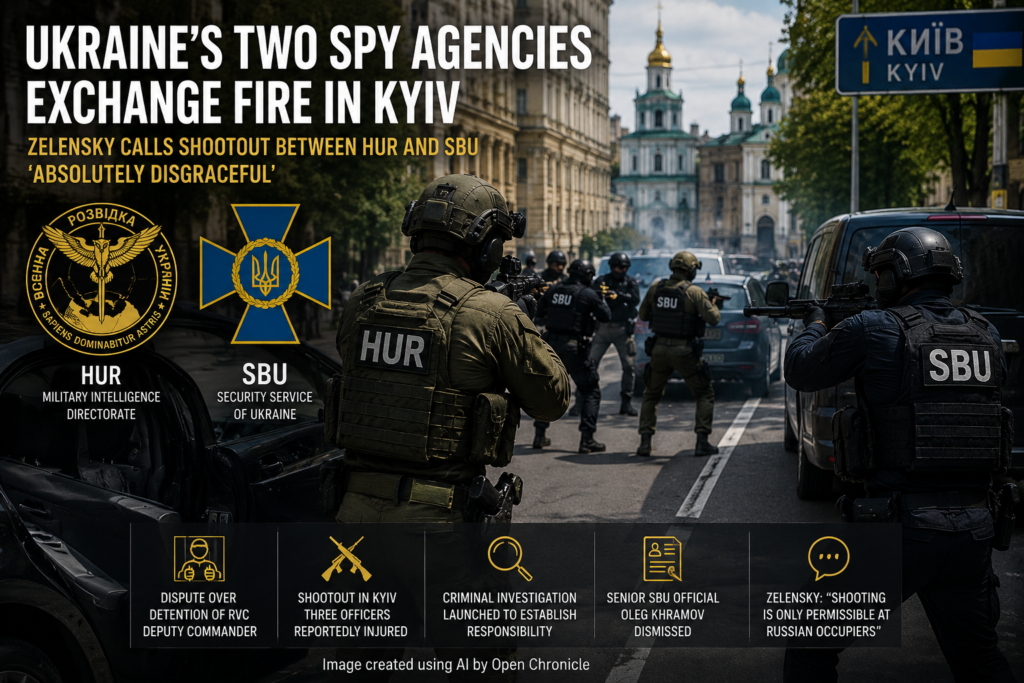
Ukrainian President Volodymyr Zelensky has condemned an extraordinary armed confrontation between two of the country’s most powerful intelligence agencies after officers exchanged gunfire in Kyiv during a dispute over the detention of a senior member of the Russian Volunteer Corps.
The confrontation between Ukraine’s military intelligence service, HUR, and the Security Service of Ukraine, SBU, reportedly left three officers injured and has triggered a criminal investigation into how an institutional dispute between agencies fighting the same war escalated into violence.
The incident centred on Stepan Kaplunov, deputy commander of the Russian Volunteer Corps, or RVC, a paramilitary formation composed largely of anti Kremlin Russian fighters operating on Ukraine’s side of the war.
Kaplunov had been detained by the SBU in late August over allegations that he was involved in helping orchestrate a Russian assassination plot that Ukrainian authorities said had been disrupted.
HUR personnel and Kaplunov’s lawyers, however, challenged the circumstances surrounding his detention, accusing SBU officers of holding him illegally and without a warrant.
The dispute ultimately erupted into an armed confrontation in the Ukrainian capital.
Intelligence officers exchange fire in Kyiv
The situation escalated early on Wednesday when SBU personnel returned Kaplunov to his residence as part of a search.
Armed HUR officers subsequently arrived and intervened.
According to law enforcement accounts, an argument between members of the two agencies developed into an armed standoff before gunfire was exchanged.
Three officers were reportedly injured.
Kaplunov’s lawyer said his client was subsequently released from custody, although his whereabouts were not immediately known.
The spectacle of Ukrainian intelligence personnel confronting one another with weapons in the streets of Kyiv has caused considerable concern within the country’s leadership, particularly while Ukraine remains engaged in an intense war with Russia.
Zelensky: weapons should be used against Russian forces
Zelensky responded publicly on Thursday, making clear that armed disputes between Ukrainian state institutions would not be tolerated.
“Here in Ukraine, shooting is only permissible at Russian occupiers in defence of Ukraine,” the president said.
Ukraine’s leadership has described the episode as “absolutely disgraceful”.
The government has also moved rapidly to demonstrate that there will be consequences.
Zelensky issued a decree dismissing Oleh Khramov, a senior SBU official, in direct connection with the incident.
The dismissal indicates the seriousness with which the Ukrainian presidency is treating the confrontation, which risks exposing divisions inside the security apparatus at a particularly sensitive moment in the war.
Criminal investigation launched
Ukraine’s Prosecutor General’s Office and State Bureau of Investigation have opened a criminal investigation to establish responsibility for the shooting.
Investigators will need to determine not only who fired weapons, but also whether Kaplunov’s original detention and the subsequent search were conducted legally.
The case therefore combines several sensitive issues, including the authority of competing intelligence organizations, treatment of detainees, operational jurisdiction and the conduct of armed officers.
HUR and the SBU perform different but sometimes overlapping functions within Ukraine’s national security system.
HUR is the military intelligence arm of Ukraine’s Ministry of Defence and has become particularly prominent during the war through intelligence gathering, covert operations and missions targeting Russian military capabilities.
The SBU is Ukraine’s principal domestic security and counterintelligence agency. Its responsibilities include counterespionage, counterterrorism and investigating threats to Ukrainian state security.
The war has significantly expanded the operational responsibilities of both organizations, increasing the potential for their activities to intersect.
Who is Stepan Kaplunov?
Kaplunov is a senior figure in the Russian Volunteer Corps, one of the Russian anti-Kremlin formations fighting alongside Ukraine.
The RVC operates under the umbrella of Ukrainian military intelligence and has participated in operations connected with the war against Russia.
That relationship makes the circumstances of Kaplunov’s detention particularly sensitive.
The SBU reportedly suspected him of involvement in a Russian assassination operation, while his defenders and figures associated with military intelligence disputed the legality of his detention.
Those competing claims now form part of a broader investigation into the events that culminated in Wednesday’s violence.
The available information does not establish whether the accusations originally made against Kaplunov were substantiated.
Not the first deadly clash involving the agencies
The confrontation has also revived memories of one of the most controversial episodes from the opening weeks of Russia’s full scale invasion.
In March 2022, SBU officers shot and killed Denys Kireyev, a Ukrainian banker who had participated in an early Ukrainian delegation involved in peace negotiations with Russia.
Kireyev was subsequently identified as an intelligence asset working for HUR.
His death exposed serious tensions and communication failures within Ukraine’s security establishment during the chaotic first weeks of the invasion.
Wednesday’s incident is different in circumstances, but the fact that armed personnel from the same two institutions have again become involved in a violent confrontation is likely to intensify scrutiny of coordination between the agencies.
Institutional tensions during wartime
Ukraine’s intelligence services have played an increasingly important role since Russia launched its full scale invasion in February 2022.
Both HUR and the SBU have conducted operations regarded by Kyiv as essential to national survival, while undergoing significant institutional transformation under wartime conditions.
That operational pressure can create jurisdictional disputes, particularly when counterintelligence investigations intersect with military intelligence networks and covert operations.
Yet the use of firearms between personnel from state security organizations represents a far more serious breakdown.
Beyond the immediate legal questions, the confrontation risks damaging public confidence in institutions whose effectiveness depends heavily on discipline, coordination and secrecy.
It could also provide Russia with material for propaganda intended to portray Ukraine’s security establishment as divided.
Zelensky moves to contain the fallout
The Ukrainian president’s rapid intervention appears designed to prevent the incident from developing into a wider institutional confrontation.
By publicly condemning the shooting, dismissing a senior SBU official and allowing criminal investigators to examine the circumstances, Zelensky has signalled that disputes between intelligence agencies must remain subordinate to the broader war effort.
The investigation will now have to determine how a disagreement over one detainee was allowed to escalate to the point where Ukrainian officers exchanged gunfire in their own capital.
For a country fighting an existential war, the implications extend well beyond the individuals involved.
Ukraine relies heavily on cooperation between its intelligence, military and security institutions to detect Russian espionage, protect political and military leaders and conduct operations behind enemy lines.
Wednesday’s confrontation revealed how damaging internal rivalries can become when those institutional boundaries break down.
Zelensky’s message was therefore deliberately simple: Ukraine has an enemy against which its weapons are meant to be directed, and it is not another Ukrainian security agency.