
By Open Chronicle Newsdesk with agencies
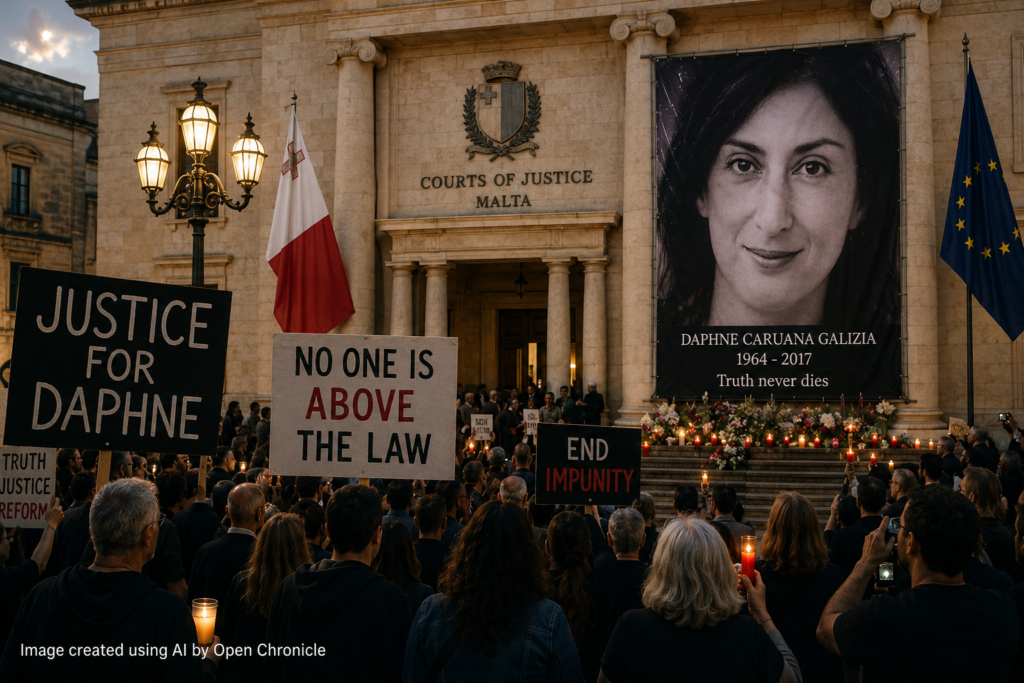
Hundreds of people have demonstrated in Malta following the acquittal of businessman Yorgen Fenech on charges that he masterminded the 2017 assassination of investigative journalist Daphne Caruana Galizia, a verdict that has triggered renewed anger over press freedom, accountability and the rule of law in the European Union’s smallest member state.
Protesters gathered in the capital, Valletta, on Wednesday after Fenech was found not guilty in connection with the car bomb attack that killed Caruana Galizia nearly nine years ago.
The verdict prompted immediate criticism from Maltese civil society organizations and international press freedom groups, which warned that the failure to convict the alleged mastermind leaves one of Europe’s most notorious journalist murders without full accountability.
As Fenech left the court a free man, some protesters shouted “Assassin!” in his direction.
Opposition demands parliament be recalled
Malta’s opposition Nationalist Party, which organized Wednesday evening’s demonstration, has called for lawmakers to return from their summer recess for an extraordinary parliamentary session devoted to the case.
The Maltese government said it had “taken note” of the verdict and appealed for restraint in public comments.
But the reaction from international organizations defending journalists was considerably stronger.
The European Centre for Press and Media Freedom said the verdict sent a “disturbing message”, while Reporters Without Borders said it was “beyond outraged” by the outcome.
“The verdict means that almost nine years since the assassination of Daphne Caruana Galizia, the Maltese authorities have failed to identify and convict the mastermind,” RSF said.
The organization called for full justice in the case and urged Maltese authorities to implement reforms intended to strengthen protections for journalists and media freedom.
The Committee to Protect Journalists also pledged to continue seeking accountability for everyone involved in Caruana Galizia’s murder.
Five people convicted over the killing
Although Fenech was acquitted, five men have previously been convicted for their involvement in the assassination.
Brothers George and Alfred Degiorgio and Vince Muscat were convicted for carrying out the murder and are serving prison sentences.
In June 2025, Robert Agius and Jamie Vella were convicted of supplying the explosive device used in the attack. Both were sentenced to life imprisonment.
The unresolved question has remained who ultimately ordered the assassination.
Prosecutors accused Fenech of arranging Caruana Galizia’s murder because the journalist was preparing to publish information potentially damaging to his business interests and associates.
Fenech, whose business interests included the energy and tourism sectors, was arrested in 2019 while aboard his yacht as he attempted to leave Malta.
His arrest followed a decision to grant a pardon to a middleman in exchange for information about those allegedly responsible for the murder.
The court has now rejected the prosecution’s case against Fenech.
The assassination that shook Malta
Caruana Galizia was killed on October 16, 2017, when a bomb planted beneath the seat of her car exploded shortly after she left her home.
She was 53 and left behind her husband and three sons.
One of Malta’s most prominent investigative journalists, Caruana Galizia investigated allegations of corruption, money laundering and questionable relationships between the country’s political and business elites.
Her prolific investigative work earned her the description of a “one woman WikiLeaks”.
Her assassination transformed what had been largely domestic concerns about corruption and governance into a European political issue.
Malta faced intense scrutiny from EU institutions, international journalists and human rights organizations over the effectiveness and independence of its institutions.
Murder triggered political crisis
The investigation eventually contributed to a major political crisis.
Then prime minister Joseph Muscat resigned in January 2020 following weeks of protests and growing accusations that his government had failed to properly address connections between individuals close to the administration and figures implicated in the investigation.
The controversy raised broader questions about whether Malta’s political institutions had allowed an environment to develop in which powerful individuals believed they could operate without meaningful accountability.
Those concerns were subsequently reinforced by an official inquiry.
Inquiry found an “atmosphere of impunity”
A two year public inquiry published in July 2021 concluded that the Maltese state should “shoulder responsibility” for circumstances surrounding Caruana Galizia’s murder.
The inquiry identified what it described as an “atmosphere of impunity” created by institutional failures.
Its conclusions transformed the case from a criminal investigation into a broader examination of Malta’s democratic institutions.
The issue was no longer simply who had planted the bomb or who might have ordered the killing. It became a question of whether weaknesses within the state had created conditions in which the assassination of an investigative journalist became possible.
Nearly nine years later, Caruana Galizia’s family argues that those underlying problems remain unresolved.
Family says accountability is overdue
Her family issued a statement calling for responsibility to extend beyond the individuals already convicted.
“Accountability is now overdue for all those who enabled, facilitated, or protected her murderers,” the family said.
“Nine years after Daphne’s brutal assassination, the institutional failures that enabled her murder remain unaddressed and unreformed.”
The statement reflects the continuing significance of the case beyond the criminal proceedings themselves.
For Caruana Galizia’s supporters, justice has always involved two separate questions: punishing those directly responsible for the bomb attack and addressing the political and institutional environment surrounding her assassination.
The acquittal has intensified concerns that the first of those objectives may never be fully achieved.
Press freedom groups demand reforms
International media organizations are now placing renewed emphasis on the second objective.
RSF called on Malta to introduce long delayed measures designed to protect journalists and strengthen media freedom.
Such demands have accompanied the case since 2017 because Caruana Galizia’s murder became one of the most prominent examples of the dangers faced by investigative journalists working inside the European Union.
Her assassination demonstrated that threats traditionally associated with journalists reporting from authoritarian states or conflict zones could also emerge within an EU democracy.
The killing consequently became a symbol for European campaigns seeking stronger protection for journalists investigating corruption and organized crime.
Malta again faces questions over rule of law
The acquittal places Malta’s institutions under renewed international scrutiny.
Five men have been convicted for constructing the bomb and carrying out the assassination, but the question of who ultimately commissioned the murder remains unresolved following Fenech’s acquittal.
For the Maltese government, the challenge will be responding to public anger while respecting the independence and final decisions of the judicial system.
For civil society and press freedom organizations, however, the verdict reinforces a broader concern: that nearly nine years after one of Europe’s most shocking journalist assassinations, the chain of accountability still stops short of establishing who ordered the killing.
The demonstrations in Valletta show that the case remains deeply embedded in Malta’s political life.
Caruana Galizia’s assassination changed the country, brought down a prime minister and exposed institutional weaknesses that attracted scrutiny across Europe.
The latest verdict ensures that the debate she triggered over corruption, political power, press freedom and accountability is far from over.