
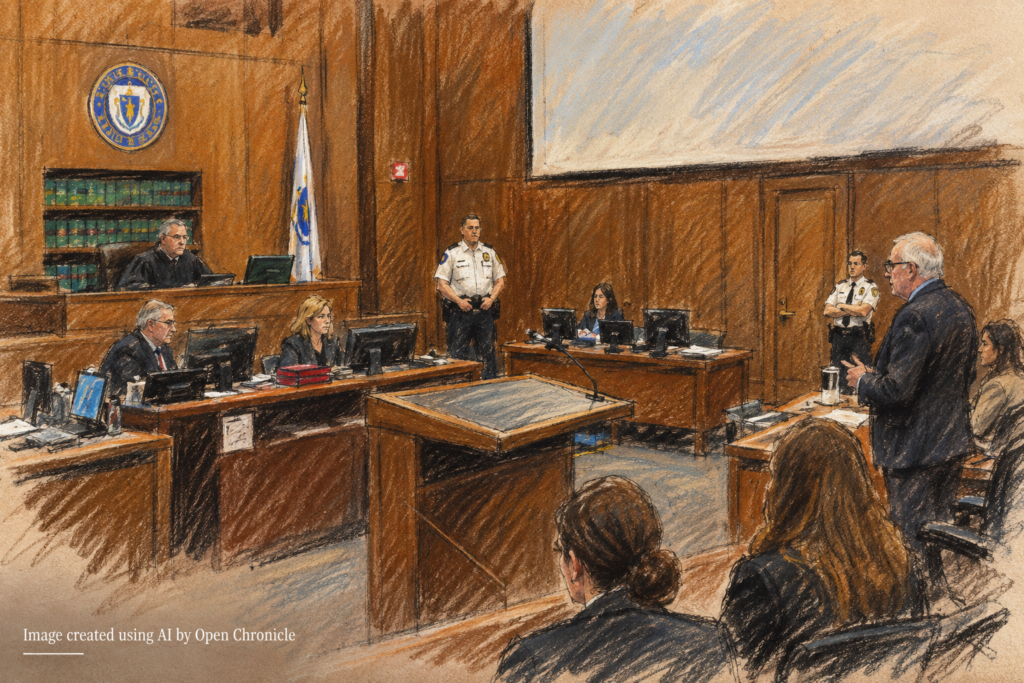
The Massachusetts case has drawn national attention to postpartum psychosis, criminal responsibility and the difficult intersection between severe mental illness and the law.
By Open Chronicle with agencies
A Massachusetts judge has declared a mistrial in the murder case against Lindsay Clancy, ending nearly six weeks of testimony in one of the most closely watched criminal cases involving postpartum mental health in recent years.
Clancy, 36, is accused of killing her three young children at the family home in Duxbury, Massachusetts, on January 24, 2023. The defence did not dispute that Clancy strangled five year old Cora, three year old Dawson and eight month old Callan using exercise bands.
Instead, the trial centred on a profoundly difficult legal question: whether Clancy was criminally responsible for her actions or was suffering from postpartum psychosis so severe that she could not be held legally responsible.
The mistrial leaves that question unresolved and means the criminal proceedings against her remain open.
🚨 BREAKING — IT'S OFFICIAL: The judge in the Lindsay Clancy trial has declared a MISTRIAL after a LONE MALE juror BLOCKED a NOT GUILTY VERDICT for Clancy
This man is an absolute HERO!
THANK YOU for REFUSING to give in to the DERANGED jurors trying to let a baby kiIIer go free! pic.twitter.com/GT43k7bS6N
— Nick Sortor (@nicksortor) September 4, 2026
Defence says Clancy was suffering from postpartum psychosis
Clancy’s attorney, Kevin Reddington, argued throughout the trial that his client should be found not guilty by reason of insanity.
The defence portrayed Clancy as a devoted mother whose mental health deteriorated significantly following the birth of her third child.
Jurors heard testimony about her repeated attempts to obtain medical help during the months before the deaths. She had been treated by healthcare professionals, prescribed several medications and admitted to a psychiatric hospital.
Her now ex husband, Patrick Clancy, was among the family members who testified about her condition.
According to his testimony, Clancy had been discharged from a psychiatric hospital less than two weeks before the children’s deaths. Despite her recent treatment, he said there was no apparent indication on the day of the killings that she intended to harm herself or their children.
He described her demeanour as appearing normal when he left the family home to collect dinner.
Prosecutors challenge insanity defence
Prosecutors did not dispute that Clancy had experienced serious mental health problems. They argued, however, that those problems did not prevent her from understanding that killing her children was wrong.
The prosecution presented evidence it said showed planning and awareness.
According to evidence introduced during the trial, Clancy used her phone to estimate how long it would take her husband to complete errands after she asked him to collect food and visit a pharmacy.
During his absence, prosecutors said, she strangled the three children.
Clancy then cut her wrists and neck before jumping from a second story window in what authorities described as an apparent suicide attempt. She survived the fall but was left paralysed.
When Patrick Clancy returned home, he found his wife injured outside.
She told him that she had attempted suicide and directed him toward the basement. There, he discovered their children with exercise bands around their necks.
Testimony focuses on reports of a man’s voice
Another central element of the defence case concerned Clancy’s reported experience of hearing a man’s voice.
Several witnesses, including Patrick Clancy, testified that she later described the experience while receiving hospital treatment.
According to testimony presented at trial, Clancy said the voice told her that if she did not act, she would lose her opportunity.
Her lawyers cited those statements as evidence that she had been experiencing a severe psychotic episode at the time of the killings.
The prosecution challenged the broader insanity argument, maintaining that Clancy’s behaviour before and during the deaths demonstrated that she understood the nature and consequences of her actions.
The competing interpretations placed psychiatric evidence at the heart of the six week trial.
A case that reopened the debate over postpartum psychosis
Beyond the courtroom, the Clancy case has renewed discussion in the United States about postpartum mental illness and how the criminal justice system responds when severe psychiatric disorders are alleged in cases involving the deaths of children.
Postpartum psychosis is distinct from the more commonly discussed postpartum depression. Severe cases can involve hallucinations, delusions, confusion and dramatic changes in behaviour and perception.
In criminal proceedings, however, the existence of a psychiatric disorder does not automatically establish legal insanity. Courts must determine whether a defendant meets the specific legal standard governing criminal responsibility.
That distinction became one of the defining issues of the Clancy trial.
Comparisons with the Andrea Yates case
The proceedings have also drawn comparisons with the case of Andrea Yates, the Texas mother who drowned her five children in 2001.
Yates was initially convicted of murder. That conviction was later overturned on appeal, and in 2006 she was found not guilty by reason of insanity after her defence argued that she had been suffering from severe postpartum psychosis.
The Yates case became a landmark in the American debate over maternal mental illness, legal responsibility and the treatment of women experiencing severe psychiatric conditions following childbirth.
More than two decades later, many of those same questions have resurfaced in Massachusetts.
What happens after the mistrial?
A mistrial does not amount to either an acquittal or a conviction.
The declaration therefore leaves the prosecution of Lindsay Clancy unresolved and opens the possibility of further proceedings.
For the families involved, the end of the six week trial provides no final legal answer to a tragedy that began more than three years ago.
For the wider public, the case has exposed an extraordinarily difficult intersection between criminal justice and psychiatric medicine: how the law should determine responsibility when an undisputed act of extreme violence occurs amid allegations of profound mental illness.
Whatever follows the mistrial, the deaths of Cora, Dawson and Callan Clancy remain at the centre of a case whose legal and medical questions are likely to continue far beyond this trial.