
By Open Chronicle Formula One Magazine
Formula 1 has always been a contest between competing aerodynamic demands. A car needs downforce to attack corners, but that same aerodynamic load produces drag and limits speed on the straights.
Active aerodynamics changes that equation.
Instead of relying on a single aerodynamic configuration throughout a lap, the system allows elements of both the front and rear wings to change position, giving the car different aerodynamic characteristics depending on where it is on the circuit.
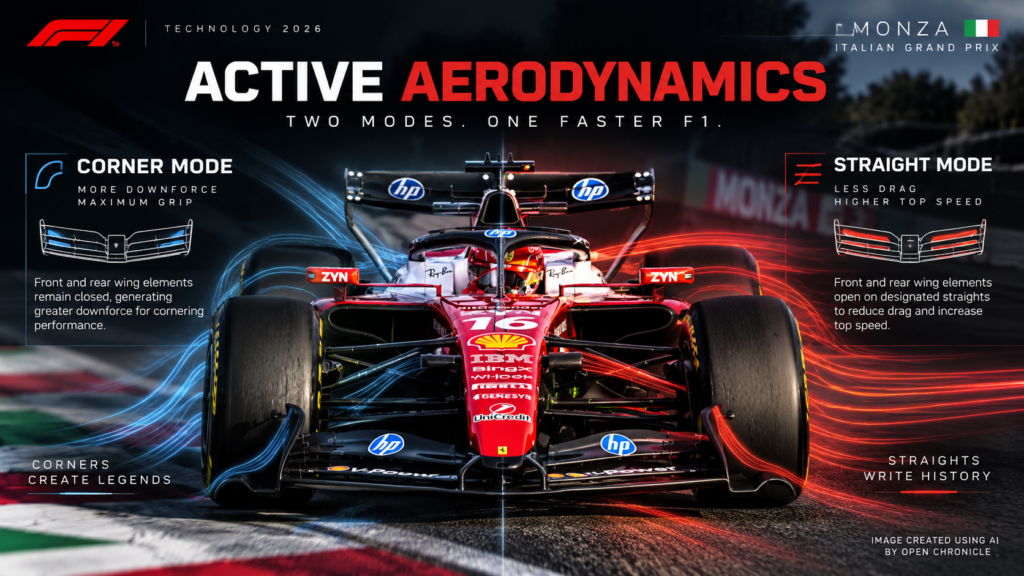
At the heart of the concept are two configurations: Corner Mode and Straight Mode.
Corner Mode: Building Downforce
Through the corners, the priority is grip.
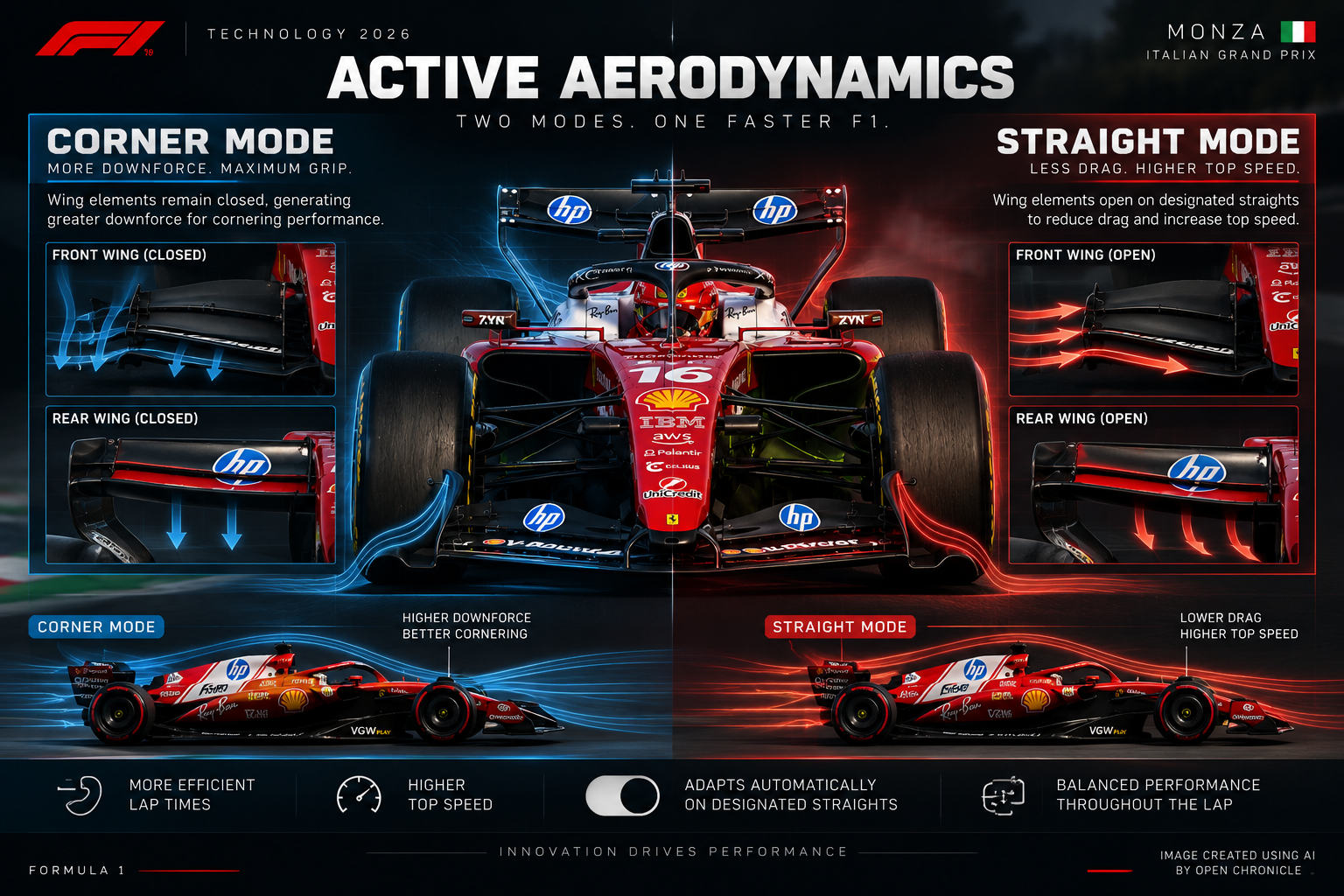
In Corner Mode, the movable wing elements remain closed, creating the aerodynamic configuration required to generate greater downforce.
The principle is fundamental to Formula 1 performance. As aerodynamic load increases, the tyres are pushed harder against the track surface, allowing the driver to carry greater speed through a corner.
The front and rear of the car also have to work together.
Changing only one end of the aerodynamic platform could dramatically alter the balance of the car. Active aerodynamics therefore involves both the front and rear wing elements, allowing the aerodynamic configuration to change while maintaining the intended balance between the two axles.
Corner Mode is effectively the car’s high downforce state.
It is the configuration designed for braking zones, turn in, mid corner stability and acceleration away from the apex.
Then comes the straight.
And the priorities change almost instantly.
Straight Mode: Reducing Drag
Once the car reaches designated sections of straight, Straight Mode becomes available.
The movable elements open, changing the profile presented to the airflow.
The objective is straightforward: reduce aerodynamic drag.
Less drag means the power unit has less aerodynamic resistance to overcome as the car accelerates. The result is greater efficiency and the potential for higher maximum speed.
Instead of forcing engineers to choose between a car optimised for corners and one optimised for straights, active aerodynamics allows the machine to move between those aerodynamic states during the lap.
That represents a significant conceptual change.
For decades, one of the central compromises of Formula 1 setup has been deciding how much wing to carry.
More wing can produce greater cornering performance but penalise straight line speed. Less wing can make a car formidable on the straights while leaving the driver fighting for grip through demanding corners.
Active aerodynamics attacks that compromise directly.
Two Cars in One
The easiest way to understand the technology is to imagine the Formula 1 car having two aerodynamic personalities.
Corner Mode
Front and rear wing elements closed. Greater aerodynamic load. Greater emphasis on cornering performance.
Straight Mode
Front and rear wing elements open. Reduced drag. Greater emphasis on straight line efficiency and maximum speed.
The transition between the two means that aerodynamic setup becomes increasingly dynamic rather than entirely fixed.
A Formula 1 car is no longer simply configured with a particular level of wing and then forced to live with the consequences everywhere around the circuit.
Its aerodynamic shape can respond to different phases of the lap.
Why the Front Wing Matters
Much of the attention surrounding movable aerodynamics naturally falls on the rear wing because Formula 1 fans are already familiar with the visual effect of opening a rear wing element.
But the involvement of the front wing is particularly important.
Aerodynamic balance determines how confidently a driver can control the car.
If rear downforce were substantially reduced while the front aerodynamic characteristics remained unchanged, the relationship between front and rear grip could shift significantly.
Having configurable elements at both ends provides engineers with a way of managing that balance as the car switches between aerodynamic modes.
This makes active aerodynamics much more than simply an evolution of a movable rear wing.
It becomes an integrated aerodynamic system.
A New Engineering Challenge
The technology does not eliminate compromise. It changes where the compromise exists.
Engineers must still develop wings capable of producing efficient airflow in different configurations. They must understand how the car transitions between those configurations and how the aerodynamic platform behaves as speed, ride height and vehicle attitude change.
The challenge becomes designing an aerodynamic package that performs effectively in multiple states.
That opens another fascinating development battle.
One team may produce exceptional downforce in Corner Mode but sacrifice more efficiency when the wings change configuration. Another may develop an extremely effective low drag Straight Mode while struggling to reproduce the same cornering stability.
As always in Formula 1, the regulation defines the concept.
The engineers determine how much performance can be extracted from it.
From Static Aerodynamics to Dynamic Aerodynamics
Active aerodynamics represents a broader change in the philosophy of Formula 1 car design.
Traditionally, aerodynamicists searched for the best compromise across an entire circuit.
Now the car can alter part of that compromise while travelling around it.
At circuits dominated by long straights, reducing drag can have enormous value. At tracks containing sequences of high speed corners, maintaining aerodynamic stability becomes critical.
The same car must be capable of handling both requirements.
That is what makes Corner Mode and Straight Mode so significant.
The wings are no longer merely surfaces shaped in the wind tunnel and fixed before the car leaves the garage. They become dynamic components of the performance package.
Formula 1 has spent generations trying to answer one fundamental aerodynamic question: how do you create enormous downforce without paying an equally enormous drag penalty?
Active aerodynamics offers a new answer.
Do not ask the car to make the same aerodynamic compromise everywhere.
Change the car.