
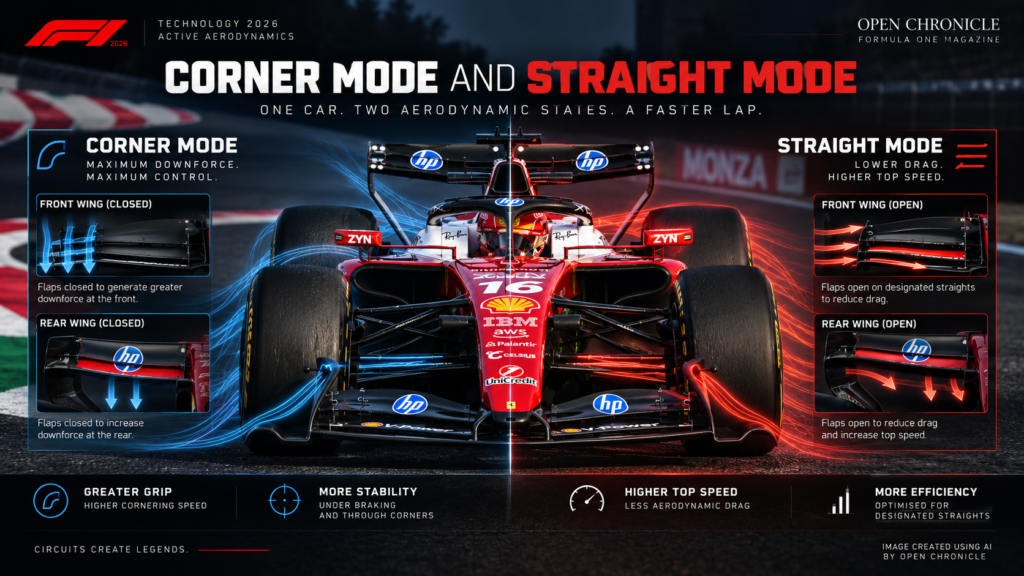
Formula 1’s new generation of active aerodynamics introduces two distinct aerodynamic states. Corner Mode is designed to generate the load needed through braking zones and corners, while Straight Mode reduces drag when the car is travelling along designated straights. Together, they fundamentally change one of Formula 1 engineering’s oldest compromises.
By Open Chronicle Formula One Magazine
Formula 1 has always been a battle between two competing aerodynamic demands.
A car needs downforce through corners. The greater the aerodynamic load, the more effectively the tyres can generate grip and the faster the driver can carry speed through a turn.
On a straight, however, some of the aerodynamic structures responsible for generating that load also create drag.
For decades, Formula 1 engineers have searched for the best compromise between those requirements.
The 2026 generation changes that equation.
Active aerodynamics allows the configuration of both the front and rear wing elements to change according to where the car is operating on the circuit.
At the centre of the concept are two aerodynamic states:
Corner Mode
and
Straight Mode.
The principle sounds simple. Its implications are considerably more significant.
Corner Mode: Building the Aerodynamic Platform
When a Formula 1 car approaches the braking zone and cornering sections of a circuit, aerodynamic grip becomes critical.
This is the environment for Corner Mode.
In this configuration, the movable wing elements adopt their higher load position, allowing the aerodynamic surfaces to generate the downforce required for cornering.
The objective is stability.
As speed increases, aerodynamic forces push the car more firmly towards the track surface. This allows the tyres to generate greater cornering forces than mechanical grip alone could provide.
That aerodynamic platform influences several phases of a corner.
Under braking, the driver needs confidence in the car as speed rapidly decreases.
During turn in, the front axle must respond accurately to steering input.
At the apex, aerodynamic balance helps determine how much speed the driver can carry.
On corner exit, stability becomes essential as power is progressively applied.
Corner Mode therefore represents the configuration in which aerodynamic load takes priority over reducing resistance.
Straight Mode: Releasing the Car
Once the car leaves the corner and enters a designated straight, the priorities change.
Downforce remains useful, but excessive aerodynamic resistance becomes costly.
This is where Straight Mode enters the equation.
The active wing elements move into a lower drag configuration. By changing their aerodynamic profile, the car reduces resistance to the airflow.
The objective is straightforward: improve efficiency and allow the car to accelerate more effectively towards its maximum speed.
Instead of carrying the same aerodynamic configuration around the entire lap, the car can therefore adapt to two very different environments.
Through the corners, it seeks aerodynamic load.
Along designated straights, it seeks aerodynamic efficiency.
That distinction is one of the defining characteristics of the new technical philosophy.
Why Both Wings Matter
The system is particularly interesting because the aerodynamic transformation involves both ends of the car.
Formula 1 cars are extremely sensitive to aerodynamic balance.
Changing only the rear aerodynamic load can alter the relationship between the front and rear axles. If that balance changes too dramatically, the driver’s perception of the car can change with it.
The involvement of the front and rear wing elements allows engineers to manage the car as a complete aerodynamic platform.
In Corner Mode, the objective is to provide the balance necessary for braking and cornering.
In Straight Mode, the objective becomes reducing drag while maintaining a stable car as speeds increase.
The transition between those states is therefore not simply about opening a wing.
It is about controlling the aerodynamic balance of the entire car.
From a Fixed Compromise to a Dynamic One
This is where the philosophy becomes especially important.
Traditional Formula 1 setup has always involved compromise.
Consider two hypothetical cars.
One is configured with greater aerodynamic load. It may be extremely competitive through the corners but vulnerable on the straights.
The other uses a lower drag configuration. It may be faster in a straight line but sacrifice some cornering performance.
Engineers traditionally had to determine which compromise produced the fastest overall lap.
Active aerodynamics changes that calculation.
The 2026 car can effectively alter part of its aerodynamic personality during the lap.
It can approach a corner configured to generate greater load, then transition towards lower drag when it reaches an appropriate straight.
It does not eliminate the need for setup compromises. Wing geometry, ride characteristics, mechanical balance, tyres and numerous other variables still matter.
But it gives engineers another powerful tool with which to manage the relationship between cornering performance and straight line efficiency.
The Driver Still Matters
A more adaptable aerodynamic system does not remove the driver’s role.
Quite the opposite.
The driver must still extract performance from the car during braking, rotation and acceleration. Differences in confidence, precision and tyre management remain decisive.
A car may have enormous aerodynamic potential, but that potential must still be translated into lap time.
Drivers will also experience cars whose aerodynamic characteristics change more significantly between different sections of a circuit.
Understanding those transitions, and developing confidence in how the car behaves around them, becomes part of mastering the new generation.
The Engineering Challenge Behind the Concept
Active aerodynamics also creates a different challenge for Formula 1 engineers.
The question is no longer simply:
What aerodynamic configuration should we use for this circuit?
It increasingly becomes:
How should the car behave in each aerodynamic state?
Engineers must consider how the car performs when generating greater load and how it behaves when drag is reduced.
They must also understand how those configurations interact with suspension behaviour, tyre loading, energy deployment and overall vehicle balance.
The fastest car will not necessarily be the machine with the greatest theoretical downforce or the highest maximum speed.
It may instead be the car that manages the transition between aerodynamic states most effectively while remaining predictable for the driver.
Different Circuits, Different Demands
The importance of the two modes will naturally vary according to circuit characteristics.
At tracks dominated by long straights, reducing aerodynamic resistance becomes particularly valuable.
At circuits containing sequences of medium and high speed corners, the quality and consistency of the aerodynamic platform becomes increasingly important.
That gives engineers another layer of optimisation.
Monza, for example, presents a fundamentally different aerodynamic challenge from Monaco.
One rewards exceptional efficiency along long straights.
The other places far greater emphasis on cornering, traction and mechanical performance.
Active aerodynamics does not make those circuits identical.
Instead, it gives Formula 1 cars a broader operating window with which to attack their different characteristics.
Beyond DRS
The significance of the system becomes clearer when viewed against the previous generation of Formula 1 cars.
For years, spectators became familiar with a movable rear wing primarily through DRS.
The new aerodynamic philosophy is broader.
Rather than treating movable aerodynamics principally as an overtaking aid, active aerodynamics becomes part of the fundamental performance architecture of the car.
That is an important conceptual change.
Aerodynamic configuration is no longer entirely static throughout a racing lap.
The car itself becomes more adaptable.
Two Modes, One Objective
Corner Mode and Straight Mode ultimately pursue the same goal:
producing the fastest possible Formula 1 car around an entire lap.
Corner Mode prioritises aerodynamic load and stability when the driver needs grip.
Straight Mode prioritises aerodynamic efficiency when reducing resistance becomes more valuable.
The engineering challenge lies in making both configurations work together.
That could become one of the defining technical battlegrounds of the 2026 era.
Because the fastest Formula 1 car may no longer simply be the one that produces the best aerodynamic compromise.
It may be the one that is best at changing that compromise as the circuit unfolds.
Open Chronicle Technical Focus
Corner Mode: Higher aerodynamic load for braking and cornering.
Straight Mode: Lower drag configuration on designated straights.
Front wing: Active elements contribute to managing front aerodynamic load.
Rear wing: Changes configuration as part of the overall aerodynamic system.
Engineering objective: Balance cornering performance with straight line efficiency across the lap.