
By Open Chronicle History Desk
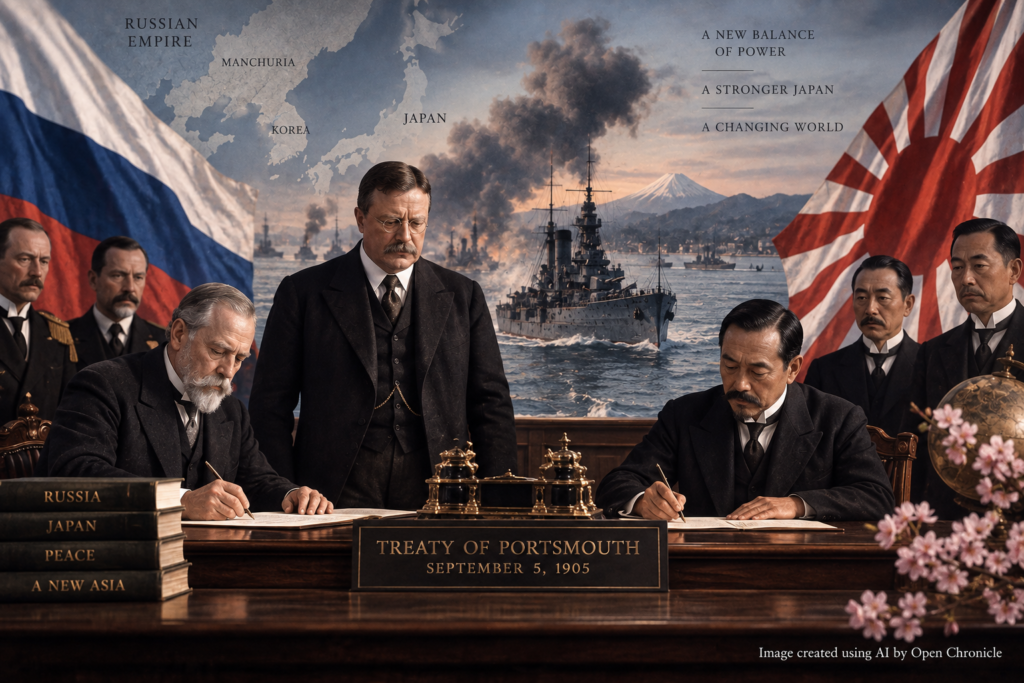
On September 5, 1905, representatives of the Russian Empire and the Empire of Japan signed the Treaty of Portsmouth, formally ending one of the most consequential wars of the early twentieth century.
The treaty was signed in Portsmouth, New Hampshire, after negotiations mediated by American President Theodore Roosevelt.
On paper, it ended the Russo Japanese War, a conflict fought largely over competing Russian and Japanese ambitions in Korea and Manchuria.
Its historical significance went much further.
Japan had defeated one of Europe’s great imperial powers.
Russian armies had been beaten in major land battles. Port Arthur had fallen. And at the Battle of Tsushima, the Japanese navy had virtually destroyed the Russian Baltic Fleet after it had travelled thousands of miles around the world to reach East Asian waters.
The consequences were profound.
Japan emerged as a major international power.
Russia suffered humiliation and political upheaval.
The balance of power in East Asia changed.
Anti colonial movements across Asia drew inspiration from Japan’s victory.
And Theodore Roosevelt’s role in negotiating the peace would help make him the first American president to receive the Nobel Peace Prize.
The Treaty of Portsmouth therefore ended much more than a war.
It announced that the global balance of power was changing.
Two Empires Look Towards East Asia
The origins of the conflict lay in the rapid transformation of East Asia during the nineteenth century.
Russia had spent generations expanding across Siberia towards the Pacific.
By the late nineteenth century, Russian strategists increasingly viewed Manchuria and the Korean Peninsula as areas of enormous economic and military importance.
Japan was undergoing an equally dramatic transformation.
For centuries, Japan had largely limited foreign contact under the Tokugawa shogunate.
That system was shattered after American Commodore Matthew Perry arrived with warships in 1853 and demanded that Japan open relations with the outside world.
The shock helped produce a political revolution.
The Meiji Restoration
In 1868, the Meiji Restoration returned political authority, at least formally, to the emperor and began one of history’s most remarkable programmes of national modernisation.
Japanese leaders understood the danger facing their country.
Western imperial powers had imposed unequal treaties on China and other Asian societies.
If Japan remained militarily and economically weak, it could suffer the same fate.
The new government therefore pursued industrialisation with extraordinary determination.
Railways were constructed.
Factories expanded.
A modern education system developed.
The army was reorganised using European models.
The navy adopted advanced Western technology and doctrine.
Government institutions were transformed.
Within a generation, Japan had created modern armed forces capable of competing with major powers.
Japan Turns Outward
Modernisation was accompanied by imperial expansion.
Japanese leaders increasingly argued that national security required influence over neighbouring territories.
Korea was particularly important.
The Korean Peninsula lay directly between Japan, China and Russia.
Tokyo feared that if another great power controlled Korea, Japan itself could become strategically vulnerable.
China traditionally exercised considerable influence over Korea.
Japan challenged that position.
The rivalry eventually produced war.
The First Sino Japanese War
In 1894, Japan and Qing China went to war.
Many foreign observers expected China, with its enormous population and long imperial history, to dominate.
Instead, Japan won decisively.
Its modernised military defeated Chinese forces on land and sea.
The Treaty of Shimonoseki in 1895 forced China to recognise Korean independence and cede Taiwan and other territories to Japan.
Japan also gained the Liaodong Peninsula in southern Manchuria.
But then European powers intervened.
The Triple Intervention
Russia, France and Germany pressured Japan to surrender the Liaodong Peninsula.
Japan reluctantly complied.
The episode became known as the Triple Intervention.
For Japanese leaders and much of the Japanese public, the humiliation was profound.
Japan had won the territory through war only to be forced to surrender it by European diplomatic pressure.
The situation became even more provocative when Russia subsequently obtained its own lease over the Liaodong Peninsula.
Russia gained access to Port Arthur, an exceptionally valuable warm water port.
From Tokyo’s perspective, Russia appeared to have taken for itself what Japan had been forced to abandon.
Resentment deepened.
Russia Expands into Manchuria
Russia continued expanding its influence across northeastern China.
The construction of the Trans Siberian Railway linked European Russia increasingly closely with the Pacific.
Additional railway projects crossed Manchuria.
Russian troops occupied large areas during the Boxer Rebellion and remained afterwards.
Port Arthur became an important Russian naval base.
Russian influence also appeared to be expanding towards Korea.
For Japan, the strategic situation was becoming dangerous.
Tokyo wanted recognition of its predominant interests in Korea.
Russia wanted to preserve and expand its position in Manchuria.
Diplomatic negotiations failed to resolve the dispute.
The Anglo Japanese Alliance
Japan had meanwhile achieved a major diplomatic breakthrough.
In 1902, Britain and Japan signed the Anglo Japanese Alliance.
For Japan, the agreement represented international recognition of its growing power.
For Britain, Japan offered a useful counterweight to Russian expansion in East Asia.
The alliance also reduced the risk that another coalition of European powers might intervene against Japan as they had after the Sino Japanese War.
Tokyo’s leaders could contemplate confrontation with Russia with greater confidence.
Negotiations Fail
Throughout 1903, Japan attempted to negotiate a settlement.
Tokyo proposed arrangements intended to recognise Russian interests in Manchuria while securing Japanese predominance in Korea.
Russia delayed and resisted key Japanese demands.
Japanese leaders increasingly concluded that waiting would only strengthen Russia.
The Trans Siberian Railway was still incomplete in important respects.
Once Russia could move troops and supplies more efficiently across Eurasia, defeating it might become much harder.
Japan decided to act.
The Attack on Port Arthur
On the night of February 8 to 9, 1904, Japanese naval forces attacked the Russian fleet at Port Arthur.
The strike came before a formal declaration of war.
Japanese torpedo boats damaged Russian vessels.
Two days later, Japan formally declared war.
The attack immediately demonstrated the central importance of naval power.
Japan needed control of the surrounding seas to transport armies to the Asian mainland.
Russia needed its Pacific fleet to prevent that.
The struggle for Port Arthur would become one of the defining campaigns of the war.
War in Korea
Japanese troops landed in Korea and moved northwards.
The Korean government was in little position to resist Japanese military dominance.
Japanese forces then advanced towards Manchuria.
The war would be fought largely outside either Russia or Japan itself.
Korean and Chinese territories became battlefields for two imperial powers competing for regional dominance.
This is an important dimension of the conflict.
The Russo Japanese War was not simply a heroic Japanese struggle against European imperialism.
Japan was itself becoming an imperial power.
The Battle of the Yalu River
In spring 1904, Japanese and Russian forces fought along the Yalu River separating Korea from Manchuria.
Japanese forces won.
The victory had enormous psychological importance.
A modern Japanese army had defeated Russian troops in a major land engagement.
The assumption that European military forces were naturally superior to Asian armies had suffered a serious blow.
But the war was only beginning.
The Siege of Port Arthur
Japanese forces surrounded Port Arthur.
The siege became extraordinarily brutal.
Russian fortifications were formidable.
Japanese troops repeatedly attacked heavily defended positions.
Machine guns, artillery, trenches, barbed wire and modern rifles produced enormous casualties.
In many ways, Port Arthur anticipated the industrialised warfare that would devastate Europe during the First World War less than a decade later.
Japanese soldiers sometimes attacked fortified positions at terrible human cost.
Eventually, Japanese artillery gained positions from which it could bombard the Russian fleet inside the harbour.
Port Arthur’s situation became hopeless.
Port Arthur Falls
On January 2, 1905, the Russian garrison surrendered.
Japan had captured the fortress.
The victory was strategically and symbolically enormous.
Russia had lost one of its most important positions in East Asia.
Japanese forces could now concentrate on the main Russian army in Manchuria.
The next great confrontation came near Mukden.
The Battle of Mukden
The Battle of Mukden, fought from February into March 1905, was among the largest land battles fought before the First World War.
Hundreds of thousands of soldiers participated.
The front extended across a vast area.
Both sides suffered enormous casualties.
Japanese forces attempted to envelop the Russian army.
Eventually, the Russians withdrew northwards.
Japan had won another major victory.
But its own losses were severe.
Tokyo was approaching the limits of what its economy and population could sustain.
Russia had suffered repeated defeats, but it possessed far greater reserves of manpower and resources.
The war was becoming dangerous for both sides.
Russia Sends the Baltic Fleet
Russia attempted to transform the naval situation through an extraordinary operation.
The Baltic Fleet was ordered to sail from European waters to East Asia.
The voyage was epic in scale.
Russian warships travelled thousands of miles around Africa and across the Indian Ocean.
The fleet faced logistical problems, exhaustion and diplomatic complications.
Its mission was to restore Russian naval power in the Pacific.
Instead, it sailed towards catastrophe.
Tsushima
In May 1905, the Russian fleet approached the waters between Korea and Japan.
Admiral Tōgō Heihachirō commanded the Japanese Combined Fleet.
On May 27 and 28, the fleets fought the Battle of Tsushima.
The result was one of the most decisive naval victories in modern history.
Japanese gunnery, manoeuvring, communications and training proved devastatingly effective.
Russian battleships were sunk or captured.
Much of the fleet was destroyed.
Only a small number of Russian vessels escaped.
Russia’s attempt to reverse the war at sea had ended in disaster.
The Shock of Tsushima
News of the victory spread around the world.
Japan had not merely survived a war against a European great power.
It had defeated Russia repeatedly on land and virtually annihilated a major Russian fleet at sea.
For European observers, the implications were startling.
The racial and imperial assumptions underlying nineteenth century geopolitics were being challenged.
For many people living under European colonial rule, Japan’s victory carried a different meaning.
It demonstrated that an Asian state could modernise, confront a European empire and win.
But Japan Was Exhausted
Military victory did not mean Japan could continue fighting indefinitely.
The war had been extraordinarily expensive.
Japanese casualties were heavy.
Government finances were under severe pressure.
The army had won at Mukden but had not destroyed Russia’s ability to continue the war.
Russia could theoretically send additional troops eastwards.
Japan therefore wanted peace while it still held the strategic advantage.
Russia also had powerful reasons to negotiate.
Its military reputation had been shattered.
And at home, the empire was entering a revolutionary crisis.
Russia’s Revolution of 1905
The war intensified existing tensions inside the Russian Empire.
Industrial workers faced difficult conditions.
Peasants remained deeply dissatisfied.
Political opposition to the autocracy was growing.
Military defeats humiliated the government of Tsar Nicholas II.
In January 1905, peaceful demonstrators marched towards the Winter Palace in St Petersburg.
Troops opened fire.
The event became known as Bloody Sunday.
Strikes and unrest spread.
Sailors mutinied.
Peasant disturbances intensified.
Nationalist movements challenged imperial authority.
Russia was fighting a foreign war while confronting revolution at home.
Peace became increasingly attractive.
Theodore Roosevelt Steps In
American President Theodore Roosevelt recognised an opportunity to mediate.
The United States had growing interests in the Pacific.
Washington did not want Russia to dominate East Asia.
But it also did not want Japan to become overwhelmingly powerful.
A negotiated balance suited American strategic interests.
Roosevelt encouraged both sides to enter peace talks.
Delegations eventually travelled to the United States.
The negotiations were held at the Portsmouth Naval Shipyard area in New Hampshire, with important diplomatic discussions also taking place nearby.
The Negotiators
Russia’s principal negotiator was Sergei Witte, one of the empire’s most capable statesmen.
Japan’s delegation was led by Foreign Minister Komura Jutarō.
Both faced difficult instructions.
Japan believed its battlefield victories justified substantial concessions.
Russia wanted to avoid the appearance of total defeat.
One of the most contentious questions concerned financial indemnities.
Japan wanted Russia to pay part of the enormous cost of the war.
Russia refused.
The negotiations nearly collapsed.
Roosevelt’s Diplomacy
Roosevelt communicated with both sides and worked to keep negotiations alive.
He understood that neither country had achieved everything it wanted.
Japan had won spectacular victories but faced financial exhaustion.
Russia had suffered humiliation but still possessed the capacity to continue fighting.
A successful settlement therefore required compromise.
Eventually, Japan abandoned its demand for a war indemnity.
That decision made agreement possible.
September 5, 1905
On September 5, the Treaty of Portsmouth was signed.
The Russo Japanese War was over.
Russia recognised Japan’s predominant political, military and economic interests in Korea.
Russia transferred its leasehold rights in the Liaodong Peninsula, including Port Arthur, to Japan.
Japan also gained control over the southern portion of Sakhalin Island.
Russian and Japanese forces were to evacuate Manchuria, which was formally returned to Chinese administration, although both powers retained important interests in the region.
Japan emerged with major strategic gains.
But there was no financial indemnity.
Anger in Japan
The absence of an indemnity shocked many Japanese citizens.
They had followed reports of battlefield victories.
They had been told of Port Arthur, Mukden and Tsushima.
Many therefore expected Russia to pay heavily for defeat.
When the treaty’s terms became public, demonstrations erupted.
The Hibiya riots in Tokyo became particularly violent.
Government buildings and police facilities were attacked.
Martial law was imposed.
The reaction revealed a paradox.
Internationally, Japan had achieved an extraordinary victory.
Domestically, many people believed their government had surrendered too much at the negotiating table.
Russia Escapes Total Humiliation
Sergei Witte returned to Russia having avoided some of Japan’s most demanding conditions.
Russia lost its dominant position in southern Manchuria and accepted Japan’s ascendancy in Korea.
But it paid no indemnity.
It also retained northern Sakhalin.
Nicholas II’s government could therefore claim that Russia had not been completely humiliated diplomatically, even though the military outcome had clearly favoured Japan.
Witte’s negotiating performance enhanced his international reputation.
Roosevelt Wins the Nobel Peace Prize
Theodore Roosevelt’s mediation also had major consequences.
In 1906, he received the Nobel Peace Prize for his role in bringing the conflict to an end.
He became the first American president to receive the award.
Roosevelt’s involvement reflected a larger transformation in American foreign policy.
The United States was becoming increasingly active in international diplomacy, particularly in the Pacific.
The peace conference therefore symbolised not only Japan’s rise but America’s growing role as a global power.
Korea Pays the Greatest Price
For Korea, the outcome was disastrous.
The treaty recognised Japan’s dominant position on the peninsula.
Japan tightened control rapidly.
In November 1905, Korea was forced into a protectorate relationship.
Korean sovereignty was progressively dismantled.
In 1910, Japan formally annexed Korea.
Japanese colonial rule would last until 1945.
The victory celebrated in Japan as liberation from European pressure therefore simultaneously facilitated Japanese imperial domination over another Asian people.
This contradiction is essential to understanding the historical significance of the war.
Japan Becomes a Great Power
The victory transformed Japan’s international status.
Only a few decades earlier, Western powers had forced Japan to accept unequal diplomatic arrangements.
Now Japan possessed a modern army, a powerful navy and an expanding empire.
Western governments could no longer treat it simply as a secondary Asian state.
Japan had entered the ranks of the world’s major powers.
The consequences would shape the entire first half of the twentieth century.
Inspiration Across Asia
Japan’s victory electrified many intellectuals and political activists across Asia and beyond.
Nationalists living under European colonial rule studied the conflict closely.
If Japan could defeat Russia, perhaps European imperial dominance was not permanent.
The psychological impact appeared in India, China, the Ottoman world and other regions.
Japan became, for some, evidence that modernisation did not necessarily require political submission to the West.
But admiration would later become much more complicated as Japanese imperial expansion intensified.
The liberator image and the imperial reality increasingly collided.
China Watches Carefully
The war had been fought largely on Chinese territory.
The weakness of the Qing government had allowed foreign powers to compete over Manchuria.
Chinese reformers therefore drew urgent lessons from Japan’s success.
Japan had modernised institutions, military structures and industry with remarkable speed.
China’s own reform efforts appeared inadequate by comparison.
The Russo Japanese War thus contributed indirectly to debates about China’s political future.
Six years later, the 1911 Revolution would overthrow the Qing dynasty.
The Impact on Russia
Russia’s defeat had equally far reaching consequences.
The Romanov monarchy survived the Revolution of 1905, but only after making concessions.
Nicholas II issued the October Manifesto, promising political reforms and establishing the State Duma.
The autocracy subsequently restricted many of those reforms.
The deeper structural problems remained unresolved.
Workers remained dissatisfied.
Peasant grievances continued.
National tensions persisted.
Political radicalism survived.
The regime had been shaken, not transformed.
A Prelude to 1917
Twelve years after Portsmouth, the Romanov dynasty collapsed.
The First World War placed pressures on Russia far greater than those of the Russo Japanese conflict.
Military defeats, economic breakdown and political incompetence contributed to revolution.
Nicholas II abdicated in 1917.
Later that year, the Bolsheviks seized power.
It would be an exaggeration to say that defeat by Japan directly caused the Russian Revolution of 1917.
But 1905 exposed many of the weaknesses that would eventually destroy the imperial system.
The war demonstrated how military failure abroad could accelerate political crisis at home.
Lessons for Modern Warfare
Military observers also studied the conflict closely.
The Russo Japanese War offered a disturbing preview of what modern industrial warfare could become.
Machine guns inflicted enormous casualties.
Heavy artillery devastated fortified positions.
Trench systems became increasingly sophisticated.
Barbed wire restricted infantry movement.
Railways transported enormous armies.
Naval battles demonstrated the growing importance of long range gunnery and wireless communications.
Sieges and mass infantry attacks produced casualties on a scale that shocked observers.
Many of these lessons would reappear during the First World War.
Not all were learned.
Tsushima and Naval Strategy
The Battle of Tsushima became particularly influential among naval strategists.
It appeared to demonstrate that a decisive fleet battle could determine control of the seas.
Navies around the world studied Japanese tactics.
The victory reinforced enthusiasm for powerful battleships.
The following year, Britain launched HMS Dreadnought, a revolutionary battleship that made earlier designs increasingly obsolete.
A new naval arms race followed.
Japan’s victory therefore became part of the broader technological and strategic competition leading towards the First World War.
The Road Towards Japanese Empire
The Treaty of Portsmouth also belongs to a longer trajectory of Japanese expansion.
Japan had already acquired Taiwan.
Its influence over Korea now became dominant.
It gained strategic positions in southern Manchuria.
In subsequent decades, Japanese influence on the Asian mainland expanded further.
In 1931, the Japanese military seized Manchuria and created the puppet state of Manchukuo.
In 1937, full scale war erupted between Japan and China.
By 1941, Japan’s imperial expansion collided directly with the United States and European colonial powers across the Pacific.
The road to the Pacific War did not begin at Portsmouth.
But the victory of 1905 gave Japanese leaders confidence that military power could fundamentally reshape the international order.
A New Global Balance
The treaty reflected three major shifts occurring simultaneously.
Russia’s prestige had declined.
Japan’s prestige had risen.
And the United States had demonstrated its increasing diplomatic influence.
These developments foreshadowed the geopolitics of the twentieth century.
The old European dominated international system was beginning to change.
Power was becoming more global.
States outside Western Europe were increasingly capable of shaping major international events.
The Pacific was becoming as strategically important as the Atlantic.
Victory and Contradiction
The Russo Japanese War remains historically complicated because its symbolism differs depending on perspective.
For Japan, it was a stunning national achievement.
For many colonised peoples, it challenged assumptions of European racial and military supremacy.
For Russia, it was a humiliating defeat that exposed serious weaknesses within the imperial state.
For Korea, it accelerated the destruction of national independence.
For China, it was another conflict between foreign powers fought partly on Chinese soil.
History rarely produces victories without consequences for those who did not choose the battlefield.
Portsmouth demonstrates that particularly clearly.
Why September 5 Matters
The Treaty of Portsmouth did not simply end a regional conflict.
It altered perceptions of global power.
Japan had defeated Russia.
A European empire had been forced to negotiate after losing to an Asian state.
Korea’s fate moved decisively towards Japanese domination.
Russia’s political system had been badly shaken.
The United States had emerged as an important diplomatic mediator.
Military planners were studying lessons that would soon become terrifyingly relevant in Europe.
And nationalist movements across Asia were reconsidering what might be politically possible.
The nineteenth century’s assumptions about the global hierarchy of power had suffered a major shock.
September 5, 1905
When Russian and Japanese representatives signed their names at Portsmouth, they ended a war that had lasted roughly eighteen months.
But they also marked the beginning of a new geopolitical era.
Japan entered the twentieth century as a recognised great power.
Russia entered it wounded and politically unstable.
The United States demonstrated that it intended to participate actively in the balance of power beyond the Western Hemisphere.
And East Asia moved closer to the conflicts that would dominate the following four decades.
The world of European imperial supremacy had not disappeared.
But on September 5, 1905, it had received an unmistakable warning.
A modern Asian power had challenged one of Europe’s great empires.
And won.