
By Open Chronicle News Desk
The U.S. Marine Corps is continuing to reshape how its forces could operate in a future maritime conflict, testing a model in which small teams spread across multiple temporary bases detect enemy ships, coordinate operations and support combat aircraft without relying on a large permanent installation.
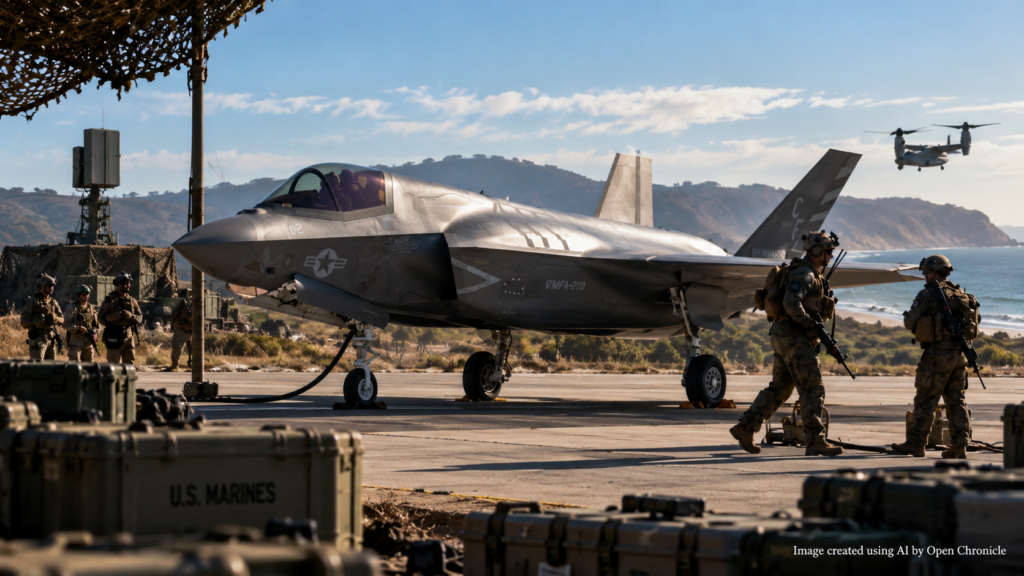
Marines from the 13th Marine Expeditionary Unit recently operated two separate expeditionary sites simultaneously near Camp Pendleton, California. One was focused on maritime surveillance and target tracking, while the other combined a forward command post with facilities capable of refueling and rearming aircraft.
The exercise offered a practical demonstration of the Marine Corps’ Expeditionary Advanced Base Operations concept, known as EABO, which is designed to allow dispersed Marine forces to support naval operations from temporary positions in contested coastal environments.
Finding ships from the coastline
At the first location, Marines established what the service describes as a sensing expeditionary advanced base.
Coastal surveillance radars and electronic sensors were combined with small unmanned aircraft operated by Marines from Battalion Landing Team 2/4.
When surveillance systems detected a vessel moving through nearby sea lanes, drone operators launched aircraft to identify the contact visually and continue tracking its movement.
The resulting imagery, coordinates and other information could then be transmitted to the Marine Expeditionary Unit commander, providing a rapidly updated picture of maritime activity.
“We pull those grids, capture the imagery, and send that critical data directly back to the MEU commander,” Sgt. Javier Guzman Granados, a drone operator with the battalion, said.
Speed is particularly important in this type of operation. Ships are constantly moving, meaning targeting or surveillance information can quickly become outdated.
The ability to detect a vessel, identify it and rapidly distribute its position could become crucial in a conflict where Marine units are helping the Navy monitor large areas of contested ocean.
A second base keeps aircraft in the fight
Miles from the surveillance position, another group of Marines established a second expeditionary site.
This location combined a forward command element with a Forward Arming and Refueling Point, or FARP.
The command post connected the two land based positions with an operations center aboard Navy ships offshore and aircraft operating overhead.
Nearby, fuel and ammunition teams were positioned to service helicopters and other aircraft.
Instead of returning to an amphibious ship or a larger airbase, aircraft could land at the temporary site, take on fuel and ordnance and return quickly to operations.
“Forward arming and refueling points minimize the time aircraft spend out of the fight and maximize their time in the air,” Sgt. Cody Quittner, a bulk fuel specialist with Marine Medium Tiltrotor Squadron 364, said.
“Instead of flying all the way back to the ship or a main base for fuel and ordnance, aircraft come directly to us, rearm, refuel, and immediately return to supporting the infantrymen on the forward line.”
Such facilities could significantly extend the effective reach of Marine aviation while reducing dependence on large bases that could become priority targets during a major conflict.
The challenge of fighting while dispersed
Operating multiple sites simultaneously also exposed one of the central challenges of distributed warfare: logistics.
Personnel responsible for transportation, security, communications and supplies had to be divided between separate locations instead of being concentrated at a single base.
“One of the major takeaways from this training evolution is the sheer number of moving parts required to establish a site and deliver that capability,” Quittner said.
That logistical complexity becomes particularly important when expeditionary bases are intended to remain small and mobile.
A forward position must have enough personnel, fuel, ammunition, sensors and communications equipment to accomplish its mission. At the same time, making the base too large could make it easier for an adversary to detect and target.
The Marine Corps is therefore experimenting with how much capability can be distributed across several locations while still allowing those positions to operate as a connected force.
From amphibious assaults to distributed maritime operations
The exercise reflects a broader transformation underway within the Marine Corps.
The service introduced Expeditionary Advanced Base Operations in 2019 as part of the wider Force Design effort.
Rather than concentrating Marines primarily for large amphibious assaults, EABO envisions relatively small units moving between temporary locations across coastlines and islands.
From those positions, Marines could provide surveillance, air defense, logistics, aviation support and potentially anti ship strike capabilities in support of Navy operations.
The approach has been developed particularly with the Indo Pacific in mind, where vast distances and numerous island chains create both opportunities and challenges for dispersed forces.
In such an environment, temporary Marine positions could complicate an adversary’s targeting problem while expanding the area from which U.S. forces can monitor maritime activity.
A network of small bases could also help extend the Navy’s operational reach without requiring every mission to be supported directly from a major ship or permanent military installation.
Building a maritime surveillance network
The sensing element demonstrated near Camp Pendleton illustrates how Marines could contribute directly to naval targeting and situational awareness.
A coastal radar might detect an unidentified vessel. A drone could then be launched to identify and track it. That information could subsequently move through the command network to ships, aircraft or other units.
The individual sensor is only one part of the system.
The larger objective is to create a network in which information gathered by relatively small units can rapidly reach commanders and potentially contribute to decisions elsewhere in the battlespace.
The 13th MEU has experimented with similar operations before.
During training at San Clemente Island in 2022, the unit employed aircraft including the RQ 20B Puma and Shield AI V BAT unmanned system to help construct a picture of maritime activity for Marine and Navy commanders.
The latest exercise takes that concept further by demonstrating how sensing, command operations and aviation support can function simultaneously from separate forward locations.
Connecting the land and sea
For the Marine Corps, the transformation is ultimately about becoming more closely integrated with naval operations.
“Connecting the land and sea is where the Marine Corps makes our money,” 1st Lt. Joseph Nameth, a platoon commander with Battalion Landing Team 2/4, said.
That statement captures the central idea behind the emerging concept.
Future Marine units may not simply deploy from Navy ships to fight ashore. They could also use positions on land to help the fleet fight at sea.
Sensors positioned along coastlines could monitor maritime traffic. Expeditionary bases could support aircraft. Command teams could distribute targeting information across the force. Mobile units could then relocate before an adversary could effectively respond.
The Camp Pendleton exercise therefore represents more than another training evolution. It demonstrates how the Marine Corps is attempting to turn distributed coastal positions into an integrated extension of American naval power.
Whether those concepts can remain effective under the pressure of a sophisticated opponent, particularly one capable of persistent surveillance and long range precision strikes, remains one of the critical questions Force Design must answer.
But the direction of travel is increasingly clear: smaller bases, greater mobility, more sensors and a Marine Corps designed to operate as part of a distributed maritime battlefield.