
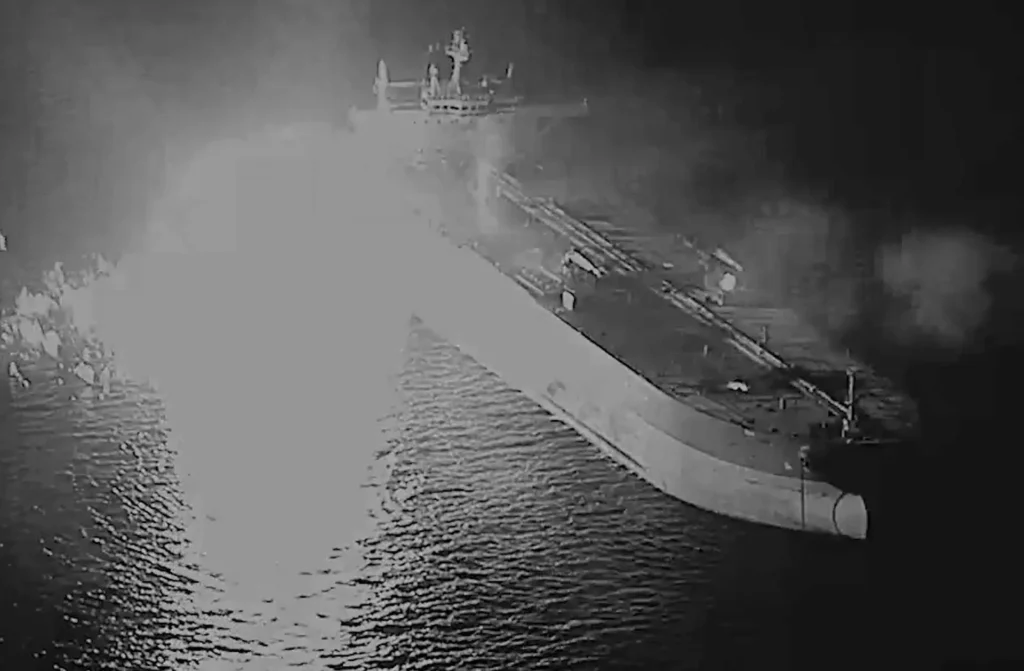
U.S. Central Command forces struck three Iranian crude-oil carriers on September 5, 2026, after the Islamic Revolutionary Guard Corps launched ballistic missiles toward two U.S. Navy warships operating in regional waters. (Picture source: U.S. Department of War/Defense)
By Open Chronicle News Desk
September 6, 2026
Iranian forces launched ballistic missiles at a U.S. Navy aircraft carrier and guided missile destroyer in Middle Eastern waters, according to U.S. Central Command, prompting American forces to strike three oil tankers that Washington says were linked to Iran’s Islamic Revolutionary Guard Corps.
The confrontation marks another significant escalation in the conflict surrounding the Strait of Hormuz, where military operations, commercial shipping and Iran’s energy exports are becoming increasingly intertwined.
CENTCOM said the Iranian missile attack took place on September 5 and targeted an aircraft carrier and an accompanying destroyer. Neither vessel has been publicly identified.
According to the U.S. military, both warships avoided the incoming missiles and no American personnel were injured.
Iran disputes that account. On September 6, the Islamic Revolutionary Guard Corps claimed that its Aerospace Force had successfully struck the two vessels and forced them to leave the engagement area.
No independently verified evidence has emerged demonstrating that either American warship was damaged.
The conflicting accounts have made the outcome of the engagement another point of contention between Washington and Tehran as the military confrontation intensifies.
A major test of Iran’s anti ship capabilities
The decision to launch ballistic missiles against moving U.S. warships is particularly significant because successfully attacking naval vessels at sea requires much more than missile range.
Iranian forces would need to locate the ships, maintain an accurate track as they maneuver, transmit updated targeting information and guide weapons toward vessels capable of rapidly changing speed and direction.
CENTCOM has not disclosed the number or type of missiles involved. It has also not explained whether the American ships escaped primarily through maneuvering, electronic warfare, decoys, interceptor missiles or a combination of defensive measures.
That distinction could prove important.
If U.S. forces disrupted Iran’s targeting network before the missiles reached their targets, the engagement may provide evidence of Washington’s ability to interfere with the reconnaissance and targeting systems required for effective Iranian anti ship operations.
Iran, however, may view the attack differently. Even unsuccessful missile launches can force American naval forces to expend defensive resources, maintain intensive surveillance and alter operations around contested waters.
U.S. strikes Iran’s oil network
Washington responded by targeting Iranian maritime assets rather than limiting retaliation to missile launchers or other conventional military installations.
American forces permanently disabled the M/T Downy near Kharg Island and the M/T Stark 1 near Jask, according to the U.S. account.
A third vessel, the M/T Kylo, also known as Noxen, was destroyed in the Gulf of Oman.
Before attacking the Kylo, American forces reportedly instructed the crew to abandon the tanker. The vessel was then struck in critical areas intended to render it unusable.
CENTCOM described the ships as components of a multibillion dollar oil network supporting the IRGC and its regional affiliates.
The attacks indicate that Washington is increasingly prepared to treat Iran’s oil logistics as part of the military confrontation.
Rather than concentrating exclusively on missile sites, air defenses and command facilities, U.S. forces are threatening assets associated with the financial networks that help sustain Iranian military operations.
Defense Secretary Pete Hegseth reinforced that message following the strikes, warning that additional Iranian attacks against American warships could bring further action against Iran’s tanker fleet.
The warning effectively connects the security of Iranian oil exports with Tehran’s decision on whether to continue attacking U.S. naval forces.
Iran threatens shipping through Hormuz
Iran subsequently widened its own claims of retaliation.
On September 6, the IRGC Navy said it attacked three oil tankers traveling through what Tehran described as an unauthorized route in the Strait of Hormuz. Iranian forces also claimed attacks against three U.S. linked vessels elsewhere.
Tehran warned commercial vessels against using maritime routes that it has not approved.
Iran separately claimed to have struck an unmanned U.S. military vessel attempting to enter the Strait of Hormuz. Washington had not immediately confirmed that incident, leaving the identity of the vessel, the weapon allegedly used and any possible damage unclear.
If confirmed, such an attack would highlight another increasingly important dimension of the maritime confrontation.
Unmanned surface and underwater systems can perform surveillance, reconnaissance and maritime awareness missions without exposing crews directly to Iranian missiles, drones or fast attack craft.
Their growing use could therefore become increasingly important if operating conditions around Hormuz become more dangerous.
The battle for the Strait of Hormuz
The geography of the latest confrontation is strategically important.
Kharg Island remains central to Iran’s crude oil export infrastructure, while Jask provides Tehran with access to maritime routes near the approaches to the Strait of Hormuz.
The strait itself remains one of the most strategically important waterways in the global economy, connecting the Persian Gulf with the Gulf of Oman and the wider Indian Ocean.
Military control of these waters is therefore closely connected to economic pressure.
Iran possesses a broad arsenal of ballistic missiles, cruise missiles, drones and coastal weapons capable of threatening military and commercial vessels. American forces, meanwhile, possess extensive surveillance, air power and precision strike capabilities that can threaten Iranian naval forces and energy infrastructure.
The result is an increasingly complex confrontation in which military and economic targets are becoming difficult to separate.
Protecting a U.S. carrier strike group
An aircraft carrier does not operate alone.
Its protection depends heavily on accompanying destroyers and other vessels providing radar coverage, missile defense, electronic warfare and anti submarine capabilities.
Carrier based aircraft extend that defensive perimeter considerably further, conducting surveillance and potentially intercepting hostile aircraft or drones before they can approach the naval formation.
The reported September 5 engagement could consequently provide valuable information about Iran’s ability to maintain targeting information against a maneuvering U.S. carrier group under wartime conditions.
Modern anti ship ballistic missiles depend on a chain of sensors, communications systems and targeting platforms. Breaking any part of that chain can dramatically reduce their effectiveness against moving vessels.
For Washington, preventing Iran from establishing a reliable targeting picture may therefore be as important as physically intercepting incoming missiles.
A dangerous new deterrence equation
The destruction and disabling of the three tankers also demonstrates a potential American strategy for increasing the economic cost of Iranian attacks.
Oil tankers are fundamentally different targets from mobile missile launchers. Large vessels depend on known ports, shipping lanes, anchorages and loading facilities. Their movements can be monitored and they cannot easily disappear from surveillance.
That vulnerability creates a difficult calculation for Tehran.
Iran can continue threatening U.S. naval forces and commercial shipping, but every attack could expose additional vessels and energy infrastructure to American retaliation.
Washington, however, faces risks of its own.
Striking Iranian oil assets may encourage Tehran to expand attacks against commercial shipping or energy infrastructure elsewhere in the Gulf, potentially drawing additional states into the conflict and disrupting global energy markets.
The possibility of miscalculation is therefore growing.
Maritime confrontation enters a more dangerous phase
The latest exchanges suggest that the conflict is evolving beyond isolated missile strikes.
Iran is attempting to demonstrate that American warships, unmanned systems and commercial vessels remain vulnerable around the Strait of Hormuz. The United States, meanwhile, is showing that Iranian oil exports and the maritime infrastructure supporting them can be directly targeted in retaliation.
For now, the most important claim remains unresolved.
Washington says the carrier and destroyer escaped the Iranian ballistic missile attack without damage or casualties. Tehran says its missiles struck the vessels.
Until independent evidence emerges, Iran’s claim should be treated cautiously.
What is clearer is that both sides are expanding the range of assets considered legitimate targets.
Another successful strike against a major U.S. warship, Iranian energy installation or commercial vessel could trigger a substantially larger response and push the struggle for control of the Strait of Hormuz into an even more dangerous phase.