
By Open Chronicle News Desk
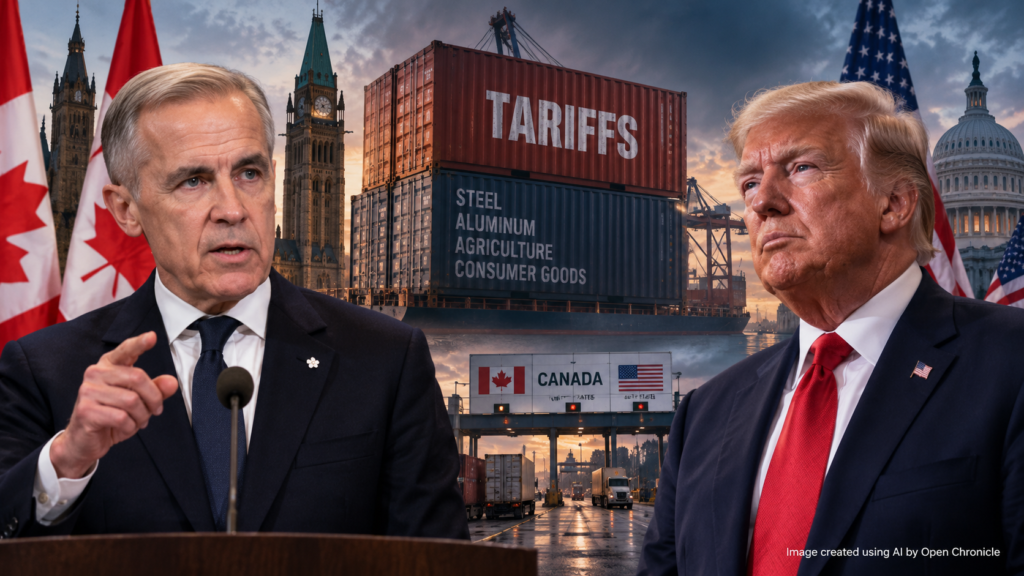
Canada has imposed a new wave of retaliatory tariffs on hundreds of American products, escalating its confrontation with the United States as Prime Minister Mark Carney warns that Washington’s economic demands threaten key Canadian industries and the country’s ability to determine its own future.
The measures target a broad range of U.S. exports, including steel, aluminum, cheese, household appliances, clothing, cosmetics and agricultural equipment.
Tariff rates of 15%, 25% and, for some products, 50% will apply, marking a significant Canadian response to mounting economic pressure from President Donald Trump’s administration.
The confrontation has developed beyond a conventional dispute over tariffs. Trump’s rhetoric about Canadian sovereignty has helped transform the conflict into a broader political debate about Canada’s independence and its relationship with its largest trading partner.
Carney draws a line against Washington
Carney has argued that accepting Washington’s demands could gradually weaken strategically important sectors of the Canadian economy.
His government is presenting the tariffs not simply as retaliation, but as part of a broader effort to protect Canada’s industrial capacity and economic independence.
That argument has gained political force amid Trump’s repeated threats and statements concerning Canada.
Rather than weakening Carney domestically, the pressure from Washington appears to have helped rally Canadians around the prime minister and turned resistance to Trump into a significant political issue.
Canadian historian Robert Bothwell described the transformation succinctly.
“Carney and Canada have become symbolic of resistance to him,” Bothwell said.
According to Bothwell, Trump may be attempting to make an example of Canada in order to demonstrate the consequences of resisting American demands. But such pressure could have the opposite effect by encouraging Canada and other countries to reduce their dependence on the United States.
Hundreds of American products targeted
The breadth of Canada’s tariff package demonstrates the seriousness of the dispute.
American steel and aluminum are among the products affected, placing two politically sensitive industrial sectors directly in the confrontation.
Consumer products are also targeted. Cheese, appliances, clothing and cosmetics will face additional import costs, while tariffs on farm equipment extend the consequences into the agricultural economy.
Depending on the product, Canadian duties will be imposed at rates of 15%, 25% or 50%.
The measures are likely to increase pressure on American exporters whose businesses depend heavily on access to the Canadian market.
They could also increase costs for Canadian companies and consumers, demonstrating the economic risks associated with a prolonged trade confrontation.
A deeply integrated economy comes under strain
Few major economies are as closely connected as Canada and the United States.
Manufacturing supply chains frequently cross the border several times before a finished product reaches consumers. The automotive, aerospace, agricultural, energy and metals industries are particularly dependent on cross border trade.
That integration means tariffs can produce consequences far beyond the companies directly targeted.
Canadian manufacturers using American components may face higher costs. American companies dependent on Canadian customers could lose sales. Businesses on both sides of the border may also begin reconsidering investment and supply chain decisions if they believe the confrontation will continue.
The deeper the tariff conflict becomes, the greater the possibility that a dispute intended to protect domestic industries could disrupt the continental economic system built around decades of integration.
Sovereignty becomes part of the trade dispute
What distinguishes the current confrontation from many previous Canada U.S. trade disputes is the increasingly political character of the disagreement.
Carney has linked economic policy with national independence, arguing that Canada cannot allow critical industries to be hollowed out by demands from Washington.
Trump’s comments concerning Canadian sovereignty have further intensified that sentiment.
For many Canadians, the dispute is therefore becoming about more than steel, aluminum or agricultural products. It increasingly concerns Canada’s ability to make independent economic and political decisions despite the enormous influence of its southern neighbour.
That dynamic could strengthen Carney’s position if Canadians continue to view his government as defending the country against external pressure.
Trump’s strategy carries risks
Washington’s economic leverage over Canada remains considerable because of the size of the U.S. market and the extent of bilateral trade.
But aggressive use of that leverage carries strategic risks.
If Canadian governments and businesses conclude that dependence on the United States has become a vulnerability, Ottawa could accelerate efforts to diversify its international trade relationships.
Canada could seek deeper commercial links with Europe and Asia while encouraging domestic production in industries considered strategically important.
Such a shift would take years and could not easily replace the scale of Canada U.S. trade. Nevertheless, a sustained confrontation could permanently alter how Canadian policymakers think about economic security.
This is the potential paradox identified by Bothwell. Attempts to demonstrate American economic power could ultimately convince allies that they need greater distance from Washington.
A trade war becoming a political test
The Canadian tariffs represent another significant escalation in a dispute that increasingly combines economics, national identity and geopolitical power.
Neither side can easily avoid the costs of prolonged confrontation.
Canada remains heavily dependent on the American market, while U.S. manufacturers, farmers and exporters benefit enormously from access to Canadian consumers and integrated North American supply chains.
For Carney, the political calculation is increasingly clear. Concessions that appear to threaten Canada’s industrial base or sovereignty could carry a greater domestic cost than retaliation.
For Trump, Canada has become a test of whether aggressive economic pressure can force a close trading partner to accept Washington’s terms.
The result could determine far more than the tariff rates applied to steel, cheese or farm machinery. It may help define the future of one of the world’s largest and most deeply integrated bilateral economic relationships.