
By Open Chronicle News Desk
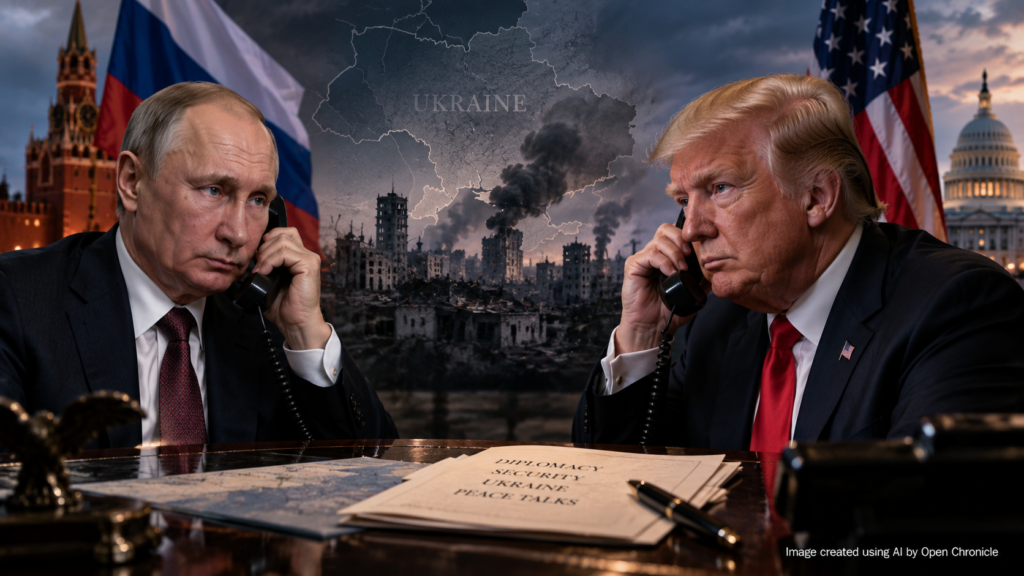
Russian President Vladimir Putin and US President Donald Trump held what the Kremlin described as an “extremely frank” telephone conversation on Tuesday, reviewing the latest American diplomatic efforts to find a path toward ending the war in Ukraine.
The roughly one hour call followed visits to Moscow and Kyiv by US envoys Steve Witkoff and Jared Kushner, who met Putin and Ukrainian President Volodymyr Zelenskyy during a weekend of intensive diplomacy.
Despite the renewed contacts between Washington, Moscow and Kyiv, there was no immediate indication of a breakthrough toward ending the four and a half year conflict.
Kremlin aide Yuri Ushakov said Putin and Trump exchanged assessments of the meetings and discussed the military and diplomatic situation in detail.
Witkoff and Kushner missions dominate talks
The latest diplomatic push has placed Witkoff and Kushner at the centre of Washington’s efforts to explore possible terms for ending the war.
Their visits to both capitals provided the basis for Tuesday’s conversation between the Russian and American presidents.
According to Ushakov, Putin and Trump “exchanged views on the outcome of the visits.”
The Kremlin did not disclose whether the US envoys presented new proposals capable of narrowing the considerable differences separating Russia and Ukraine.
The absence of an immediate agreement suggests that the fundamental obstacles to a settlement remain unresolved.
Putin gives Trump his assessment of the battlefield
Ushakov said Putin provided Trump with what the Kremlin described as an “objective and detailed analysis” of developments along the frontline.
Moscow continues to argue that Russian forces are advancing and that Ukraine’s military position will deteriorate if the war continues.
Putin has repeatedly maintained that Russian forces will eventually secure the remaining parts of the Donbas that Moscow claims as Russian territory.
According to Ushakov, Putin also explained to Trump what he believed Washington could “realistically do to bring the hostilities to a swift conclusion.”
The Kremlin did not reveal what measures Putin proposed.
That omission is significant because Russia has so far shown little public willingness to abandon the central conditions it has attached to a peace settlement.
Among Moscow’s demands is that Ukraine relinquish territory in the east, including areas claimed by Russia but not currently controlled by Russian forces. Kyiv has repeatedly rejected demands that it surrender additional territory.
Putin tells Trump Russia has no plans to attack Europe
European security also featured prominently in the conversation.
According to Ushakov, Putin told Trump that Russia has “absolutely no aggressive plans whatsoever towards Europe.”
The Russian president rejected warnings from European governments that Moscow could pose a broader military threat beyond Ukraine.
“The myths being spread about the Russian threat serve as a pretext for Europeans to ramp up support for Ukraine and their own military spending,” Ushakov said, outlining the Kremlin’s position.
European governments have increasingly taken a different view.
Russia’s invasion of Ukraine, its military buildup and allegations of sabotage, cyber operations and other hostile activities have contributed to a major expansion of European defence preparations.
Moscow denies accusations that it is conducting a coordinated sabotage campaign against Ukraine’s European supporters.
NATO concerns remain
Concerns about Russia’s intentions have also become an important issue between Washington and Moscow.
CIA Director John Ratcliffe made a surprise visit to Moscow in late August. According to US media reports, Ratcliffe warned Russian officials against any attack on a NATO member.
The episode highlighted the continuing tension between Moscow’s assurances that it has no intention of attacking Europe and Western concerns about the possibility of further escalation.
Trump himself has publicly expressed scepticism that Putin intends to attack NATO territory, while European governments have increasingly invested in air defence, ammunition production, border security and military readiness.
The disagreement over Russia’s long term intentions is becoming one of the central strategic questions surrounding the Ukraine war.
Diplomacy continues while fighting resumes
The Putin Trump conversation also came against the backdrop of renewed Russian attacks on Ukraine.
Russian missile and drone strikes against Kyiv resumed shortly after Witkoff and Kushner completed their diplomatic visit, demonstrating the gulf between diplomatic activity and conditions on the battlefield.
For Washington, the challenge remains finding sufficient common ground between two sides whose fundamental positions are still far apart.
Ukraine wants security guarantees and rejects a settlement that would leave it vulnerable to another Russian attack. Moscow continues to demand territorial and strategic concessions that Kyiv considers unacceptable.
Russia also wants any settlement to address what it describes as the underlying causes of the conflict, a formulation Moscow has repeatedly used when discussing NATO, Ukraine’s military alignment and the European security order.
No breakthrough, but diplomatic channels remain open
The significance of Tuesday’s conversation may therefore lie less in any immediate agreement than in the fact that direct communication between Washington and Moscow remains active.
The weekend missions by Witkoff and Kushner, followed by the Putin Trump call, represent a concentrated effort to determine whether negotiations can move beyond exploratory discussions.
For now, there is little evidence that either Moscow or Kyiv has accepted the concessions likely to be necessary for a comprehensive settlement.
The Kremlin’s description of the conversation as “extremely frank” suggests that the two presidents discussed those differences directly.
Whether that exchange moves into negotiations will depend on what happens next, particularly whether Washington can translate its renewed diplomacy into proposals acceptable to both Moscow and Kyiv.
After four and a half years of war, the diplomatic channel appears increasingly active. The distance between the parties, however, remains substantial.