
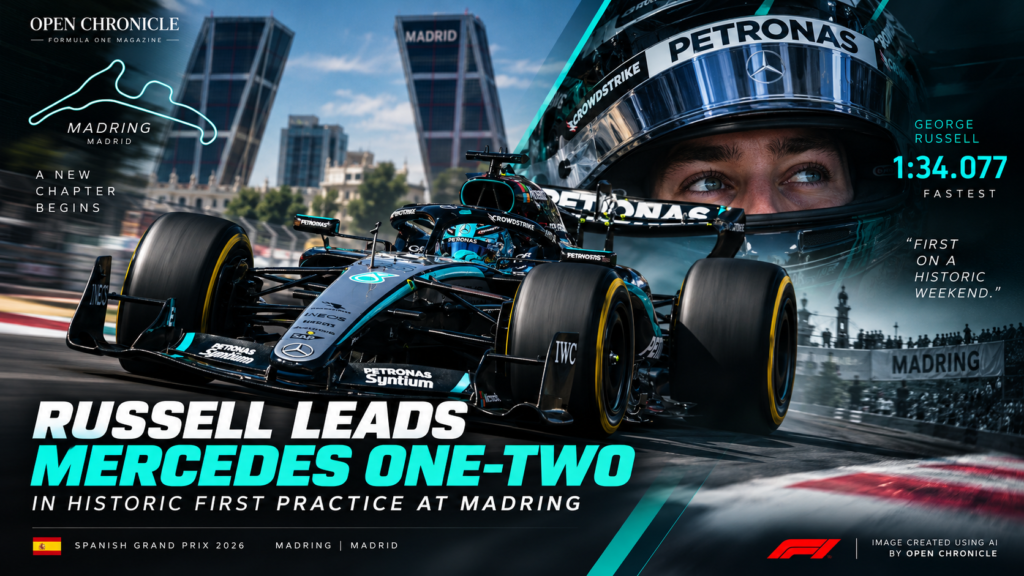
George Russell has written the first competitive benchmark into Madring’s Formula 1 history, leading Mercedes teammate Kimi Antonelli in the opening practice session for the 2026 Spanish Grand Prix. Russell’s 1:34.077 put him 0.286 seconds clear of the championship leader, while Ferrari emerged as an early threat with Charles Leclerc and Lewis Hamilton immediately behind the Mercedes pair.
By Open Chronicle Formula One Magazine
Formula 1 has officially begun a new chapter in Madrid.
George Russell became the first driver to top an official Formula 1 session at the new Madring circuit on Friday, setting the pace in opening practice for the 2026 Spanish Grand Prix as teams began the complex process of understanding a circuit they had previously known only through simulation and engineering data.
Russell produced a best lap of 1:34.077, leading a Mercedes one two ahead of Kimi Antonelli.
Antonelli, arriving in Spain after his extraordinary victory from 19th at Monza, finished 0.286 seconds behind his teammate with a 1:34.363.
Ferrari provided the closest opposition.
Charles Leclerc took third with 1:34.536, while Lewis Hamilton completed the top four on 1:34.620.
Max Verstappen was fifth for Red Bull Racing, followed by Lando Norris, Arvid Lindblad and Oscar Piastri.
But the significance of the session went beyond the timing screen.
This was Formula 1’s first official competitive encounter with Madring.
And every lap was adding information to a circuit that, until Friday morning, existed for the teams primarily as a collection of simulations.
Formula 1 Arrives at Madring
The new Madrid circuit presents an unusual engineering challenge.
At 5.414 kilometres and 22 corners, Madring combines public roads with purpose built sections, creating a hybrid between the characteristics of a street circuit and those of a conventional permanent racing facility.
Its layout contains high speed sections, slower technical sequences, heavy braking zones and areas where Formula 1 cars are expected to approach approximately 340 km/h.
But one corner has already emerged as the defining feature.
Turn 12, La Monumental.
The banked corner extends for approximately 550 metres and features an inclination of around 24 percent, subjecting the cars and tyres to roughly six seconds of sustained load.
That combination makes Madring more than simply another new street venue.
It presents teams with aerodynamic, mechanical and tyre behaviour questions for which simulator work can provide guidance, but not complete answers.
FP1 was about discovering those answers.
Sixty Minutes of Learning
The green light triggered immediate activity.
With 22 corners to learn and only 60 minutes available, almost the entire field headed onto the circuit as soon as the session began.
Most drivers started on Pirelli’s medium compound.
Gabriel Bortoleto was the notable exception.
Audi sent the Brazilian out on the hard tyre, creating a different programme from almost everyone around him. Nico Hülkenberg initially remained in the garage before joining the session.
One of the earliest observations came from Esteban Ocon.
Despite expectations that Madring’s fresh and relatively smooth asphalt could initially provide limited grip before improving as rubber accumulated, the Haas driver reported surprisingly strong adhesion.
The timing screen nevertheless demonstrated how much learning remained.
Verstappen Sets the First References
Max Verstappen established an early benchmark at 1:39.257.
It lasted very little time.
Leclerc improved to 1:38.504 as lap times began falling rapidly with every tour.
Bortoleto recorded a 1:39.042 and briefly climbed to fourth despite using the harder compound.
At this stage, outright position meant relatively little.
Some drivers were finding confidence more quickly than others. Fuel loads, tyre compounds and individual programmes differed, while every lap offered another opportunity to understand braking points, kerbs, surface characteristics and the limits of the circuit.
Hamilton accelerated the progression with a 1:36.066.
Piastri produced a 1:37.741, Norris a 1:37.251 and Lindblad a 1:38.395. Liam Lawson moved towards the front with 1:36.833 before Verstappen lowered his own time to 1:36.683.
Then Ferrari began to establish itself.
Ferrari Becomes Madring’s First Serious Benchmark
Hamilton improved to 1:35.563.
Leclerc responded with 1:35.668.
Ferrari was beginning to look increasingly comfortable on the medium tyres.
Bortoleto, still running the hard compound, returned to the circuit after a brief visit to the pits and improved first to 1:37.665 and then substantially to 1:36.620.
That moved the Audi into sixth.
The comparison was particularly encouraging because Bortoleto was conducting a fundamentally different tyre programme from most of the field.
Hülkenberg also began progressing.
A 1:37.560 was deleted for exceeding track limits, but the German followed it with 1:36.613.
Hamilton then pushed the benchmark into the 1:34 range.
His 1:34.803 came despite an error during the lap.
Leclerc answered with 1:34.683.
For the first phase of Formula 1’s inaugural Madring practice, Ferrari had become the team to beat.
And it had done so on medium tyres.
Mercedes Turns to the Softs
The complexion of the session changed shortly before halfway.
Soft tyres began appearing.
Antonelli, Russell and Lawson were among the first drivers to switch to Pirelli’s C4 compound.
The Mercedes immediately became more threatening.
Hamilton improved once more to 1:34.620, a time that would eventually stand as his best of the session.
Russell began his soft tyre programme with 1:34.729.
Antonelli produced 1:34.683.
Then Russell moved ahead.
His first major step came with a 1:34.145.
Mercedes had taken control of the timing screen.
Ferrari subsequently fitted soft tyres to its cars, but the improvement was not as pronounced as might have been expected.
That was one of the more interesting technical observations of the session.
Ferrari had looked particularly competitive on the mediums. Neither Hamilton nor Leclerc extracted the same relative gain from the softer C4 that Mercedes found.
Russell did.
1:34.077, Madring’s First FP1 Benchmark
Russell improved again.
1:34.077.
Nobody would beat it.
It is only an FP1 time, set on the first day of Formula 1 running at a completely new circuit. Track evolution, setup development, fuel levels and qualifying engine modes mean significantly faster laps should follow as the weekend develops.
But historically, the number has permanence.
George Russell’s 1:34.077 became the benchmark from the first Formula 1 practice session ever held at Madring.
Antonelli was the only driver who came particularly close.
Bortoleto Shows More Than P11 Suggests
Audi changed Bortoleto’s programme during the second half of the session.
After completing much of his early running on hard tyres, the Brazilian finally received a set of softs.
His first attempt immediately suggested significant potential.
Bortoleto produced what was, at that moment, the fastest opening sector of the entire session.
But the lap unravelled later.
He encountered Lance Stroll in the final section and lost time in traffic.
Bortoleto still completed the lap in 1:35.652, temporarily climbing to ninth.
The final classification eventually pushed him down to 11th, but the position did not fully reflect the potential demonstrated during his soft tyre attempt.
Hülkenberg ultimately finished ninth with 1:35.529.
Bortoleto ended only 0.123 seconds behind his Audi teammate and 0.113 seconds behind Lawson, who occupied the final position inside the top ten.
For Audi, having both cars around the top ten represented an encouraging beginning to an unknown circuit.
Antonelli Keeps Russell Within Reach
At the front, Verstappen improved to 1:34.703.
Norris reached 1:34.947 and Lindblad produced an impressive 1:35.033 for Racing Bulls.
But Antonelli was the driver who came closest to Russell.
The Italian recorded a 1:34.363.
The gap was 0.286 seconds.
Mercedes therefore held first and second.
For Antonelli, the session represented his first competitive running since the remarkable Italian Grand Prix victory that strengthened his championship lead.
For Russell, it was an immediate response after finishing second to his teammate at Monza.
The championship rivals had begun the Madrid weekend exactly where Mercedes would want them.
At the front.
Long Runs Replace Qualifying Simulations
As FP1 entered its final phase, the priorities changed.
Several teams moved away from outright lap time and began gathering longer run data.
Russell returned to the medium tyre for a sustained sequence, allowing Mercedes to study degradation and balance with additional fuel.
That information could prove particularly valuable at Madring.
Pirelli selected the C2, C3 and C4 compounds for the weekend, corresponding to hard, medium and soft.
Pre event simulations suggested the new circuit could rank among the five most demanding venues of the season in terms of energy transmitted through the tyres.
La Monumental is an obvious contributor, but the combination of high speed sections, heavy braking and sustained loads makes tyre behaviour one of the central questions of the inaugural Spanish Grand Prix at Madring.
Ferrari Finishes Immediately Behind Mercedes
Leclerc found one final improvement before the chequered flag.
His 1:34.536 secured third.
Hamilton remained fourth with 1:34.620.
That left Ferrari only 0.459 seconds from Russell’s benchmark with Leclerc and 0.543 with Hamilton.
More interesting than the raw gaps was how Ferrari had produced its performance.
The SF26 had been particularly convincing during the medium tyre phase.
Its limited improvement on softs leaves an obvious question for the remainder of Friday: whether Ferrari simply failed to optimise the C4 during FP1 or whether Mercedes possesses a genuine advantage when the cars move towards lower fuel qualifying conditions.
One hour of practice cannot answer that.
But it gives engineers something to investigate.
Russell Becomes Madring’s First Formula 1 Leader
The chequered flag brought the first official Formula 1 session at Madring to an end.
Russell was first.
Antonelli second.
Leclerc third.
Hamilton fourth.
Mercedes had the one two, Ferrari had both cars immediately behind, and Verstappen remained close enough in fifth to ensure that no conclusions about the competitive order could yet be considered secure.
McLaren finished with Norris sixth and Piastri eighth, separated by Lindblad’s Racing Bulls.
Hülkenberg placed Audi ninth, Lawson completed the top ten and Bortoleto followed in 11th.
The times will almost certainly fall dramatically as the circuit evolves and the teams understand it better.
That is why FP1 should not be treated as a definitive performance ranking.
But this particular practice session will always carry a small piece of Formula 1 history.
For the first time, 22 Formula 1 cars attacked Madring in an official Grand Prix weekend.
And when the first 60 minutes were complete, the name at the top was George Russell.
2026 Spanish Grand Prix, FP1 Classification
| Pos. | Driver | Team | Time |
|---|---|---|---|
| 1 | George Russell | Mercedes | 1:34.077 |
| 2 | Kimi Antonelli | Mercedes | 1:34.363 |
| 3 | Charles Leclerc | Ferrari | 1:34.536 |
| 4 | Lewis Hamilton | Ferrari | 1:34.620 |
| 5 | Max Verstappen | Red Bull Racing | 1:34.703 |
| 6 | Lando Norris | McLaren | 1:34.947 |
| 7 | Arvid Lindblad | Racing Bulls | 1:35.033 |
| 8 | Oscar Piastri | McLaren | 1:35.148 |
| 9 | Nico Hülkenberg | Audi | 1:35.529 |
| 10 | Liam Lawson | Red Bull Racing | 1:35.539 |
| 11 | Gabriel Bortoleto | Audi | 1:35.652 |
| 12 | Esteban Ocon | Haas | 1:35.834 |
| 13 | Franco Colapinto | Alpine | 1:35.933 |
| 14 | Pierre Gasly | Alpine | 1:36.244 |
| 15 | Fernando Alonso | Aston Martin | 1:36.473 |
| 16 | Oliver Bearman | Haas | 1:36.853 |
| 17 | Carlos Sainz | Williams | 1:36.870 |
| 18 | Yuki Tsunoda | Racing Bulls | 1:36.939 |
| 19 | Lance Stroll | Aston Martin | 1:37.254 |
| 20 | Alexander Albon | Williams | 1:37.591 |
| 21 | Sergio Pérez | Cadillac | 1:38.150 |
| 22 | Valtteri Bottas | Cadillac | 1:38.818 |
What FP1 Tells Us, and What It Does Not
Mercedes leaves the opening session with the cleanest headline.
Russell was fastest, Antonelli was second, and the W17 appeared immediately comfortable enough for both drivers to extract performance from the soft tyre.
Ferrari’s medium tyre pace, however, means the picture is not straightforward.
Leclerc and Hamilton provided the first serious benchmarks of the session before Mercedes moved onto softs, suggesting Ferrari may have a competitive underlying platform around Madring.
Verstappen remains within striking distance. McLaren has substantial work to do before its true level can be judged. Audi’s position is also more encouraging than Bortoleto’s 11th place initially suggests.
Most importantly, everyone has much more to learn.
FP1 at an established circuit is a data gathering exercise.
FP1 at a circuit Formula 1 has never raced before is something larger.
Every braking point is being refined. Every kerb is being assessed. Every tyre response is being recorded. Every simulation is finally being compared against reality.
Madring has stopped being a virtual Formula 1 circuit.
It is now a real one.
And George Russell owns its first official benchmark.