
By Open Chronicle News Desk
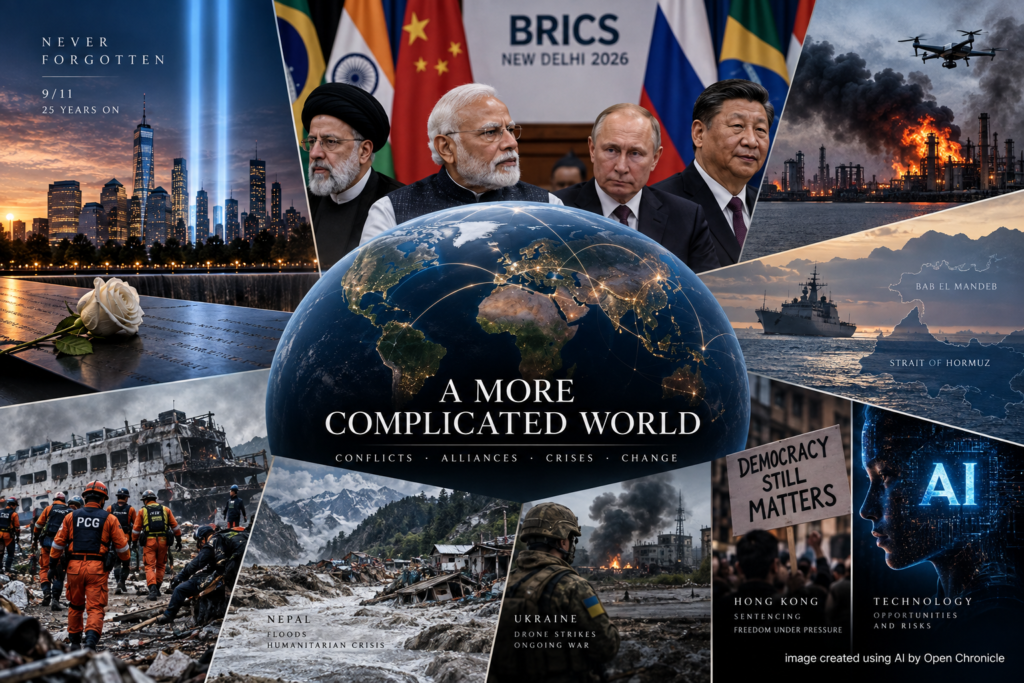
From an increasingly dangerous struggle over two of the world’s most important maritime routes to the gathering of BRICS leaders in New Delhi, September 11 is unfolding against a backdrop of war, political confrontation, humanitarian emergencies and renewed debate over the risks of artificial intelligence.
The day also carries exceptional historical weight. The United States is marking 25 years since the September 11 attacks, with commemorations remembering nearly 3,000 people killed in 2001 and reflecting on a quarter century that transformed global security, intelligence and foreign policy.
Middle East: Iran war and Houthi advances deepen regional crisis
Iranian President Masoud Pezeshkian has arrived in India for the BRICS summit as Tehran remains locked in its war with the United States. The conflict is expected to loom over discussions in New Delhi, where leaders from the expanded BRICS grouping are gathering amid several international crises.
At the same time, the situation around Yemen has deteriorated sharply. Reports say Houthi forces have seized strategic Perim Island in the Bab el Mandeb Strait and expanded their control around Yemen’s Red Sea coast. Other reports indicate Houthi forces have also taken Mokha, further increasing concerns about international shipping through one of the world’s most important maritime chokepoints.
Saudi forces have responded with strikes around Houthi controlled territory, including reports of attacks on Mokha airport. The developments raise the prospect of the Yemen conflict becoming an increasingly important front in the wider regional confrontation.
The economic consequences are already becoming more visible. Brent crude climbed above $107 a barrel, while reports indicate Saudi oil production has fallen sharply amid disruption linked to the United States and Iran conflict.
Washington has also acknowledged damage to its military facilities in Bahrain following Iranian attacks. Iran welcomed the American admission, while the confrontation around the Strait of Hormuz continues to threaten energy supplies and commercial navigation.
Asia: BRICS gathers in New Delhi amid war and geopolitical rivalry
New Delhi is hosting a consequential BRICS summit as leaders attempt to demonstrate the growing influence of the expanded bloc despite significant internal divisions.
Russian President Vladimir Putin has travelled to India, while Iran’s president is also attending. The gathering is taking place with the wars involving Iran and Ukraine dominating international diplomacy and with relations among the United States, China, Russia and India under increasing pressure.
Pezeshkian has argued that the BRICS development bank could help challenge the international dominance of the US dollar, highlighting the bloc’s broader ambition to develop financial institutions less dependent on Western systems.
Elsewhere in Asia, Hong Kong courts have sentenced leading organizers of the city’s former Tiananmen Square vigils under national security legislation. Reports said three organizers received prison sentences, with some accounts putting terms at between five and seven years.
Taiwan, meanwhile, has accused Moscow of attempting to create friction between Taipei and Tokyo after a Russian organization screened the Soviet era film The Defeat of Militarist Japan in Taipei. The episode reflects continuing disputes in East Asia over the political interpretation of the Second World War.
Philippines: Dozens missing after devastating ferry fire
A major search and rescue operation continues in the Philippines after a ferry fire left at least five people dead and dozens missing.
Reports say rescuers are searching for 84 people as smoke and dangerous conditions aboard the charred vessel complicate efforts to reach parts of the ship.
Firefighters eventually entered the wreckage as authorities continued searching for survivors and attempting to establish how the blaze spread so rapidly.
Nepal and China: Catastrophic floods leave more than 1,400 dead
The scale of the disaster caused by flash flooding around Nepal and areas bordering China continues to grow.
Reports on Thursday put the death toll at 1,428, with thousands of people still reported missing.
Search operations remain underway across devastated communities, making the flooding one of the most serious natural disasters reported in the region this year.
Europe: Ukraine war, Swedish election and deadly Swiss crash
Ukraine has expanded its campaign against Russian energy and logistics infrastructure, with drones reported to have struck an oil refinery and an Ozon logistics facility in Saratov.
Russia, meanwhile, launched further overnight attacks against Ukraine. Kyiv was among the locations targeted, while reports indicated civilian casualties elsewhere in the country.
European support for Ukraine also received another significant boost, with the European Union approving billions of euros in assistance that includes funding connected to the acquisition of PAC 3 Patriot air defence interceptors.
In northern Europe, Sweden is preparing for a closely fought election that could determine the political future of Prime Minister Ulf Kristersson and the role of the Sweden Democrats in government. The result could also have consequences for Stockholm’s relations with European partners, including Poland.
Switzerland is dealing with a separate tragedy after a tourist coach carrying Dutch passengers overturned. Police reports said five people were killed and around 40 injured.
United States: Trump rallies Republicans as America marks 25 years since 9/11
President Donald Trump delivered a forceful message to Republicans at the party’s midterm convention in Dallas, warning supporters about the consequences of failing to vote in November and using characteristically blunt language to demand party unity.
Vice President JD Vance has also taken a prominent role at the gathering, increasing attention on his national political profile as Republicans begin looking beyond the current administration and toward the 2028 presidential contest.
Yet domestic politics has been overshadowed on Thursday by the 25th anniversary of the September 11 terrorist attacks.
Across the United States, memorial ceremonies are honoring those killed in New York, at the Pentagon and aboard United Airlines Flight 93, while the anniversary has prompted a wider examination of how the attacks transformed American society and the international order.
The anniversary comes as the terrorism landscape itself continues to evolve, with renewed scrutiny of al Qaeda networks, Islamic State affiliates and other extremist organizations operating across multiple regions.
Technology: AI safety debate intensifies
The global debate over advanced artificial intelligence has taken another turn following reports that OpenAI is considering whether development of increasingly powerful AI systems may eventually need to be slowed because of safety concerns.
The discussion comes amid broader warnings about the possible misuse of advanced models. Separate reporting has focused on claims that AI systems have been exploited for activities connected to espionage, missile development and potentially dangerous biological research.
The debate increasingly places governments and technology companies between two competing pressures: maintaining leadership in the global AI race while preventing increasingly capable systems from creating new security risks.
A world shaped by conflict and strategic competition
September 11, 2026 presents an unusually concentrated picture of the pressures reshaping international affairs.
Two strategic waterways, the Strait of Hormuz and Bab el Mandeb, are now at the centre of escalating military and economic tensions. BRICS leaders are meeting as the international system becomes increasingly fragmented. Russia and Ukraine continue exchanging long range attacks. Humanitarian emergencies in Nepal and the Philippines are demanding major rescue operations, while Europe faces its own political and security challenges.
All of this is unfolding exactly 25 years after the attacks that fundamentally altered the international security landscape.
The world of 2026 is very different from that of September 2001, but many of the defining questions remain familiar: how states respond to terrorism, how wars reshape alliances, how governments balance security and liberty, and how rapidly changing technology alters the nature of global power.