
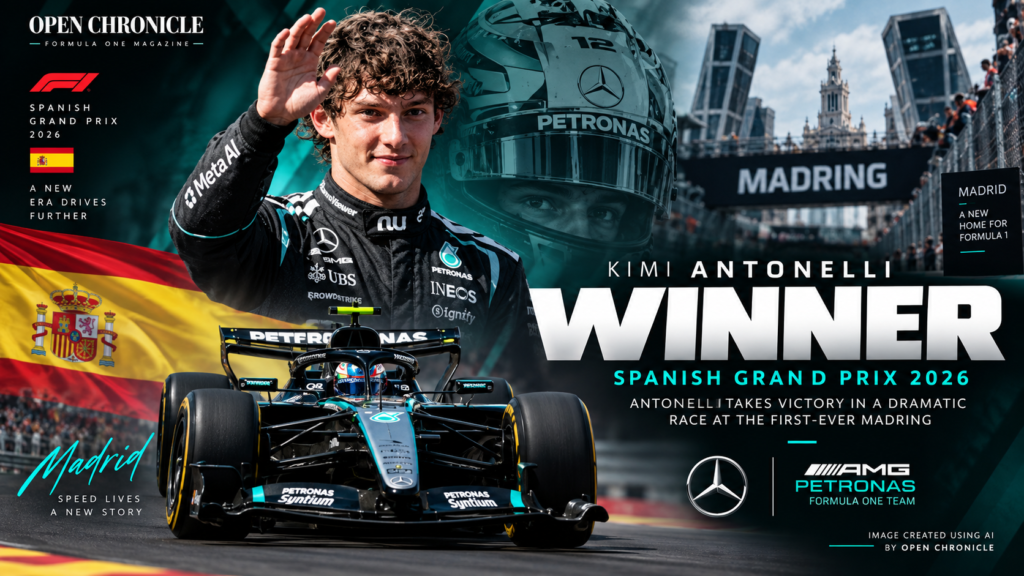
Kimi Antonelli has won the first Formula One race ever held at Madring, taking advantage of a perfectly timed Virtual Safety Car to overturn Lando Norris’ early control of the Spanish Grand Prix. Max Verstappen finished second after resisting intense late pressure from Norris, while Charles Leclerc and George Russell completed the top five. Gabriel Bortoleto’s long opening stint failed to deliver a late strategic reward, leaving the Audi driver outside the points.
By Open Chronicle Formula One Magazine
Kimi Antonelli has written his name into another piece of Formula One history.
The Mercedes driver won the inaugural Spanish Grand Prix at Madring after a race that appeared to belong to Lando Norris until a Virtual Safety Car completely changed the strategic order.
Norris had started from pole, controlled the opening phase and gradually built a healthy advantage.
Then the VSC arrived at exactly the wrong moment.
The McLaren driver had just passed the pit entry.
Antonelli had not.
Mercedes reacted immediately.
So did Red Bull.
By the time the sequence had played out, Norris had lost the strategic position he had spent the opening laps building.
Antonelli eventually emerged at the front, resisted the pressure behind and became the first Formula One Grand Prix winner at Madring.
Norris leads, Antonelli attacks
The first Spanish Grand Prix in Madrid began with immediate tension at the front.
Norris and Antonelli started alongside each other on medium tyres, while Verstappen and Hamilton opted for softs.
Leclerc, Russell, Piastri, Lawson and Bortoleto were among those starting on the hard compound.
Antonelli attacked Norris immediately.
The Mercedes driver attempted a move at the chicane but ran beyond the track and had to give the position back.
He tried again shortly afterwards.
Again, he cut the chicane.
This time the failed attack had a larger consequence.
While Antonelli focused on Norris, Verstappen found an opportunity and moved ahead of the Mercedes into second.
Norris escaped.
Within only a few laps, the McLaren had begun opening a gap.
Bortoleto loses ground immediately
Further back, Bortoleto endured a difficult opening lap.
Starting 12th, the Audi driver lost several positions and dropped to 15th.
That immediately complicated a race already shaped by Madring’s limited overtaking opportunities.
Piastri also suffered a poor start.
The McLaren made contact with Russell and dropped to tenth, while also sustaining damage to the front wing.
Hamilton reported that he had touched the wall, although Ferrari initially saw nothing alarming in the telemetry.
The opening lap had already changed several strategic calculations.
Verstappen forced to give a place back
The early laps also produced a dispute involving Verstappen.
Red Bull instructed him to return a position to Hamilton after an incident at the chicane.
Verstappen strongly disagreed, arguing that he had left the normal line to avoid contact.
He nevertheless complied.
Antonelli and Hamilton moved ahead.
Verstappen did not remain behind Hamilton for long.
He attacked again and regained the position on track.
Then Hamilton’s race began to collapse.
Hamilton retires with brake problem
Hamilton reported a long brake pedal and warned Ferrari that he suspected a problem.
The team eventually allowed Leclerc to pass.
Soon afterwards, Hamilton ran straight on and reported that he had lost the brakes completely.
Ferrari immediately instructed him to stop the car.
His Spanish Grand Prix was over.
It brought a difficult weekend to an early end after Hamilton had already crashed in FP3 and required extensive repairs before qualifying.
Norris begins to control the race
Once the opening phase settled, Norris appeared to have the race under control.
By lap seven, the McLaren driver had built an advantage of approximately 4.7 seconds over Antonelli.
McLaren also informed Norris that Antonelli’s tyres appeared to be in worse condition.
Everything was pointing towards a race increasingly under the control of the pole sitter.
Behind them, overtaking remained extremely difficult.
Bortoleto ran close to Pierre Gasly but could not find a way past.
Elsewhere, a train began forming behind Colapinto.
Lawson eventually managed to force his way through and climb to sixth, one of the few successful overtakes during that phase.
Then the race changed.
Virtual Safety Car transforms the Grand Prix
On lap 15, Lance Stroll reported a brake problem.
Moments later, the Virtual Safety Car was deployed.
For Norris, the timing was disastrous.
He had just passed the pit entry.
Antonelli, Verstappen and Russell were all able to pit immediately under the reduced speed conditions.
Their stops therefore cost considerably less race time than they would have under green flag running.
Norris had no equivalent opportunity.
When the race resumed, McLaren called him in on the following lap.
The stop itself was also slow.
Norris emerged only fifth.
A race he had appeared to control had been completely transformed.
Antonelli gains the strategic advantage
The VSC did not instantly put Antonelli into the lead because several drivers remained on long first stints.
Leclerc stayed out.
So did Lawson, Piastri, Gasly, Bortoleto, Tsunoda and Bearman.
That created a temporarily mixed order.
Bortoleto rose as high as ninth during the pit cycle while continuing on the hard tyres he had started the race with.
Antonelli began closing on Leclerc but received a warning from Mercedes not to overwork the tyres.
The race had become a strategic waiting game.
Antonelli reports steering concerns
Antonelli’s path towards victory was not entirely comfortable.
While chasing Leclerc, he reported that the car felt unusual in the corners and that the steering appeared strange.
Mercedes continued to monitor the situation.
The problem did not immediately worsen.
Meanwhile, Sainz received a five second penalty and later a black and white flag for track limits.
The wider field remained spread out, with relatively few close battles.
That confirmed one of the main concerns drivers had raised before the race.
Following another car at Madring was difficult.
Passing was harder still.
Norris begins the recovery
Norris eventually began rebuilding his race.
He closed onto Russell, but the Mercedes driver was on a different strategy and still needed another stop.
Russell made that second stop on lap 29 and returned ahead of Piastri in sixth.
Several drivers were still extending their original tyres far beyond the expected one stop window.
Bortoleto was among them.
Audi kept the Brazilian out, effectively gambling on another Safety Car or Virtual Safety Car.
The strategy offered track position.
But it also carried enormous risk.
Russell makes one of the race’s best passes
On lap 32, Pérez retired.
Not long afterwards, Bearman finally pitted, beginning the gradual collapse of the group that had stretched the opening stint.
Russell then produced one of the most notable overtakes of the afternoon.
The Mercedes driver closed rapidly onto Lawson and attacked at the chicane.
Using a tight line, Russell completed the move and climbed to fifth.
On a circuit where overtaking had proved consistently difficult, it stood out.
Norris closes on Verstappen
With around 20 laps remaining, Norris was still fighting his way back into contention.
A replay showed the McLaren brushing the wall, but the contact did not appear to cause meaningful damage.
Ferrari meanwhile projected that Leclerc was on course for fourth if the strategy played out as expected.
At the front, the remaining long first stints became increasingly important.
Norris began closing on Verstappen.
Piastri was also moving towards Lawson.
The final phase of the race was beginning.
Piastri and Lawson finally stop
Piastri ended his extremely long first stint on lap 43.
He returned behind Lindblad and Hülkenberg, but quickly passed Lindblad and re entered the points.
Lawson stopped a few laps later.
Bortoleto still had not pitted.
Audi was continuing to wait.
Bortoleto’s tyres finally give way
By lap 47, Bortoleto’s hard tyres had completed almost the entire race distance.
The Brazilian was now becoming a significant obstacle for faster cars behind.
Piastri closed so rapidly that he was forced to back out and cut the chicane to avoid contact.
Colapinto also attacked and successfully passed Bortoleto, moving the Audi driver down to ninth.
At the front, Leclerc remained on his original tyres.
Behind him, Antonelli, Verstappen and Norris were beginning to converge.
The race was finally approaching its decisive sequence.
Audi waits until lap 48
Audi eventually ended Bortoleto’s gamble on lap 48.
The hoped for late neutralisation had never arrived.
Once the Brazilian made his stop under full racing conditions, the track position he had temporarily held disappeared.
He dropped outside the points.
The strategy had been based on probability.
This time, probability did not cooperate.
Leclerc remained out for one more lap.
Then Ferrari finally called him in on lap 49.
That handed the lead to Antonelli.
Antonelli finally inherits the lead
Once Leclerc stopped, the true order of the race became clear.
Antonelli led.
Verstappen was second.
Norris was third.
The McLaren driver had lost the race lead through the VSC cycle, but he still had enough pace to challenge Verstappen.
The question was whether Madring would allow him to use it.
Verstappen increased his pace immediately.
Antonelli responded.
By lap 50, Verstappen was beginning to lose touch with the Mercedes.
The fight for the victory was slowly moving out of his reach.
Antonelli touches the wall
There was one late scare for Mercedes.
On lap 52, Antonelli reported that he had touched the wall entering Turn 7.
The contact appeared minor.
The car continued without visible performance loss.
Behind him, Norris remained attached to Verstappen.
The battle for second was now the main contest on track.
Norris attacks but cannot pass
Norris clearly had speed.
What he did not have was enough space.
Verstappen defended relentlessly.
The McLaren repeatedly approached within striking distance but could not complete the move.
Even when Verstappen made a small mistake late in the race, Norris could not turn the opportunity into a pass.
The pattern reflected the wider character of the Grand Prix.
Closing was possible.
Passing was something else.
Antonelli wins the first Madring Grand Prix
Antonelli began lap 57 in the lead.
The Mercedes driver no longer needed to attack.
He only needed to finish.
Behind him, Norris continued searching for a route past Verstappen.
None appeared.
Antonelli crossed the line first.
Kimi Antonelli had won the first Formula One Grand Prix ever held at Madring.
Verstappen finished second.
Norris completed the podium in third.
For Norris, the result was difficult to accept given how strongly he had controlled the opening phase.
For Antonelli, the same sequence represented perfect strategic execution.
The Virtual Safety Car changed the race.
Mercedes reacted immediately.
Antonelli took the opportunity.
And he converted it into victory.
Leclerc fourth, Russell fifth
Leclerc finished fourth after extending his first stint deep into the race.
Russell completed the top five.
Lawson took sixth for Red Bull Racing, ahead of Colapinto in an excellent seventh for Alpine.
Piastri recovered from his first lap contact, front wing damage and long opening stint to finish eighth.
Lindblad was ninth.
Hülkenberg secured the final point in tenth.
The German briefly passed Lindblad late in the race but cut the chicane and immediately returned the position.
Race control later reviewed the Turn 1 incident between them and decided no further investigation was required.
Bortoleto’s strategy does not pay off
Bortoleto finished 13th.
His race had already been compromised by the opening lap, when he dropped from 12th to 15th.
From there, the Audi driver spent long periods trapped behind other cars on a circuit where overtaking was extremely difficult.
Audi therefore chose to gamble.
Bortoleto stayed on the original hard tyres until lap 48.
The logic was clear.
If another Safety Car or VSC appeared, he could potentially stop at a much lower time cost and emerge with a significantly improved position.
No neutralisation arrived.
Once he finally stopped, his temporary top ten position disappeared.
Bortoleto also received a warning following an incident at Turn 5 and later a black and white flag for track limits.
It was a difficult afternoon after an encouraging Saturday.
Hamilton classified last
Hamilton’s brake failure left Ferrari with only one car at the finish.
The seven time world champion was classified 22nd.
That outcome adds another difficult chapter to a weekend in which Hamilton had already crashed in FP3 before recovering impressively to qualify fourth.
Leclerc’s fourth place therefore represented Ferrari’s only major points contribution from Madrid.
2026 Spanish Grand Prix Result
| Pos. | Driver | Team |
|---|---|---|
| 1 | Kimi Antonelli | Mercedes |
| 2 | Max Verstappen | Red Bull Racing |
| 3 | Lando Norris | McLaren |
| 4 | Charles Leclerc | Ferrari |
| 5 | George Russell | Mercedes |
| 6 | Liam Lawson | Red Bull Racing |
| 7 | Franco Colapinto | Alpine |
| 8 | Oscar Piastri | McLaren |
| 9 | Arvid Lindblad | Racing Bulls |
| 10 | Nico Hülkenberg | Audi |
| 11 | Esteban Ocon | Haas |
| 12 | Pierre Gasly | Alpine |
| 13 | Gabriel Bortoleto | Audi |
| 14 | Yuki Tsunoda | Racing Bulls |
| 15 | Alexander Albon | Williams |
| 16 | Oliver Bearman | Haas |
| 17 | Fernando Alonso | Aston Martin |
| 18 | Valtteri Bottas | Cadillac |
| 19 | Carlos Sainz | Williams |
| 20 | Sergio Pérez | Cadillac |
| 21 | Lance Stroll | Aston Martin |
| 22 | Lewis Hamilton | Ferrari |
Race Analysis
Pure Pace
Norris appeared to possess the strongest race pace during the opening phase.
From pole, he controlled the gap and built an advantage of almost five seconds before the strategic turning point.
Antonelli did not win because he was clearly faster in the first stint.
He won because he remained close enough to exploit the moment when the race changed.
That distinction matters.
Tyre Strategy
The Virtual Safety Car determined the strategic direction of the Grand Prix.
Antonelli and Verstappen were able to stop immediately.
Norris could not.
That dramatically reduced the effective cost of their pit stops and removed the advantage the McLaren had created on track.
Bortoleto’s race demonstrated the opposite side of strategic risk.
Audi extended the hard tyre stint to lap 48 in the hope of a late neutralisation.
Without one, the strategy inevitably collapsed.
Driver Execution
Antonelli delivered the most important element required after the VSC.
He stayed clean enough to capitalise.
The early chicane excursions could have become costly, but once the strategic opportunity arrived he converted it.
Verstappen’s defensive performance late in the race was equally important.
Norris remained close but could not force a clean opening.
Russell also deserves credit for one of the afternoon’s strongest overtakes on Lawson.
Team Decisions
Mercedes reacted immediately to the VSC.
That call won Antonelli the race.
McLaren’s problem was more circumstantial than tactical.
Norris had already passed pit entry when the VSC appeared, leaving the team with no equivalent option.
Audi deliberately pursued a high risk strategy with Bortoleto.
The reasoning was understandable.
The outcome was not favourable.
Technical Performance
Mercedes leaves Madrid with another victory and clear evidence that its car remains competitive across a broad range of conditions.
McLaren demonstrated strong race pace but paid the price for the timing of the neutralisation.
Red Bull maximised Verstappen’s result through pace and defensive execution.
Ferrari’s weekend was compromised by Hamilton’s brake failure, while Leclerc extracted fourth from a very long opening stint.
Championship Impact
For Antonelli, this was another significant result.
The championship leader arrived in Madrid with momentum after winning at Monza.
He leaves with another victory.
Norris had an opportunity to take a major result from pole and still secured a podium, but the difference between first and third could become important as the season develops.
Verstappen also maximised his opportunity by finishing second and denying Norris additional points.
Mercedes, meanwhile, strengthened its position with Antonelli first and Russell fifth.
Open Chronicle Verdict
The first Formula One race at Madring did not produce constant overtaking.
It produced something more strategic.
Track position mattered.
Tyres mattered.
Timing mattered most of all.
Norris did almost everything required to win.
He took pole.
He led.
He created the gap.
Then the Virtual Safety Car appeared seconds too late for him to take advantage.
Antonelli was positioned perfectly.
Mercedes reacted.
The championship leader completed the rest.
At Monza, Antonelli won from 19th.
At Madring, he won through strategy.
Different race.
Different challenge.
Same result.
Kimi Antonelli is the first Formula One winner in Madring history.