
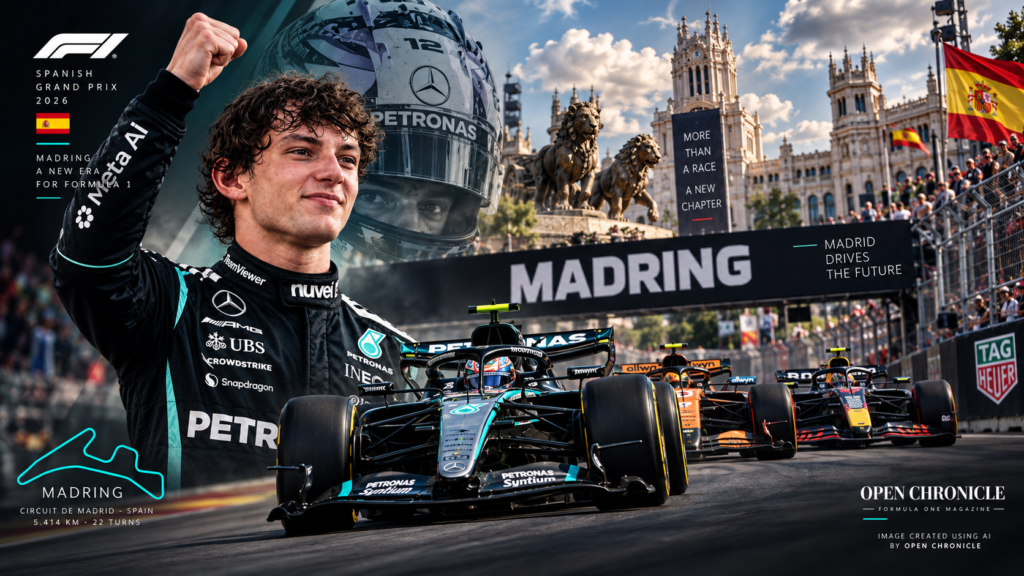
Formula One’s first weekend at Madring delivered a new circuit, rapidly evolving track conditions, major practice crashes, an extraordinary qualifying fight decided by 0.011 seconds and a race transformed by the timing of a Virtual Safety Car. George Russell opened the weekend fastest, Kimi Antonelli took control through Friday and Saturday, Lando Norris claimed a historic first pole, and Antonelli ultimately became the first Formula One Grand Prix winner in Madrid.
By Open Chronicle Formula One Magazine
Formula One arrived in Madrid with almost no real world reference.
Teams had simulations.
Drivers had studied maps, video and simulator laps.
Engineers had predictions for tyre behaviour, aerodynamic load and energy demands.
But until Friday morning, nobody had driven a Formula One car around Madring in an official Grand Prix session.
Three days later, the championship had its first complete picture of the circuit.
And one driver had left the clearest mark.
Kimi Antonelli.
The championship leader finished the weekend with victory after already topping FP2 and FP3, but his route to the top was anything but straightforward.
Mercedes did not dominate every session.
Ferrari remained close.
McLaren found pole position.
Max Verstappen remained a constant threat.
And strategy ultimately decided the race.
The inaugural Spanish Grand Prix at Madring became a weekend shaped by learning, adaptation and timing.
Friday Morning: Russell Sets Madring’s First Official Benchmark
George Russell became the first driver to lead an official Formula One session at Madring.
The Mercedes driver topped FP1 with a 1:34.077, beating Antonelli by 0.286 seconds.
Charles Leclerc finished third and Lewis Hamilton fourth, immediately confirming that Ferrari had arrived in Madrid with competitive pace.
The significance of the session went beyond the classification.
Madring was completely new.
The circuit combined public roads and permanent sections across 5.414 kilometres and 22 corners, with a mixture of high speed direction changes, slower technical sections and heavy braking zones.
Turn 12, La Monumental, quickly became one of the defining features of the venue because of its banking and sustained load.
FP1 was therefore less about establishing the definitive competitive order and more about understanding reality.
Brake references.
Kerbs.
Tyre temperatures.
Ride behaviour.
Track limits.
Every lap added information that no simulator could fully reproduce.
FP1 Top Five
| Pos. | Driver | Team | Time |
|---|---|---|---|
| 1 | George Russell | Mercedes | 1:34.077 |
| 2 | Kimi Antonelli | Mercedes | 1:34.363 |
| 3 | Charles Leclerc | Ferrari | 1:34.536 |
| 4 | Lewis Hamilton | Ferrari | 1:34.620 |
| 5 | Max Verstappen | Red Bull Racing | 1:34.703 |
Mercedes had the one two.
Ferrari was immediately behind.
The tone of the weekend had been established.
Friday Afternoon: Antonelli Responds
If FP1 belonged to Russell, FP2 belonged to Antonelli.
The championship leader lowered the benchmark to 1:33.662, moving ahead of Leclerc and Hamilton.
Only 0.149 seconds separated the top three.
Ferrari had maintained the pressure.
Arvid Lindblad delivered one of the surprises of the day by finishing fourth, although his session ended with an accident that caused a red flag.
Russell dropped to fifth.
Verstappen was sixth.
The biggest setback belonged to Norris.
The McLaren driver reported a gearbox related problem and was unable to set a representative time.
For a driver who would eventually become one of the central figures of the weekend, losing almost an entire practice session was significant.
Yet it would not prevent his recovery.
FP2 Top Five
| Pos. | Driver | Team | Time |
|---|---|---|---|
| 1 | Kimi Antonelli | Mercedes | 1:33.662 |
| 2 | Charles Leclerc | Ferrari | 1:33.775 |
| 3 | Lewis Hamilton | Ferrari | 1:33.811 |
| 4 | Arvid Lindblad | Racing Bulls | 1:33.890 |
| 5 | George Russell | Mercedes | 1:33.999 |
At the end of Friday, one conclusion was already clear.
Mercedes had topped both sessions.
But it had not escaped.
Saturday Morning: Antonelli Leads a Chaotic FP3
Final practice brought the most disrupted session of the weekend.
Antonelli again finished fastest.
His 1:32.797 represented another major improvement as the circuit continued gaining grip.
Leclerc finished just 0.166 seconds behind.
Oscar Piastri moved McLaren into third.
Norris completed his recovery from Friday’s problems by finishing fourth.
Verstappen was fifth.
But the timing screen did not tell the full story.
Hamilton crashed at Turn 22 and damaged the TecPro barrier.
The resulting repairs caused a long red flag and removed a substantial portion of the session.
Hamilton initially attempted to return to the pits with damage to the front of the Ferrari before eventually stopping.
The session later restarted with only a short window remaining.
Drivers effectively entered a compressed qualifying simulation.
Then Oliver Bearman crashed heavily near the end.
Another red flag appeared.
FP3 was finished.
FP3 Top Five
| Pos. | Driver | Team | Time |
|---|---|---|---|
| 1 | Kimi Antonelli | Mercedes | 1:32.797 |
| 2 | Charles Leclerc | Ferrari | 1:32.963 |
| 3 | Oscar Piastri | McLaren | 1:32.986 |
| 4 | Lando Norris | McLaren | 1:33.033 |
| 5 | Max Verstappen | Red Bull Racing | 1:33.172 |
Antonelli had topped two consecutive sessions.
Mercedes had led all three practice periods.
Qualifying appeared to be heading towards a Mercedes advantage.
Then Norris changed the weekend.
Qualifying: Norris Takes Madring’s First Pole by 0.011 Seconds
Formula One’s first qualifying session at Madring produced the smallest and most dramatic margin of the weekend.
Antonelli had been the reference through practice.
Verstappen then led Q2.
Hamilton briefly held provisional pole in Q3.
But the final sequence came down to Antonelli and Norris.
Antonelli produced a superb 1:31.835.
It was the first lap of the weekend below 1:32.
For a few seconds, it looked like pole.
Then Norris crossed the line.
1:31.824.
The margin was 0.011 seconds.
Eleven thousandths.
Norris became the first Formula One pole sitter in Madring history.
Verstappen completed the top three.
Hamilton recovered from his FP3 crash to qualify fourth, only 0.006 seconds ahead of Leclerc.
Russell was sixth.
Piastri seventh.
Qualifying Top Ten
| Pos. | Driver | Team | Time |
|---|---|---|---|
| 1 | Lando Norris | McLaren | 1:31.824 |
| 2 | Kimi Antonelli | Mercedes | 1:31.835 |
| 3 | Max Verstappen | Red Bull Racing | 1:31.964 |
| 4 | Lewis Hamilton | Ferrari | 1:32.013 |
| 5 | Charles Leclerc | Ferrari | 1:32.019 |
| 6 | George Russell | Mercedes | 1:32.149 |
| 7 | Oscar Piastri | McLaren | 1:32.294 |
| 8 | Liam Lawson | Red Bull Racing | 1:32.316 |
| 9 | Franco Colapinto | Alpine | 1:32.903 |
| 10 | Arvid Lindblad | Racing Bulls | 1:33.041 |
Gabriel Bortoleto narrowly missed Q3.
The Audi driver was eliminated in Q2 after recording 1:33.388.
Norris had won Saturday.
Sunday would belong to strategy.
Race Day: Norris Controls the Opening Phase
The first Formula One Grand Prix at Madring began with Norris and Antonelli together on the front row.
Both started on medium tyres.
Verstappen and Hamilton selected softs.
Leclerc, Russell, Piastri, Lawson and Bortoleto were among the drivers starting on hard tyres.
Antonelli attacked Norris immediately.
Twice he tried to challenge.
Twice he ran through the chicane.
The second attempt cost him.
Verstappen found space and moved ahead.
Norris escaped at the front.
By lap seven, the McLaren driver had built an advantage of approximately 4.7 seconds.
Everything suggested that the pole sitter had the race under control.
Then the strategic picture changed completely.
Lap 15: The Moment That Decided the Grand Prix
Lance Stroll reported brake problems.
The Virtual Safety Car was activated.
Norris had just passed the pit entry.
Antonelli had not.
Mercedes immediately called its driver in.
Red Bull did the same with Verstappen.
Russell also benefited.
Stopping under the VSC significantly reduced the time lost in the pits.
Norris could do nothing.
He had to complete another lap before stopping.
McLaren then suffered a slower pit stop.
The race leader returned only fifth.
In a matter of moments, a race Norris had controlled was transformed.
For Antonelli, the timing could not have been better.
Long Strategies Create a Mixed Order
Several drivers stayed out.
Leclerc delayed his first stop.
So did Lawson, Piastri, Gasly, Bortoleto, Tsunoda and Bearman.
The classification became temporarily misleading.
Bortoleto climbed into the top ten while extending his first hard tyre stint.
Audi was gambling on another neutralisation.
If another VSC or Safety Car arrived, the Brazilian could stop at a reduced time cost and potentially gain substantial track position.
It never came.
The strategy gradually became more difficult to sustain.
Hamilton’s Race Ends Early
Hamilton’s weekend had already included his FP3 accident and an impressive qualifying recovery.
The race brought another problem.
The Ferrari driver reported a long brake pedal.
The issue worsened.
Hamilton eventually ran straight on and told the team he had lost the brakes.
Ferrari instructed him to stop.
His race was over.
Leclerc became Ferrari’s sole remaining representative in the fight near the front.
Norris Begins the Chase
Once the strategic order began to settle, Norris started recovering.
Russell made another stop.
Several long running drivers eventually entered the pits.
Norris closed onto Verstappen.
The pace was there.
The passing opportunity was not.
That became one of the main themes of the race.
Drivers could follow closely enough to create pressure.
Completing the pass was considerably more difficult.
Bortoleto’s Gamble Fails
Audi waited until lap 48 before finally stopping Bortoleto.
By then, the hard tyres had completed almost the entire race.
The Brazilian had temporarily held a position inside the top ten, but much of that was strategic rather than representative of the final order.
Without another neutralisation, the late stop cost him the positions he had accumulated.
He returned outside the points.
Bortoleto eventually finished 13th.
The strategy had needed outside intervention.
It never arrived.
Leclerc Stops and Antonelli Takes the Lead
Leclerc extended his first stint even further.
The Ferrari driver finally stopped on lap 49.
Once he entered the pits, the true race order became clear.
Antonelli was leading.
Verstappen was second.
Norris was third.
The fight had entered its final phase.
Antonelli Survives a Late Wall Contact
Antonelli still had one moment of concern.
On lap 52, the Mercedes driver reported touching the wall entering Turn 7.
The contact appeared minor.
The car continued normally.
Verstappen was unable to close significantly.
Norris remained close to the Red Bull but could not find a way through.
Even a small late mistake from Verstappen was not enough to create a successful passing opportunity.
The first Madring Grand Prix was approaching its conclusion.
Antonelli Makes History
Antonelli began the final lap in control.
Norris continued searching for second place.
Verstappen closed every available gap.
Nothing changed.
Antonelli crossed the line first.
Kimi Antonelli became the first Formula One Grand Prix winner at Madring.
Verstappen finished second.
Norris took third.
Leclerc was fourth.
Russell completed the top five.
Spanish Grand Prix Top Ten
| Pos. | Driver | Team |
|---|---|---|
| 1 | Kimi Antonelli | Mercedes |
| 2 | Max Verstappen | Red Bull Racing |
| 3 | Lando Norris | McLaren |
| 4 | Charles Leclerc | Ferrari |
| 5 | George Russell | Mercedes |
| 6 | Liam Lawson | Red Bull Racing |
| 7 | Franco Colapinto | Alpine |
| 8 | Oscar Piastri | McLaren |
| 9 | Arvid Lindblad | Racing Bulls |
| 10 | Nico Hülkenberg | Audi |
The Weekend in Numbers
| Category | Result |
|---|---|
| FP1 | George Russell, Mercedes, 1:34.077 |
| FP2 | Kimi Antonelli, Mercedes, 1:33.662 |
| FP3 | Kimi Antonelli, Mercedes, 1:32.797 |
| Pole Position | Lando Norris, McLaren, 1:31.824 |
| Front Row | Norris and Antonelli |
| Race Winner | Kimi Antonelli, Mercedes |
| Second | Max Verstappen, Red Bull Racing |
| Third | Lando Norris, McLaren |
| Pole Margin | 0.011 seconds |
| Key Race Moment | Virtual Safety Car, lap 15 |
| Historic Milestone | First Formula One Grand Prix at Madring |
The Grand Prix Weekend Verdict
Madring’s first Formula One weekend told several different stories.
Mercedes arrived strongest.
Ferrari remained close.
McLaren recovered from a difficult Friday and produced the fastest qualifying lap.
Norris became the circuit’s first pole sitter.
Antonelli became its first race winner.
But the defining difference came from circumstance and reaction.
Norris did not lose the race because he lacked pace.
He lost it because the Virtual Safety Car appeared seconds after he had passed the pit entry.
Antonelli was positioned to benefit.
Mercedes reacted immediately.
That was enough.
The weekend also confirmed something broader about the championship leader.
Antonelli is no longer winning races in only one way.
He can win through outright speed.
He can recover through the field.
He can manage pressure.
And now, he has won through strategic opportunity.
Monza required a comeback from 19th.
Madrid required patience and timing.
Different problems.
Same winner.
Madring’s first Formula One weekend now has two names permanently attached to its history.
Lando Norris, first pole sitter.
Kimi Antonelli, first Grand Prix winner.