
By Open Chronicle History Desk
On September 14, 1812, Napoleon Bonaparte reached Moscow.
For the French emperor, the moment should have represented the culmination of one of the most ambitious military campaigns in European history.
Napoleon had crossed into the Russian Empire with an enormous multinational army. He had marched hundreds of kilometres into enemy territory, fought one of the bloodiest battles of the Napoleonic Wars at Borodino and forced the Russian army to abandon Moscow.
Now the ancient city lay before him.
Napoleon expected its capture to produce a political result.
Surely Tsar Alexander I would negotiate.
Surely Russia could not continue after losing Moscow.
But no delegation arrived offering peace.
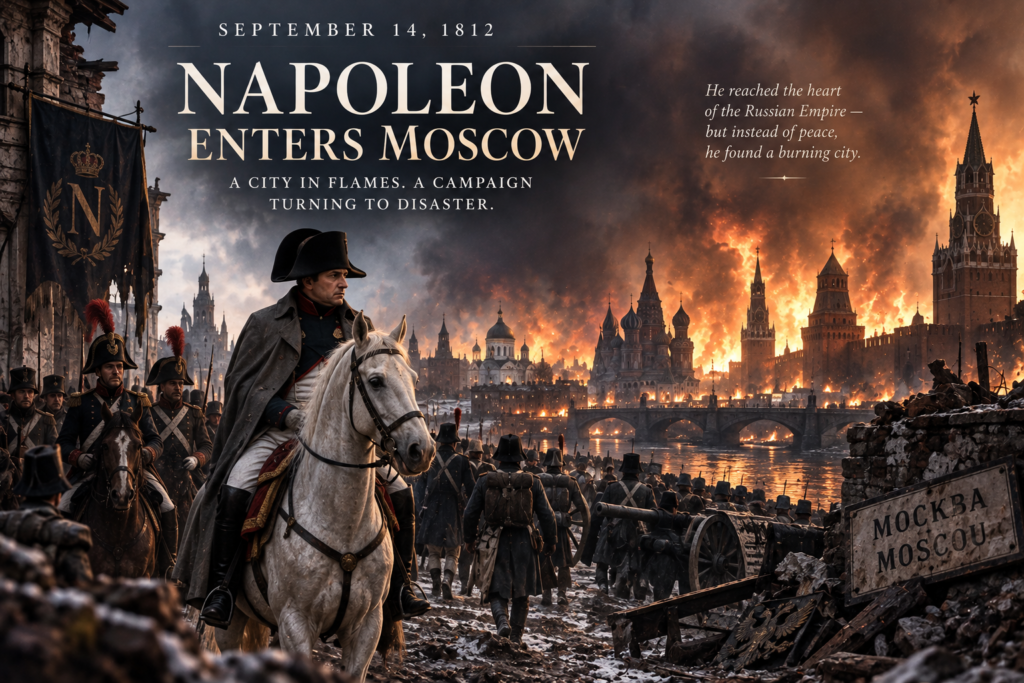
Instead, Napoleon entered a largely deserted city.
Then Moscow began to burn.
The fires that engulfed large parts of the city became the defining image of a campaign that was already moving towards catastrophe.
Napoleon had captured Moscow.
But he had failed to defeat Russia.
Within weeks, his army would begin one of the most disastrous retreats in military history.
Napoleon at the Height of His Power
To understand the significance of September 14, it is necessary to understand the extraordinary position Napoleon occupied in Europe.
Little more than two decades earlier, the French Revolution had overthrown the Bourbon monarchy and plunged France into political upheaval and war.
Napoleon rose through the revolutionary armies.
His victories in Italy transformed him into a national figure.
His seizure of power in 1799 made him France’s dominant political leader.
In 1804, he crowned himself Emperor of the French.
Military victories followed on an astonishing scale.
Austerlitz
In December 1805, Napoleon defeated Russian and Austrian forces at the Battle of Austerlitz.
The victory became one of his greatest military achievements.
The Holy Roman Empire soon disappeared.
In 1806, Napoleon crushed Prussia at Jena and Auerstedt.
French armies entered Berlin.
In 1807, Napoleon again fought Russia, culminating in the Battle of Friedland.
Tsar Alexander I then met Napoleon at Tilsit.
For a moment, the two emperors appeared capable of dividing influence over much of continental Europe.
But their partnership contained deep contradictions.
The Continental System
Napoleon had defeated most of his continental enemies.
Britain remained beyond his reach.
The Royal Navy’s victory at Trafalgar in 1805 had made a direct French invasion of Britain extraordinarily difficult.
Napoleon therefore attempted to defeat Britain economically.
His Continental System sought to exclude British goods from European markets.
Ports controlled by France and its allies were supposed to close themselves to British trade.
In theory, Britain would be economically strangled.
In practice, enforcing the system across Europe proved extremely difficult.
Smuggling flourished.
European economies suffered.
And Russia increasingly questioned whether participation served its interests.
Napoleon and Alexander Drift Apart
Relations between Napoleon and Alexander deteriorated.
Russia’s economy depended heavily on international trade.
The Continental System created serious difficulties for Russian merchants and landowners.
Political tensions also grew over Poland.
Napoleon had created the Duchy of Warsaw from Polish territories previously controlled by Prussia and Austria.
Alexander feared that Napoleon might eventually restore a larger independent Polish state, threatening Russian control of former Polish lands.
The alliance created at Tilsit gradually unravelled.
By 1812, both empires were preparing for war.
The Grande Armée
Napoleon assembled a military force of extraordinary size.
The army that invaded Russia is commonly referred to as the Grande Armée, although only part of it consisted of French troops.
The invasion force drew soldiers from across Napoleon’s imperial system.
Frenchmen marched alongside Poles, Germans, Italians, Dutchmen, Swiss, Croats and soldiers from other territories.
Estimates vary depending on which formations are counted, but more than 600,000 troops were mobilised for the invasion and associated operations.
It was one of the largest armies Europe had ever seen.
Its size was also one of its greatest vulnerabilities.
June 1812
In late June, Napoleon’s forces crossed the Niemen River into the Russian Empire.
Napoleon hoped to bring the Russian armies to battle quickly.
His previous campaigns had often been decided through rapid manoeuvre.
He would concentrate superior forces, defeat the enemy’s main army and force the opposing government to negotiate.
That strategy had worked against Austria.
It had worked against Prussia.
It had worked against Russia before.
But Russia presented a fundamentally different strategic problem.
It was enormous.
The Russians Retreat
Russian commanders understood the danger of fighting Napoleon too close to the frontier.
Rather than allowing their armies to be trapped and destroyed, Russian forces repeatedly withdrew.
Napoleon advanced.
The Russians withdrew again.
French troops captured territory but struggled to force the decisive battle Napoleon wanted.
Every kilometre the Grande Armée advanced increased the distance between the troops and their supply bases.
The army needed enormous quantities of food, ammunition and fodder.
Russia’s roads were poor.
Summer heat was intense.
Disease spread.
Horses died.
Men deserted.
The invasion was already consuming Napoleon’s army before the decisive battle had even occurred.
Scorched Earth
Russian forces frequently removed or destroyed supplies as they retreated.
Food that might sustain the invading army disappeared.
Villages could be emptied.
Stores were removed.
Crops and buildings were sometimes destroyed.
The term scorched earth has become closely associated with the campaign, although destruction resulted from a combination of deliberate Russian measures, military operations and the general devastation caused by enormous armies moving across the countryside.
Napoleon’s logistical assumptions increasingly failed.
The Grande Armée could not simply live off the land at the scale required.
Smolensk
In August, Napoleon reached Smolensk.
A major battle developed around the city.
Russian forces eventually withdrew.
Napoleon captured Smolensk, but once again he had failed to destroy the main Russian army.
The strategic dilemma became increasingly serious.
Should Napoleon stop?
Should he establish winter quarters?
Or should he continue towards Moscow?
The emperor chose Moscow.
He believed capturing the city would force Alexander to negotiate.
The Russians were finally preparing to fight.
Kutuzov Takes Command
Russian dissatisfaction with the continuing retreat led to a change in command.
General Mikhail Kutuzov, an experienced officer who had previously fought Napoleon, was appointed commander in chief.
Kutuzov understood both the political and military pressures facing Russia.
Constant retreat damaged morale.
Moscow could not simply be surrendered without a major attempt to stop the French.
A defensive position was selected near the village of Borodino, west of Moscow.
There, Napoleon would finally receive the battle he had been seeking.
The Battle of Borodino
On September 7, 1812, the French and Russian armies collided at Borodino.
The battle became one of the bloodiest single days of the Napoleonic Wars.
French forces launched repeated attacks against heavily defended Russian positions.
Among the most fiercely contested locations were the Bagration flèches and the Great Redoubt.
Artillery fire devastated tightly packed formations.
Infantry assaults produced enormous casualties.
Cavalry charged through smoke and confusion.
Neither side achieved an easy breakthrough.
A Terrible Victory
By the end of the battle, Russian forces withdrew.
Napoleon therefore held the battlefield and could claim victory.
But the result was far from the decisive destruction he needed.
Tens of thousands of men had been killed or wounded on both sides.
The Russian army remained capable of continuing the war.
Napoleon had lost experienced soldiers who could not easily be replaced so far from France.
Borodino opened the road to Moscow.
It did not end the campaign.
This distinction would become crucial.
Moscow Must Be Abandoned
Kutuzov now faced an agonising decision.
Defending Moscow might require another major battle.
If the Russian army were destroyed, the entire war could be lost.
At a council held at Fili, Russian commanders debated their options.
Kutuzov decided to preserve the army.
Moscow would be abandoned.
The decision was politically painful.
Moscow was not the formal imperial capital. That was St Petersburg.
But Moscow possessed immense historical, cultural and spiritual significance.
Surrendering it without another battle seemed almost unimaginable.
Yet the Russian army marched away.
Napoleon Sees Moscow
On September 14, Napoleon’s forces approached the city.
Tradition associates the moment with the Poklonnaya Hill area, from where Napoleon expected to receive representatives of Moscow.
He waited.
No delegation came.
There were no city leaders presenting keys.
No formal surrender ceremony.
No peace offer.
Something was wrong.
Moscow was strangely quiet.
Large numbers of residents had already fled.
Authorities had withdrawn.
Many supplies had been removed.
Napoleon was about to occupy one of Europe’s great cities without obtaining the political victory he expected.
The French Enter Moscow
French troops entered Moscow during the afternoon.
They encountered an extraordinary scene.
The city was largely deserted compared with its normal population.
Some residents remained, but vast numbers had left.
Houses stood empty.
Shops had been abandoned.
The social machinery of the city had broken down.
French soldiers began occupying buildings.
Some searched for food and valuables.
Discipline deteriorated in places.
Napoleon eventually established himself in the Kremlin.
He had reached Moscow.
But Alexander had not surrendered.
Then the Fires Began
Fires appeared across Moscow.
Some began on September 14 and intensified dramatically over the following days.
Strong winds helped spread the flames.
Large areas of the city consisted of wooden buildings.
Fire moved rapidly from street to street.
The destruction became enormous.
French soldiers attempted to fight some fires while looting and disorder contributed to the chaos.
Napoleon’s great prize was disappearing around him.
Who Burned Moscow?
The cause of the Moscow fire remains one of the campaign’s most debated questions.
French accounts frequently blamed deliberate Russian arson.
Moscow’s governor general, Fyodor Rostopchin, became associated with the destruction, and Russian authorities had removed or disabled some firefighting equipment before leaving.
There is evidence that deliberate fires were set.
But the full destruction cannot necessarily be attributed to a single coordinated order.
A largely abandoned wooden city occupied by a huge army, combined with looting, cooking fires, military activity and strong winds, created ideal conditions for uncontrolled fire.
The most reasonable historical picture is therefore complex.
Some fires were likely deliberately set.
Others probably arose accidentally.
Together they produced catastrophe.
Moscow Burns
For several days, flames consumed large areas of the city.
Churches, houses, warehouses and shops burned.
Smoke filled the streets.
Explosions erupted where combustible materials were stored.
French soldiers attempted to salvage supplies.
Others looted abandoned properties.
The Kremlin itself appeared threatened.
Napoleon temporarily left the complex as the fires intensified.
The visual symbolism was extraordinary.
The emperor who dominated Europe had captured Moscow only to watch much of it burn around him.
Napoleon Waits for Peace
Yet Napoleon still believed the campaign could end politically.
He expected Alexander to negotiate.
Days passed.
Nothing happened.
Napoleon sent signals indicating his willingness to discuss peace.
Alexander refused.
This was the central strategic failure of the campaign.
Napoleon had assumed that capturing a major city would compel Russia to behave like other European states he had defeated.
But Russia was willing to continue the war despite losing Moscow.
Territory could be sacrificed.
The Russian army still existed.
The government still functioned.
The empire’s vast interior remained beyond French control.
Napoleon possessed Moscow.
He did not possess victory.
The Wrong Capital
Moscow’s importance can also obscure a crucial point.
It was not Russia’s administrative capital in 1812.
St Petersburg was the seat of imperial government.
Alexander remained politically secure there.
Capturing Moscow inflicted an enormous psychological blow, but it did not automatically decapitate the Russian state.
Napoleon’s strategy depended on political assumptions that Alexander refused to fulfil.
Every day spent waiting in Moscow made the French position more dangerous.
The Grande Armée Was Shrinking
The army that reached Moscow was already dramatically smaller than the force that had crossed the Niemen.
Battle casualties accounted for only part of the losses.
Disease had killed thousands.
Desertion reduced units.
Men had been detached to protect supply lines and garrisons.
Horses had died in enormous numbers.
Many soldiers were exhausted.
Napoleon’s ability to move and supply his army was deteriorating.
And autumn was approaching.
The Myth of General Winter
Popular memory often reduces Napoleon’s defeat to one explanation:
the Russian winter.
Winter was unquestionably devastating.
But it did not defeat a healthy Grande Armée.
The army had already suffered catastrophic attrition before the worst cold arrived.
Logistical failure, disease, inadequate supplies, Russian strategy, battle casualties, the enormous distances involved and the loss of horses had weakened the army dramatically.
Winter transformed an already disastrous situation into something even worse.
The campaign was lost through a combination of factors.
Napoleon Delays
Napoleon remained in Moscow for roughly five weeks.
This delay proved costly.
He continued hoping Alexander would negotiate.
Meanwhile, Russian forces regrouped.
Kutuzov positioned his army south of Moscow, threatening French access to regions where supplies might still be found.
The season advanced.
Napoleon eventually accepted that peace was not coming.
He had to leave.
On October 19, 1812, the Grande Armée began withdrawing from Moscow.
The retreat had begun.
Napoleon Tries Another Route
Napoleon initially hoped to retreat through territory that had not already been devastated during the advance.
This might provide food and shelter.
But Russian forces blocked his movement near Maloyaroslavets.
A fierce battle followed.
Although French forces held the battlefield, Napoleon decided against continuing along the southern route.
He turned back towards the road through Smolensk.
That decision was disastrous.
The army would retreat across territory it had already stripped during the advance.
There was little left to eat.
Hunger
Food became increasingly scarce.
Soldiers slaughtered horses.
Men searched abandoned villages for anything edible.
Units lost cohesion.
Stragglers filled the roads.
Discipline deteriorated.
The distinction between an organised army and a mass of desperate survivors became increasingly blurred.
Foraging parties risked attack by Russian cavalry, Cossacks and peasants.
Every day reduced the Grande Armée further.
The Horses Die
The loss of horses was particularly destructive.
Napoleon’s army depended on horses not only for cavalry but also for artillery and transport.
Without horses, cannons had to be abandoned.
Supply wagons could not move.
Cavalry formations ceased functioning effectively.
The army’s mobility collapsed.
Thousands of dead horses lined the route.
A nineteenth century army without animal transport could not maintain itself.
The logistical system was disintegrating.
The Cossacks
Russian Cossack cavalry became one of the nightmares of the retreat.
Highly mobile forces harassed French columns.
They attacked isolated groups.
They threatened supply movements.
They captured stragglers.
The Russians did not need to risk another Borodino-sized confrontation.
They could allow hunger, exhaustion and cold to weaken Napoleon while continuously applying pressure.
Kutuzov understood that time and distance were now fighting on Russia’s side.
Smolensk Offers Little Salvation
Napoleon hoped supplies at Smolensk would restore the army.
The reality was disappointing.
Organisation was poor.
Resources were insufficient for the enormous number of desperate troops arriving.
Units fought for supplies.
Men continued dying.
The retreat continued westwards.
Then temperatures fell dramatically.
Winter had arrived.
The Cold
Soldiers lacked adequate clothing.
Some wrapped themselves in whatever fabric they could find.
Frostbite became widespread.
Men who stopped walking risked death.
Weapons became difficult to operate.
Icy roads made movement dangerous.
Horses slipped and collapsed.
Exhausted soldiers sometimes sat down beside the road and never rose again.
The Russian winter became the final amplifier of every previous failure.
The Berezina
One of the retreat’s most dramatic episodes occurred at the Berezina River in late November.
Russian armies threatened to trap Napoleon against the river.
The bridges normally available to the French had been destroyed.
French engineers constructed temporary bridges under extraordinary conditions.
Troops, wagons, civilians and stragglers crowded towards the crossings.
Russian forces attacked.
Chaos followed.
Thousands were killed, drowned or captured.
Yet Napoleon and a significant portion of his remaining combat forces escaped.
Militarily, the Berezina was not simply the annihilation sometimes portrayed in popular memory.
French engineers had prevented an even greater catastrophe.
But the human scenes were horrific.
The Army Disappears
By the time the survivors crossed back towards the western frontier of the Russian Empire, the army that had invaded in June had effectively ceased to exist in its original form.
Precise numbers remain debated because the multinational invasion force included different formations entering and leaving the theatre at different times.
But the scale of the catastrophe is beyond dispute.
Hundreds of thousands of men were dead, wounded, missing, captured or otherwise lost to Napoleon’s effective military strength.
A campaign intended to compel Russia to obey Napoleon had instead destroyed a huge portion of his military power.
Napoleon Leaves the Army
In early December, Napoleon learned of political concerns in Paris.
He decided to leave the remnants of his army and return rapidly to France.
The decision has often been portrayed as abandonment.
From Napoleon’s perspective, maintaining political control of the empire was essential.
He travelled across Europe and reached Paris before many people realised the full scale of the disaster.
The emperor survived.
His aura of invincibility did not.
Europe Takes Notice
For years, European governments had watched Napoleon defeat coalition after coalition.
Austerlitz.
Jena.
Friedland.
Wagram.
The Russian campaign changed perceptions.
Napoleon could be defeated.
His army could be destroyed.
His empire was vulnerable.
Prussia began moving away from French domination.
Russia advanced westwards.
Britain continued fighting.
Austria eventually joined Napoleon’s enemies.
A new coalition formed.
The disaster in Russia became the beginning of the end of Napoleon’s European empire.
Leipzig
In October 1813, Napoleon faced coalition armies at the Battle of Leipzig, sometimes called the Battle of the Nations.
It became one of the largest battles fought in Europe before the twentieth century.
Napoleon was defeated.
French forces withdrew westwards.
The Allies invaded France.
Paris fell in 1814.
Napoleon abdicated.
He was exiled to the island of Elba.
The chain of events leading to his first downfall cannot be separated from the catastrophe of 1812.
Waterloo Was Still Ahead
Napoleon returned dramatically from Elba in 1815.
For roughly one hundred days, he again ruled France.
European powers mobilised against him.
His final campaign ended at the Battle of Waterloo on June 18, 1815.
Napoleon was defeated by Allied forces led principally by the Duke of Wellington and the Prussian commander Gebhard Leberecht von Blücher.
This time his exile was permanent.
He was sent to Saint Helena in the South Atlantic.
He died there in 1821.
But the decisive weakening of his empire had begun years earlier.
On the road to Moscow.
Why Did Napoleon Fail?
No single explanation is sufficient.
The Russian campaign combined several strategic failures.
Napoleon underestimated geographical distance.
His logistical system could not reliably support such an enormous army deep inside Russia.
He failed to destroy the principal Russian armies.
The Russians repeatedly traded territory for time.
The Grande Armée suffered enormous losses from disease and exhaustion.
The capture of Moscow produced no political settlement.
Napoleon waited too long before retreating.
Russian forces continuously harassed the withdrawal.
Food disappeared.
Horses died.
And winter magnified the catastrophe.
The campaign became a lesson in the limits of military power.
Russia Had Space
Russia possessed something Napoleon’s previous continental opponents had lacked on the same scale.
Strategic depth.
Austria and Prussia could lose decisive battles near their political centres and face immediate pressure to negotiate.
Russia could retreat hundreds of kilometres.
It could surrender major cities.
It could rebuild armies farther east.
The geography of the empire transformed Napoleon’s greatest strength, rapid decisive warfare, into a weakness.
The farther he advanced, the more fragile his army became.
Kutuzov’s Strategy
Kutuzov’s reputation has also been debated.
He did not defeat Napoleon through a single brilliant battlefield manoeuvre.
Borodino was enormously costly.
The abandonment of Moscow was controversial.
But Kutuzov understood a fundamental strategic reality.
Russia did not need to destroy Napoleon in one battle.
It needed to survive.
As long as the Russian army remained intact and Alexander refused negotiations, Napoleon’s position deteriorated automatically.
Distance, hunger and time became Russian weapons.
Alexander Refuses to Negotiate
Tsar Alexander’s political determination was therefore crucial.
Had he negotiated after Moscow fell, Napoleon might have transformed the campaign into a political victory despite his losses.
Alexander refused.
His decision forced Napoleon to confront the strategic emptiness of capturing Moscow.
A city could be occupied.
A war could continue.
This is one of the central lessons of 1812.
Military occupation and political victory are not the same thing.
The Destruction of Moscow
The fire also became part of Russian national memory.
Much of Moscow had to be rebuilt.
The destruction was traumatic.
But the city’s sacrifice became connected to a larger narrative of national resistance.
Russian culture later transformed 1812 into one of the defining episodes of national history.
The campaign inspired paintings, memorials, literature and music.
The most famous literary treatment would appear decades later.
Tolstoy and War and Peace
Leo Tolstoy’s War and Peace placed Napoleon’s invasion at the centre of one of literature’s greatest historical novels.
Published in the nineteenth century, the work explored not simply battles and rulers but the lives of individuals caught inside enormous historical forces.
Tolstoy challenged the idea that history could be explained entirely through the decisions of supposedly great men.
His Napoleon is powerful but also constrained by events beyond his control.
The campaign of 1812 provided the perfect setting for that argument.
An emperor who believed he could command history discovered that history was far larger than any emperor.
Tchaikovsky’s 1812 Overture
The campaign also inspired one of the most recognisable works of classical music.
Pyotr Ilyich Tchaikovsky’s 1812 Overture commemorated Russia’s resistance to Napoleon.
Its dramatic conclusion, often performed with bells and cannon fire, transformed the campaign into musical national mythology.
Ironically, the work later became popular internationally in contexts far removed from its original historical meaning.
The cultural memory of 1812 extended far beyond Russia.
The Legend of Napoleon’s Retreat
Few military disasters have produced such enduring imagery.
French soldiers walking through snow.
Abandoned artillery.
Dead horses.
Cossacks appearing on the horizon.
Frozen rivers.
Men clustered around fires.
The Grande Armée reduced from an instrument of imperial domination to columns of exhausted survivors.
These images became symbols of military hubris.
But focusing only on the retreat can hide the deeper point.
The campaign was failing long before the snow became severe.
The road to catastrophe began during the advance.
A Lesson Repeated in History
Later military planners repeatedly studied Napoleon’s invasion.
The Russian experience demonstrated the dangers of invading enormous territories without secure logistics.
More than a century later, Nazi Germany launched Operation Barbarossa against the Soviet Union in 1941.
The historical circumstances, ideology, technology and military systems were very different.
Yet observers inevitably compared the two invasions.
Again, an enormous European army advanced deep into the east.
Again, logistical difficulties became severe.
Again, Soviet territory absorbed enormous initial losses without producing immediate political collapse.
Again, winter became part of the story.
History did not repeat itself exactly.
But the warning of 1812 remained unmistakable.
Moscow Was a Victory That Meant Nothing
This may be the most important paradox of September 14.
Napoleon achieved his immediate operational objective.
He entered Moscow.
The Russians had abandoned the city.
The French emperor occupied the Kremlin.
By conventional appearances, he had won.
Yet the victory gave him almost nothing he needed.
The Russian army survived.
Alexander refused peace.
Moscow could not adequately supply the French.
The city burned.
The season advanced.
The supply lines stretched hundreds of kilometres westwards.
Napoleon had captured his objective and simultaneously placed his army in an increasingly impossible position.
It was a victory without strategic success.
Why September 14 Matters
September 14, 1812 matters because it captures the precise moment when apparent triumph concealed approaching disaster.
Napoleon stood at the height of his military reputation.
He had defeated armies across Europe.
He had entered one of Russia’s greatest cities.
Few rulers since antiquity had exercised comparable power across the continent.
Yet Moscow exposed the limits of that power.
Napoleon could win battles.
He could capture cities.
He could overthrow governments.
But he could not force Alexander to surrender.
He could not shorten Russia’s distances.
He could not create food where none existed.
He could not restore thousands of dead horses.
He could not prevent disease from consuming his army.
And ultimately, he could not command the Russian winter.
September 14, 1812
Imagine the scene as Napoleon approached Moscow.
Behind him lay hundreds of kilometres of exhausted marching.
Smolensk had fallen.
Borodino had been fought.
The Russian army had withdrawn.
Ahead stood Moscow.
For almost any other European campaign, this should have been the moment of decision.
Napoleon expected representatives.
He expected negotiation.
He expected victory.
Instead, he found silence.
Then smoke.
Then fire.
And still no message from Alexander offering peace.
The emperor had marched one of the greatest armies assembled in European history into the heart of Russia.
He had reached the city he believed would end the war.
But Russia had refused to behave according to Napoleon’s strategy.
Five weeks later, he would leave Moscow.
Then came hunger.
Cold.
Cossacks.
Smolensk.
The Berezina.
And the destruction of the Grande Armée.
Napoleon entered Moscow on September 14, 1812 as the conqueror of much of Europe.
He left it as the commander of an army beginning a fight for survival.
The city he believed would confirm his supremacy instead became the symbol of the campaign that began to break his empire.