
By Open Chronicle History Desk
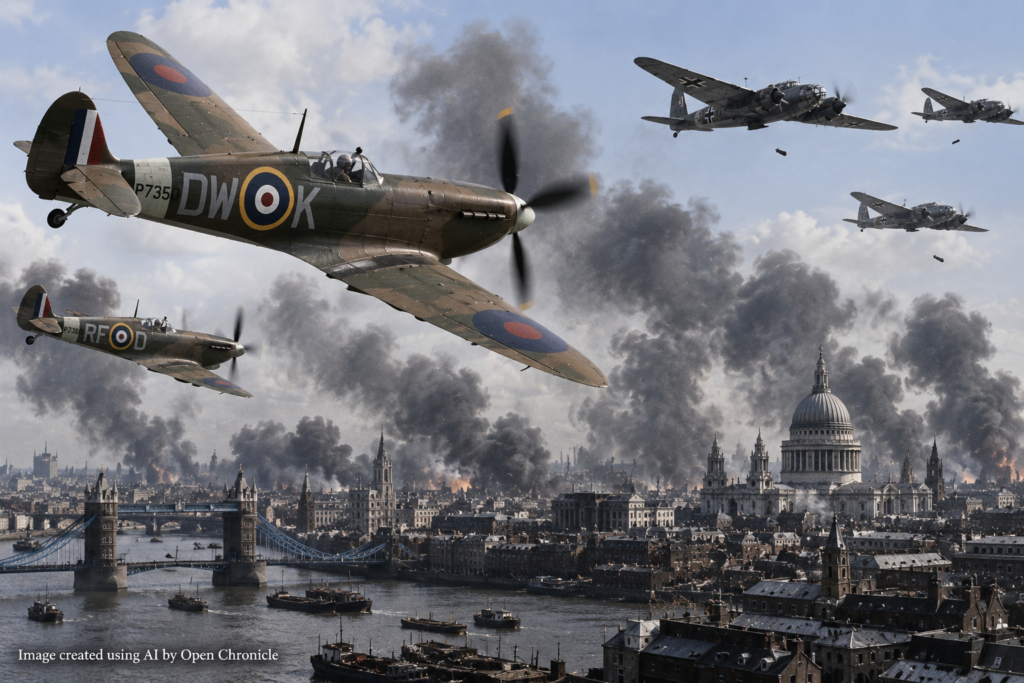
On September 15, 1940, hundreds of German aircraft crossed the English Channel and headed towards southern England.
Their objective was London.
Above the capital and the surrounding countryside, British fighters rose to meet them.
Hawker Hurricanes and Supermarine Spitfires climbed into formations of German bombers protected by Messerschmitt fighters. Across southern England, radar stations, observers, operations rooms and airfields worked together to direct Royal Air Force squadrons towards the approaching enemy.
The resulting air battles became some of the most famous of the Second World War.
Germany had spent months attempting to weaken RAF Fighter Command sufficiently to gain control of the skies over Britain. Without air superiority, Adolf Hitler’s planned invasion of Britain, Operation Sea Lion, faced enormous risks.
September 15 was intended to demonstrate German strength.
Instead, it demonstrated that the RAF was still very much alive.
The Luftwaffe suffered significant losses, while British fighters repeatedly intercepted the German formations.
Two days later, Hitler postponed Operation Sea Lion.
September 15 subsequently became remembered as Battle of Britain Day, one of the defining dates in Britain’s wartime history.
But the reality behind the legend was more complicated.
Britain had not destroyed the Luftwaffe.
Germany had not abandoned the war.
London would continue to be bombed.
And victory had depended upon far more than the celebrated pilots remembered as “The Few.”
It depended upon an entire defensive system built before the war, maintained under extraordinary pressure and supported by thousands of people whose names rarely appeared in newspaper headlines.
Britain Alone in Western Europe
The battle emerged from the catastrophe that had overtaken Europe earlier in 1940.
On May 10, German forces attacked the Netherlands, Belgium, Luxembourg and France.
The campaign overturned expectations.
French and British commanders anticipated the principal German offensive through Belgium.
Instead, German armoured forces made their decisive advance through the Ardennes.
They crossed the Meuse and drove towards the English Channel.
Allied armies in Belgium were threatened with encirclement.
Within weeks, the military situation had become disastrous.
Dunkirk
Large numbers of British, French and other Allied troops were trapped near the northern French port of Dunkirk.
Between late May and early June, an extraordinary evacuation took place.
Royal Navy vessels and hundreds of civilian craft helped carry troops across the Channel.
More than 330,000 Allied personnel were evacuated.
Britain celebrated their rescue.
But Dunkirk was not a military victory.
The British Expeditionary Force had lost enormous quantities of equipment.
France remained under attack.
And Germany’s armies continued advancing.
France Falls
Paris fell in June.
The French government sought an armistice.
On June 22, 1940, France signed an armistice with Germany.
Hitler now dominated much of Western and Central Europe.
Poland had been defeated.
Denmark and Norway had been invaded.
The Netherlands and Belgium had fallen.
France was out of the war.
Britain remained.
For Hitler, the question became how to remove the last major opponent in Western Europe.
Churchill Refuses to Negotiate
Winston Churchill had become prime minister on May 10.
Some members of Britain’s political establishment considered whether a negotiated settlement might become necessary.
Churchill resisted.
He believed that accepting German domination of Europe would place Britain’s future in profound danger.
His speeches framed the conflict as a struggle for national survival.
After Dunkirk, Churchill warned Parliament that the Battle of France was over and that another struggle was about to begin.
The Battle of Britain was approaching.
Operation Sea Lion
Germany began preparing plans for an invasion across the English Channel.
The operation received the codename Seelöwe, or Sea Lion.
An amphibious invasion of Britain would be enormously difficult.
The Royal Navy was considerably stronger than Germany’s surface fleet.
German forces crossing the Channel in vulnerable transports could be devastated if British naval forces intervened.
The Luftwaffe therefore needed to establish air superiority.
RAF Fighter Command had to be destroyed or rendered incapable of seriously interfering with an invasion.
The battle would be fought primarily in the sky.
The Luftwaffe
The German air force entered the campaign with an intimidating reputation.
The Luftwaffe had played a central role in German victories over Poland and Western Europe.
Its bomber force included aircraft such as the Heinkel He 111, Dornier Do 17 and Junkers Ju 88.
The famous Junkers Ju 87 Stuka dive bomber had provided devastating tactical support to German ground forces.
German fighter units operated the Messerschmitt Bf 109, an aircraft broadly comparable in performance to Britain’s best fighters.
Germany possessed experienced pilots and commanders.
But the campaign over Britain would present challenges unlike those encountered over continental battlefields.
Fighter Command
Britain’s principal defensive organisation was RAF Fighter Command, led by Air Chief Marshal Hugh Dowding.
Its most famous aircraft were the Supermarine Spitfire and the Hawker Hurricane.
Popular memory often gives the Spitfire centre stage.
Its elegant design and high performance made it an icon.
But Hurricanes equipped more RAF fighter squadrons during the battle and played a crucial role in the defence.
The two aircraft complemented one another.
Yet aircraft alone do not explain Britain’s success.
The decisive advantage lay partly in the system connecting them.
The Dowding System
Britain had constructed one of the world’s most sophisticated integrated air defence networks.
Radar stations belonging to the Chain Home system detected approaching German aircraft.
The Royal Observer Corps tracked formations once they crossed the coastline and helped fill gaps in radar coverage.
Information travelled through filter rooms and command headquarters.
Sector stations then directed fighter squadrons towards the enemy.
This was revolutionary.
British pilots did not need to spend endless hours patrolling randomly in the hope of encountering German aircraft.
They could remain on the ground until information indicated where they were needed.
Britain was turning information into combat power.
Radar Did Not Win Alone
Radar is sometimes described as the secret weapon that won the Battle of Britain.
That simplifies the story.
Radar provided warning.
But warning was useful only because it formed part of a larger system.
Telephone networks transmitted information.
Plotters updated maps.
Controllers made rapid decisions.
Ground crews prepared aircraft.
Pilots took off.
Anti-aircraft batteries defended important targets.
Aircraft factories replaced losses.
Repair crews restored damaged airfields.
Intelligence contributed to the overall picture.
The Battle of Britain was therefore an early example of networked warfare, decades before that phrase existed.
The Channel Battles
The campaign developed gradually.
During July 1940, German aircraft attacked shipping in the English Channel and coastal targets.
These engagements tested British defences and attempted to draw Fighter Command into combat.
The Luftwaffe wanted to destroy British fighters.
Dowding wanted to preserve them.
Every British aircraft lost mattered.
But pilots were even more valuable.
An aircraft could be manufactured relatively quickly.
An experienced fighter pilot could not.
August 13: Eagle Day
Germany intensified the offensive in August.
August 13 became known as Adlertag, or Eagle Day.
The Luftwaffe launched large-scale operations against British airfields, radar stations and other targets.
German commanders hoped to destroy Fighter Command within weeks.
Attacks continued.
RAF stations in southern England came under increasing pressure.
Aircraft were destroyed.
Buildings were damaged.
Pilots were exhausted.
The battle became a contest of endurance.
The Luftwaffe’s Intelligence Problem
German commanders faced a major difficulty.
They did not possess an accurate picture of Fighter Command’s strength.
British losses were repeatedly overestimated.
The Luftwaffe therefore believed at various moments that the RAF was much closer to collapse than it actually was.
Britain also benefited from fighting over its own territory.
A British pilot who survived being shot down might return to his squadron.
A German pilot descending by parachute over Britain became a prisoner of war.
Over time, this asymmetry mattered.
The Pilots
The pilots who defended Britain came from far beyond England.
Fighter Command included airmen from Poland, Czechoslovakia, Canada, New Zealand, Australia, South Africa, Belgium, France and other countries, as well as British pilots.
Polish airmen became particularly renowned.
Many had already fought Germany in Poland and France.
Their combat experience proved extremely valuable.
The Battle of Britain was a British victory.
But it was also an international Allied effort.
No. 303 Polish Squadron
Among the most famous units was No. 303 Polish Fighter Squadron.
Its pilots became highly successful during the battle.
They brought combat experience and an aggressive fighting style developed through previous campaigns.
The presence of Polish and Czechoslovak pilots also reflected a broader reality.
Britain was not simply defending its own territory.
Many of the men flying above England were fighting because their own countries had already been occupied by Nazi Germany.
For them, Britain represented the place from which the war could continue.
The Pressure Increases
By late August, Luftwaffe attacks on Fighter Command infrastructure had become increasingly dangerous.
Sector stations were particularly important because they coordinated local fighter operations.
Repeated attacks damaged airfields and exhausted personnel.
Some British squadrons suffered heavy losses.
Replacement pilots sometimes arrived with limited training.
The RAF remained functional.
But the pressure was real.
Then German strategy increasingly shifted towards London.
September 7: The Blitz Begins
On September 7, the Luftwaffe launched a massive attack against London.
The docklands and East End were heavily bombed.
That night, German aircraft returned.
The attack marked the beginning of the sustained bombing campaign known as the Blitz.
London would be bombed for 57 consecutive nights.
The strategic shift remains debated.
Attacking London had military logic.
The capital contained docks, railways, factories, communications and government infrastructure.
German commanders also hoped that attacking the capital would force Fighter Command into major battles.
But concentrating increasingly on London reduced some of the pressure on RAF fighter stations.
Britain gained valuable time.
Fighter Command Was Not Defeated
This is crucial to understanding September 15.
German commanders believed Fighter Command had suffered devastating losses.
They hoped one or more major attacks might draw the remaining British fighters into combat and destroy them.
Instead, the RAF continued putting substantial numbers of aircraft into the air.
Britain’s fighter production was also stronger than German intelligence appreciated.
Aircraft damaged in combat were repaired.
New machines arrived.
The defence system survived.
The Luftwaffe was preparing another major effort.
Sunday, September 15
The morning of September 15 began with German reconnaissance and smaller operations.
Then larger formations began assembling over northern France.
Radar operators detected the buildup.
Information moved through Fighter Command.
Squadrons were alerted.
Around late morning, a major German formation crossed the Channel and headed towards London.
Bombers flew surrounded by fighter escorts.
British fighters climbed to intercept them.
The first great battle of the day began.
The First Attack
German aircraft approached the capital from the southeast.
RAF squadrons were directed into their path.
Dogfights developed across Kent, Surrey and the London area.
Spitfires and Hurricanes attacked bomber formations.
Messerschmitt fighters attempted to protect them.
Bombers continued towards their targets, but the formations were disrupted.
Some reached London and dropped their bombs.
Others were forced to abandon attacks.
Then the surviving German aircraft turned towards France.
The battle was not over.
A Second Great Raid
During the afternoon, another major German force approached.
Once again, Fighter Command responded.
The scale of British resistance surprised German crews.
The Luftwaffe had expected an enemy approaching exhaustion.
Instead, German formations encountered repeated interceptions.
Aircraft fought across a vast area of southern England.
Londoners looking upward could sometimes see vapour trails crossing the sky.
Aircraft engines and gunfire could be heard above the city.
The air battle was taking place over one of the world’s largest urban populations.
Churchill at Uxbridge
One of the most famous episodes associated with September 15 occurred at RAF Uxbridge, headquarters of No. 11 Group.
Churchill visited the operations room while the battle was underway.
No. 11 Group, commanded by Keith Park, carried much of the burden of defending London and southeast England.
As reports arrived and squadrons were committed, Churchill watched the battle being managed through maps, markers and telephone communications.
He later recalled asking what reserves remained.
The answer suggested that few were immediately available.
The story captured the intensity of the moment.
Britain was committing enormous resources to stopping the raids.
Keith Park
Air Vice-Marshal Keith Park was one of the most important commanders of the Battle of Britain.
His No. 11 Group defended the region most exposed to German attack.
Park generally favoured sending individual squadrons or smaller formations into action rapidly.
His priority was interception.
German bombers had to be attacked before or as they reached their targets.
Another RAF commander preferred a different approach.
The disagreement would become one of the battle’s most famous controversies.
The Big Wing
Air Vice-Marshal Trafford Leigh-Mallory, commanding No. 12 Group north of Park’s area, supported the use of larger formations of fighters.
The concept became associated with Douglas Bader and the so-called Big Wing.
Several squadrons would assemble before attacking German formations together.
In theory, a large concentration could inflict devastating losses.
In practice, assembling it took time.
Historians continue debating the effectiveness of the approach.
The controversy illustrates that Britain did not win through a single universally accepted tactical doctrine.
Senior commanders disagreed intensely about how the battle should be fought.
German Fighter Limitations
The Messerschmitt Bf 109 was an excellent fighter.
But when operating over southern England, it faced an important limitation.
Range.
German fighters had to cross the Channel, escort bombers, fight British aircraft and retain enough fuel to return to bases in France.
Their combat time over London was limited.
British fighters operated close to their airfields.
A German formation could therefore find itself vulnerable if fighter escorts had to turn home because of fuel shortages.
Geography favoured the defender.
The Spitfire and Hurricane
Popular accounts often describe Spitfires fighting German fighters while Hurricanes attacked bombers.
Reality was less tidy.
Both types engaged both categories of enemy aircraft.
The Spitfire’s performance made it particularly effective against the Bf 109.
The Hurricane was robust, numerous and highly capable.
Together they formed the core of Fighter Command.
Their success also depended on mechanics working relentlessly on the ground.
Every fighter returning damaged created another race against time.
Could it be repaired before the next raid?
Often, the answer was yes.
What Were the Losses?
Wartime claims dramatically exaggerated German losses on September 15.
British authorities initially claimed around 185 German aircraft destroyed.
Postwar research showed the actual number was much lower.
Modern estimates generally place German aircraft losses that day at roughly 60, while the RAF lost around two dozen fighters, with figures varying somewhat according to definitions and records.
The correction does not diminish the importance of the day.
The crucial fact was not an enormous numerical annihilation of the Luftwaffe.
It was that Germany had launched major attacks and encountered a British fighter force that remained capable of mounting powerful resistance.
The RAF was not broken.
Propaganda and Reality
Both sides exaggerated enemy losses during the Battle of Britain.
This was partly because pilots naturally overclaimed in chaotic aerial combat.
Several pilots might fire at the same aircraft and each believe they had destroyed it.
Aircraft seen falling through cloud might recover.
Damaged aircraft could return to base.
Propaganda amplified the numbers further.
For historians, the surviving operational records provide a more reliable picture.
September 15 was a significant British success.
But it was not the destruction of German air power.
Why September 15 Was Different
The significance of the day was psychological and strategic as much as numerical.
German leaders had hoped that Fighter Command was nearing exhaustion.
Instead, RAF squadrons repeatedly appeared.
The Luftwaffe could still bomb Britain.
It could still inflict terrible destruction.
But it had not achieved air superiority.
That meant the central prerequisite for a cross-Channel invasion remained unresolved.
Hitler faced a decision.
September 17: Sea Lion Postponed
Two days later, on September 17, Hitler postponed Operation Sea Lion.
The invasion preparations did not instantly disappear, and German planning continued in various forms.
But the realistic prospect of invasion in 1940 was fading.
The weather would soon deteriorate.
The Luftwaffe had not destroyed Fighter Command.
The Royal Navy remained formidable.
Britain had survived the immediate danger.
Germany turned increasingly towards sustained bombing rather than preparations for an imminent landing.
The Blitz Continues
For Londoners, there was little sense that victory had arrived.
German bombers continued attacking.
The Blitz lasted into May 1941.
Coventry suffered devastating destruction.
Liverpool was heavily bombed.
Birmingham, Bristol, Plymouth, Southampton, Belfast and other cities experienced major raids.
Approximately 43,000 British civilians were killed during the Blitz.
Thousands more were injured.
Hundreds of thousands of homes were damaged or destroyed.
Winning the Battle of Britain did not mean Britain was safe.
It meant Germany had failed to secure control of the air necessary for invasion.
Britain’s Factories
Another essential part of the story occurred far from aerial combat.
British industry replaced aircraft at a remarkable rate.
Under Lord Beaverbrook, the Ministry of Aircraft Production pushed factories to maximise output.
Workers laboured long shifts.
Damaged aircraft were salvaged and repaired.
Parts were recovered.
Production figures became strategically important.
Germany repeatedly underestimated Britain’s ability to replace fighter losses.
An air battle is not fought only by the aircraft currently in the sky.
It is fought by the industrial system capable of putting another aircraft there tomorrow.
Women and the Battle
Women played indispensable roles throughout Britain’s air defence system.
Members of the Women’s Auxiliary Air Force worked as radar operators, plotters, communications personnel and in numerous support roles.
Women served in aircraft production.
They worked in civil defence.
They drove ambulances.
They staffed hospitals and communications centres.
The famous image of male fighter pilots captures only one part of the battle.
Behind every squadron stood a large organisation in which women were essential.
Ground Crews
The same is true of RAF ground crews.
Mechanics refuelled aircraft.
Armourers loaded ammunition.
Engine specialists repaired damage.
Crews patched bullet holes.
Aircraft that appeared incapable of flying could sometimes return to service within hours.
These men rarely received the public attention given to pilots.
But Fighter Command could not have operated without them.
A Spitfire on the ground with a damaged engine was not an air defence weapon.
Ground crews turned it back into one.
The Observer Corps
The Royal Observer Corps provided another layer of Britain’s defence.
Radar was excellent at detecting approaching formations over the sea.
Once aircraft crossed inland, visual observers became increasingly important.
Posts across the country tracked aircraft movement and reported information.
Thousands of volunteers contributed.
Again, the battle depended on information.
Knowing where the enemy was could matter almost as much as possessing aircraft capable of intercepting it.
The Few
On August 20, 1940, Churchill had delivered one of his most famous lines:
“Never in the field of human conflict was so much owed by so many to so few.”
The phrase became inseparable from the Battle of Britain.
“The Few” came to mean the fighter pilots who defended the country.
The tribute was deserved.
Their casualty rates were significant, and many flew repeated combat missions under extraordinary pressure.
But historical perspective expands the meaning of victory.
The Few succeeded because hundreds of thousands of others supported them.
The Battle Was International
The conflict also challenges a purely national interpretation.
Pilots from occupied Europe fought alongside British airmen.
Commonwealth personnel participated.
Polish and Czechoslovak pilots brought invaluable combat experience.
Britain itself drew resources from a global empire and Commonwealth.
The struggle above southern England was therefore connected to a much larger international war.
The men defending London sometimes spoke languages other than English.
They nevertheless shared the same enemy.
What About the Royal Navy?
The Battle of Britain is usually told as a contest between the RAF and Luftwaffe.
That is correct in operational terms.
But the Royal Navy remained crucial to the invasion question.
Even if Germany had gained greater air superiority, crossing the Channel and sustaining an invasion force would have been enormously difficult.
Britain possessed powerful naval forces.
Germany lacked specialised amphibious capability on the scale later demonstrated by the Allies in Normandy.
Sea Lion was therefore an exceptionally risky operation.
The RAF’s survival made that operation still more dangerous.
Did Hitler Really Intend to Invade?
Historians have debated the seriousness of Operation Sea Lion.
Some interpretations emphasise its logistical weaknesses and suggest Hitler hoped primarily to pressure Britain into negotiations.
Others note that substantial preparations were made and that invasion planning was genuine even if extremely difficult.
The safest conclusion is that Germany seriously examined and prepared for invasion while recognising formidable obstacles.
What matters for September 15 is straightforward.
Without control of the air, those obstacles became overwhelming.
Fighter Command denied Germany that control.
Germany Turns East
Hitler’s strategic attention increasingly moved elsewhere.
He had long viewed the Soviet Union as the central target of his ideological and territorial ambitions.
Planning accelerated for the invasion of the USSR.
On June 22, 1941, Germany launched Operation Barbarossa.
The war expanded dramatically eastwards.
Britain was no longer facing Germany alone.
Then, in December 1941, Japan attacked Pearl Harbor and Germany subsequently declared war on the United States.
The conflict became fully global.
Britain’s survival in 1940 had enormous consequences for everything that followed.
Britain Becomes an Allied Base
Because Britain remained in the war, it became an essential base for future Allied operations.
American troops eventually arrived.
Aircraft operated from British airfields.
Naval forces used British ports.
Intelligence operations were coordinated there.
Resistance movements received support.
Strategic bombing missions departed from Britain.
Then came June 6, 1944.
D-Day.
The Allied invasion of Normandy was launched across the same Channel Germany had failed to cross four years earlier.
The direction of invasion had reversed.
What If Britain Had Lost?
Counterfactual history must be treated cautiously.
We cannot know precisely what would have happened had Fighter Command collapsed.
An invasion might still have failed because of the Royal Navy and German logistical weaknesses.
Britain might have continued fighting from elsewhere.
Political negotiations might or might not have occurred.
But Germany gaining air superiority would unquestionably have created an extraordinarily dangerous situation.
The RAF’s success prevented that scenario from being tested.
That alone gives the Battle of Britain immense historical importance.
The Myth of a Single Decisive Day
September 15 should not be understood as a battle that single-handedly decided Britain’s survival.
The Battle of Britain unfolded over months.
July mattered.
August mattered.
September 7 mattered.
The resilience of Fighter Command throughout the entire campaign mattered.
September 15 became symbolic because it concentrated the larger struggle into one dramatic day.
Large German formations attacked.
The RAF intercepted them.
The Luftwaffe suffered significant losses.
And the German belief that Fighter Command was almost finished was exposed as false.
Symbols are not the whole history.
But this one reflects something real.
Dowding’s Achievement
Hugh Dowding deserves particular attention.
His leadership was not glamorous.
He was cautious about wasting fighter strength.
He understood that Britain’s objective was not necessarily to destroy the Luftwaffe.
It was to prevent the Luftwaffe from destroying Fighter Command.
That distinction was fundamental.
Germany had to win air superiority.
Britain merely had to deny it.
The defender therefore possessed a strategic advantage.
As long as Fighter Command remained a credible fighting force, Germany had failed in its primary objective.
Park’s Achievement
Keith Park’s operational leadership was equally important.
No. 11 Group faced the most intense attacks.
Park had to decide constantly when to launch squadrons, where to send them and how much strength to retain.
Information was incomplete.
German formations could change direction.
Fighter fuel was limited.
Pilots were exhausted.
Decisions had to be made within minutes.
September 15 represented not simply the courage of pilots but the effectiveness of command under enormous pressure.
German Mistakes
The Luftwaffe made several strategic mistakes.
German intelligence underestimated Britain’s fighter strength.
The importance of the integrated air defence system was not fully understood.
Attacks on radar infrastructure were not pursued consistently enough to destroy the network.
The shift towards London relieved pressure on parts of Fighter Command’s ground organisation.
German bombers lacked the defensive capability to operate safely without fighter protection.
And German fighters faced range limitations over Britain.
None of these mistakes alone decided the battle.
Together, they mattered enormously.
Britain’s Advantages
Britain also possessed advantages that should not be mistaken for inevitability.
It fought over home territory.
Its pilots who survived being shot down could often return to service.
Radar provided warning.
The Observer Corps tracked aircraft.
Industry replaced losses.
Aircraft repair organisations returned damaged fighters to combat.
The English Channel complicated German operations.
Fighter Command’s command-and-control system concentrated resources efficiently.
Victory emerged from the interaction of all these advantages.
The Human Cost in the Air
Behind operational statistics were young men.
Many pilots were in their early twenties.
Some had only recently completed training.
Combat could last minutes.
Aircraft caught fire.
Pilots were wounded.
Parachutes failed.
Men disappeared into the Channel.
Those who survived might fly again later that day or the following morning.
Psychological exhaustion accumulated.
Victory did not protect individuals from fear.
The romantic image of the fighter ace can obscure how brutal aerial combat actually was.
Memory and Myth
The Battle of Britain became central to Britain’s national memory.
Spitfires became cultural icons.
Churchill’s speeches entered the historical canon.
The pilots became “The Few.”
Films, books, memorials and documentaries reinforced the story.
Like all powerful historical memories, some details became simplified.
Britain was not entirely alone.
The Luftwaffe was not destroyed.
Radar was not the only reason for victory.
September 15 did not instantly end the battle.
But the central fact remains.
Germany attempted to establish air superiority over Britain.
It failed.
Battle of Britain Day
September 15 became officially commemorated as Battle of Britain Day.
Memorial ceremonies honour those who participated.
The date represents a larger campaign extending across the summer and autumn of 1940.
It also represents a particular historical turning point.
By mid-September, Germany’s assumption that Fighter Command could quickly be eliminated had proved wrong.
Britain would remain in the war.
The consequences would extend far beyond 1940.
Why September 15 Matters
September 15, 1940 matters because the battle above southern England demonstrated the limits of German military power at a moment when Nazi Germany appeared almost unstoppable.
Poland had fallen.
Norway had fallen.
The Netherlands had fallen.
Belgium had fallen.
France had fallen.
British forces had escaped from Dunkirk.
Across Europe, Hitler’s armies appeared victorious.
Then the Luftwaffe encountered a defensive system it could not destroy quickly enough.
Britain remained unconquered.
For the first time in the Second World War, Germany had failed to achieve a major strategic objective.
September 15, 1940
Imagine London that Sunday.
Air raid warnings sound.
People look upward.
High above them, hundreds of aircraft cross the sky.
Bombers approach the capital.
German fighters circle around them.
Then British fighters arrive.
Spitfires and Hurricanes dive into the formations.
Aircraft scatter.
Vapour trails cut across the sky.
Bombs fall.
Anti-aircraft guns fire.
Pilots fight thousands of metres above streets filled with civilians.
In operations rooms below, markers move across maps while controllers send additional squadrons into battle.
Nobody watching could know with certainty what the day would mean.
Germany had not been defeated.
The Blitz would continue.
Years of war remained.
Millions more would die before Nazi Germany surrendered.
But something fundamental had become clear.
The Luftwaffe had failed to break Fighter Command.
Britain could still defend its skies.
Two days later, Hitler postponed Operation Sea Lion.
The invasion never came.
The pilots who fought on September 15 did not win the Second World War that day.
But they helped ensure that Britain remained in it.
And that would change the course of history.