
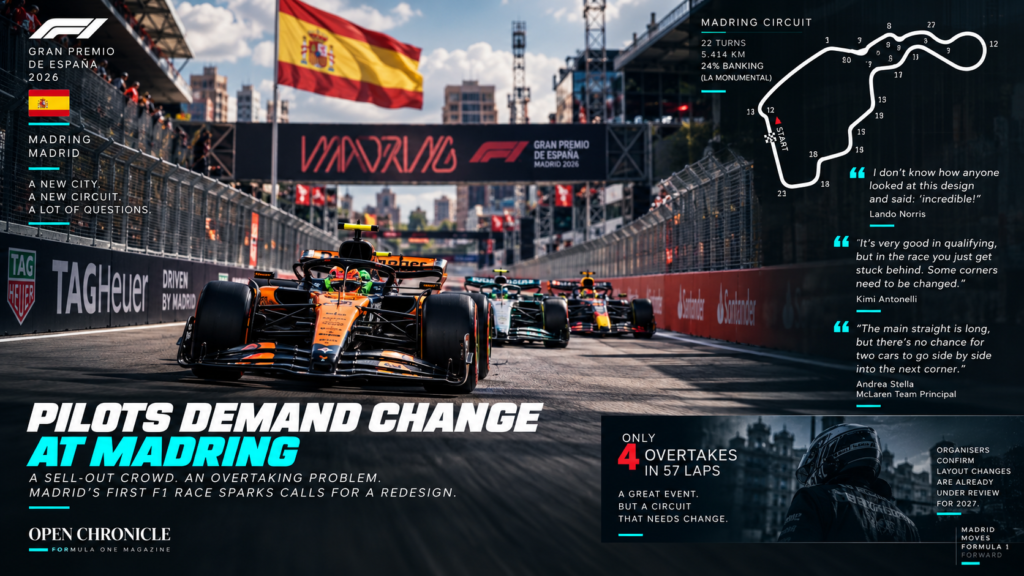
Madrid’s first Formula One weekend delivered packed grandstands, an impressive event atmosphere and a circuit that drivers found challenging over a single lap. But Sunday’s Spanish Grand Prix exposed Madring’s biggest weakness. Only four overtakes were recorded during the race, leaving drivers frustrated and prompting organisers to confirm that the FIA has already identified ways to modify the layout for 2027.
By Open Chronicle Formula One Magazine
Madrid succeeded in bringing Formula One back to the Spanish capital.
The racing was another matter.
The inaugural Grand Prix at Madring attracted nearly 353,000 spectators across the weekend, with the venue around IFEMA benefiting from strong public transport links and proximity to both central Madrid and the city’s airport. The circuit itself also provided a demanding qualifying challenge, with drivers praising aspects of its speed and technical difficulty.
Then came Sunday.
Across 57 laps, Formula One recorded only four overtakes, the lowest total of the first 14 Grands Prix of the 2026 season. Track position became overwhelmingly important, and much of the field spent the afternoon unable to convert a pace advantage into an actual pass.
The reaction from the drivers was clear.
Madring may be exciting to drive.
But in its current configuration, they believe it is not good enough for racing.
A Great Qualifying Circuit, a Difficult Racing Circuit
This distinction appeared repeatedly throughout the weekend.
Madring’s combination of walls, fast corners, changing gradients and the spectacular banked La Monumental created a genuine driving challenge.
Qualifying provided evidence of that.
Lando Norris took pole with a 1:31.824, beating Kimi Antonelli by only 0.011 seconds. Max Verstappen was just 0.140 behind.
The circuit demanded precision.
Mistakes carried consequences.
Finding the limit was difficult.
But producing a challenging qualifying lap and producing a circuit on which Formula One cars can race are two different design problems.
On Sunday, that difference became impossible to ignore.
Only Four Overtakes
The statistic that will follow Madring’s inaugural race is brutally simple.
Four overtakes.
For comparison, even Monaco, the circuit most frequently criticised for its limited passing opportunities, produced more overtaking during its 2026 Grand Prix.
The problem was not simply that overtaking was difficult.
Modern Formula One contains several circuits where passing requires patience.
The concern was that drivers frequently felt they had almost no realistic opportunity to attempt a move at all.
The expected principal passing opportunity around Turn 5 did not work as intended. The curved braking approach and configuration of the chicane made positioning a car alongside another particularly difficult.
Norris: The Layout Needs Work
Norris was among the most outspoken critics.
After starting from pole and controlling the early phase before the Virtual Safety Car changed his race, the McLaren driver questioned how some parts of the layout had reached their final form.
His criticism focused particularly on the final section.
Norris suggested eliminating Turns 18 and 19 and replacing that sequence with a longer straight leading into a much stronger braking opportunity. Reports from the post race discussion also indicate that he identified the second chicane as another area that could be reconsidered.
The underlying concept is straightforward.
Formula One cars need enough distance on the straight for a pursuing driver to establish a meaningful speed advantage.
Then they need a braking zone where two cars can realistically occupy different lines.
Without both elements, following closely does not necessarily produce overtaking.
Antonelli: Excellent for One Lap, Frustrating on Sunday
Race winner Antonelli reached a similar conclusion.
The Mercedes driver considered Madring enjoyable in qualifying conditions but much more restrictive during the Grand Prix.
That assessment matters.
Antonelli won the race.
His criticism therefore cannot easily be dismissed as frustration caused by a poor result.
The fundamental problem, according to the drivers, is that several parts of Madring do not provide sufficient space or geometry for two cars to fight through a corner.
Attempting a move therefore carries a high probability of contact.
When the potential reward is small and the collision risk is high, drivers naturally become less willing to attack.
Why a Long Straight Is Not Enough
Madring demonstrates an important principle of circuit design.
A long straight does not automatically create overtaking.
What happens after the straight can be just as important.
McLaren team principal Andrea Stella highlighted the problem around the end of the main straight.
Cars may have enough distance to approach one another, but if the following corner cannot realistically accommodate two cars side by side, the attacking driver has nowhere useful to complete the move.
This creates a false overtaking zone.
On a circuit map it appears promising.
On track it does not work.
The Turn 5 Problem
Turn 5 was intended to provide one of Madring’s principal passing opportunities.
In practice, the approach did not create the conventional heavy braking contest that engineers and drivers want from a major overtaking zone.
The braking phase is complicated by the geometry of the approach, while the chicane itself limits the available racing lines.
Autosport reported that this area is already one of the parts of the circuit being considered for modification.
This could become one of the most important changes before Formula One returns.
The circuit does not necessarily need overtaking opportunities everywhere.
It needs at least a few that genuinely work.
Verstappen Says Drivers Should Have Been Consulted Earlier
Max Verstappen raised a broader issue.
According to the Red Bull driver, the Formula One drivers were not meaningfully involved during the development of the Madrid layout.
He contrasted that process with Jeddah, where driver feedback contributed to changes.
His argument was not simply that drivers should be asked whether they like a circuit.
It was about timing.
Driver input becomes significantly more useful before construction reaches the point where changes become expensive or complicated.
Madring has one major advantage in this respect.
Much of the circuit is not permanently fixed in the same way as a traditional venue.
That gives organisers considerably more freedom to reconsider parts of the layout.
Bortoleto: Even the Drivers Were Bored
Gabriel Bortoleto delivered one of the more memorable assessments of the race, joking afterwards that even he had almost fallen asleep.
Other drivers also expressed frustration with the lack of action, including George Russell, Oliver Bearman and Alexander Albon.
The criticism was therefore not confined to one team or one part of the grid.
That is significant.
Drivers naturally disagree about circuits.
A car that performs well through one type of corner may struggle through another.
Personal preferences also differ.
But the post race concern at Madring centred overwhelmingly on the same issue.
Racing another car was too difficult.
The Problem Was Visible Beyond Formula One
There was another warning sign.
The difficulty was not restricted to the Formula One Grand Prix.
The Formula 2 and Formula 3 races also struggled to generate the level of passing expected from categories that can often produce extremely close racing.
That strengthens the argument that the problem was connected to the circuit itself rather than simply the aerodynamic characteristics of the 2026 Formula One cars.
If several categories encounter similar problems at the same venue, circuit geometry deserves serious attention.
Yet Madring Was Not a Complete Failure
It would be misleading to describe Madrid’s entire debut as unsuccessful.
The event itself achieved several important objectives.
Crowds were substantial.
Access to the circuit was comparatively straightforward for a major urban event.
The paddock and facilities were well received.
The location around IFEMA provides significantly more physical flexibility than Monaco.
And the circuit produced an intense qualifying challenge.
Some drivers also praised the track itself.
Pierre Gasly said he enjoyed its high adrenaline nature. Charles Leclerc was impressed by the grip available from such a new surface. Carlos Sainz described the layout as having character and a wide variety of corners, while Nico Hülkenberg characterised Madring as an extremely fast version of the kind of challenge normally associated with Monaco.
That distinction is important.
The objective is not necessarily to abandon Madring’s identity.
It is to make that identity produce better racing.
A Circuit Can Be Good to Drive and Bad to Race
Formula One sometimes treats these ideas as though they are interchangeable.
They are not.
A circuit can be exhilarating for a driver alone against the stopwatch.
Fast corners.
Walls.
Elevation.
Banking.
Precision.
Commitment.
All can create a memorable qualifying lap.
But racing introduces another requirement.
Two cars need to interact.
There must be places where a following driver can position the car differently.
There must be braking zones where the attacker can create overlap.
There must be enough usable track width for drivers to attempt alternative lines.
And ideally, a failed attack should not automatically destroy the following driver’s ability to remain close.
Madring succeeded at the first challenge.
Its debut suggests it has substantial work to do on the second.
Organisers Accept the Problem
Most importantly, the organisers are not pretending otherwise.
Madring director Luis García Abad confirmed after the race that the FIA has already provided guidance on how the circuit can be improved.
He said organisers are open to changing the layout before Formula One returns in 2027 and stressed that the venue has the space, infrastructure and capacity required to make modifications.
That is encouraging.
Madring is not Monaco.
Its limitations are not entirely dictated by centuries old streets, buildings and harbour infrastructure.
There is room to work.
Changes Could Come for 2027
No final revised layout has yet been formally approved.
That distinction matters.
But several areas are already being discussed.
The Turn 5 and Turn 6 section is an obvious candidate because it was supposed to provide a significant overtaking opportunity.
Other reported possibilities include creating a stronger braking challenge after La Monumental and reconsidering parts of the final sector. Norris’ proposal to remove Turns 18 and 19 represents one possible driver suggested direction rather than a confirmed redesign.
The final solution will require cooperation between Madring, Formula One and the FIA.
The Ideal Madring Overtaking Zone
The engineering objective should be relatively clear.
A successful overtaking zone generally needs a sequence something like this:
Corner allowing the following car to remain close
↓
Meaningful acceleration zone
↓
Long straight
↓
Slipstream opportunity
↓
Strong braking zone
↓
Enough width for alternative lines
↓
Corner geometry that allows two cars to coexist
Madring possesses several pieces of that sequence.
The problem is connecting them effectively.
La Monumental Should Remain Part of the Identity
One element that should not be confused with the overtaking problem is La Monumental.
The spectacular banked Turn 12 has already become Madring’s defining visual feature.
Its approximately 24 percent banking and sustained load make it one of the most distinctive corners on the Formula One calendar.
It provides identity.
It provides technical difficulty.
It provides spectacle.
The challenge is therefore not to transform Madring into a collection of long straights and hairpins.
Formula One needs circuits with personality.
The objective should be to preserve the distinctive elements while introducing strategic locations where drivers can genuinely fight.
Madrid Has an Advantage Monaco Does Not
Comparisons with Monaco appeared repeatedly after the race.
But there is a crucial difference.
Monaco has extremely limited options.
Its circuit exists within one of the most constrained urban environments imaginable.
Madrid has space.
García Abad explicitly emphasised that point when discussing potential changes.
The organisers know the circuit will need to be reconstructed for the next event anyway.
That creates an opportunity.
Instead of accepting poor overtaking as an unavoidable feature of Madring, the 2027 edition can become a revised version based on actual racing evidence.
Formula One Now Has Something More Valuable Than Simulation
Before September 2026, Madring existed largely through design models, simulation and testing.
Now its designers possess something much more valuable.
A complete Formula One weekend.
They know where drivers struggled to follow.
They know where overtaking attempts failed.
They have GPS data.
They have speed traces.
They have driver feedback.
They have F2 and F3 evidence.
They know how the circuit behaved as grip evolved.
They know where cars could race and where they could not.
The first Grand Prix therefore becomes a huge real world engineering test.
The important question is what Madring does with the results.
From Criticism to Development
New circuits do not have to remain exactly as they were at their first Grand Prix.
Miami is one example of a modern venue that underwent modifications after its opening events.
Madrid now has the same opportunity.
The organisers have already acknowledged the problem.
The FIA has identified possible improvements.
Drivers are providing suggestions.
And because significant portions of Madring are reconstructed for the event, physical changes are more realistic than they would be at many traditional street circuits.
That turns the criticism into useful development information.
Madring’s First Verdict
Madrid’s first Formula One weekend produced two very different conclusions.
As an event, there was much to admire.
Huge attendance.
Strong atmosphere.
Modern facilities.
Excellent accessibility.
A spectacular urban setting.
A challenging qualifying circuit.
As a race track, however, the first version of Madring failed to produce enough opportunities for drivers to compete directly against one another.
Four overtakes across an entire Grand Prix is difficult to ignore.
The drivers certainly did not.
And neither, apparently, have the organisers.
Open Chronicle Verdict
Madring does not need to be condemned after one Grand Prix.
But neither should Formula One dismiss the criticism simply because the venue delivered commercially and attracted more than 350,000 spectators.
The first Madrid weekend demonstrated that event spectacle and racing spectacle are not the same thing.
Madrid succeeded at the first.
The circuit struggled badly with the second.
There is also reason for optimism.
The fundamental ingredients are present.
Madring has challenging corners.
It has elevation.
It has speed.
It has La Monumental.
It has a strong location and substantial infrastructure.
Most importantly, it has something Monaco does not.
Space to change.
The FIA has already identified areas for improvement, the organisers have publicly accepted that changes should be considered, and the drivers have supplied the most valuable feedback possible after experiencing the circuit in genuine racing conditions.
The first Madring showed that Madrid can build a Formula One event.
The task for 2027 is different.
Build a Formula One race track where the cars can actually race.