
By Open Chronicle with agencies
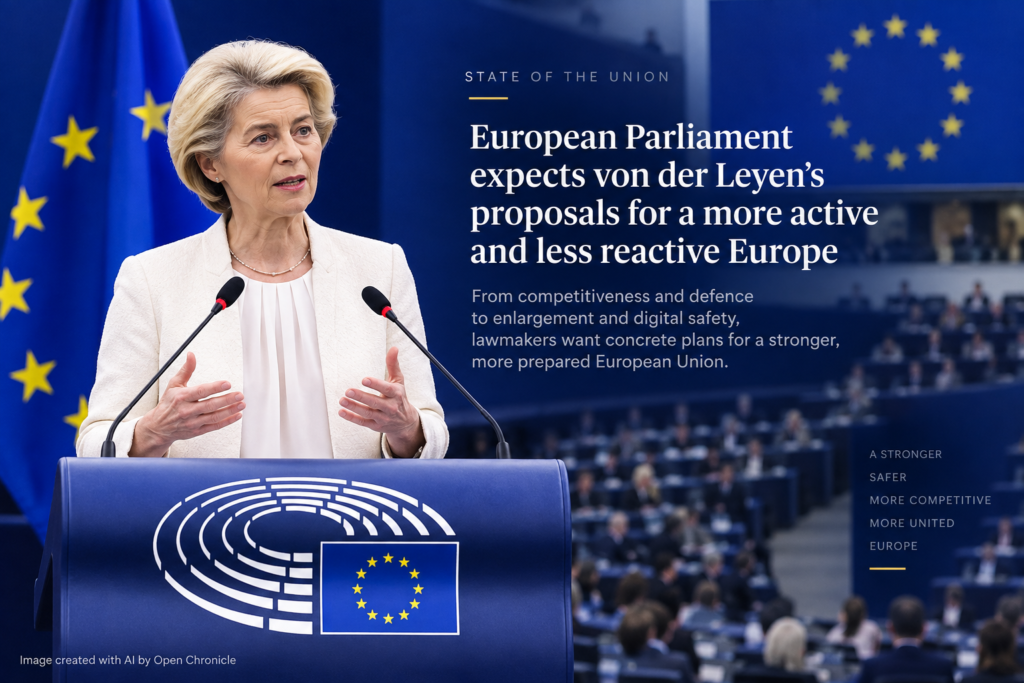
The European Parliament is looking to European Commission President Ursula von der Leyen’s State of the Union address for more than a review of Brussels’ recent record. Lawmakers want concrete proposals for a European Union that anticipates crises rather than simply responding to them.
Ahead of the State of the European Union debate, Alfredo Sousa de Jesus, head of the European Parliament Liaison Office in Portugal, stressed that the annual exercise should be understood as part of Parliament’s scrutiny of the European Commission.
The address provides an opportunity for the Commission to explain how it intends to turn political priorities into legislation, while members of the European Parliament can question the direction of the EU executive and assess whether previous commitments have been fulfilled.
More than a speech
According to Sousa de Jesus, the European Parliament does not regard the State of the Union simply as a presidential speech, but as a political debate.
Parliament has powers to scrutinise the Commission, both in the process through which the EU executive is appointed and in monitoring how it performs its responsibilities.
The State of the Union therefore represents the culmination of a broader political process in which the Commission is expected to translate priorities discussed and expressed by Parliament throughout the year into specific proposals.
One example concerns the protection of children online. Parliament has repeatedly called for social media platforms to provide a healthier and safer environment for younger users, creating an expectation among lawmakers that the Commission will address the issue in its forthcoming agenda.
Competitiveness, defence and enlargement
The European Parliament is also expecting significant proposals in several areas that are increasingly shaping the EU’s strategic agenda.
Economic competitiveness is among them, alongside efforts to strengthen Europe’s defence capabilities and defence industrial base.
Enlargement is another major issue as the bloc considers its relationship with candidate countries and the possibility of admitting new members in the coming years.
Lawmakers are also looking for progress on trade agreements that can provide the EU with stable and credible international partnerships, as well as measures involving banking and investment, migration and security.
Taken together, these priorities reflect a broader debate over whether Europe has the economic, political and security instruments required to operate more independently in an increasingly uncertain international environment.
Parliament wants Europe to anticipate crises
A central expectation is that the Commission should move beyond policies designed primarily as responses to emergencies.
Sousa de Jesus said Parliament wants a Union that is better prepared to identify and anticipate future crises.
The objective, he said, echoes European Parliament President Roberta Metsola’s argument that Europe needs a vision based on major advances rather than a succession of isolated measures in individual sectors.
The challenge for von der Leyen will therefore be to demonstrate how that ambition can be converted into practical policies.
Parliament and Commission do not always agree
Although the European Parliament and Commission share priorities in several areas, their positions are not identical.
Parliament has mechanisms allowing lawmakers to monitor whether the Commission is delivering promised initiatives and introducing the legislation it previously committed to proposing.
According to figures cited by Sousa de Jesus, the Commission has announced more than 400 proposals since the beginning of its current mandate. Around 300 have already been formally presented.
Of those, more than 100 have completed the legislative process and have become law, while roughly 200 are being negotiated between the European Parliament and the Council of the European Union, the two institutions involved in adopting most EU legislation.
Around 20 proposals remain particularly difficult, with negotiations yet to produce sufficient convergence between the institutions.
A test of Europe’s direction
The State of the Union debate will consequently serve as both an assessment of the Commission’s record and a preview of the political agenda ahead.
For Parliament, the underlying question is increasingly strategic: whether the European Union can become more capable of shaping events rather than waiting for crises to determine its priorities.
Von der Leyen’s proposals on competitiveness, defence, enlargement, trade, migration, investment and security will offer an indication of how the Commission intends to answer that challenge.