
By Open Chronicle with agencies
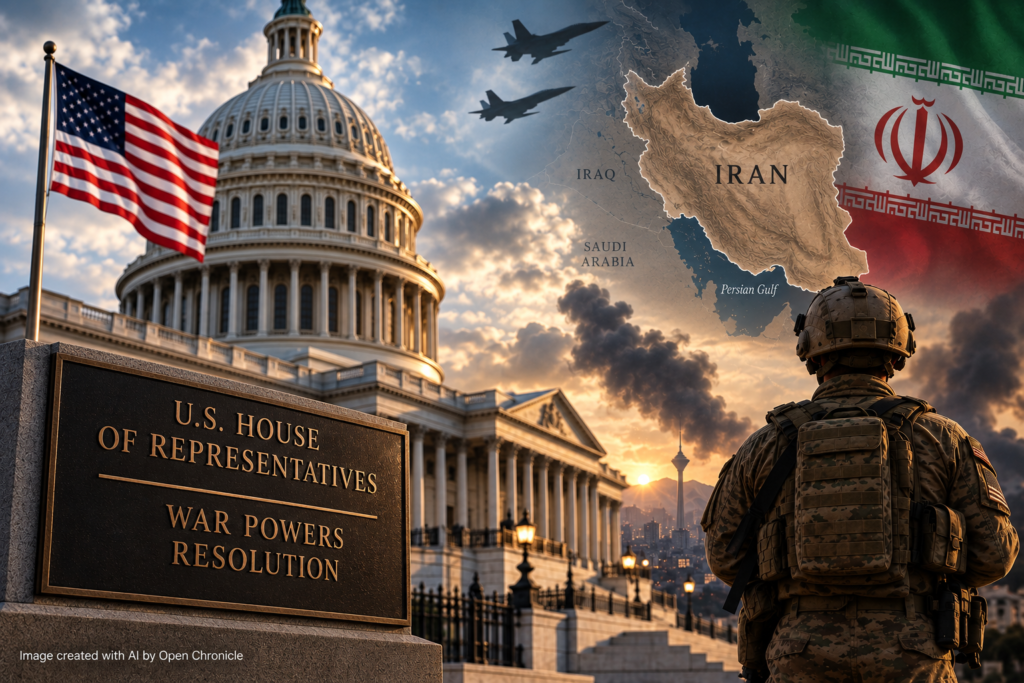
The US House of Representatives has approved a war powers resolution directing President Donald Trump to remove American forces from hostilities with Iran, marking the latest congressional effort to challenge the administration’s conduct of a conflict now approaching seven months.
The House passed H. Con. Res. 93 late Tuesday by 220 votes to 204, with seven Republicans joining Democrats in supporting the measure. The resolution was introduced by Democratic Representative Seth Moulton of Massachusetts.
It is the third war powers resolution approved by the House since the United States launched military operations against Iran on February 28. Previous congressional attempts to restrict the campaign have not resulted in an end to US military operations.
Seven Republicans join Democrats
The vote demonstrated a degree of bipartisan concern over the duration of the conflict and the scope of presidential war powers.
The seven Republicans supporting the measure were Thomas Massie of Kentucky, Brian Fitzpatrick of Pennsylvania, Warren Davidson of Ohio, Tom Barrett of Michigan, Mariannette Miller-Meeks and Zach Nunn of Iowa, and Nancy Mace of South Carolina.
Moulton, a former Marine officer who served in Iraq, argued that Congress should assert its constitutional role over sustained military action. His resolution calls for US forces to be removed from hostilities against Iran unless military action has been specifically authorized by Congress.
The vote does not by itself bring US operations to an end. Previous House resolutions have failed to reach the president’s desk, and any measure that ultimately reaches Trump could face a presidential veto.
Nearly seven months of conflict
The vote comes as lawmakers increasingly focus on the human and economic costs of the Iran campaign.
Representative Gregory Meeks, the ranking Democrat on the House Foreign Affairs Committee, said the conflict was approaching 200 days and argued that the administration had failed to achieve its stated objectives. He cited 19 US service members killed and more than 750 wounded, as well as higher fuel prices and tens of billions of dollars in military expenditure. Those casualty and policy assessments were presented by Meeks as part of his argument for ending the conflict.
Separately, the Congressional Budget Office has estimated that military operations against Iran cost approximately $38 billion during the first five months, with continued operations adding roughly $2 billion to $3 billion per month.
The economic consequences have also become part of the political debate as disruption around the Strait of Hormuz has contributed to higher energy prices.
Republicans defend continued military operations
Supporters of the administration argue that Iran continues to pose a threat to American forces and interests in the Middle East and that restricting the president’s military options could weaken the US response.
Republican Representative Brian Mast, chairman of the House Foreign Affairs Committee, questioned which American military capabilities supporters of the resolution wanted withdrawn from the region. He described Iran as an ongoing threat to the United States and defended the administration’s approach.
The disagreement reflects a broader constitutional dispute over the division of war powers between Congress and the presidency.
The Constitution gives Congress the power to declare war, while the president serves as commander in chief. The 1973 War Powers Resolution was intended to establish limits on prolonged military deployments undertaken without explicit congressional authorization, although successive administrations of both parties have disputed aspects of its application.
Iran war moves deeper into US domestic politics
Tuesday’s vote comes less than two months before the US midterm elections, increasing the political significance of the conflict.
Fuel prices, inflation, military spending and the duration of the Iran campaign are becoming prominent issues as lawmakers return to their districts to campaign for control of Congress.
For Democrats and the Republicans who backed Moulton’s resolution, the vote was an attempt to reassert Congress’s authority over an increasingly prolonged military campaign. The administration and its congressional allies, meanwhile, maintain that Iran remains a security threat requiring continued American military flexibility.
With the House now having voted three times to restrict or end US involvement, the dispute over Iran has become not only a question of American strategy in the Middle East, but also a renewed test of the constitutional balance between Congress and the White House.