
By Open Chronicle with agencies
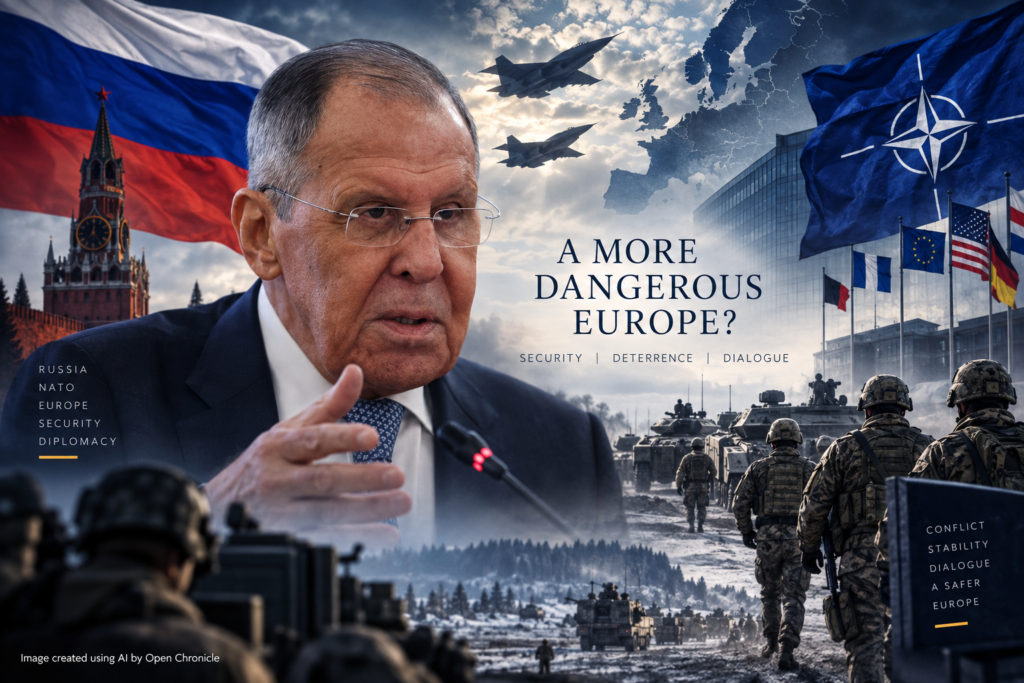
Russian Foreign Minister Sergey Lavrov has accused Western governments of preparing for a military confrontation with Russia while promoting what he described as a “myth” that Moscow poses a threat to Europe.
Speaking in Moscow on Thursday at the opening of the fourth Congress of the International Russophile Movement, Lavrov said Russia was capable of responding to external security challenges and accused Western political elites of using fears about Russia to justify their defence policies.
The comments come as European governments accelerate defence spending and military preparedness amid the continuing war in Ukraine and concern about Russian military and hybrid activity. European leaders generally present those measures as deterrence and preparation against potential aggression, rather than preparations to initiate a war with Russia.
Lavrov accuses Western governments of preparing for conflict
Lavrov argued that political leaders across much of the West were portraying Russia as an increasingly serious security threat while simultaneously expanding their own military capabilities.
“Today, the ruling circles and elites of most Western countries are promoting a myth about a threat emanating from Russia, actively preparing for war against our country,” Lavrov said.
He also accused Western governments of condemning Moscow for undermining European values, rejecting that criticism and questioning the principles European governments claim to defend.
Lavrov said Russia would find ways to respond to challenges affecting its security and development.
His assertion that Western states are preparing to wage war against Russia is the Russian government’s characterization of Western defence policies, not an independently established fact.
Europe strengthens its defences
Lavrov’s comments come against the backdrop of significant changes in European defence policy.
Russia’s invasion of Ukraine has led many European countries to increase military spending, rebuild weapons inventories and invest in air defence, drones, ammunition and other capabilities.
Uncertainty over the future scale of the U.S. military presence in Europe has added another factor. The Pentagon is reviewing the American force posture on the continent, where roughly 80,000 U.S. troops are currently stationed.
European Commission President Ursula von der Leyen has also proposed new EU security mechanisms and investments in strategic military capabilities, including missile defence, satellites and other systems. Her proposals have been framed as strengthening European deterrence and the continent’s ability to respond to security threats.
That provides an important distinction from Lavrov’s description. European and NATO governments say their military buildup is defensive and intended to deter Russia, while Moscow portrays the same developments as evidence of Western militarisation directed against it.
Lavrov draws distinction between Washington and Europe
Despite his criticism of the West, Lavrov drew a notable distinction between the United States and European governments.
He said American officials remained willing to communicate with Moscow even when the two sides held fundamentally different positions.
“There is an important difference between the US and European elites. They are ready to talk,” Lavrov said, adding that dialogue remained valuable even when positions were “diametrically opposed.”
Lavrov said Russia remained prepared for serious discussions with foreign governments willing to engage substantively.
He argued that officials did not need to travel to Moscow merely to repeat criticism of Russia, saying that Moscow wanted meaningful negotiations rather than meetings centred on public condemnation.
Moscow says dialogue has produced little change
Lavrov nevertheless acknowledged that continued contacts between Moscow and Washington have not produced a significant improvement in relations.
He said Russian and U.S. officials remain in contact at several levels, including communication between the two presidents and between Lavrov and U.S. Secretary of State Marco Rubio.
According to Lavrov, working groups dealing with the war in Ukraine have also maintained contacts. But he said there had been no “material effect” in restoring broader relations between the two countries and that he did not expect an immediate breakthrough.
The combination of continued diplomatic contacts and unresolved strategic disagreements illustrates the complicated state of relations between Washington and Moscow.
Competing narratives over European security
Lavrov’s remarks also underline the widening divide between Russian and European interpretations of the continent’s security environment.
Moscow argues that NATO expansion, European rearmament and Western military support for Ukraine threaten Russian security.
European governments and NATO members, by contrast, point to Russia’s full scale invasion of Ukraine, drone incidents, cyberattacks and other forms of hybrid activity as reasons for strengthening their own defences.
Polish Prime Minister Donald Tusk said Thursday that intelligence assessments indicated Russia could be preparing hybrid actions involving drones and missiles against NATO countries supporting Ukraine.
These competing narratives have become increasingly central to the confrontation between Russia and Europe.
For Moscow, Europe’s expanding military capabilities are evidence of an increasingly hostile Western policy. For European governments, those same investments are presented as necessary deterrence against the possibility of further Russian aggression.
Dialogue amid growing military tension
Lavrov’s comments therefore carried two messages.
The first was confrontational: Russia believes Western governments are increasingly preparing their societies and armed forces for a potential conflict with Moscow.
The second was diplomatic: Russia says it remains willing to maintain communication, particularly with Washington, even when fundamental disagreements remain unresolved.
The gap between those messages reflects the broader state of European security in 2026. Military preparations are accelerating on both sides while diplomatic channels remain open.
Whether those channels can prevent the increasingly adversarial relationship between Russia and the West from deteriorating further remains one of the central security questions facing Europe.