
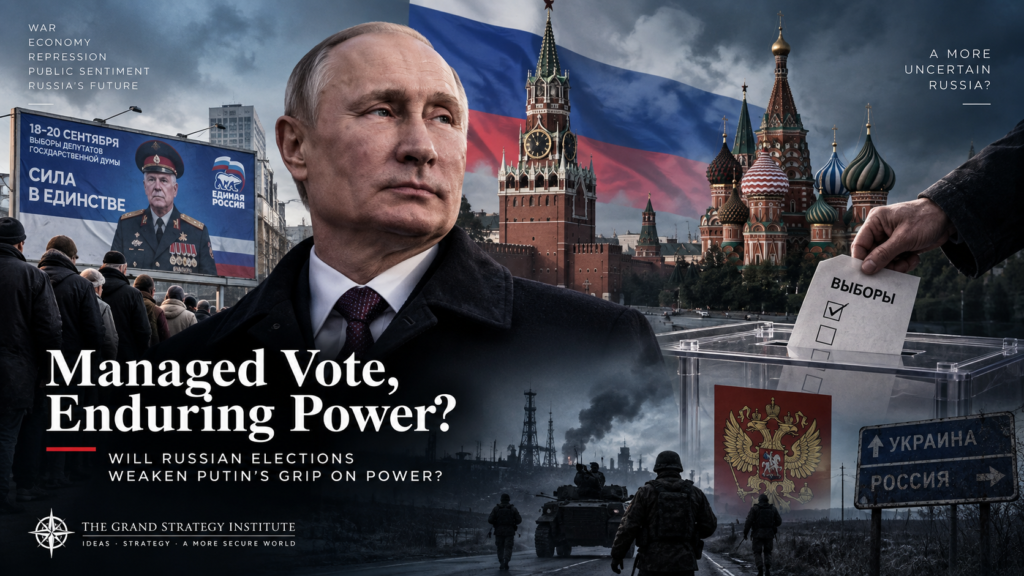
United Russia is expected to retain control of parliament when Russians vote from 18 to 20 September. The more important question is not who wins, but how much repression, exclusion and electoral management the Kremlin requires to demonstrate that wartime Russia remains politically stable.
By The Grand Strategy Institute Research Division
Grand Strategy Analysis | 17 September 2026
Russia will begin voting on 18 September in its first parliamentary election since the full-scale invasion of Ukraine transformed the country’s politics, economy and relationship with the outside world.
There is little uncertainty about the broad institutional outcome.
The ruling United Russia party is expected to remain dominant in the 450-seat State Duma. Russia’s other established parliamentary parties largely operate within a political system that accepts the central authority of President Vladimir Putin and, on major questions, generally supports the Kremlin’s agenda. Genuine anti-war opposition has been heavily restricted.
Putin himself has given the election a significance extending far beyond parliament.
In an address ahead of voting, he explicitly connected participation with Russia’s war in Ukraine, presenting the ballot as evidence of national unity and support for Russian forces.
That makes the election strategically interesting.
The central question is not whether Putin will lose control of the Duma.
There is currently little evidence that he will.
The more revealing question is this:
How much political engineering does the Kremlin now require to produce the appearance of overwhelming consent?
That distinction matters because authoritarian political systems rarely become vulnerable simply because an opposition party suddenly wins an election.
Their problems often begin elsewhere.
When genuine enthusiasm becomes harder to manufacture.
When coercion becomes more necessary.
When elites become less certain.
When economic sacrifices increase.
When citizens obey but cease to believe.
Russia may be approaching a period in which those distinctions matter considerably more than the official percentage printed beside United Russia’s name.
This Is Not Primarily an Election About Parliament
Russia will elect 450 members of the State Duma during three days of voting from 18 to 20 September.
Formally, this is a legislative election.
Strategically, it serves several additional functions.
It measures the Kremlin’s capacity to mobilise voters.
It demonstrates control over regional political machines.
It tests the effectiveness of state media.
It provides a mechanism for distributing positions among loyal political constituencies.
It gives the political system a constitutional ritual through which continuity can be demonstrated.
And during wartime, it provides something particularly valuable:
a claim to political legitimacy.
Putin has made this function unusually explicit.
He told Russians that voting would demonstrate that millions stand behind Russian soldiers and show that the country cannot be divided or intimidated by outside pressure.
The Kremlin is therefore asking the election to demonstrate more than support for United Russia.
It is asking it to demonstrate the political resilience of wartime Russia.
That raises the stakes.
United Russia Does Not Need to Be Popular in the Conventional Sense
One of the mistakes frequently made when analysing authoritarian political systems is applying the electoral logic of competitive democracies.
A governing party in Britain, Germany or France needs sufficient public support to defeat competing parties under meaningful electoral uncertainty.
United Russia operates under fundamentally different conditions.
The Russian political system is tightly controlled, genuine opposition is limited, and the State Duma has consistently supported the Kremlin’s central policy initiatives. Reuters describes United Russia as widely expected to maintain its dominance.
The principal parliamentary alternatives do not constitute an opposition coalition capable of replacing the government.
The Communist Party, LDPR, Just Russia and New People offer different political identities and sometimes criticise specific policies, but they broadly operate within the boundaries of the existing political system.
This is commonly described as systemic opposition.
It allows disagreement.
But only within limits that do not threaten the fundamental architecture of power.
The result is political pluralism without normal alternation of power.
The Anti-War Problem
The war has made those boundaries considerably more important.
Yabloko remains one of the few registered political organisations inside Russia openly associated with opposition to the war.
Its national prospects were already limited.
Yet most of its candidates have been prevented from participating following an August Supreme Court ruling concerning alleged violations of electoral rules. Reuters reported that only a small number of Yabloko candidates remain in individual constituencies, including 24-year-old Polina Lermant in Moscow.
The political significance is larger than Yabloko’s electoral strength.
A weak anti-war party would be unlikely to threaten United Russia’s parliamentary control.
But it could provide something else.
A visible mechanism for measuring dissent.
That is potentially uncomfortable for the Kremlin.
A vote for an anti-war candidate does not need to win a constituency to matter politically.
It can reveal how many citizens are prepared to register opposition publicly.
Suppressing that option therefore reduces uncertainty.
It also reduces information.
Elections Tell Authoritarian Governments Things
This produces one of the paradoxes of managed elections.
Even authoritarian governments need political information.
They need to know which governors are effective.
Which regions are dissatisfied.
Which social groups are becoming alienated.
Whether unpopular policies are producing dangerous resentment.
Whether local elites can still mobilise supporters.
Whether economic deterioration is changing political behaviour.
Semi-competitive elections can provide that information.
But the more tightly the political system controls the ballot, the less reliable the information becomes.
If voters are afraid to speak honestly to pollsters, opinion surveys become less useful.
If opposition parties are removed, election results become less informative.
If turnout is administratively manufactured, turnout ceases to measure enthusiasm.
If official results are heavily engineered, they stop functioning as a diagnostic instrument.
The Kremlin can therefore produce political certainty at the cost of understanding the society it governs.
That is a genuine strategic vulnerability.
The Difference Between Support and Compliance
This distinction becomes particularly important after more than four years of full-scale war.
Political stability does not necessarily require enthusiastic support.
It can rest on passive acceptance.
Many Russians may support the war.
Others may support Putin while wanting the war to end.
Some may oppose the war but believe political resistance is futile.
Others may avoid politics entirely.
Still others may prioritise economic security, family interests or personal survival over ideological questions.
These attitudes are politically different.
But under a tightly controlled electoral system, they can produce exactly the same observable behaviour:
compliance.
The difficulty for the Kremlin is determining when compliance begins replacing conviction.
Russia’s War Is Becoming Harder to Keep Distant
For much of the conflict, the Kremlin sought to insulate ordinary Russian life from the battlefield.
The war could remain geographically distant.
Military casualties could remain concentrated among soldiers and their families.
Higher defence spending could stimulate selected industries and regions.
State media could portray the conflict as controlled.
That insulation has become harder to maintain.
Ukrainian long-range strikes have increasingly brought the war to Russian energy infrastructure and other targets far from the battlefield.
Economic pressures have accumulated.
Labour shortages remain significant.
Military expenditure consumes enormous resources.
The fiscal position has deteriorated.
And the possibility of further mobilisation remains politically sensitive.
The physical distance between Moscow and the battlefield has not changed.
The political distance has.
The Mobilisation Question Matters Enormously
Few issues illustrate the Kremlin’s political constraints better than mobilisation.
Russia’s September 2022 partial mobilisation produced a visible domestic shock.
Hundreds of thousands of men were called up.
Others left Russia.
The episode demonstrated that Russians could tolerate a distant war differently from a war that entered directly into family life.
Since then, Moscow has relied heavily on financial incentives, contract recruitment and other mechanisms to sustain manpower.
Rumours of another large mobilisation therefore matter even when they remain unconfirmed.
Ukraine has claimed that Russia could launch another mobilisation after the election. Moscow has denied that such mobilisation is planned. Those competing claims should not be treated as established evidence that a new mobilisation decision has already been taken.
But the political sensitivity itself is revealing.
Mobilisation changes the distribution of war costs.
Money can be hidden inside budgets.
Military casualties can remain abstract for families without soldiers.
Inflation can be blamed on multiple factors.
A mobilisation order is different.
It transforms the state’s demand from:
support the war
into:
participate personally in the war.
That is a much more demanding political contract.
The Economy Is Becoming Part of the Political Battlefield
Russia is not facing imminent economic collapse.
That distinction is important.
The Russian state retains substantial resources.
It continues to finance military operations.
Its defence industrial base has expanded significantly.
Energy exports continue generating revenue.
But the relevant political question is not whether Russia can continue functioning.
It is what maintaining the war increasingly costs.
The Grand Strategy Institute has previously described this as the gradual erosion of strategic choice.
More resources allocated to defence mean fewer resources available elsewhere.
High borrowing costs constrain investment.
Labour shortages intensify competition between military and civilian sectors.
Ukrainian attacks create additional costs for protecting and repairing infrastructure.
Fuel disruption is particularly politically sensitive because Russia is one of the world’s great energy producers.
When citizens of a major petroleum power encounter shortages or higher fuel costs, the contradiction becomes visible in everyday life.
Economic statistics become political experience.
Russians Do Not Experience the State Budget. They Experience Daily Life.
This distinction is essential when evaluating regime stability.
Most citizens do not assess national power by examining defence-production statistics.
They assess conditions through salaries.
Prices.
Jobs.
Petrol.
Housing.
Pensions.
Consumer credit.
Availability of goods.
And whether their children might be mobilised.
An economy can therefore remain technically functional while political dissatisfaction increases.
Conversely, economic difficulty does not automatically generate organised political opposition.
Russia has experienced significant economic crises before without regime collapse.
The question is whether economic pressure begins interacting with other sources of dissatisfaction.
War fatigue.
Casualties.
Mobilisation fears.
Elite tensions.
Regional inequality.
Political repression.
Declining confidence in institutions.
Individually, these pressures may remain manageable.
Together, they can become more consequential.
The Kremlin’s Greatest Advantage Is the Absence of an Alternative
This remains perhaps Putin’s most important source of political strength.
There is currently no nationally organised opposition movement inside Russia capable of contesting power on equal terms.
Alexei Navalny is dead.
Many opposition figures are imprisoned, exiled or politically marginalised.
Independent media have been heavily constrained.
Civil society organisations face extensive restrictions.
Anti-war activism can carry severe legal consequences.
The remaining parliamentary parties operate inside the established political system.
This matters because dissatisfaction alone does not remove governments.
Political change requires organisation.
Leadership.
Coordination.
Information.
Resources.
Networks.
And usually some belief among participants that collective action has a realistic possibility of success.
The Kremlin has spent years systematically weakening precisely those mechanisms.
That gives Putin considerable resilience even if genuine enthusiasm declines.
Repression Can Demonstrate Strength and Weakness Simultaneously
There is a tempting but simplistic conclusion that increasing repression proves a regime is becoming weak.
Not necessarily.
Repression can work.
It can destroy organisations.
It can deter protesters.
It can frighten potential challengers.
It can increase the personal cost of dissent.
A government capable of enforcing repression across a vast country is demonstrating considerable institutional power.
But there is another side.
A political system that once tolerated a marginal opponent but later decides that opponent is unacceptable may be revealing a reduced tolerance for uncertainty.
The treatment of Yabloko is relevant in this respect.
The party was never positioned to overthrow Putin through the 2026 parliamentary election.
Its importance lay in offering an identifiable anti-war political position.
Restricting that position therefore suggests that the Kremlin considers even limited public measurement of anti-war sentiment politically undesirable.
That does not prove imminent instability.
It does indicate heightened sensitivity.
Watch the Numbers Behind the Number
The headline after the election will almost certainly concern United Russia’s result.
That may not be the most interesting figure.
Several other indicators deserve attention.
Turnout.
Can the Kremlin generate meaningful participation without extraordinary administrative mobilisation?
United Russia’s official vote share.
How large a victory does the system believe it needs to demonstrate?
Regional variation.
Do major cities, economically pressured regions or areas heavily affected by military recruitment behave differently?
Spoiled ballots and protest voting.
Where meaningful alternatives are absent, unconventional voting behaviour can provide limited evidence of dissatisfaction.
Results for permitted Yabloko candidates.
They will not determine control of parliament, but local performance could provide clues about the constituency for explicitly anti-war politics.
The gap between official enthusiasm and observable public mood.
This is harder to quantify, but politically important.
And perhaps most importantly:
what happens after the election.
The Day After May Matter More Than Election Day
Authoritarian elections sometimes function as political checkpoints.
Difficult decisions can be postponed until after voting.
Economic reforms.
Tax changes.
Military measures.
Personnel changes.
Mobilisation.
Budget cuts.
Repression.
The Kremlin has denied that another mobilisation is planned, and there is no verified basis at present for treating post-election mobilisation as decided.
But Russians themselves will watch closely.
If unpopular measures follow quickly after a highly managed election, the relationship between voting and political consent could weaken further.
The Kremlin wants the election to demonstrate legitimacy.
Using the resulting mandate immediately to demand greater sacrifices would test how much legitimacy actually exists.
Putin Has Turned the Election Into a War Referendum
This may be the most consequential strategic choice.
Putin could have presented the parliamentary election as administrative continuity.
Instead, he explicitly connected participation with the war and national unity.
He said voting would demonstrate support for Russian soldiers and provide a collective response to those he said seek to weaken the country.
Politically, the logic is understandable.
If United Russia produces a large victory, the Kremlin can portray the result as evidence that Russian society remains united behind the state despite sanctions, casualties and economic pressure.
But linking the election to the war also creates a measurement problem.
The more the Kremlin describes the result as proof of popular support for the conflict, the more important the credibility of that result becomes.
A manufactured mandate can still perform political functions domestically.
But it cannot completely eliminate the underlying question:
Does the government still know what Russians actually think?
The Authoritarian Information Problem
This may ultimately be more important than the ballot itself.
Authoritarian governments frequently suffer from what political scientists describe as an information problem.
Citizens conceal preferences.
Officials tell superiors what they want to hear.
Regional authorities inflate achievements.
Opinion surveys become distorted by fear.
Media suppress bad news.
Bureaucracies hide failures.
Political leaders therefore risk receiving increasingly inaccurate information.
The stronger the repression, the greater the potential distortion.
This creates a paradox at the centre of highly centralised government.
The leader can become more powerful while becoming less informed.
Putin may therefore emerge from the election with overwhelming institutional control and simultaneously possess a less reliable picture of genuine public sentiment.
Those conditions are not contradictory.
What Would Genuine Weakening Look Like?
An unexpectedly low United Russia vote would attract attention.
But Putin’s political vulnerability would become substantially more significant only if public dissatisfaction began connecting with other components of regime stability.
Several would matter.
Elite fragmentation
Putin’s system depends on cooperation among security institutions, political administrators, economic elites and regional authorities.
Serious fractures inside those networks would matter far more than isolated public criticism.
Security-service hesitation
The regime’s coercive capacity remains central.
Mass protest becomes much more dangerous to authoritarian governments when security forces become unwilling or unable to enforce political decisions.
There is currently no clear evidence of such systemic hesitation.
Organised opposition
Private dissatisfaction becomes politically consequential when organisation converts it into collective action.
Russia’s opposition infrastructure remains severely weakened.
Fiscal stress
A state that can continue paying soldiers, security personnel, pensioners, public employees and strategic industries retains enormous stabilising capacity.
A severe fiscal crisis would change that equation.
Military failure
Battlefield developments matter most politically when they become impossible to reconcile with the government’s strategic narrative.
A succession problem
Highly personalised political systems can appear extraordinarily stable while the leader remains capable of arbitrating between competing elites.
Succession can expose tensions previously suppressed by personal authority.
None of these conditions is currently demonstrated by the parliamentary election itself.
That is why predicting Putin’s imminent political collapse from declining enthusiasm would be analytically unsound.
The Election Could Weaken Putin Without Threatening His Rule
This is perhaps the most important distinction.
Political power is not binary.
Putin does not need to be either completely secure or about to fall.
He can remain firmly in control while his political environment becomes less favourable.
He can control parliament while public enthusiasm declines.
He can suppress opposition while the cost of suppression rises.
He can finance the war while economic flexibility deteriorates.
He can prevent protest while private anxiety grows.
He can dominate the elite while becoming increasingly dependent on security institutions.
In this sense, the election could reveal erosion without transition.
That is strategically important even if it produces no immediate change of government.
Elections in Authoritarian Systems Are About Elites Too
The public is only one audience.
Russian officials will be watching.
Governors will watch regional results.
Security officials will watch protest activity.
Business leaders will watch economic policy after voting.
Potential successors will watch personnel movements.
The Kremlin will watch all of them.
An overwhelming United Russia victory reinforces the message that Putin remains the uncontested centre of the political system.
But if maintaining that image requires increasingly visible intervention, elites may privately draw a different conclusion.
Authoritarian politics often becomes dangerous not when everybody suddenly opposes the leader, but when influential actors begin wondering whether everybody else still supports him.
That is why perceptions of inevitability matter.
Putin’s power depends partly upon the widespread assumption that there is no viable alternative to Putin.
GSI Strategic Assessment
The Grand Strategy Institute assesses that the September 2026 State Duma election is unlikely by itself to weaken Vladimir Putin’s immediate institutional control over Russia.
United Russia is widely expected to retain dominance in the 450-seat parliament, genuine political competition remains severely constrained, and no organised national opposition currently possesses the institutional capacity to challenge the Kremlin for power.
The election nevertheless matters as an indicator of the changing political environment surrounding Putin.
First, the principal uncertainty concerns the management of the result rather than control of parliament.
The degree of mobilisation, exclusion and political intervention required to generate the desired outcome may reveal more than the headline result.
Second, Putin has explicitly linked the election to the Ukraine war.
This allows the Kremlin to present a strong result as evidence of national unity but also ties electoral legitimacy more directly to the conflict.
Third, the restriction of anti-war political participation reduces the possibility of measuring genuine opposition to the conflict.
Yabloko remains active in limited constituencies, but most of its candidates were excluded following the Supreme Court ruling.
Fourth, declining enthusiasm should not be confused with imminent regime instability.
Passive acceptance can sustain authoritarian systems for long periods, particularly where organised alternatives have been dismantled.
Fifth, war fatigue becomes strategically important when combined with personal sacrifice.
Mobilisation, casualties, fuel disruption and declining household economic security have greater political potential than abstract geopolitical disagreement.
Sixth, Russia’s economy remains capable of sustaining the state and war effort, but increasing military expenditure reduces policy flexibility.
The relevant risk is cumulative pressure rather than sudden economic collapse.
Seventh, Putin retains the decisive institutional advantages.
The security apparatus remains loyal, organised opposition is weak, parliament is controlled and state media remain powerful.
Eighth, greater repression can indicate both coercive strength and political sensitivity.
The exclusion of marginal opposition should therefore neither be dismissed nor interpreted automatically as evidence of regime collapse.
Ninth, the Kremlin faces an increasingly serious information problem.
The more tightly elections, polling, media and public expression are controlled, the harder it becomes for political leaders to distinguish genuine support from compliance.
Tenth, the post-election period may be more revealing than the election itself.
Changes in mobilisation policy, economic measures, elite appointments, repression and war strategy will provide better evidence about how the Kremlin interprets Russia’s domestic position.
Key Judgements
- Russia will hold State Duma elections from 18 to 20 September 2026, the first parliamentary election since the February 2022 full-scale invasion of Ukraine.
- United Russia is widely expected to retain control of the 450-seat Duma. The election therefore contains little conventional uncertainty over which political force will dominate parliament.
- Putin has explicitly presented participation as evidence of national unity and support for Russia’s war effort.
- The election should therefore be analysed partly as a wartime legitimacy exercise rather than simply a parliamentary contest.
- Most genuine anti-war political competition has been severely restricted. Most Yabloko candidates have been prevented from participating nationally, although some individual candidates remain.
- The exclusion of opposition makes official results less useful for measuring genuine public attitudes toward the war.
- There is evidence of increased Russian interest in negotiations, but opinion polling under authoritarian conditions should be interpreted cautiously because respondents may conceal politically sensitive preferences. Reuters notes polling showing more than 60 percent supporting peace talks.
- War fatigue does not automatically translate into opposition to Putin. Russians can simultaneously support the president, favour negotiations and oppose additional personal sacrifices.
- Fear of mobilisation is potentially more politically destabilising than abstract dissatisfaction with foreign policy, because it directly distributes the human cost of war across society.
- Claims that a new mobilisation will immediately follow the election remain unverified. Ukraine has made such allegations while Moscow denies that mobilisation is planned.
- Russia is not facing imminent economic collapse, but accumulated wartime costs can progressively reduce the Kremlin’s political and fiscal flexibility.
- The absence of organised opposition remains one of Putin’s strongest political advantages.
- Increasing repression should not automatically be interpreted as evidence of weakness. Effective coercion can strengthen authoritarian control even while revealing greater sensitivity to dissent.
- The election’s most useful indicators may be turnout, regional variation, the treatment of remaining anti-war candidates and the measures introduced immediately after voting.
- The principal long-term threat to Putin would emerge if popular dissatisfaction converged with elite fragmentation, fiscal stress, military setbacks or weakening security-service cohesion.
- There is currently insufficient evidence to conclude that such a convergence is occurring.
- The deeper vulnerability may be informational. As the political system becomes more controlled, the Kremlin becomes less able to distinguish genuine consent from obedience.
- The election could therefore reveal erosion in Putin’s political environment without representing an immediate threat to his rule.
Conclusion
The result of Russia’s parliamentary election is unlikely to surprise anyone.
United Russia is expected to win.
The Kremlin will retain control of the State Duma.
Vladimir Putin will remain the dominant figure in Russian politics.
But those facts do not make the election meaningless.
The most important political information may lie beneath the official result.
How much participation must be mobilised?
How much opposition must be excluded?
How much coercion is required?
How convincingly can the Kremlin transform an administratively controlled election into evidence of genuine wartime unity?
And what will the Russian government do once voting is over?
Those questions matter because Putin’s political system is confronting a problem very different from the one it faced in February 2022.
The war is no longer new.
Its costs have accumulated.
Its casualties have accumulated.
Its economic consequences are increasingly visible.
Ukrainian strikes have brought elements of the conflict onto Russian territory.
And the Kremlin is asking society not merely to accept the war but to demonstrate publicly that the country remains united behind it.
Putin does not need enthusiastic support from every Russian to remain in power.
He needs the security apparatus to remain loyal.
He needs elites to remain coordinated.
He needs the state to continue paying its obligations.
He needs organised alternatives to remain weak.
And he needs most citizens to believe that challenging the system carries greater costs than accepting it.
For the moment, those foundations remain substantially intact.
The September election is therefore unlikely to answer the dramatic question of whether Putin is about to lose power.
It can answer a subtler and potentially more important one.
Is Putin still governing through political consent reinforced by coercion, or is coercion increasingly being required to manufacture the appearance of consent?
The difference may not determine who controls Russia on 20 September 2026.
Over time, however, it could determine how resilient the Russian political system remains as the war continues.
The Grand Strategy Institute
Continue Exploring Strategic Analysis
Return to The Grand Strategy Institute for strategic assessments, long-form analysis and research examining geopolitics, military affairs, international security, emerging technologies and the changing international order.
← Back to The Grand Strategy Institute