
By Open Chronicle with agencies
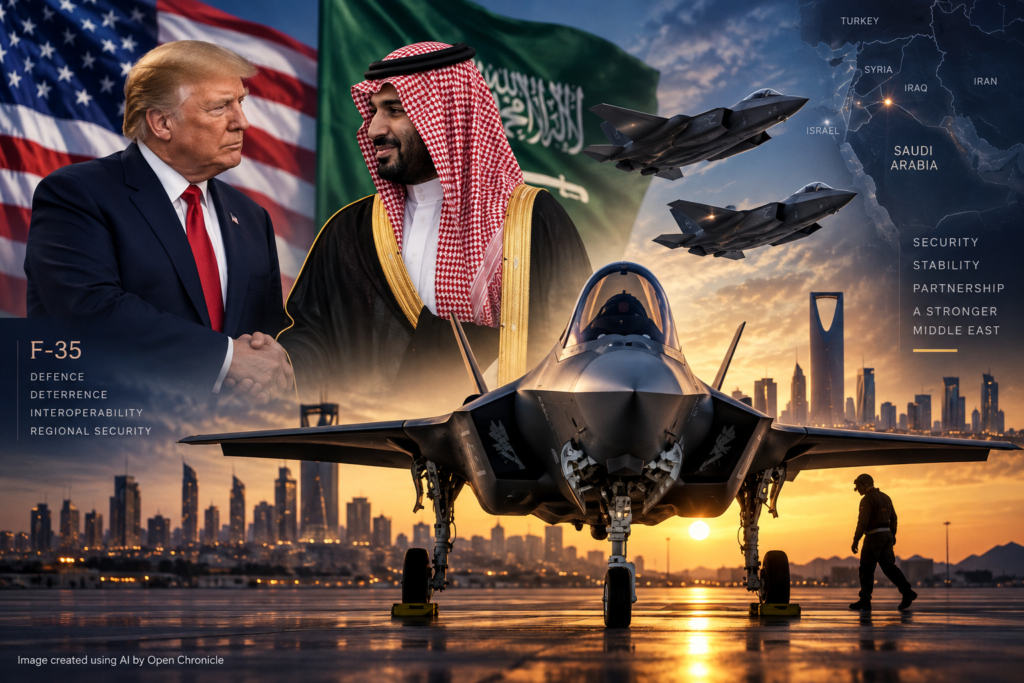
The United States has approved the potential sale of 48 F-35 stealth fighter jets to Saudi Arabia, advancing a major defence agreement despite concerns in Congress and within the U.S. intelligence community that the kingdom’s growing relationship with China could expose some of America’s most sensitive military technology.
The State Department announced on Thursday that it had approved a possible Foreign Military Sale worth an estimated $24.3 billion. The package includes 48 Lockheed Martin F-35 Lightning II aircraft, 49 Pratt & Whitney engines, communications equipment, spare parts and associated logistical and technical support.
The approval is an important step, but it does not mean the aircraft will immediately be transferred. The proposal now faces congressional scrutiny before the process can advance toward contracts, production and eventual delivery.
If completed, the deal would fundamentally change the air power landscape in the Middle East. Israel is currently the region’s only operator of the F-35.
Saudi Arabia moves closer to the F-35
Riyadh has sought access to the fifth generation fighter for years as part of its effort to modernise the Saudi armed forces and strengthen its ability to counter regional threats.
The F-35 combines stealth technology, advanced sensors, electronic warfare capabilities and networked battlefield systems. Its technology is among the most closely protected in the American defence industry.
Washington says providing the aircraft would strengthen Saudi Arabia’s ability to defend itself and improve interoperability with U.S. and allied forces.
The State Department said the proposed sale “will not alter the military balance in the region.”
The announcement comes at a particularly volatile moment for Saudi Arabia. The kingdom has faced attacks linked to the widening Middle East conflict, including threats from Iranian backed Houthi forces in Yemen.
China becomes the central security concern
The most significant obstacle may be Saudi Arabia’s expanding military, technological and economic relationship with China.
U.S. intelligence officials have reportedly warned that Beijing could potentially acquire sensitive F-35 technology through espionage in Saudi Arabia or through Chinese access associated with the kingdom’s defence and security infrastructure.
A recent Defense Intelligence Agency assessment examined Chinese military access to Saudi facilities, the presence of Chinese telecommunications technology and whether sites containing sensitive F-35 systems could be adequately secured.
The aircraft’s radar, surveillance equipment, electronic systems and stealth technologies are considered particularly sensitive.
The concern is not necessarily that Riyadh intends to transfer F-35 technology directly to Beijing. Rather, U.S. officials are examining whether China’s presence in Saudi telecommunications and military infrastructure could create opportunities for intelligence collection.
Saudi Arabia has simultaneously developed close security relationships with both Washington and Beijing. China has supplied ballistic missile technology to the kingdom, while Chinese companies have established a significant presence in Saudi telecommunications and other strategic sectors.
Lawmakers warn about sensitive technology
Some members of Congress are already challenging the proposed sale.
Representative Raja Krishnamoorthi, a Democrat who serves on the House Intelligence Committee, warned on Thursday that proceeding with the transfer despite intelligence concerns could expose critical U.S. technology.
Krishnamoorthi said the sale could put “the crown jewels of American military technology” within reach of the Chinese Communist Party.
He and other Democratic lawmakers had raised similar concerns with the Trump administration in November 2025, asking whether Saudi Arabia would be required to restrict military and technological cooperation with China before receiving the aircraft.
Among the questions raised by lawmakers are whether Chinese companies such as Huawei have access to Saudi communications infrastructure connected with defence facilities and whether Chinese military or intelligence personnel could operate near locations where F-35 technology would be maintained.
The intelligence assessments have reportedly asked whether Riyadh would agree to limit Chinese access to sensitive sites and remove certain Chinese telecommunications equipment from relevant installations.
Israel’s qualitative military edge
The agreement also raises questions about Israel’s longstanding military advantage in the Middle East.
Israel currently operates approximately 50 F-35s and is the only country in the region flying the aircraft. U.S. policy and legislation require Washington to consider Israel’s “qualitative military edge” when approving major weapons transfers to other Middle Eastern countries.
A Saudi fleet of 48 F-35s would therefore represent one of the most important changes to regional air power in decades.
Israeli officials have previously expressed concern about providing F-35s to Arab states, including during negotiations over a proposed sale to the United Arab Emirates.
Washington maintains that the Saudi agreement would not change the overall regional military balance. How the United States intends to reconcile the Saudi acquisition with its commitment to Israel’s qualitative military edge is likely to remain an important issue during congressional review.
The UAE precedent
Washington has confronted similar concerns before.
During Donald Trump’s first administration, the United States agreed in principle to sell F-35s to the United Arab Emirates following the 2020 Abraham Accords.
The proposed $23 billion package was subsequently reviewed by the Biden administration amid concerns over Abu Dhabi’s relationship with Beijing, including the presence of Chinese telecommunications technology.
The UAE announced in December 2021 that it was suspending discussions over the purchase.
That experience provides a clear precedent for the current Saudi debate. In both cases, Washington has had to balance its desire to strengthen a Gulf security partner against the need to protect highly classified American defence technology from potential Chinese intelligence collection.
Trump deepens defence relationship with Riyadh
The F-35 proposal forms part of a broader strengthening of relations between Washington and Riyadh under President Donald Trump.
During Crown Prince Mohammed bin Salman’s November 2025 visit to Washington, the two governments expanded cooperation covering defence, artificial intelligence, critical minerals and civilian nuclear energy. Saudi Arabia was also designated a major non-NATO ally.
The F-35 sale would take that relationship significantly further by providing the kingdom with one of the most advanced weapons systems available to American allies.
It also reflects Washington’s broader strategic challenge in the Gulf.
Saudi Arabia remains heavily dependent on American military equipment, but Riyadh has increasingly pursued relationships with other powers, particularly China, as part of a more diversified foreign policy.
Beijing and Riyadh describe their relationship as a comprehensive strategic partnership and have continued expanding diplomatic and economic cooperation.
For Washington, keeping Saudi Arabia firmly connected to the American defence architecture could limit China’s ability to become a major security provider in the Gulf. At the same time, deeper Saudi cooperation with Beijing makes transferring America’s most sensitive military technologies considerably more complicated.
Congress becomes the next battleground
State Department approval therefore represents a major milestone rather than the conclusion of the F-35 debate.
Congress will now have an opportunity to scrutinise the proposed transfer, including the safeguards intended to protect the aircraft’s technology and the potential implications for Israel.
Lawmakers are likely to examine Saudi military cooperation with China, Chinese telecommunications infrastructure inside the kingdom, access to Saudi military installations and the mechanisms Washington would use to protect F-35 systems.
The outcome will have consequences extending far beyond the 48 aircraft themselves.
The debate touches three of Washington’s most important strategic relationships at once: its longstanding security partnership with Saudi Arabia, its commitment to preserving Israel’s military advantage and its intensifying technological and geopolitical competition with China.
At the centre of all three now sits one of America’s most advanced combat aircraft.