
By Open Chronicle with agencies
Turkish authorities have launched a sweeping nationwide operation targeting LGBT rights organisations, activists and businesses, dramatically escalating the government’s campaign to promote what it describes as traditional family values.
The operation, called “Ailem Güvende,” or “My Family Is Safe,” began with coordinated raids during the weekend of September 12 and 13 and has expanded across at least 15 provinces. Prosecutors are investigating 162 people, nine associations and 13 businesses, according to Turkish authorities and international reporting.
Amnesty International said more than 60 people had been arrested by September 15, at least 23 had been placed in pretrial detention and more than 180 social media accounts belonging to LGBT organisations, activists, journalists and media outlets had been blocked or restricted. Arrest and detention figures have continued to change as the operation and related protests have developed.
The crackdown has drawn criticism from international human rights organisations, the Council of Europe and European officials, while President Recep Tayyip Erdoğan’s government says its actions are intended to protect children, families and public morality.
Raids across Turkey
Police operations have targeted organisations and venues in cities including Istanbul, Ankara and İzmir. Offices have been searched, websites blocked and activists detained.
Reuters reported on September 16 that eight members of Kaos GL, one of Turkey’s best known LGBT rights organisations, had been jailed pending trial. Seven other members, including a journalist, were released under judicial supervision. Prosecutors accused the activists of disseminating obscene material, allegations the organisation rejects.
The operation extends beyond individual activists. Authorities have opened proceedings involving nine associations and 13 businesses across 15 provinces.
Justice Minister Akın Gürlek has presented the campaign as part of a broader effort to protect families, children and young people.
On Monday, the Justice Ministry sent instructions to 175 chief public prosecutors’ offices covering all 81 Turkish provinces. According to Amnesty International, prosecutors were instructed to assess complaints involving material or activities authorities consider contrary to “public morality” or harmful to families, children and young people.
The circular instructed prosecutors to take investigative steps, preserve digital evidence and, where considered necessary, seek the removal or blocking of online content.
Amnesty calls crackdown a “full-scale assault”
Amnesty International has strongly criticised the operation, describing the escalation as a “full-scale assault on LGBTI rights and those who defend them.”
Esther Major, Amnesty’s Deputy Regional Director for Europe, argued that the government was using the protection of families as a justification for further discrimination and intimidation against LGBT people and civil society organisations.
Amnesty has called for the release of people it says have been detained solely for their human rights activities and urged authorities to allow organisations and activists to operate without discrimination, intimidation or criminalisation.
The restrictions have also affected Amnesty itself.
Its Turkish X account was blocked inside the country after a decision communicated by Turkey’s Cyber Security Presidency under Article 8/A of Law No. 5651. Amnesty said it had requested a copy of the decision so it could examine its legal basis.
Protests lead to further detentions
The raids have triggered demonstrations, which have themselves resulted in large numbers of detentions.
Police surrounded demonstrators outside Istanbul’s Çağlayan courthouse on September 15 before they could deliver a planned statement. Associated Press reported that dozens were detained after authorities declared the gathering unauthorised.
Reuters subsequently reported 126 protesters detained during demonstrations in Ankara and Istanbul.
Amnesty said police had also used pepper spray against peaceful demonstrators in İzmir. Two people were initially detained there and later released.
The protests have therefore created a second front in the confrontation, moving the issue beyond investigations of LGBT organisations to questions about freedom of assembly, expression and civil society.
Erdoğan’s “Decade of the Family”
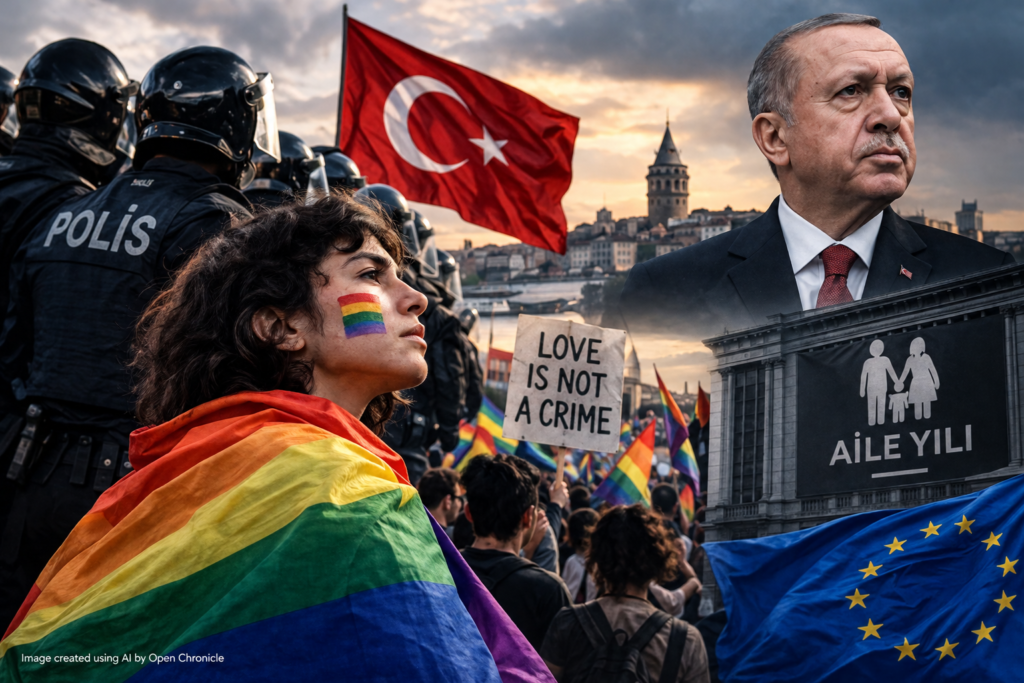
The operation comes against the background of Erdoğan’s “Decade of Family and Population,” a government strategy aimed at strengthening families and responding to Turkey’s declining fertility rate.
Erdoğan has increasingly placed demographic policy and conservative conceptions of family at the centre of his domestic agenda. The initiative was announced in 2025 as a long term programme intended to address population trends and encourage higher birth rates.
The government argues that the current enforcement campaign protects children and society. Human rights groups and government critics dispute that characterization and say the authorities are using family policy to restrict LGBT organisations and stigmatise LGBT people.
Same sex relationships are not illegal in Turkey. However, LGBT events and organisations have faced increasing restrictions in recent years. Istanbul Pride has been banned since 2015, and demonstrations attempting to proceed despite restrictions have repeatedly encountered police intervention.
EU raises concerns
The crackdown is also becoming an issue in Turkey’s already complicated relationship with the European Union.
Turkey has formally been an EU candidate since 1999, although its accession negotiations have effectively been frozen for years.
European officials have raised concerns about the arrests, legal proceedings, restrictions on websites and social media accounts and the implications for fundamental rights.
Speaking during a European Parliament debate, European Commissioner Maroš Šefčovič said Turkey must ensure respect for the rights and dignity of individuals regardless of identity or sexual orientation and said discrimination and stigmatisation were contrary to EU values.
The European Commission has indicated that the measures targeting LGBT activists and organisations will form part of its assessment of fundamental rights in Turkey in its 2026 enlargement report.
The Council of Europe has also intervened. Human Rights Commissioner Michael O’Flaherty called for the release of people detained for legitimate civil society and human rights work and warned against invoking family values to justify restrictions on fundamental rights.
A wider debate over Turkey’s future
The confrontation is likely to intensify an existing debate over the direction of Turkish society under Erdoğan.
Supporters of the government’s family policies frame them as a response to demographic decline and a defence of social and cultural traditions.
Critics see the campaign differently, arguing that LGBT people and organisations have become politically useful targets in a broader effort to consolidate conservative social norms and restrict independent civil society.
Whatever the political motivations attributed to the government, the concrete measures are extensive: coordinated police raids, criminal investigations involving more than 160 people, proceedings against organisations and businesses, widespread online restrictions and arrests connected with subsequent protests.
The international response is also expanding. Amnesty International said demonstrations in solidarity with LGBT people in Turkey were planned outside Turkish embassies in cities including Brussels, Paris, London, Oslo and Washington on September 18.
The dispute therefore reaches beyond LGBT rights alone. It has become part of a wider struggle over civil liberties, freedom of association, the role of conservative family policy and Turkey’s relationship with European human rights standards.